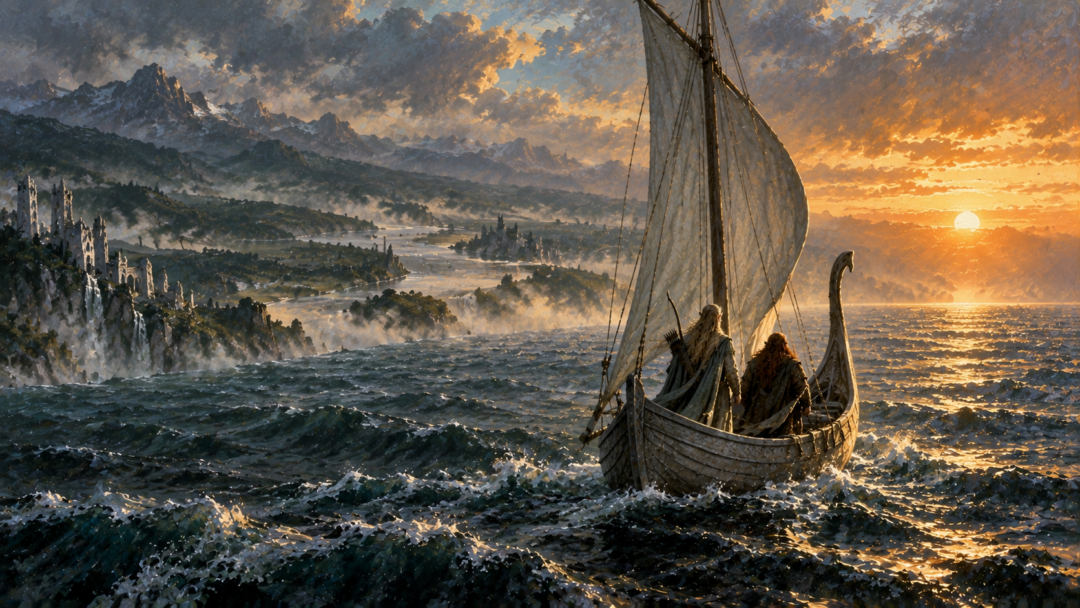
At the end of the Fellowship’s long story, one image seems almost too perfect: Legolas builds a grey ship in Ithilien, sails down the Anduin, and takes Gimli with him across the Sea.
The Elf and the Dwarf who began their journey divided by ancient suspicion leave Middle-earth together.
Yet the Appendices of The Lord of the Rings do something important with this beautiful ending. They do not present Gimli’s presence aboard that ship with the same certainty used for many other events. Appendix B says that Legolas sailed over Sea and adds that, “it is said,” Gimli went with him. Appendix A is more cautious still. One of the last notes in the Red Book begins with a report that has been heard, asks what would follow “if this is true,” offers a possible explanation involving Galadriel, and finally admits that no more can be said.
That uncertainty is not a flaw in the story. It is part of what makes Gimli’s last journey feel like something Middle-earth itself would remember: history fading into tradition at the edge of the known world.
What the Red Book Actually Claims
The crucial passage appears near the end of Appendix A, in the section concerning Durin’s Folk.
After describing Gimli’s achievements following the War of the Ring, the account says that when King Elessar died, Legolas finally sailed over Sea. Then comes an explicit editorial marker: what follows is described as one of the last notes in the Red Book.
The wording changes immediately.
The note reports that people had “heard tell” that Legolas took Gimli with him because of their extraordinary friendship. It then says, “If this is true,” the event would be remarkable for several reasons. A Dwarf would have willingly abandoned Middle-earth; the Eldar would have received him; and the Lords of the West would have permitted his coming.
The note then supplies another tradition: Gimli supposedly wished to see Galadriel again. It cautiously suggests that Galadriel may have obtained this grace for him.
Then the record closes the question: “More cannot be said of this matter.”
This is unusually restrained language for an event often repeated as a simple biographical fact.
Appendix B preserves the same caution. Under the year corresponding to Fourth Age 120, it records the death of Elessar, followed by Legolas building a grey ship in Ithilien and sailing down the Anduin and over Sea. Gimli’s presence receives the qualification: “with him, it is said, went Gimli the Dwarf.”
So there is a distinction worth preserving. Legolas’s departure is narrated directly. Gimli’s participation is reported as received tradition.
Why Nobody in Middle-earth Could Simply Confirm the Ending
The uncertainty fits the nature of the voyage.
A ship sailing into the West was not making an ordinary journey from which a messenger could conveniently return with confirmation. Those who passed from Middle-earth along that road departed the ordinary historical world of the chroniclers who remained behind.
That makes the lack of eyewitness confirmation entirely natural within the frame of the Red Book.
Someone might have known that Legolas intended to take Gimli. Someone might even have watched Gimli board the ship. The text, however, does not tell us that such testimony survived. Nor does it identify a witness to their departure together.
We therefore should not invent one.
What survives in the written tradition is precisely what the Appendices give us: Legolas sailed, and Gimli was said to have gone with him.
This resembles another deliberately traditional ending preserved in Appendix B. Samwise Gamgee’s final departure is handed down among his descendants as a tradition originating with Elanor: after giving her the Red Book, Sam passed the Tower Hills, reached the Grey Havens, and went over Sea.
The surviving history of Middle-earth is therefore not presented as an omniscient modern chronicle. Some endings reach the reader through family memory, report, or tradition.
Gimli’s is one of them.
Why Gimli’s Departure Would Have Been So Extraordinary
The Red Book itself explains why its recorder hesitates.
Gimli was a Dwarf.
Elves departing into the West belonged to a very different relationship with Arda. Gimli had no ordinary Dwarvish expectation of sailing there. Indeed, the Appendix calls the very idea of a Dwarf willingly leaving Middle-earth for love a strange thing.
That makes his voyage fundamentally different from Legolas’s.
Legolas had already experienced the awakening of sea-longing. In The Return of the King, after hearing gulls at Pelargir, he sings of the Sea and recognizes that once he has heard its call, the forests will no longer fully satisfy him. His eventual sailing therefore fulfills something established during the War of the Ring.
Gimli has no comparable summons.
If the tradition is true, he leaves for personal bonds powerful enough to carry him beyond the expected ending of his people’s story.
The Friendship That Makes the Tradition Believable
The first explanation given by the Red Book is Legolas.
Their friendship matters precisely because it began where friendship seemed unlikely.
At the Council of Elrond, Legolas and Gimli entered the Fellowship carrying the long history of estrangement between Elves and Dwarves behind them. Their journey gradually overturns that inheritance.
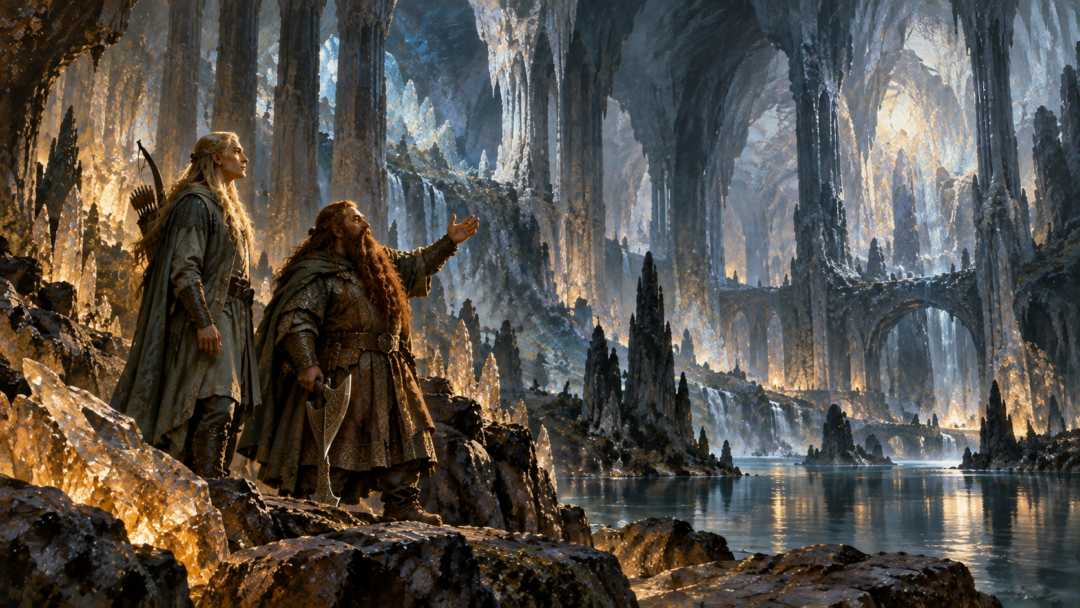
By the time they reach Rohan, they defend one another. During the Battle of the Hornburg they compete in Orc-counting with grim humor. After the war they honor promises to experience together the places each loves: Fangorn for Legolas and Aglarond, the Glittering Caves, for Gimli.
The Appendix eventually describes their friendship as greater than any known between Elf and Dwarf.
If Gimli truly sailed, therefore, his voyage would be the final expression of a relationship already demonstrated repeatedly in the narrative.
The significance is not merely that a Dwarf boarded an Elven ship. It is that an ancient division between peoples ends, in these two individuals, with companionship stronger than the boundaries inherited from the past.
Galadriel Is the Second Half of the Mystery
The Red Book also connects Gimli’s possible voyage with Galadriel.
That connection begins in Lothlórien.
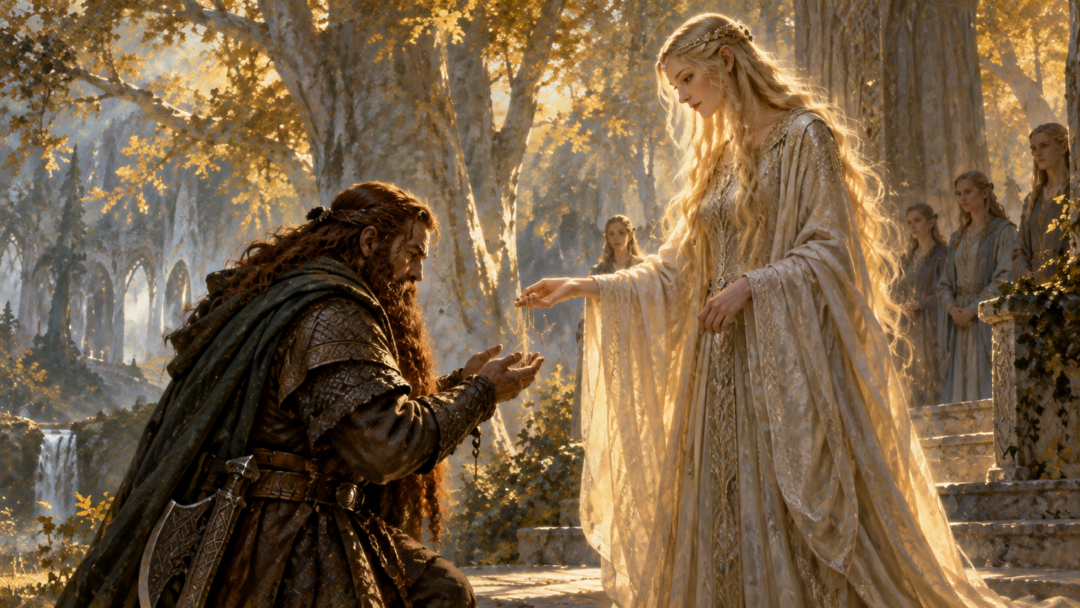
Gimli arrives under suspicion. The old bitterness between Dwarves and Elves is close to the surface, particularly because of the history surrounding Moria and Lórien. Yet Galadriel speaks to him with understanding, naming places dear to the Dwarves in their own tongue.
Gimli is profoundly affected.
When Galadriel later offers gifts to the Fellowship, he initially asks for nothing. When pressed, he requests a single strand of her hair as a treasure and memorial. She gives him three.
From that point onward, Gimli’s devotion to Galadriel becomes one of his defining personal loyalties. He challenges Éomer over harsh words concerning her and later reaches a friendship with him without surrendering his reverence for her.
The final Red Book note therefore does not introduce a new motive when it says Gimli desired to see Galadriel’s beauty again. It brings an established relationship to its last possible consequence.
What remains uncertain is the mechanism.
The text says only that Galadriel “may” have obtained the necessary grace for him. It does not describe a petition, ruling, ceremony, or conversation among the Valar. Any detailed account of how permission was secured goes beyond the text.
Later Commentary Makes the Intended Outcome Clearer
There is an important distinction between the uncertainty inside the Red Book and the broader evidence concerning the story.
In Letter 154, written in 1954, Gimli is discussed as a “unique exception” among those allowed to pass with the Elves into the West, specifically in connection with Legolas and Galadriel. That commentary treats the underlying idea of Gimli’s departure more directly than the fictional chroniclers do.
It also prevents a common misunderstanding about what such a voyage would mean.
Going West would not make Gimli immortal.
The same letter explains that mortals allowed into Elvenhome do not have their fundamental nature permanently changed. Their stay may provide healing or reward, but they cannot remain bodily alive forever merely because they have reached the West.
Gimli’s case is unusual even within this already exceptional category because he is a Dwarf rather than one of the mortal Ring-bearers.
So two levels of the story can be held together without forcing either one aside.
Within the surviving history of Middle-earth, Gimli’s voyage is a tradition reported cautiously.
In external explanation of the mythology, his voyage is treated as the intended exceptional outcome.
“More Cannot Be Said”
That final sentence may be the most important part of the whole passage.
The Red Book does not attempt to turn uncertainty into certainty.
It preserves what was remembered.
By the time Legolas sails, Aragorn is dead. Merry and Pippin have reached the ends of their lives. Frodo and Bilbo have long vanished into the West. Sam has also departed according to the tradition preserved by his descendants. The Fellowship has passed beyond the world in which its deeds could still be gathered through living companions.
Then the last ship associated with it disappears.
Appendix B marks that departure as the end of the Fellowship in Middle-earth.
And aboard that ship, according to tradition, was Gimli.
Perhaps that is exactly the right form for his final appearance. His friendship with Legolas had already crossed a boundary that history told Elves and Dwarves to preserve. His love for Galadriel had transformed an inherited estrangement into reverence. His last journey, if the Red Book’s tradition is true, crossed an even greater boundary.
But the chronicler cannot follow him.
At the shore, history loses sight of Gimli.
What remains is a story: carefully preserved, openly uncertain, and powerful enough that generations remembered that an Elf and a Dwarf may have sailed out of Middle-earth together.
Sources & Notes
- https://tolkiengateway.net/wiki/Gimli — Tolkien Gateway, Gimli (Tolkien primary-text references in article)
- https://tolkiengateway.net/wiki/Legolas — Tolkien Gateway, Legolas (Tolkien primary-text references in article)
- https://tolkiengateway.net/wiki/Straight_Road — Tolkien Gateway, Straight Road (Tolkien primary-text references in article)
Relevant Tolkien text and chronology are referenced by the linked Tolkien Gateway entries; interpretive conclusions remain distinguished from canon.