Why Gimli’s Journey West Is One of Middle-earth’s Strangest Endings
When readers reach the end of The Lord of the Rings, they expect certain departures. Frodo sails West because the wounds of his burden cannot be healed in Middle-earth. Gandalf leaves because his task is complete. Elrond and Galadriel depart because the age of the Elves is ending.
But then there is Gimli.
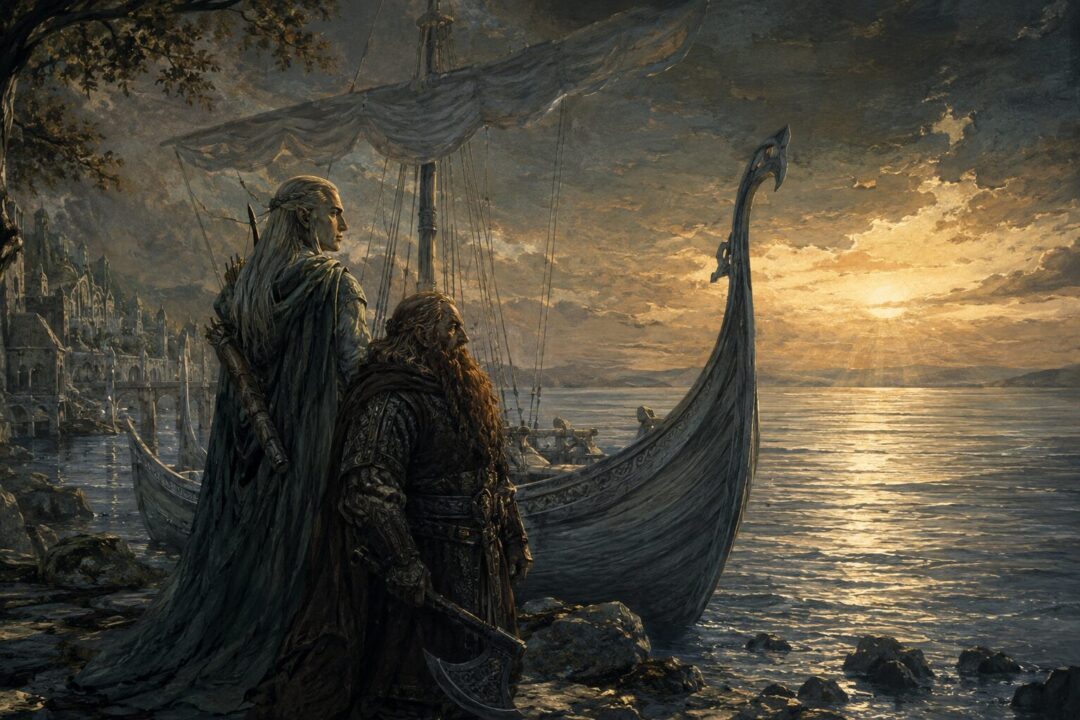
A Dwarf, son of Glóin, warrior of Erebor, companion of Aragorn, and one of the Fellowship of the Ring, is said to have sailed across the Sea. According to the tradition preserved in the Appendices, Gimli went West with Legolas after the death of King Elessar. It is one of the most surprising details in Tolkien’s legendarium because it appears to violate boundaries that seem firmly established throughout the story.
The Undying Lands are not a reward for heroes. Mortals are not meant to dwell there. Dwarves have no known history of sailing the Sea. Yet somehow Gimli becomes the exception.
The deeper question is not merely whether Gimli reached Aman. It is why Tolkien chose to leave this remarkable possibility at the very edge of his story, and what it reveals about friendship, healing, and the fading world of Middle-earth.
The Strange Note Hidden in the Appendices
Many readers finish the main narrative of The Lord of the Rings without realizing Gimli’s story has one final chapter.
In Appendix A, the tradition is recorded that after Aragorn’s death, Legolas built a grey ship in Ithilien and sailed over Sea. With him, it is said, went Gimli the Dwarf.
The wording is important. The text presents this as a tradition rather than a detailed narrative account. Tolkien does not describe the voyage itself, nor does he provide a scene of arrival in the West.
This restraint matters because it leaves room for uncertainty. The tradition is treated as something remembered rather than directly witnessed. Yet Tolkien clearly intended readers to consider it possible, and later writings support the idea that Gimli’s passage West was exceptional but genuine.
Even among the many remarkable conclusions of the Third Age, this stands apart. A Hobbit sailing West makes sense within the established story. A Maia returning there is expected. But a Dwarf crossing the Sea is almost unprecedented.
The oddity is not accidental. It draws attention to something unusual about Gimli himself.
The Barrier Mortals Were Not Meant to Cross
To understand why Gimli’s departure feels so strange, it helps to remember what the West actually is.
Aman is often misunderstood as a heavenly reward. In Tolkien’s world, it is not.
The Undying Lands do not grant immortality. Mortals who travel there do not become deathless simply because they arrive. Their nature remains unchanged.
This distinction is crucial. The Blessed Realm is the home of the Valar and many of the Eldar, but it was never intended as a universal destination for the peoples of Middle-earth.
The Númenóreans learned this lesson disastrously. Believing that immortality could be gained by reaching Aman, they attempted to seize what was not meant for them. Their rebellion ended in catastrophe.
Against this background, Gimli’s voyage appears even more unusual. Tolkien established repeatedly that Aman was not a place mortals were supposed to claim for themselves.
The question, then, becomes why an exception was made.
The answer seems to lie not in Gimli’s achievements as a warrior, but in the relationships he forged.
The Friendship That Changed Everything
At the Council of Elrond, friendship between a Dwarf and an Elf hardly seemed inevitable.
The history of their peoples was marked by suspicion, grievances, and old wounds. Elves and Dwarves could cooperate when necessary, but deep trust was rare.
Yet among all the relationships formed during the War of the Ring, the bond between Legolas and Gimli became one of the most transformative.
Their friendship begins amid tension and gradually becomes one of the emotional foundations of the Fellowship. They travel together through danger, grieve together, fight side by side, and learn to see beyond inherited prejudices.
Tolkien never presents this friendship as merely personal. It carries symbolic weight. The reconciliation of Elf and Dwarf represents the healing of divisions that stretch back through the ages.
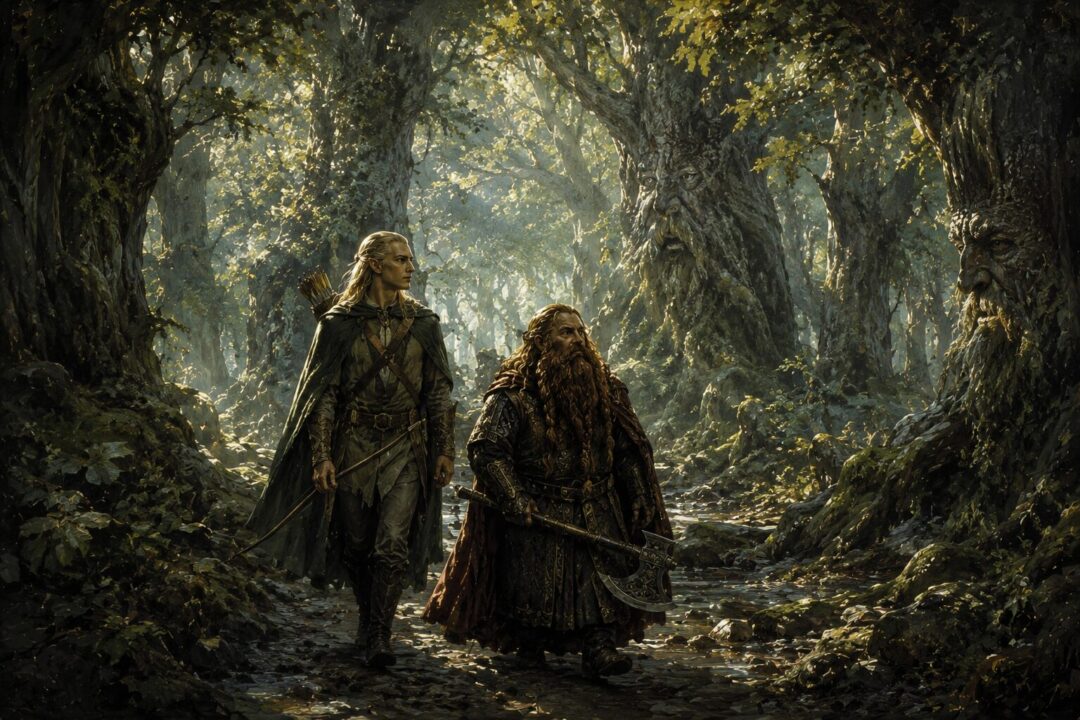
By the end of the story, Legolas and Gimli have become inseparable companions. They visit Helm’s Deep together. They journey through Fangorn together. They accompany Aragorn throughout the founding of the Reunited Kingdom.
Their friendship survives not only war but peace.
In many ways, Gimli’s eventual voyage West is the final expression of that friendship. He does not sail because he seeks power, immortality, or escape. He sails because he and Legolas remain bound together even at the end of the age.
The Lady of the Golden Wood
There is another figure standing behind Gimli’s extraordinary fate.
Galadriel.
Among the Fellowship, Gimli’s encounter with Galadriel is one of the most quietly significant moments in the entire narrative.
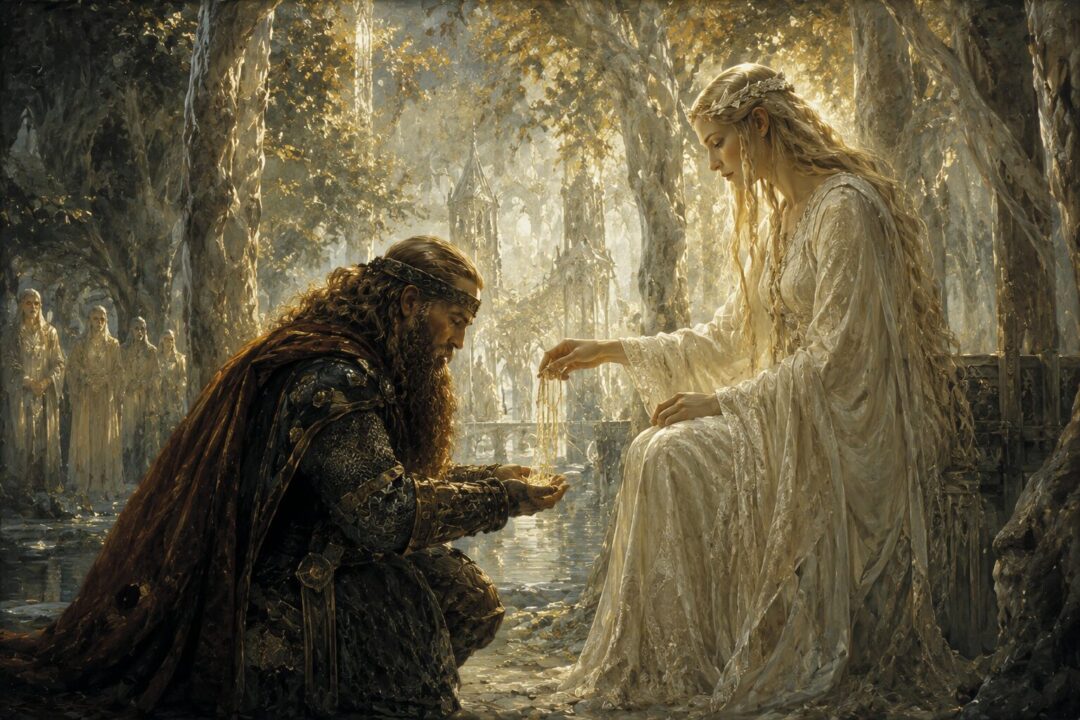
Unlike many Dwarves, Gimli does not leave Lothlórien resentful or suspicious. Instead, he becomes one of Galadriel’s greatest admirers. His request for a single strand of her hair—ultimately answered with three strands freely given—is one of the most memorable exchanges in the book.
The moment carries deep symbolic meaning.
Earlier traditions of the Elder Days tell of another figure who desired Galadriel’s hair: Fëanor, greatest of the Noldor, whose request was denied. Gimli receives a gift that Fëanor never obtained.
This does not elevate Gimli above Fëanor. Rather, it highlights the difference between possessiveness and reverence. Gimli desires beauty not to own it but to honor it.
Later writings suggest that Galadriel may have played a role in securing permission for Gimli to sail West. Tolkien never provides a detailed account of such a request, but he explicitly connects Gimli’s passage with Galadriel’s favor.
If so, the implication is remarkable.
One of the greatest Elves remaining in Middle-earth may have interceded on behalf of a Dwarf because she recognized the sincerity of his heart.
A Dwarf Unlike Any Other
Gimli is not the most powerful Dwarf in Tolkien’s writings.
He is not a king. He does not reclaim a lost realm. He does not discover a Silmaril or overthrow a Dark Lord.
Yet he possesses qualities that repeatedly distinguish him.
He demonstrates courage, certainly, but many characters do. More unusual is his capacity for growth.
When Gimli enters Lothlórien, he carries assumptions inherited from generations of distrust. He leaves transformed.
When he meets Treebeard, he is willing to learn from someone utterly unlike himself. When he travels with Legolas, he learns to admire things that traditional Dwarven culture often valued differently: forests, living beauty, and the artistry of the Elves.
Importantly, he never ceases to be a Dwarf.
Tolkien does not portray growth as abandoning one’s identity. Gimli remains proud of his people, their craftsmanship, and their history. The achievement lies in expanding his understanding without surrendering who he is.
This balance may help explain why his story ends differently from those of most mortals.
His life becomes a bridge between worlds that had long remained apart.
Did Gimli Actually Reach Aman?
A careful reading requires some caution.
The texts do not provide a detailed narrative of Gimli arriving in Aman. Nor do they explain precisely what happened after the voyage.
However, Tolkien addressed the matter elsewhere, stating that Gimli’s sailing was permitted because of his friendship with Legolas and his reverence for Galadriel.
Even then, the situation remains exceptional rather than normal.
Nothing suggests that Dwarves generally gained access to Aman. Nothing indicates a new rule allowing mortals to settle there freely. Gimli appears to be a singular case.
Nor should his voyage be understood as escaping mortality.
If Gimli reached Aman, he would still remain what he always was: a mortal Dwarf. The Blessed Realm could not alter the fundamental nature of his existence.
This makes the story more moving rather than less.
The journey is not about avoiding death. It is about receiving one final grace before death comes.
The Last Friendship of the Third Age
There is a melancholy beauty in the timing of Gimli’s departure.
He does not sail at the height of victory. He does not leave immediately after Sauron’s fall.
He remains.
Years pass. Kingdoms are rebuilt. Aragorn reigns. The Fourth Age unfolds.
Only after Aragorn’s death does the final departure occur.
By then, much of the world that shaped the Fellowship is fading away. The Elves continue to diminish in Middle-earth. Ancient wonders become memories. The great age of legends gives way to the age of ordinary history.
Legolas and Gimli sailing together feels like the last echo of the Fellowship itself.
One is an Elf whose people are departing forever. The other is a Dwarf whose race was never expected to cross the Sea at all.
Together they represent reconciliation achieved against all expectations.
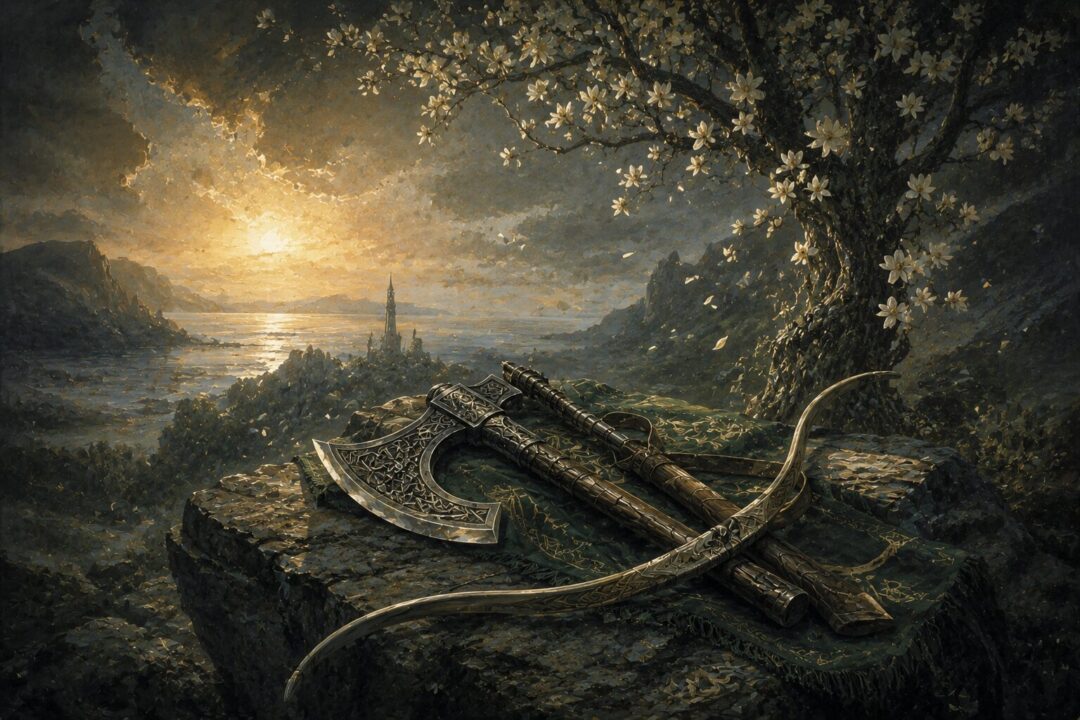
Why This Ending Matters
Gimli’s journey West remains one of the strangest endings in Tolkien’s legendarium because it sits at the intersection of rule and exception.
The rules of the world say that Aman is not for mortals. The history of Middle-earth repeatedly reinforces boundaries between peoples. Elves and Dwarves carry ancient grievances. The Sea marks a division few can cross.
Yet Gimli’s story does not break these rules so much as reveal something deeper within them.
His passage is not earned through conquest, power, or privilege. It comes through friendship, humility, loyalty, and a genuine appreciation of beauty beyond his own culture.
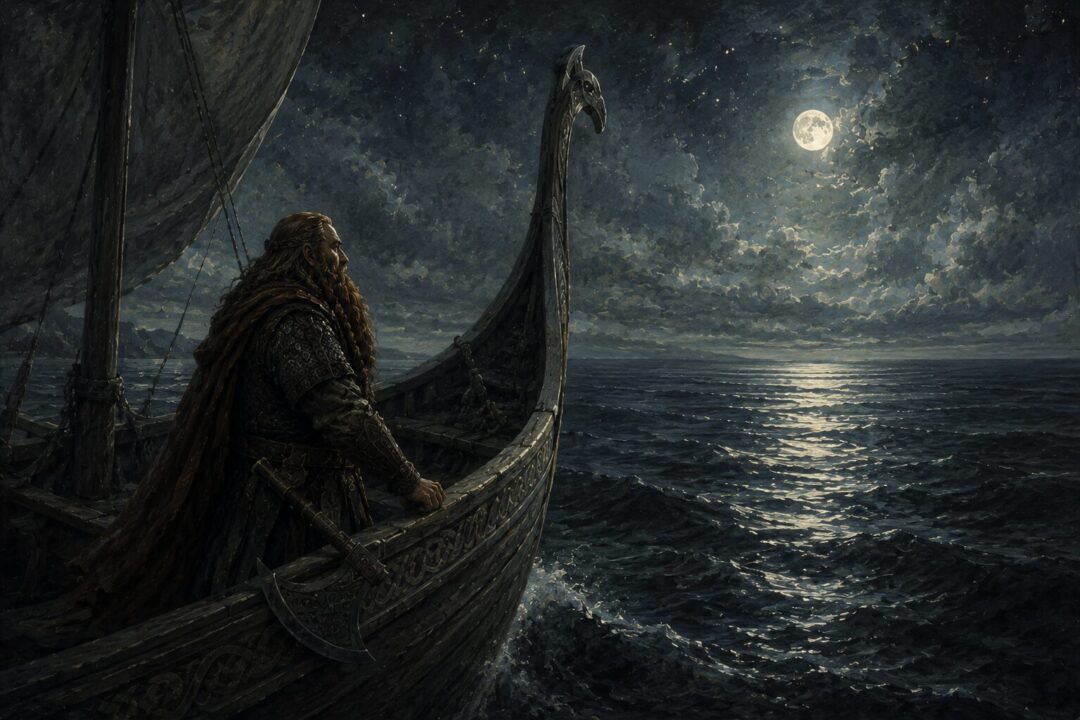
The warrior who once stood among the halls of Erebor eventually becomes the first known Dwarf to sail into the West.
Not because he ceased to be a Dwarf.
But because, among all the peoples of Middle-earth, he learned how to love what seemed most different from himself.
That is what makes the ending so unusual—and why it continues to resonate long after the final page is turned.
Sources & Notes
- Tolkien Gateway, “Gimli” — summarizes Gimli’s friendship with Legolas and the tradition that he sailed West after Aragorn’s death. https://tolkiengateway.net/wiki/Gimli
- Tolkien Gateway, “Undying Lands” — explains the West/Valinor destination and why mortal access to it is exceptional. https://tolkiengateway.net/wiki/Undying_Lands
- Tolkien Gateway, “Galadriel” — provides context for Gimli’s devotion to Galadriel and the grace associated with his unusual ending. https://tolkiengateway.net/wiki/Galadriel
Sources added for Gimli’s journey West and its exceptional context.