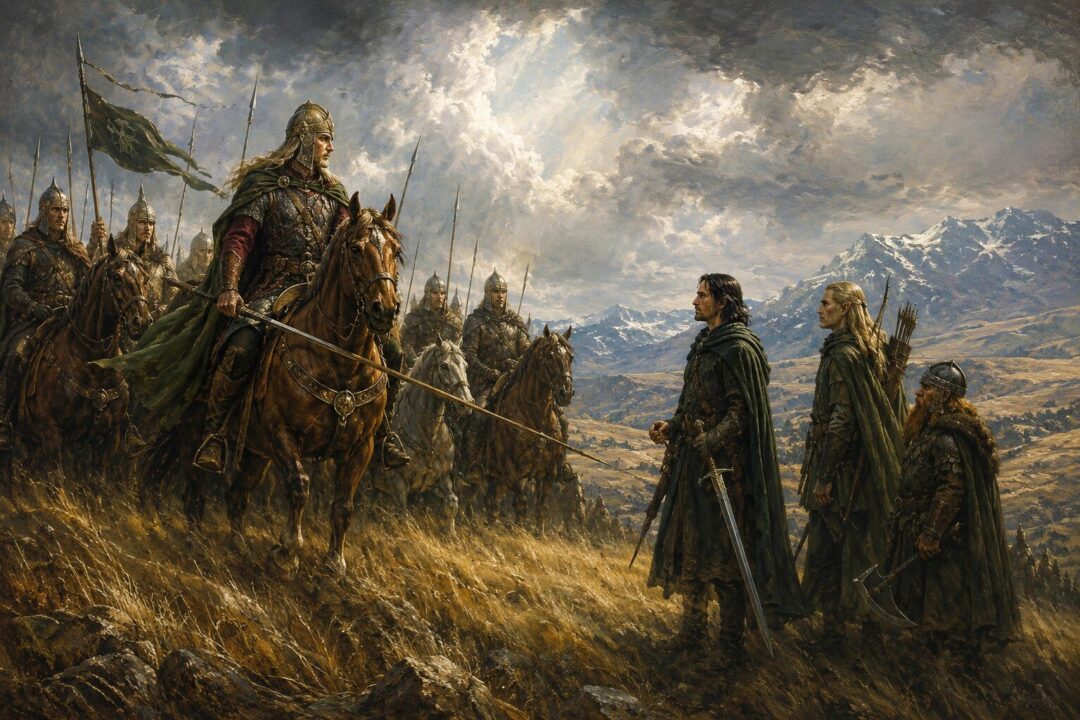
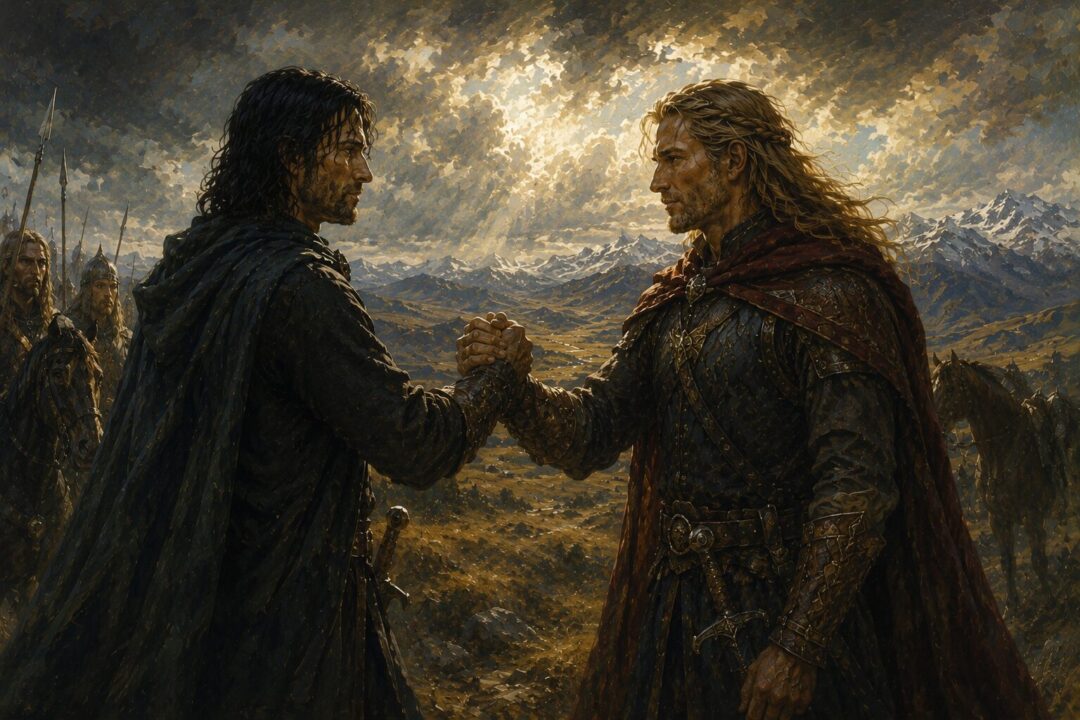
When Aragorn first meets Éomer on the plains of Rohan, almost every reason points toward conflict instead of friendship.
A stranger appears in the Riddermark carrying a sword, traveling with an Elf and a Dwarf during an age when ancient suspicions still linger. The kingdom has forbidden outsiders. Orcs have recently crossed the borders. King Théoden seems increasingly isolated. The political situation is unstable, and Éomer himself has already fallen under suspicion for acting too independently.
Yet within a remarkably short conversation, Éomer chooses trust.
On the surface, it almost feels reckless. Why would one of Rohan's greatest captains risk his position—and perhaps his life—for men he had only just met?
The answer lies not in naïve optimism but in Tolkien's careful portrayal of character. Éomer does not ignore danger. Instead, he recognizes something that cannot easily be faked: the visible marks of honor. His judgment becomes one of the earliest examples of a recurring truth throughout The Lord of the Rings: wisdom often means recognizing virtue before certainty becomes possible.
A Meeting at the Edge of War
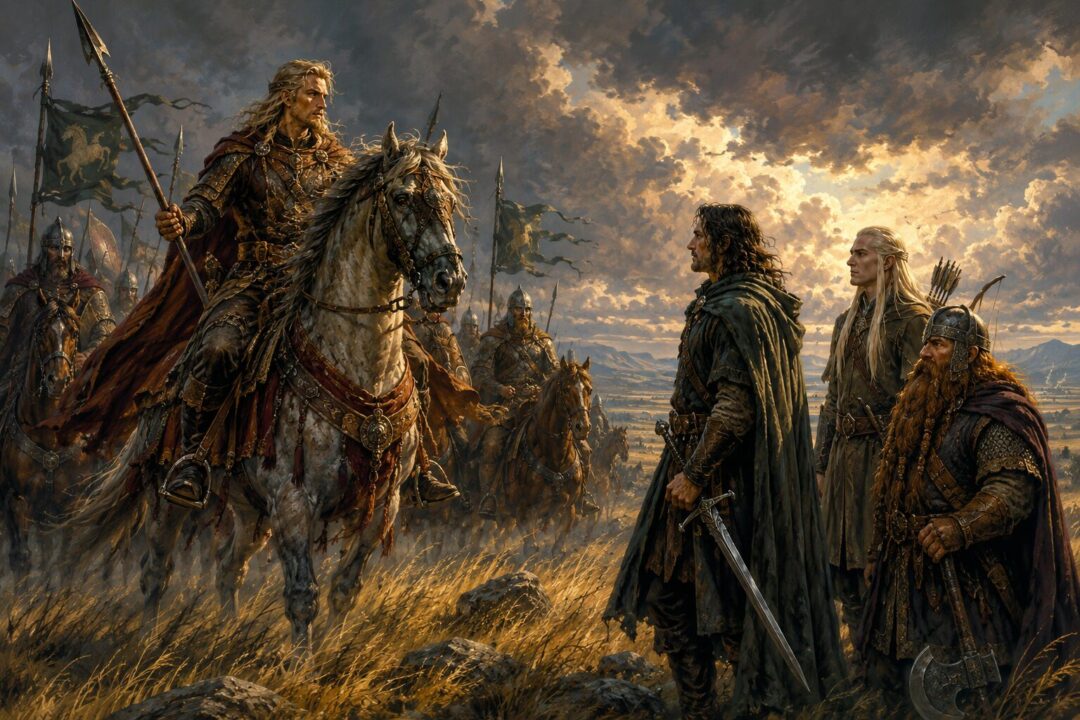
The encounter takes place after the Fellowship has been broken.
Boromir has died defending Merry and Pippin. The two Hobbits have been carried away by Orcs. Aragorn, Legolas, and Gimli have pursued them relentlessly across the plains of Rohan for several days before finally encountering Éomer and his company.
From Éomer's perspective, the situation is deeply suspicious.
Three armed strangers have appeared in a region already threatened by invasion. One is clearly an Elf. Another is unmistakably a Dwarf. Their story sounds extraordinary, involving Halflings, a great company, and enemies moving across the Mark.
Nothing about the meeting invites easy confidence.
Indeed, Éomer begins cautiously. He questions Aragorn repeatedly and demands explanations before offering any assistance. His trust is earned through conversation rather than granted immediately.
Aragorn Carries the Weight of His Identity
One reason Éomer's opinion changes so quickly is that Aragorn simply does not resemble an ordinary wanderer.
Although he lives as a Ranger, Tolkien consistently describes Aragorn as someone whose true nobility becomes increasingly visible when circumstances require it.
His bearing matters.
Aragorn speaks confidently without boasting. He neither pleads nor threatens. When challenged, he answers directly. When asked his name, he openly declares it despite knowing it may invite disbelief.
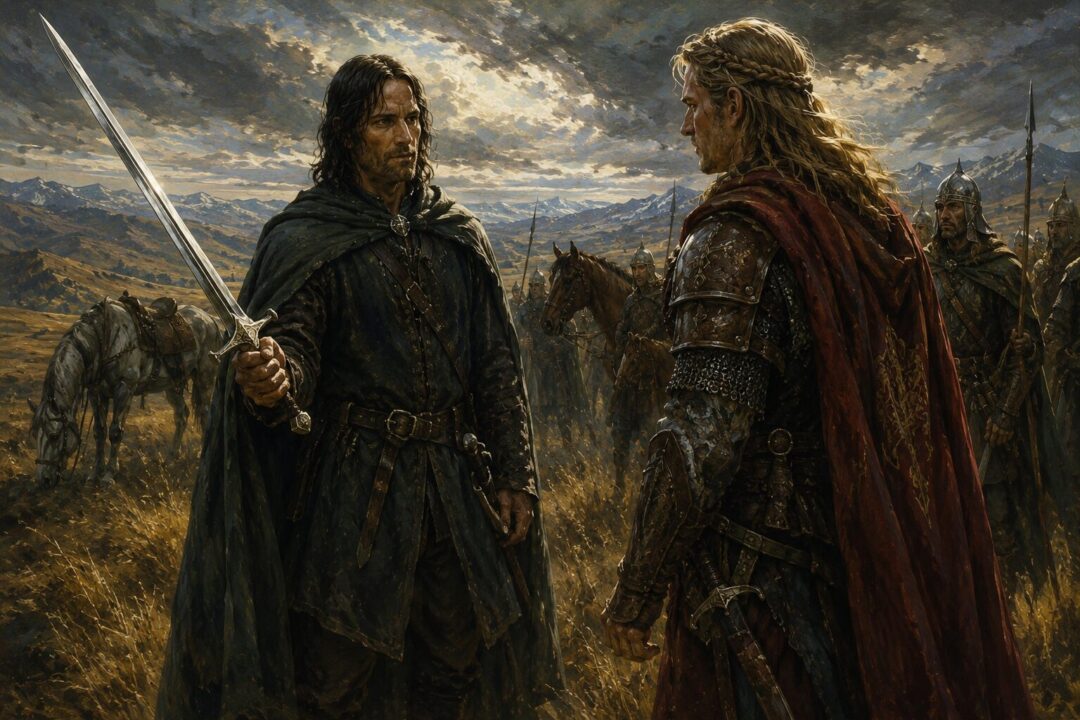
Even more striking is his willingness to reveal the Sword that was Broken, newly reforged as Andúril.
To most people, the sword would simply appear ancient and remarkable.
To those familiar with old traditions, however, it symbolizes forgotten history reaching into the present. Aragorn is not attempting to impress Éomer with wealth or military strength. Instead, he presents evidence of identity rooted in lineage, responsibility, and ancient promises.
The text repeatedly suggests that people perceive something extraordinary about Aragorn before fully understanding who he is.
Éomer becomes one of the first rulers outside the Fellowship to respond to that presence.
The Conversation Reveals Character
Perhaps the strongest reason for Éomer's confidence is not Aragorn's sword but his words.
Throughout their exchange, Aragorn remains remarkably consistent.
He never changes his story.
He does not exaggerate his achievements.
He freely admits what he does not know.
He explains his pursuit of the Orcs with urgency but without desperation.
This consistency matters because Éomer is an experienced military commander.
He has spent years judging men, reading intentions, and deciding whom to trust in dangerous situations. Tolkien never portrays him as gullible. Instead, he is accustomed to making rapid assessments where hesitation can prove fatal.
From Éomer's perspective, Aragorn's account rings true precisely because it lacks the marks of deception.
Éomer Himself Is Already an Outsider
An overlooked detail is that Éomer is not operating from a position of complete political security.
By the time he meets Aragorn, his relationship with King Théoden's court has become increasingly strained.
Gríma Wormtongue has been undermining Théoden's confidence for years. One consequence is growing suspicion toward Éomer, whose loyalty to Rohan remains unquestioned but whose independence troubles those influenced by Gríma.
In fact, Éomer has already acted without full royal approval in defending the Mark.
That experience changes how he evaluates others.
Someone who has himself been distrusted for honorable reasons may become better at recognizing genuine integrity in another person.
This does not mean Éomer ignores caution. Rather, he understands that rigid obedience is not always the same thing as wisdom.
Honor Recognizes Honor
One of Tolkien's recurring themes is that virtuous people often recognize each other surprisingly quickly.
This does not happen through magic.
Instead, shared values become visible through countless small decisions.
Aragorn refuses unnecessary violence.
Legolas speaks with restraint.
Gimli shows fierce loyalty to his companions.
None behaves like spies or raiders.
Éomer notices these details.
Likewise, Aragorn immediately treats Éomer with respect despite receiving suspicion in return. He neither insults the Riders nor attempts to force cooperation.
Each man offers the other opportunities to choose honor over pride.
The result is mutual respect formed long before lasting friendship.
The Gift of Horses Was an Extraordinary Risk
The clearest demonstration of trust comes after the questioning has ended.
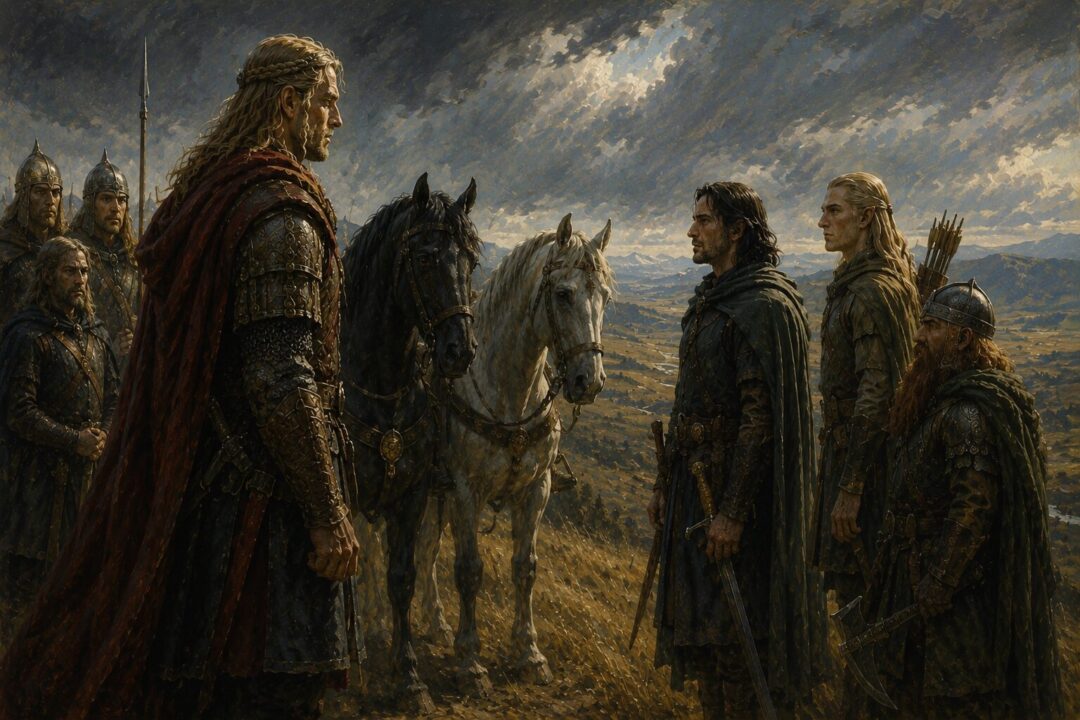
Éomer lends Aragorn, Legolas, and Gimli two horses—Hasufel and Arod—despite knowing this decision violates Théoden's standing orders.
This is no trivial courtesy.
Warhorses represent enormous military value.
Allowing armed strangers to leave mounted could easily be interpreted as treason if they proved hostile.
Éomer openly accepts that possibility.
Later, he is indeed imprisoned because of actions connected to his independent judgment.
His willingness to risk punishment demonstrates that trust always carries a cost.
The narrative does not portray this as recklessness but as moral courage.
Was It Really Too Fast?
Modern readers sometimes assume Éomer decides almost instantly.
The text presents something more nuanced.
The conversation is substantial.
Questions are asked.
Names are exchanged.
Claims are examined.
Weapons are observed.
Behavior is carefully evaluated.
Most importantly, Éomer never entrusts Aragorn with command of his army or reveals sensitive military plans.
He offers practical assistance appropriate to the evidence before him.
This distinction matters.
Trust is not all-or-nothing.
Éomer extends enough confidence to help three honorable travelers continue their pursuit while accepting personal responsibility for that decision.
That is measured trust, not blind faith.
Providence Also Shapes the Story
Like many pivotal meetings in The Lord of the Rings, this encounter carries an element of providence.
The narrative repeatedly suggests that important events occur through purposes larger than any individual understands.
Characters often speak of chance while gradually realizing that their meetings possess deeper significance.
This does not remove personal responsibility.
Éomer still chooses.
Aragorn still chooses.
Each could have responded with suspicion, pride, or violence.
Instead, both exercise wisdom.
Providence creates the opportunity; character determines the response.
That distinction remains central throughout the legendarium.
Trust Changes the Course of the War
The consequences of Éomer's decision ripple far beyond this meeting.
Without horses, Aragorn, Legolas, and Gimli would have reached Fangorn much later.
The Riders' destruction of the Orc host had already changed the fate of Merry and Pippin, allowing them to escape into the forest.
Later, Aragorn and Éomer fight together at Helm's Deep.
Still later, they stand side by side on the Pelennor Fields.
Finally, Éomer supports Aragorn's claim during the restoration of the kingdom.
None of these later events erase the risk of that first encounter.
Instead, they reveal that one wise judgment can reshape history.
Why This Moment Still Resonates
Many fantasy stories reward suspicion above all else.
Tolkien offers a more difficult lesson.
Blind trust is dangerous.
Blind distrust is equally dangerous.
Éomer succeeds because he avoids both extremes.
He listens carefully.
He tests what he hears.
He observes actions as much as words.
Then, despite uncertainty, he accepts responsibility for a decision that could cost him dearly.
That balance feels surprisingly modern.
In everyday life, certainty rarely arrives before choices must be made. Leaders, friends, and families often face incomplete information. Waiting for absolute proof can become another form of failure.
Éomer demonstrates that wisdom is not possessing perfect knowledge.
It is recognizing character when evidence points consistently in one direction, even while acknowledging risk.
His trust in Aragorn was not faster than it should have been.
It was exactly as fast as honor, experience, and courage allowed.
That is why the moment remains one of the quiet turning points of The Lord of the Rings. Before kingdoms unite, before great battles are won, and before crowns are restored, two strangers on an open plain choose to believe that integrity is still possible in a world overshadowed by fear.
Sources & Notes
- Tolkien Gateway, “Éomer” — summarizes Éomer’s meeting with Aragorn, his judgment in the Riddermark, and his later kingship. https://tolkiengateway.net/wiki/%C3%89omer
- Tolkien Gateway, “Aragorn” — provides context for Aragorn’s identity, authority, and encounters with the Rohirrim. https://tolkiengateway.net/wiki/Aragorn
- Tolkien Gateway, “Rohan” — explains the political and military setting in which Éomer makes his decision. https://tolkiengateway.net/wiki/Rohan
Sources added for Éomer, Aragorn, and Rohan context.