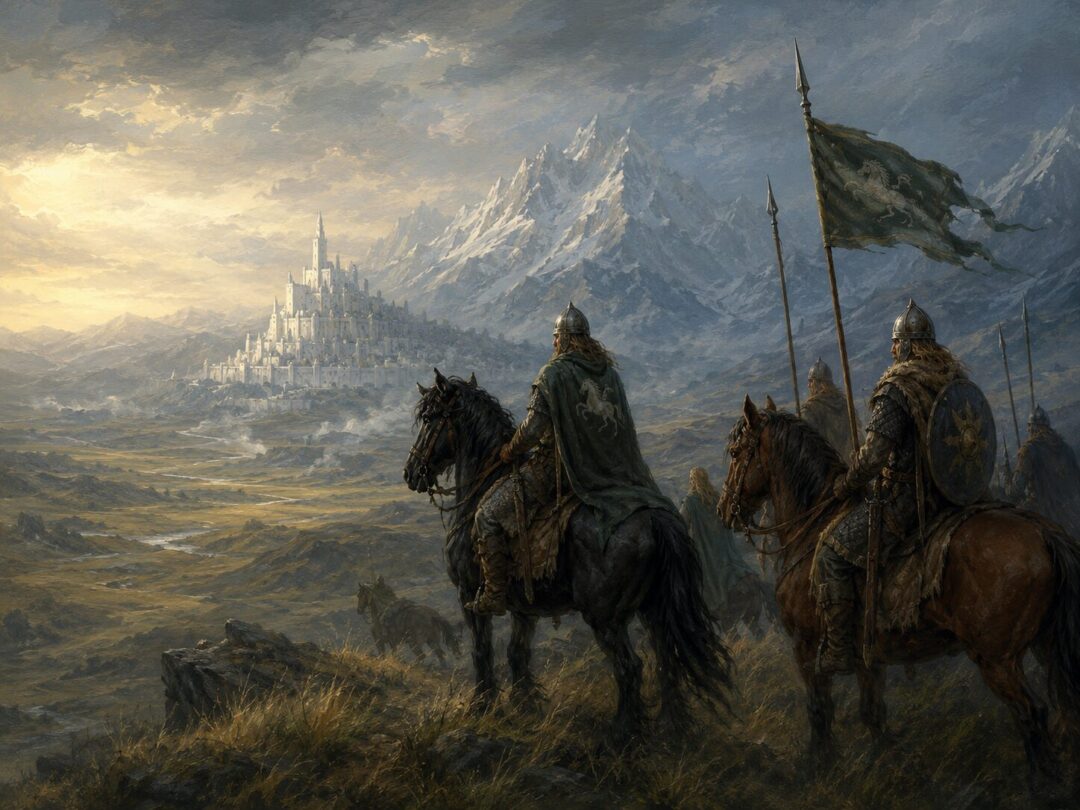
At first glance, Gondor looks like the realm that should endure.
It has the white city, the ancient bloodlines, the stone walls, the memory of Númenor, the seven levels of Minas Tirith, the tombs of kings, the Stewards guarding an empty throne, and the long shadow of a civilization that once reached far beyond its present strength. Rohan, beside it, seems younger, rougher, poorer, and less adorned. Its greatest hall is not a marble citadel but Meduseld, a golden-roofed house on a hill. Its power is not stored in libraries, towers, palantíri, or old imperial memory. It rides on horses, speaks in oaths, and gathers in the open wind.
Yet that is exactly why Rohan survives.
Not because it is stronger than Gondor in any simple military sense. Not because its people are wiser, purer, or untouched by corruption. Rohan nearly falls to Saruman, Wormtongue, despair, and bad counsel. But Rohan carries less historical weight on its back. It has fewer ruins to worship. It is less glorious, and therefore less trapped by glory.
Gondor Is Great Enough to Be Haunted by Itself
Gondor’s tragedy is not that it lacks greatness. Its tragedy is that it has too much greatness behind it.
The South-kingdom is heir to Númenor through the Realms in Exile founded after the Downfall. Its history contains kings, towers, ancient cities, sea-lords, great fortresses, and a scale of memory Rohan never possesses. Minas Tirith itself, originally Minas Anor, becomes the capital after Osgiliath’s decline, and the city stands as a monument to endurance as much as living rule.
But that inheritance has a cost. Gondor is always measuring the present against a larger past. Its people live among signs of loss: the dead White Tree, the empty throne, the silent tombs, the ruined former capital of Osgiliath, and the constant knowledge that their realm is no longer what it was. The texts repeatedly frame Gondor as noble but diminished, still beautiful but worn down by centuries of war, plague, invasion, and the pressure of Mordor.
This does not make Gondor weak. In fact, Gondor holds the line for much of Middle-earth. Without Gondor, Sauron’s return would be far more dangerous far earlier. But Gondor’s greatness has hardened into burden. Its nobility is real, yet it can become ceremonial. Its memory is precious, yet it can become paralyzing.
Denethor is the clearest example of this danger. He is not a fool, nor merely a coward. He is intelligent, proud, disciplined, and deeply aware of Gondor’s long decline. His despair is powerful precisely because it is rooted in knowledge. He sees too much of the scale of the war and too little of the mercy hidden inside it. Gondor’s ancient vision becomes, in him, a kind of imprisonment.
Rohan Has a Shorter Memory — and That Saves It
Rohan does not begin as an ancient kingdom of stone. It begins as a gift, a rescue, and an oath.
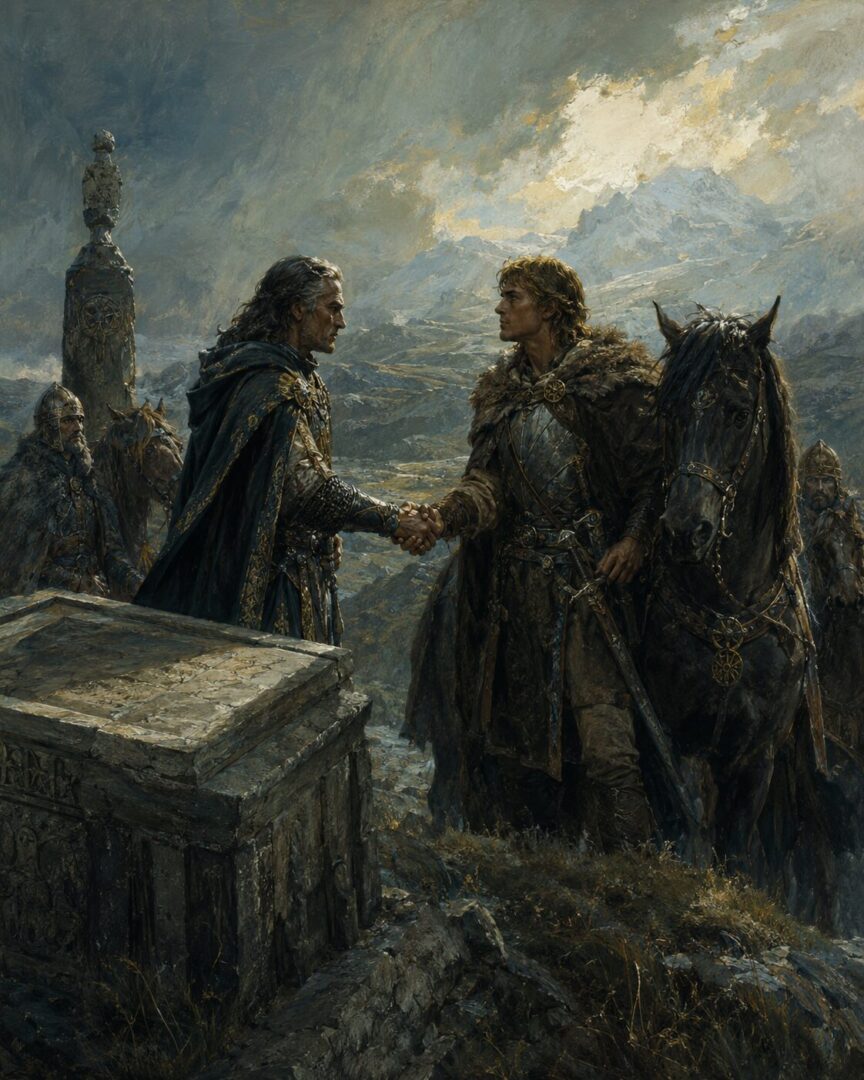
In the Third Age, the land that becomes Rohan is Calenardhon, a region of Gondor that has become thinly populated. When Gondor is threatened by the Balchoth and other enemies, Cirion the Steward seeks help from Eorl and the Éothéod. Eorl rides south, helps Gondor in the Battle of the Field of Celebrant, and afterward Cirion grants Calenardhon to Eorl’s people. The alliance between the two peoples is sealed by the Oath of Cirion and Eorl.
That origin matters.
Rohan is not founded on the memory of a drowned world. It is not trying to preserve the last visible shape of a vanished civilization. It is born from movement: a people riding to aid another, receiving land, and becoming bound by mutual obligation. Its identity is not “we were once greater.” Its identity is closer to “we answered when called.”
That difference shapes everything.
Rohan’s culture is not without pride. The Rohirrim value lineage, songs, horses, courage, and honor. They remember Eorl. They remember their kings. They are not rootless. But their memory is more usable than Gondor’s. It does not crush the present beneath the grandeur of the past. It gives them a story they can still act out.
When the Red Arrow comes, Rohan understands what it means. When the beacons burn, Théoden does not need to become an emperor or restore a lost world. He needs to fulfill an oath.
Less Splendor Means Fewer Illusions
Rohan’s simplicity should not be mistaken for innocence. The Mark has its own darkness.
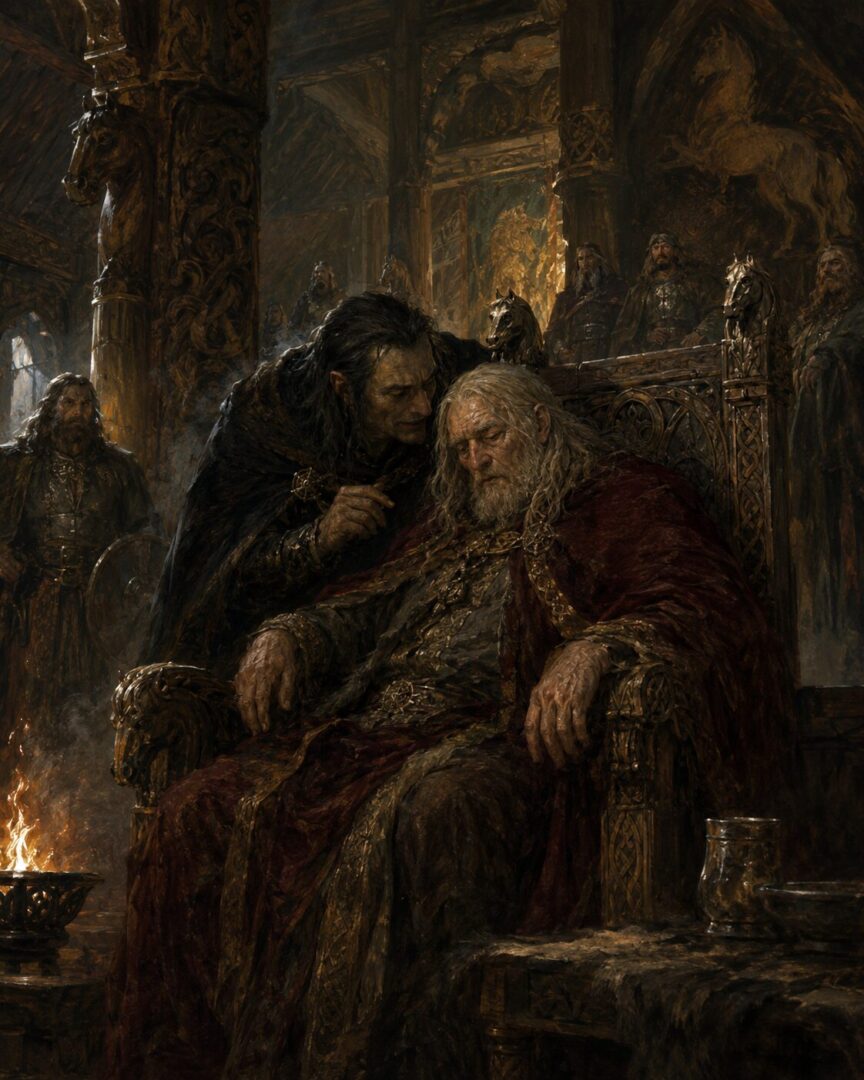
Théoden’s court is poisoned by Gríma Wormtongue. Saruman manipulates Rohan’s weakness. Théodred dies. Westfold burns. The king sits diminished while others act around him. Rohan’s social closeness, which can be a strength, also makes betrayal intimate. Wormtongue does not need to conquer a vast bureaucracy. He only needs access to the king’s ear.
But Rohan’s crisis is more direct than Gondor’s. It can be named. The king is failing. The enemy is at Isengard. The land is under attack. The people must ride.
That directness matters. Rohan does not have to debate the meaning of an empty throne or interpret the long defeat of Númenor. Its peril is terrible, but it is not abstract. Once Théoden is restored to himself, he does not become all-powerful, but he becomes actionable. He can choose. He can ride to Helm’s Deep. He can answer Gondor. He can die in a way that turns decline into dignity rather than paralysis.
Gondor’s greatness often forces its leaders to think in terms of the whole age. Rohan’s smaller world lets Théoden think in terms of duty.
That may sound lesser. In the War of the Ring, it becomes salvation.
Gondor Endures by Walls; Rohan Endures by Movement
Gondor’s defensive imagination is architectural. Minas Tirith, the Rammas Echor, Osgiliath, the river crossings, the guarded roads, the towers facing Mordor — its strength is fixed in place. This is appropriate. Gondor stands at the edge of the Shadow. It must hold territory. It must defend the approaches to the West.
Rohan’s power is different. It is kinetic.
The Rohirrim are a horse people, and in war their strength lies in muster, speed, and shock. They do not win because they possess older stone than the Enemy. They win moments because they can gather living force and bring it where it is needed. Reputable lore summaries reflect the textual picture of Rohan as a realm ruled by the descendants of Eorl, whose able men ride in time of war to the Muster of Rohan.
This mobility is not just tactical. It is spiritual.
Gondor often appears as a realm waiting: waiting for the king, waiting behind walls, waiting under siege, waiting for signs of whether the old hope can live again. Rohan is at its best when it moves. The Ride of the Rohirrim is powerful because it is not inevitable. It is a choice made across distance, fear, and almost certain death.
Rohan survives because it can still become motion.
The Oath Is Stronger Than Grandeur
The alliance between Gondor and Rohan is one of the most important political relationships in the late Third Age. But it is not based on equality of splendor.
Gondor is older, more learned, more monumental. Rohan is younger, plainer, and in some ways dependent on Gondor’s earlier generosity. The land itself was once Gondor’s Calenardhon. But the oath does something glory cannot do: it creates a living bond.
An empire can decay while its monuments remain. An oath either lives or it does not.
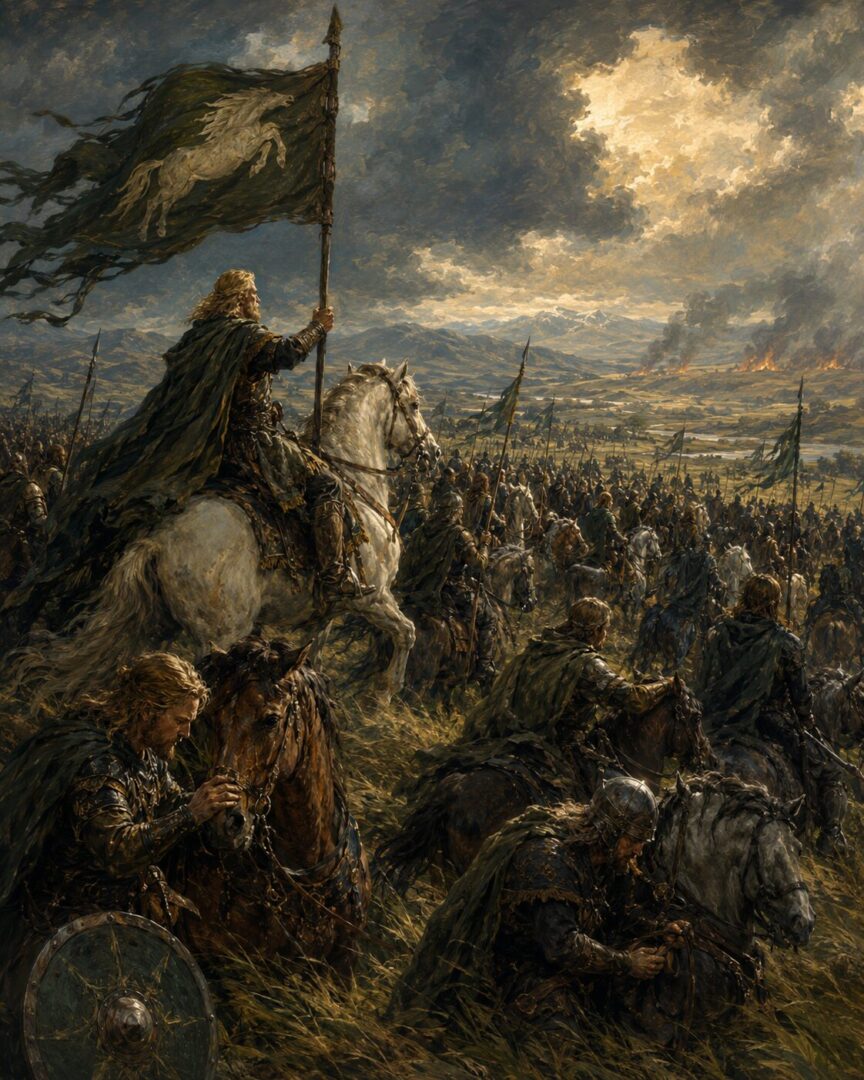
That is why the arrival of the Rohirrim at the Pelennor Fields matters so much. It is not merely cavalry arriving at a battle. It is the past becoming active in the present. Cirion’s trust, Eorl’s answer, the gift of land, the long friendship between the realms — all of it rides into the dawn.
Gondor’s glory provides the stage. Rohan’s oath provides the movement.
And crucially, Rohan does not come because victory is guaranteed. Théoden rides to Minas Tirith after a devastating war at home, with limited strength, under the knowledge that he may be too late. This is not imperial calculation. It is fidelity.
Rohan Is Not Better Than Gondor — It Is Less Burdened
It would be too easy to turn this contrast into a moral ranking: living Rohan good, ancient Gondor bad. The texts do not support that.
Gondor is indispensable. Faramir, Imrahil, Beregond, the soldiers of Minas Tirith, and countless unnamed defenders show courage, loyalty, and mercy. Aragorn’s return does not reject Gondor’s past; it heals and fulfills it. The White Tree matters because memory matters. A world without Gondor would be poorer, weaker, and more vulnerable to Sauron.
Rohan’s lesser glory is not a virtue by itself. The Rohirrim can be suspicious, harsh, and limited in knowledge. Their world is smaller. Their view of other peoples is not always generous. Éomer’s first meeting with Aragorn, Legolas, and Gimli is tense and dangerous. Rohan’s strength does not come from being morally untouched.
Its strength comes from being able to act without needing to solve the whole sorrow of history first.
That is the overlooked difference. Gondor must carry the meaning of the West in exile. Rohan must carry its king, its riders, its dead, its songs, and its oath. Both burdens are heavy. But one is lighter enough to move.
The Hidden Mercy of Being Smaller
In Middle-earth, grandeur often attracts danger.
The great Rings are dangerous. The great cities fall. The great lineages fade. The great powers of the First and Second Ages leave ruins behind them. Even when glory is good, it is rarely safe. It tempts people to preserve, possess, dominate, or despair when preservation fails.
Rohan’s world is more mortal. Its halls are wooden. Its songs are remembered by living voices. Its kings die openly. Its beauty can burn. Its strength can be scattered. Yet that very mortality keeps it close to ordinary courage.
Theoden’s transformation is not the restoration of a mythic empire. It is an old man standing up again. Éowyn’s defiance is not born from imperial ambition but from being trapped in a narrow role while doom approaches. Éomer’s loyalty is fierce because his world is personal: sister, king, riders, land, oath.
Rohan’s glory exists, but it is human-sized.
That is why it can still answer the horn.
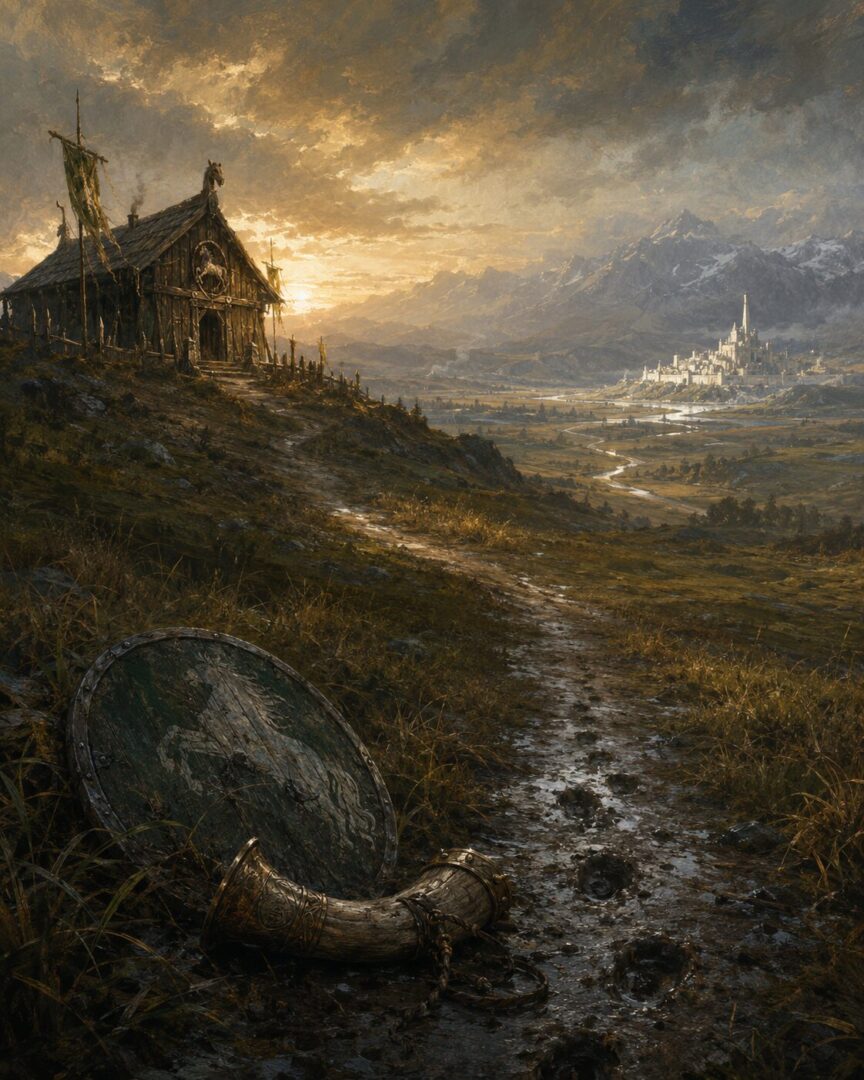
Why Rohan Survives
Rohan survives because it does not have to be Gondor.
It does not have to guard the whole memory of Númenor. It does not have to interpret the silence of the king’s throne. It does not have to stand as the last architectural symbol of an ancient order. It can be smaller, rougher, warmer, more immediate, and more alive.
Its greatness is not in being less noble than Gondor, but in being less imprisoned by nobility. Its halls can still fill with voices. Its riders can still gather. Its king can still be recalled to himself. Its oath can still become action.
Gondor survives by remembering what must not be lost.
Rohan survives by riding before the memory dies.
And in the War of the Ring, Middle-earth needs both.
Sources & Notes
- Tolkien Gateway, “Rohan” — summarizes Rohan’s people, military culture, and strategic role beside Gondor. https://tolkiengateway.net/wiki/Rohan
- Tolkien Gateway, “Gondor” — provides contrast with Gondor’s ancient Númenórean inheritance, institutions, and long struggle against Mordor. https://tolkiengateway.net/wiki/Gondor
- Tolkien Gateway, “Rohirrim” — explains the horse-lords’ identity, social structure, and practical strengths. https://tolkiengateway.net/wiki/Rohirrim
Sources added for Rohan/Gondor comparison and Rohirrim background.