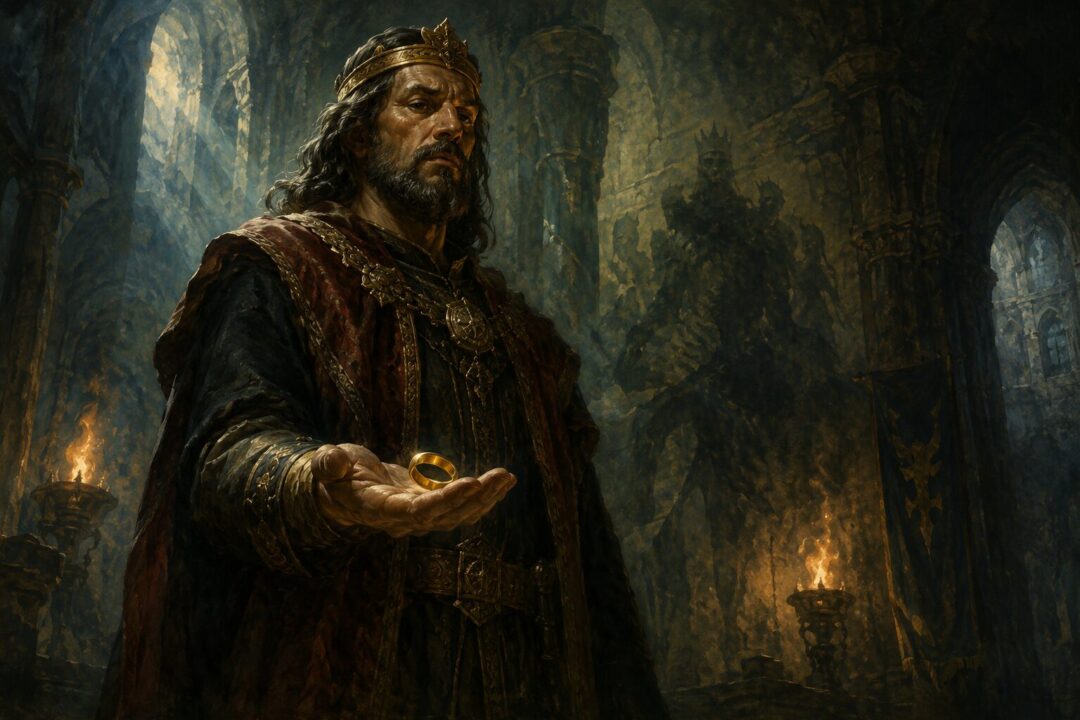
The Nine Rings promised what mortal rulers fear losing most: power, command, fame, and time. To a king, a sorcerer, or a warrior of the Second Age, such gifts would not have looked like chains. They would have looked like victory over every limit that makes Men mortal.
That is the terrible contradiction at the heart of the Nazgûl. The Nine were not given to weaklings. The texts remember their bearers as “mighty in their day,” as kings, sorcerers, and warriors of old. They gained glory and wealth. Their lives were stretched far beyond the natural span of Men. They could walk unseen and perceive things hidden from mortal sight.
And yet none of this made them gods.
It made them servants.
The reason lies in one of Middle-earth’s most important hidden rules: power that denies mortality does not free Men from death. It makes them more vulnerable to domination by something worse.
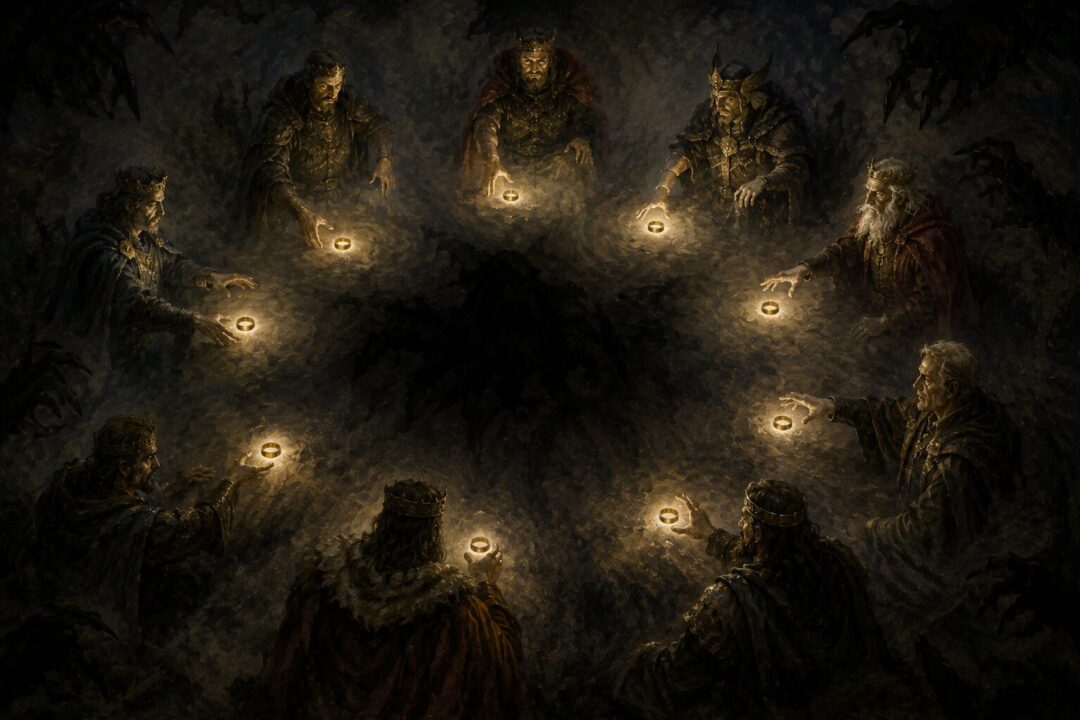
The Rings Offered Power, But Not Independence
The Rings of Power were never neutral treasures. Even before the Nine reached mortal hands, they belonged to a larger design of control. The Elven-smiths of Eregion made the Great Rings with knowledge taught by Sauron in disguise, while Sauron secretly forged the One Ring to rule the others.
That matters. The Nine did not simply amplify the natural strength of their bearers. They connected those bearers to a system whose center was elsewhere. The mortal kings who accepted them may have imagined themselves rising above other Men, but the deeper structure of the Rings bent inward toward Sauron.
This is why the Nine could produce greatness and slavery at the same time. They gave the appearance of expansion: longer life, greater authority, invisible movement, and access to the Unseen world. But every gift came through a channel already compromised. The more the bearer depended on the Ring, the more his power was mediated by Sauron’s design.
A god, in the ancient sense, possesses power from his own being. The Ringwraiths possessed power by dependence. Their strength did not make them sovereign. It made them useful.
Men Were the Most Vulnerable Bearers
The Three were preserved from Sauron’s hand because he never touched them, though they were still subject to the One. The Seven failed to enslave the Dwarves in the same way because Dwarves were made hard to dominate; the Rings inflamed greed, but did not turn them into wraith-servants. Men were different.
Men in Tolkien’s world are defined by mortality. Death is not presented simply as punishment or biological weakness, but as part of their appointed nature. The tragedy of Men often begins when they cannot accept this limit. Númenor itself falls through the desire to escape death and seize an immortality not granted to Men.
The Nine Rings exploited that fear. They did not offer mortal rulers a wholesome immortality. They offered duration without healing, preservation without peace. The texts say that the bearers seemed to have unending life, yet life became unendurable to them. That is not godhood. It is a parody of immortality.
The Rings stretched the mortal self past its proper shape. The body and will continued, but not in freedom. Over time, the bearers faded. They became less present in the visible world and more bound to the shadowed realm in which Sauron’s power was strongest.
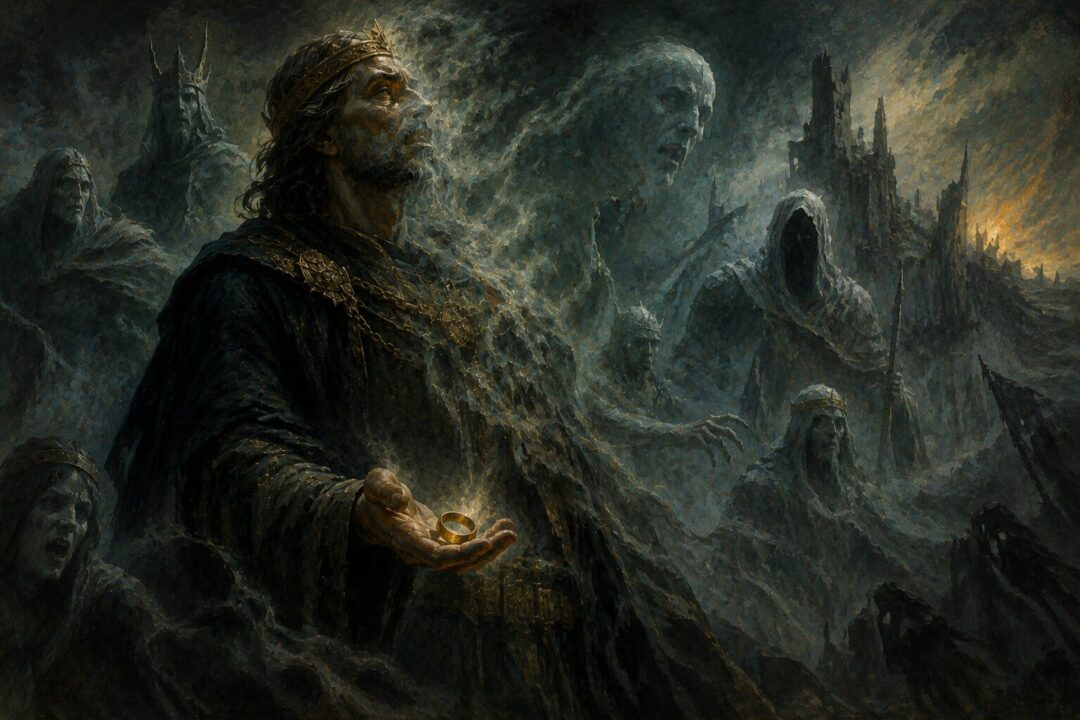
Invisibility Was Not Escape
One of the most seductive powers of the Nine was the ability to walk unseen. To a ruler or warrior, invisibility seems like perfect advantage. It means spying without risk, striking without warning, moving beyond ordinary fear.
But in Middle-earth, invisibility through a Ring is not merely camouflage. It pulls the wearer into the Unseen. Bilbo and Frodo experience this in a limited way with the One Ring: when wearing it, they vanish from ordinary sight but become more exposed to the eyes and powers of the wraith-world. The Nine experienced this condition far more terribly and permanently.
The bearers could see things invisible to mortal Men, but the texts warn that they too often beheld phantoms and delusions of Sauron. Their expanded sight did not bring wisdom. It opened them to deception. Their hiddenness did not protect their identity. It erased it.
This is one of the cruelest reversals in the story of the Nine. The power to disappear from others became the loss of themselves.
Glory Was the Bait
The Nine did not become wraiths immediately, at least not as the texts present their fall. They first became mighty. They obtained wealth and fame. That delay is essential to the trap.
If the Rings had instantly turned kings into shrieking shadows, no proud lord would have accepted them. Their corruption worked because the first results confirmed the bearer’s desire. A king became more kingly. A sorcerer gained deeper arts. A warrior became more terrible. The Ring seemed to prove that ambition was justified.
This is why the Nine are not merely victims of an external curse. The texts leave much unknown about their individual motives, and only Khamûl is named with certainty. Still, the pattern is clear: the Rings worked through desires already present in mortal hearts. Pride, fear of death, hunger for mastery, and love of domination made the bearers easier to claim.
The tragedy is that their early greatness was real enough to deceive them. They did rise. But they rose on a road that had only one end.
Sauron Did Not Need Them to Worship Him
The Nine did not become servants because they admired Sauron. They became servants because their wills were captured.
This distinction matters. Tolkien’s evil often does not require love. It can rule through fear, dependency, and the shrinking of the self. The Ringwraiths are terrifying because they are not merely loyal officers. They are beings whose wills have been bent into instruments.
In the late Third Age, Sauron held the Nine Rings, and through them had primary control over the Nazgûl. That detail reveals how complete their fall had become. The objects that once seemed to elevate them were now the means by which they were governed.
They were not gods because gods are not puppets. They were not true kings because kingship requires a will capable of judgment. They were not even fully themselves, because their identities had been consumed by their function.
They became what Sauron most valued: extensions of his fear.
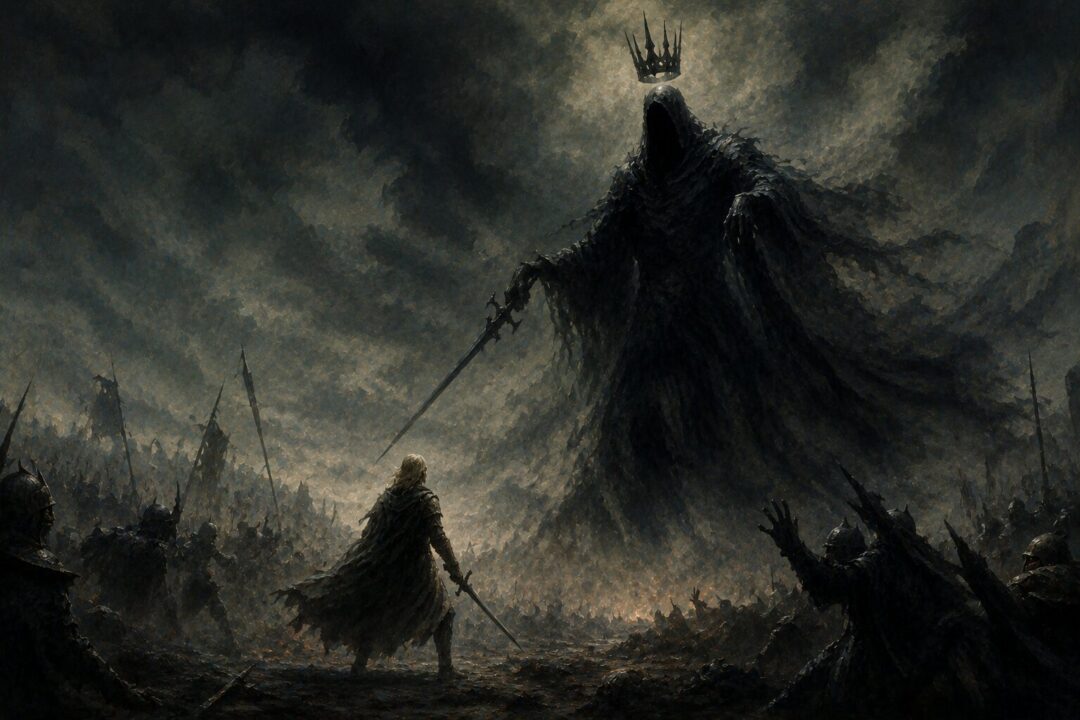
The Witch-king Shows the Limit of Their Power
The Witch-king of Angmar, lord of the Nazgûl, is the clearest example of the Nine’s terrible strength and ultimate limitation. He could found a realm of dread in Angmar, shatter the northern kingdoms of the Dúnedain, command armies, and spread terror. At the Pelennor Fields, he appears almost invincible.
Yet his power is still derivative. His prophecy does not make him immortal. His terror does not make him unconquerable. He is destroyed through a convergence of courage, loyalty, and an overlooked condition: not by the hand of a man, but by Éowyn, aided by Merry’s blade from the Barrow-downs.
His fall reveals the falsehood beneath the Nine. The Witch-king could become more than a mortal tyrant, but not more than doom. His power inspired despair, yet it could be answered by pity, bravery, and resistance from those he dismissed.
That is the moral shape of his defeat. The servant of domination is undone by the free actions of the small and the disregarded.
The Nine Are a Warning About Immortality Without Grace
The deepest reason the Nine Rings made servants instead of gods is that they offered immortality severed from its proper source. Elves endure by nature within the world. Men are appointed to leave it. When Men try to possess endless life inside the world by force, the result is not divinity but distortion.
The Nazgûl are not simply “undead” monsters. They are Men preserved wrongly. Their continued existence is a wound. Their power is a symptom of that wound. Their terror comes from the fact that something human remains, but only as a shadow under another will.
This is why their story belongs beside Númenor’s downfall. Both turn on the same temptation: the refusal to accept the limits placed upon Men. Númenor sought deathlessness through rebellion against the Ban of the Valar. The Nine sought it, or accepted it, through Rings made subject to Sauron’s ruling power. In both cases, the attempt to escape death led not to freedom but to ruin.
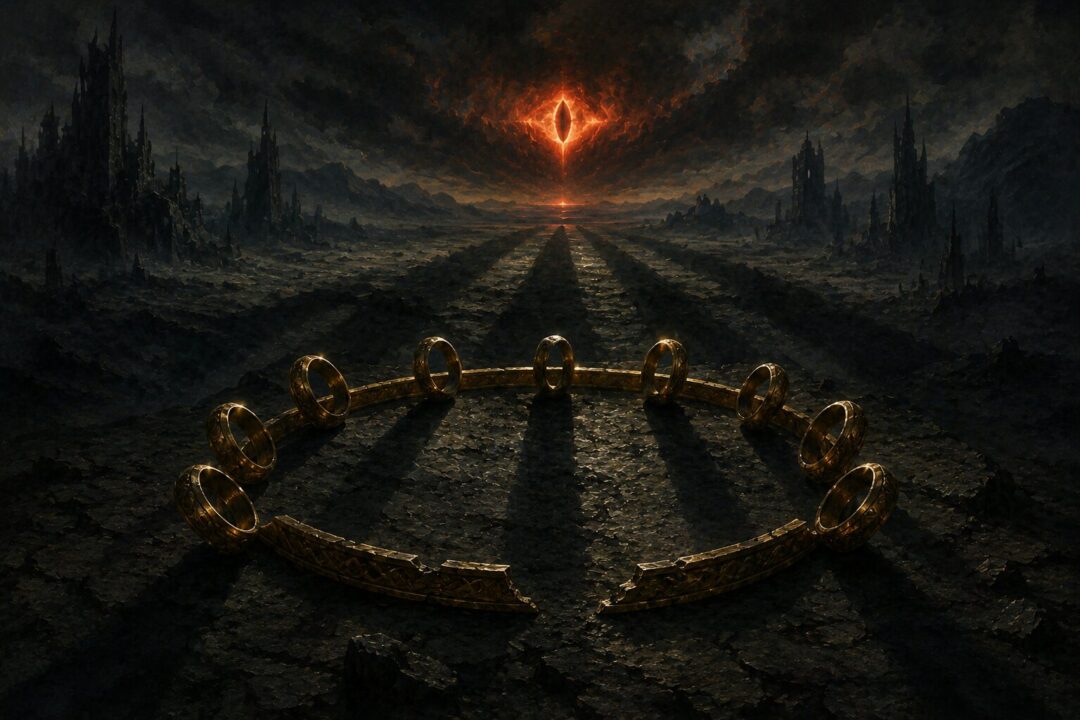
Servants, Not Gods
The Nine Rings made kings into servants because they magnified desire without purifying it. They extended life without giving meaning. They opened hidden sight without granting wisdom. They gave power through a system built for domination.
The bearers were not weak because they became slaves. They became slaves because their strength was captured. Their pride gave Sauron leverage. Their fear of death made the offer irresistible. Their dependence on the Rings made their wills accessible. Their fading made their identities less and less able to resist.
That is the terrifying genius of the Nine. They did not overthrow kings by taking crowns away. They let kings keep the dream of mastery until mastery itself became the chain.
In the end, the Nazgûl are not images of Men becoming divine. They are images of Men refusing to be mortal, and losing even the freedom that mortality had given them.
The Nine promised thrones beyond death.
They delivered only servitude in the dark.
Sources & Notes
- Tolkien Gateway, “Nine Rings” — explains the Rings given to Men and their transformation of rulers into the Nazgûl. https://tolkiengateway.net/wiki/Nine_Rings
- Tolkien Gateway, “Nazgûl” — details the wraiths’ origin as mortal kings, sorcerers, and warriors enslaved by Sauron. https://tolkiengateway.net/wiki/Nazg%C3%BBl
- Tolkien Gateway, “Sauron” — gives context for Sauron’s strategy of domination through the Rings of Power. https://tolkiengateway.net/wiki/Sauron
Sources added for the Nine Rings, Nazgûl, and Sauron’s domination.