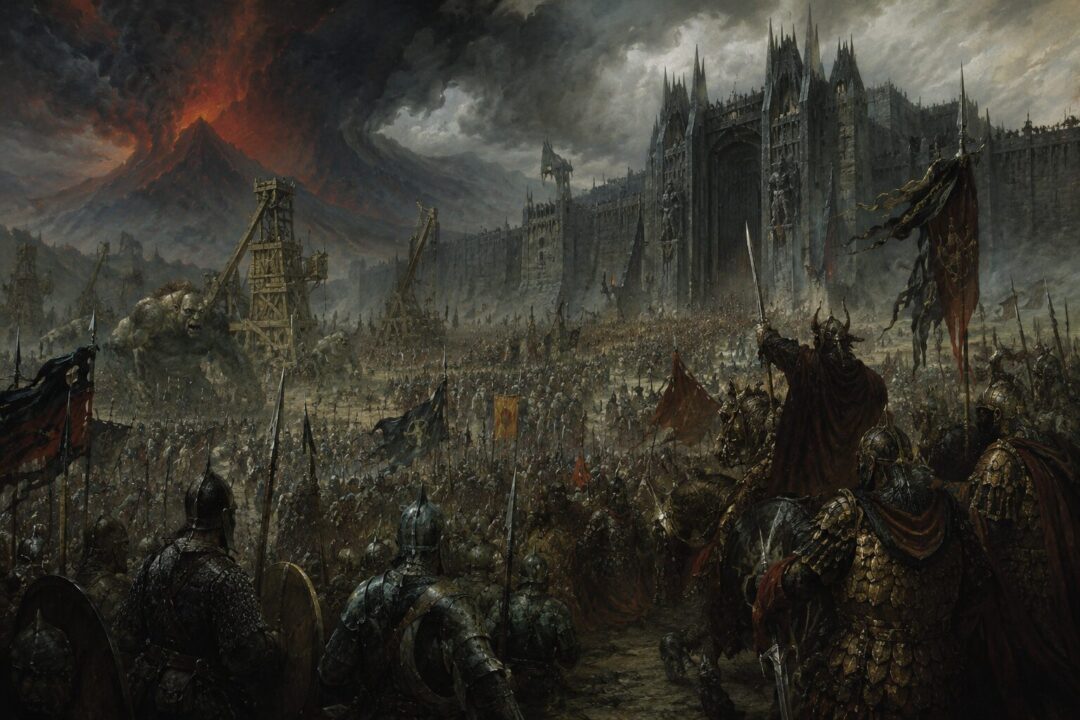
What does it say about a Dark Lord when he can command hundreds of thousands, yet still cannot truly rule a single free heart?
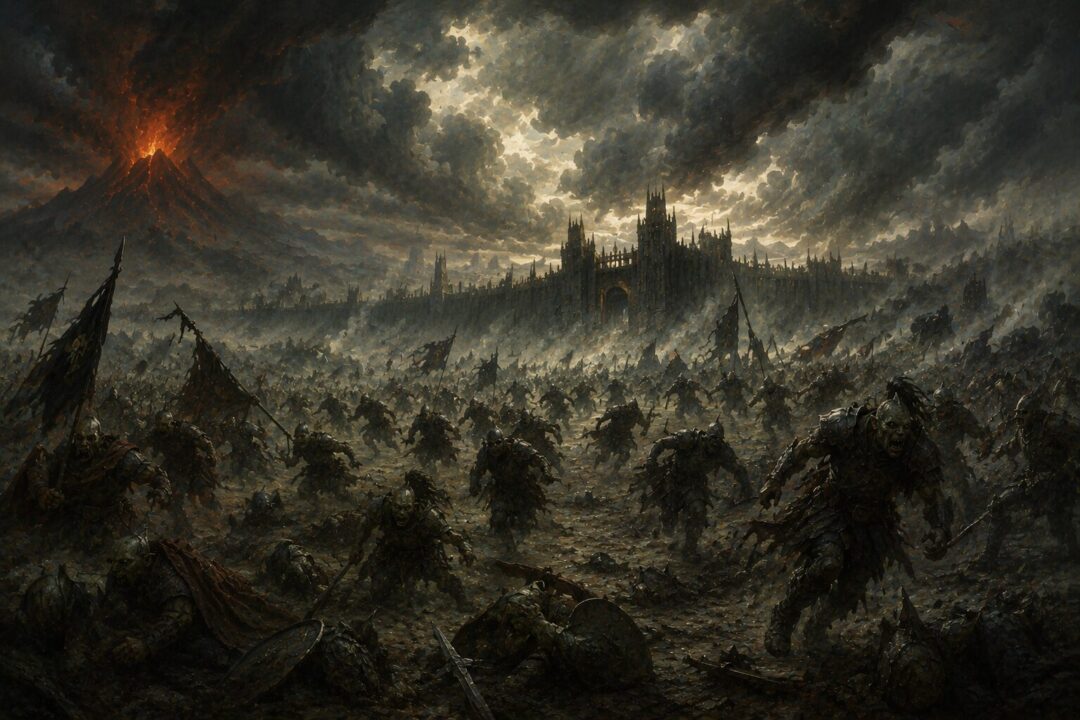
Mordor’s armies are among the most terrifying forces in Middle-earth. Vast hosts of Orcs, Easterlings, Haradrim, trolls, and other servants of the Shadow pour from the Black Land and nearly overwhelm the West. Their numbers seem endless. Their discipline appears formidable. Their victories often come through careful planning and relentless pressure.
Yet beneath that apparent strength lies one of the most revealing truths about Sauron.
The armies of Mordor expose a fundamental weakness in the kind of power he possesses. He can dominate, terrify, corrupt, deceive, and command. He can bend wills and manipulate desires. But he cannot create genuine loyalty, inspire selfless devotion, or unite free peoples through love rather than fear.
The closer we examine the military machine of Mordor, the more clearly we see that Sauron’s greatest limitation is not a lack of strength. It is the nature of strength itself.
The Vast Military Power of Mordor
By the end of the Third Age, Sauron commands the greatest military force in Middle-earth.
From Mordor come immense armies of Orcs. Allies arrive from distant lands beyond the knowledge of most western peoples. The Haradrim march beneath scarlet banners. Easterling warriors answer the summons of the Dark Lord. Great siege engines are assembled. Massive fortifications guard strategic approaches.
The hosts that attack Minas Tirith are only part of Sauron’s strength. Gandalf explicitly warns that the assault on Gondor is not the full measure of Mordor’s power. Other armies move elsewhere. Forces threaten Erebor and Dale in the north. The war stretches across vast distances.
From a purely military perspective, Sauron appears nearly unstoppable.
Yet the texts repeatedly suggest that numbers alone do not equal true mastery. Again and again, cracks appear within the structure of his power.
Those cracks reveal something deeper than military weakness. They reveal a spiritual weakness embedded within the foundations of his rule.
An Army Held Together by Fear
One of the clearest characteristics of Mordor's forces is fear.
Fear flows downward from Sauron through every level of his hierarchy.
The Nazgûl inspire terror among allies and enemies alike. Orc captains fear punishment from superiors. Lesser servants fear greater servants. The entire system functions through intimidation and coercion.
This creates obedience, but it does not create unity.
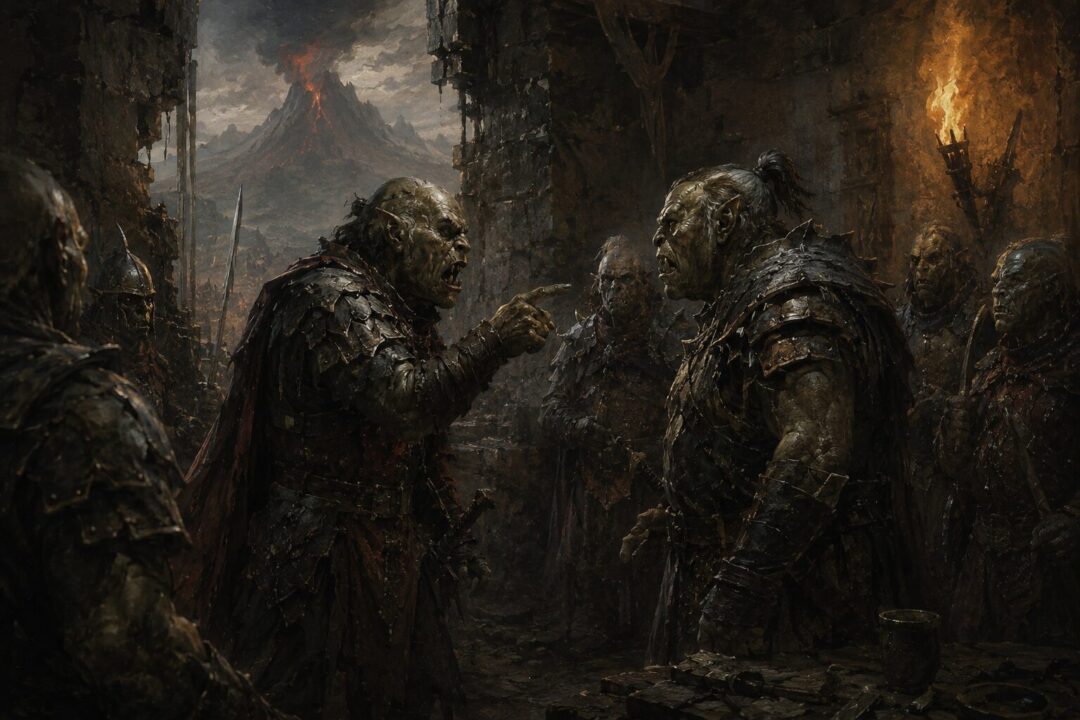
The conversations between Orcs in The Lord of the Rings are especially revealing. When readers glimpse ordinary Orc soldiers speaking among themselves, they rarely sound devoted to a shared cause. Instead, they complain, scheme, distrust one another, and seek opportunities for personal advantage.
The Orcs Shagrat and Gorbag discuss their situation with cynicism rather than loyalty. They imagine escaping authority altogether if circumstances allow. Their words suggest that even within Mordor’s military structure, faith in the cause is remarkably thin.
Sauron can force obedience.
He cannot inspire genuine belief.
That distinction matters because fear creates a different kind of army than loyalty does.
A soldier who fights because he loves his homeland behaves differently from one who fights because he fears punishment. A people united by shared purpose can endure suffering voluntarily. A population ruled through terror must constantly be controlled.
Mordor's military system depends upon that control never weakening.
The Constant Problem of Internal Division
One striking feature of Sauron's armies is how often their members quarrel among themselves.
The struggle between Orc factions after Frodo is captured near Cirith Ungol provides a vivid example. Rival groups compete for status, authority, and rewards. Suspicion quickly turns into violence. The result is chaos within a supposedly disciplined military organization.
This is not presented as an isolated incident.
Throughout the legendarium, evil powers frequently suffer from internal rivalry. Ambition, jealousy, and self-interest repeatedly undermine cooperation.
The reason appears connected to the very nature of Sauron’s rule.
His servants are not encouraged to pursue virtue, sacrifice, or mutual trust. Instead, power flows through domination. Advancement comes through strength, intimidation, and usefulness to the Dark Lord.
Such a system can produce efficiency.
It struggles to produce fellowship.
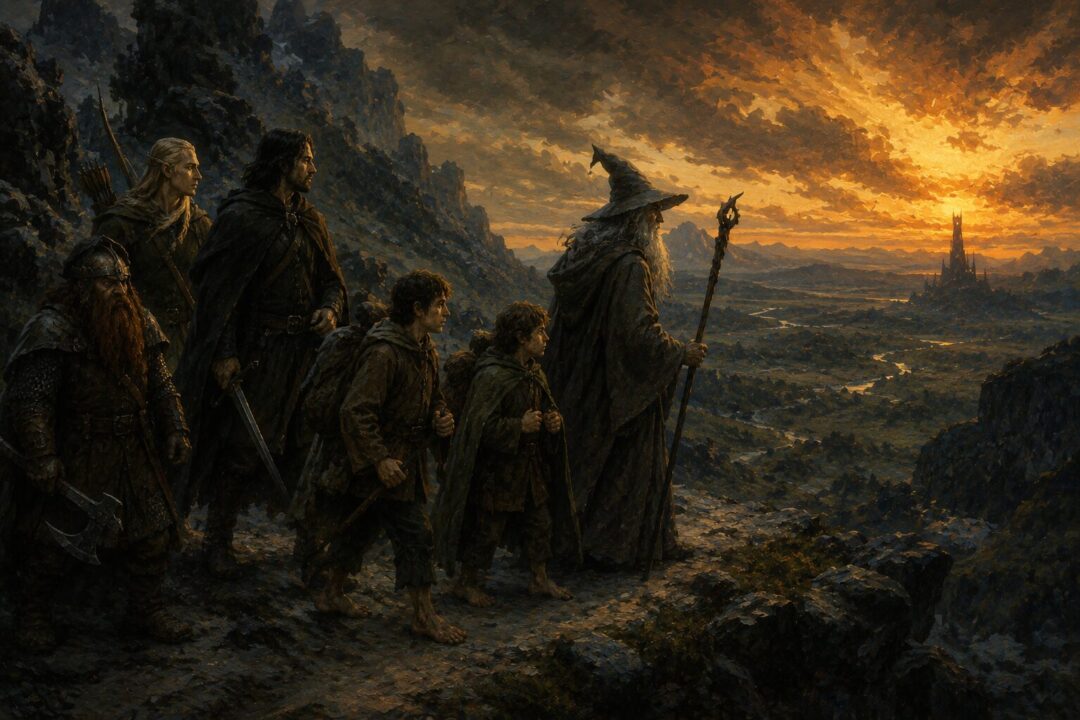
The Fellowship of the Ring itself serves as a deliberate contrast. Its members come from different peoples with different histories and priorities. They remain together not because anyone forces them to stay, but because they freely choose a common purpose.
Mordor achieves unity from above.
The Free Peoples achieve unity from within.
The difference becomes increasingly important as the War of the Ring unfolds.
Sauron Understands Power Better Than Mercy
Perhaps the most important weakness revealed by Mordor's armies is Sauron’s inability to understand certain motivations.
He understands ambition.
He understands fear.
He understands pride.
He understands the desire for domination.
These are the tools he himself uses.
What he consistently fails to understand is mercy.
This limitation shapes many of his strategic assumptions.
Sauron cannot imagine someone willingly giving up immense power. As a result, he never seriously considers that the One Ring might be destroyed rather than claimed. His attention focuses on military threats because military power is how he understands the world.
The army of Mordor becomes an extension of that worldview.
Strength is measured through force.
Victory comes through conquest.
Authority comes through domination.
Yet the decisive actions of the War of the Ring emerge from motivations outside this framework.
Frodo accepts suffering rather than seeking glory.
Sam remains faithful when there is little hope.
Aragorn chooses responsibility over personal gain.
Faramir rejects a weapon that could increase his own power.
These choices are difficult for Sauron to anticipate because they arise from principles fundamentally different from his own.
His armies reveal the limits of a ruler who understands control better than conscience.
Why Sauron Needs Endless Expansion
Another revealing feature of Mordor is its constant drive toward expansion.
A realm built primarily on fear faces a permanent problem.
Fear must continually be maintained.
Subjects cannot simply be left alone. Allies must be monitored. Rivals must be crushed. Potential resistance must be eliminated before it grows.
This creates a tendency toward perpetual conquest.
The military machinery of Mordor never appears designed for peaceful coexistence with neighboring realms. Its logic points toward continual domination.
This reflects the deeper nature of Sauron’s ambitions.
He does not merely seek security.
He seeks order imposed according to his will.
In Tolkien's writings, Sauron is often associated with a desire to organize and control the world. Unlike Morgoth, whose destructive impulses become increasingly chaotic, Sauron frequently seeks efficient domination.
Yet imposed order carries its own weakness.
Order created through force depends on the continued presence of force.
If the center weakens, the system begins to unravel.
The Collapse After the Ring Is Destroyed
The destruction of the One Ring provides the clearest evidence of this weakness.
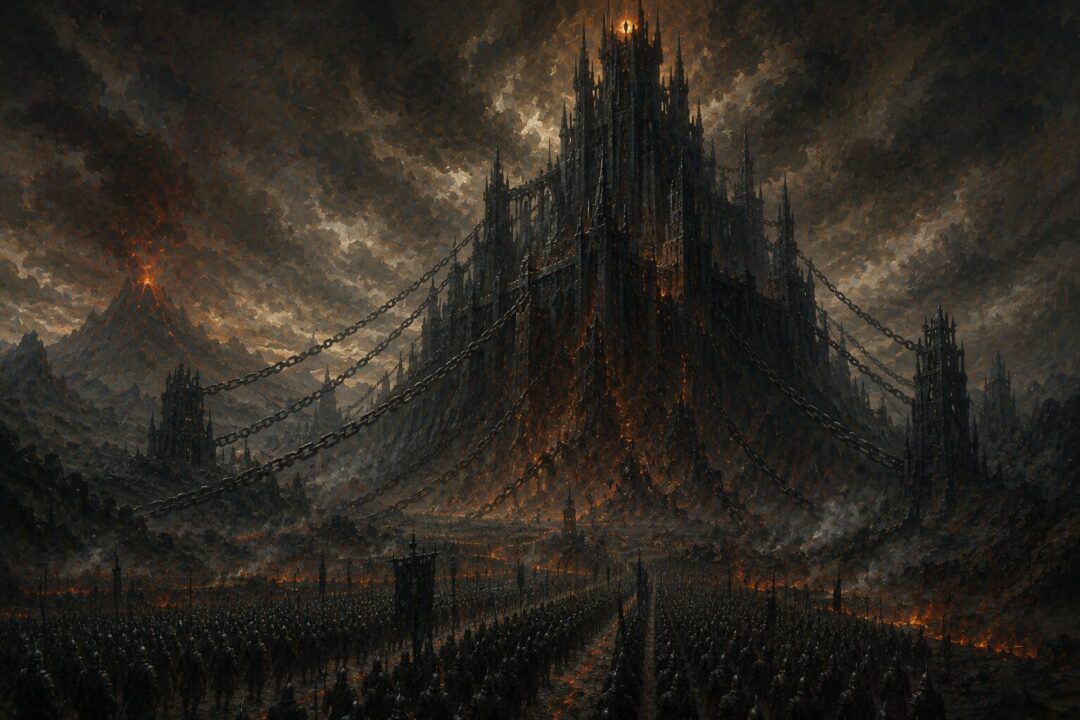
At the Battle of the Morannon, Sauron's armies appear overwhelming. The Captains of the West stand before impossible odds.
Then the Ring is destroyed.
The transformation is immediate.
Many of Sauron’s servants flee. Others panic. The organized resistance of Mordor collapses.
Of course, this collapse is linked directly to Sauron's downfall and the destruction of the power he had invested in the Ring. Yet the speed of the disintegration remains revealing.
The armies do not continue fighting with unwavering commitment to a cause larger than themselves.
The system depends upon Sauron.
When Sauron falls, much of the cohesion falls with him.
This stands in sharp contrast to the Free Peoples.
Gondor survives the deaths of kings.
Rohan survives changes of leadership.
The Shire remains itself despite enormous events beyond its borders.
Their societies possess identities independent of a single dominating will.
Mordor does not appear to possess the same resilience.
Its strength is concentrated rather than shared.
The Deepest Contrast: Mordor and the Fellowship
The most revealing comparison may be between Mordor’s armies and the Fellowship itself.
At first glance, the comparison seems absurd.
One side commands vast military power.
The other consists of only nine travelers.
Yet Tolkien repeatedly highlights the significance of freely chosen cooperation.
The Fellowship includes representatives from peoples with ancient grievances and cultural differences. Elves, Dwarves, Men, and Hobbits walk together despite histories that often pulled them apart.
No one compels their participation.
No magical domination binds them together.
They remain because they choose to remain.
This is exactly the kind of unity Sauron cannot create.
He can gather armies.
He cannot create fellowship.
He can command obedience.
He cannot command love.
He can generate fear.
He cannot manufacture trust.
The military might of Mordor therefore reveals not only Sauron’s greatest strength but also his greatest limitation.
What Mordor’s Armies Ultimately Reveal
Mordor’s armies are terrifying because they demonstrate how much can be accomplished through fear, manipulation, and centralized power.
Sauron nearly conquers Middle-earth.
His strategies are often effective. His preparations are extensive. His military resources dwarf those of his enemies.
Yet the foundations of his power contain a flaw that cannot be repaired through larger armies or stronger fortresses.
The flaw lies in the inability of domination to replace genuine allegiance.
The servants of Mordor obey because they must.
The heroes of Middle-earth endure because they choose to.
That distinction ultimately shapes the outcome of the War of the Ring.
The armies of the Dark Lord reveal that power based on fear can become enormous. It can conquer lands, command hosts, and darken entire kingdoms.
But it remains vulnerable in a way that freely given loyalty is not.
In the end, Sauron’s greatest weakness is not military, magical, or strategic.
It is that he never learns the difference between ruling wills and winning hearts.
Sources & Notes
- Tolkien Gateway, “Mordor” — summarizes Mordor’s geography, fortifications, and role as Sauron’s militarized realm. https://tolkiengateway.net/wiki/Mordor
- Tolkien Gateway, “Orcs” — describes the main soldiers of Mordor and their coercive, brutal place in Sauron’s armies. https://tolkiengateway.net/wiki/Orcs
- Tolkien Gateway, “Sauron” — provides context for Sauron’s reliance on domination, fear, armies, and servants. https://tolkiengateway.net/wiki/Sauron
Sources added for Mordor, Orc armies, and Sauron’s mode of power.