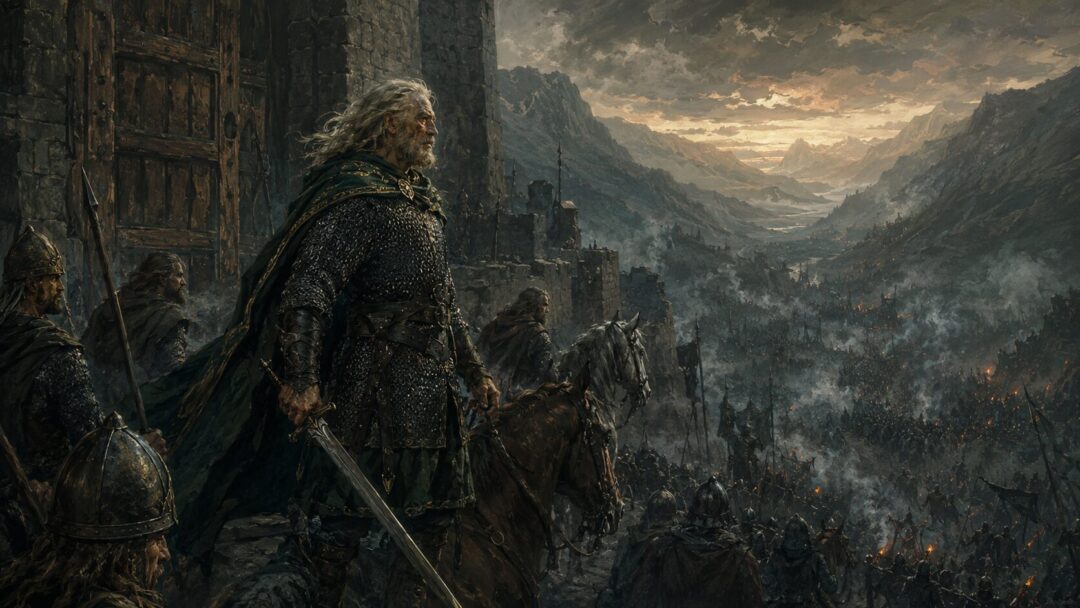
Helm’s Deep is remembered for stone walls, sounding horns, and the sudden blaze of morning over a valley filled with enemies. Minas Tirith is remembered for white towers, black sails, and a Steward who looks into a seeing-stone and chooses fire. At first glance, Théoden and Denethor seem to face the same question: what should a ruler do when defeat appears certain?
But the deeper contrast is not courage versus cowardice. Denethor is not written as a simple coward, and Théoden is not written as a man without fear. Both are old rulers under impossible pressure. Both have lost sons, strength, and certainty. Both inherit kingdoms standing near the end of an age.
The difference is this: at Helm’s Deep, Théoden understands that hope is not the same as optimism. Denethor, in his final crisis, never truly does.
Two Old Rulers at the Edge of Ruin
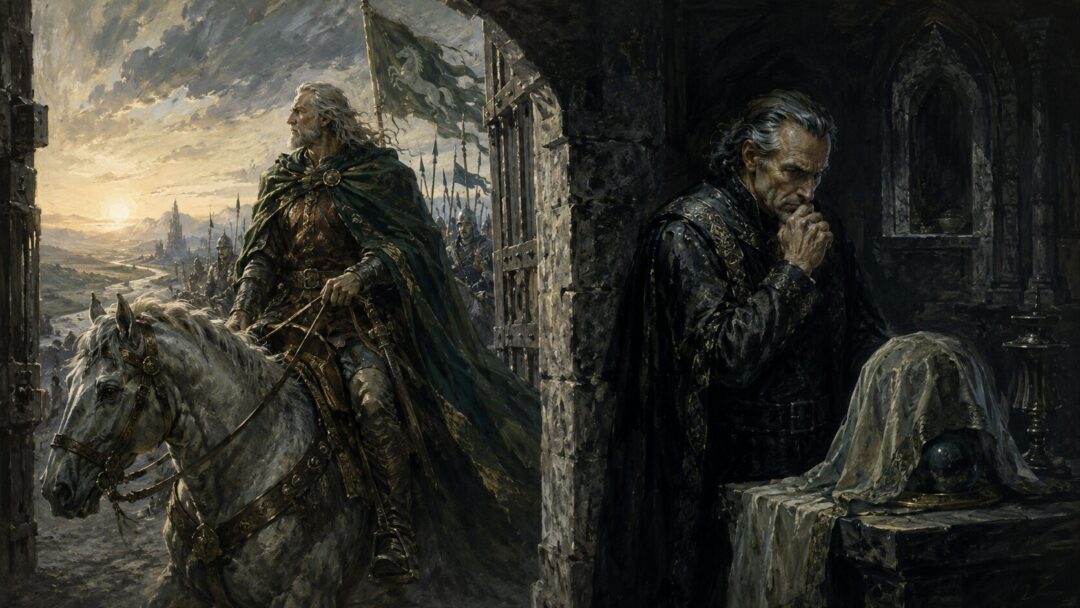
Théoden and Denethor are mirrors, but not twins.
Théoden is King of Rohan, a lord of a younger people whose strength lies in horses, oaths, memory, and swift action. When Gandalf comes to Edoras, Théoden has been diminished by age, grief, and the poisonous influence of Wormtongue. He has not merely been advised badly; his will has been bent inward. His house has grown silent. His son Théodred is dead. His people are scattered and threatened by Saruman.
Denethor is Steward of Gondor, heir to a long office established to preserve the realm in the king’s absence. He is far-sighted, proud, learned, and strong-willed. The texts never present him as foolish. He has ruled a realm that has borne the weight of Mordor for generations. His eldest son Boromir is dead. His younger son Faramir returns wounded and fevered. The Enemy is at the gates.
Both men have reasons to despair. That matters. The story does not make despair look absurd. In both Rohan and Gondor, the military situation is genuinely terrible.
Yet one ruler rises from near-defeat into costly action. The other descends from knowledge into possession, isolation, and self-destruction.
Helm’s Deep Is Not a Scene of Easy Hope
It is important not to soften Helm’s Deep into a simple victory story.
In the book, the Battle of the Hornburg is fought through the night against the forces of Isengard. Théoden’s host is badly outnumbered. The Deeping Wall is breached. The defenders are driven back. The Glittering Caves become a refuge for many of Rohan’s people. The fortress is not a place where Théoden can comfortably wait out the storm.
Nor does Théoden know that Gandalf will return with decisive aid. Gandalf has promised to come, but the king does not possess certainty. He has no map of providence. He has no guarantee that the morning will bring rescue rather than death.
That uncertainty is the heart of the scene.
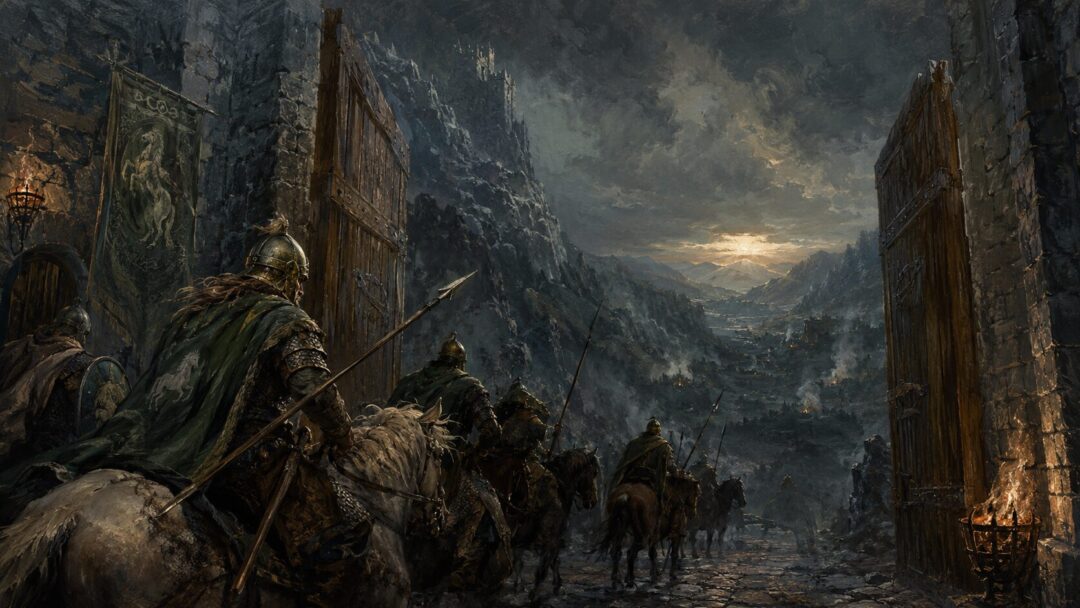
When Théoden resolves to ride out from the Hornburg, he is not making a calculation that victory is now likely. He is choosing what kind of king he will be if the end has come. The ride is not a denial of danger. It is an answer to danger.
He understands that a ruler’s duty does not depend on seeing the whole outcome.
Théoden’s Hidden Discovery: Action Can Be Faithful Even When It Fails
At Helm’s Deep, Théoden regains something deeper than military confidence. He regains the ability to act faithfully without possessing certainty.
That is the overlooked point. Théoden does not need to know that the charge will succeed in order for the charge to be meaningful. If the ride ends in death, it may still be the proper act of a king. He can spend his remaining strength in defense of his people, beside his companions, with his face toward the enemy.
This is not reckless despair. It is almost the opposite.
Despair says, “Because I cannot see success, action has no meaning.” Théoden says, in effect, “Because I may be near the end, my action matters all the more.”
That is why the dawn at Helm’s Deep feels earned. The morning does not erase the night; it answers those who endured it. Théoden’s ride opens the gate before he knows what waits beyond it. Only then does the larger help arrive: Gandalf, Erkenbrand, and the strange terror of the Huorns in the valley.
The order matters. Théoden acts before the rescue is revealed.
Denethor Sees More, But Understands Less
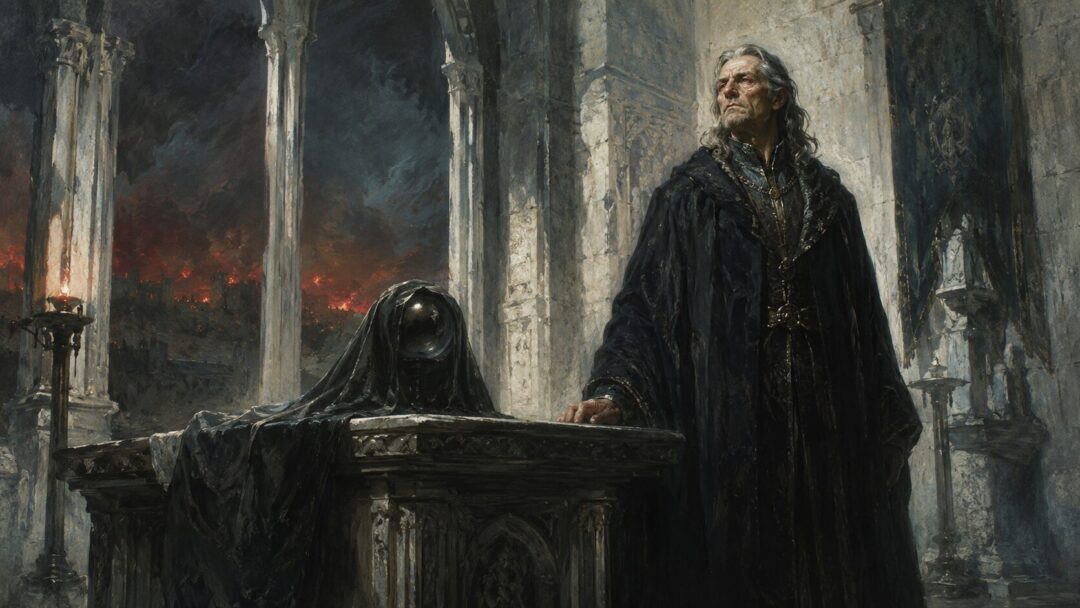
Denethor’s tragedy is sharpened by the fact that he has access to more information than Théoden.
Through the palantír of Minas Tirith, Denethor has looked far beyond the ordinary reach of men. The seeing-stones do not simply show lies; that would be too easy. Their danger is subtler. They can show true things, partial things, terrifying things, and things arranged by a hostile will to produce a desired conclusion.
Denethor is not merely fooled because he is weak. He is overmatched because he believes that seeing more gives him the right to judge the end.
The texts imply that Sauron could not easily dominate Denethor in the same way he dominated lesser minds. Denethor’s will was great. But greatness of will is not the same as humility. He sees the vast strength of Mordor, the approach of fleets, the collapse of his hopes, and the apparent ruin of his house. From those sights he draws a conclusion that no mortal ruler has the authority to draw: that resistance has become meaningless.
This is where Denethor fails most deeply.
He does not merely lose hope. He decides that because he cannot imagine deliverance, deliverance cannot exist.
Stewardship Versus Possession
Denethor’s title matters. He is not King of Gondor. He is Steward.
A steward is entrusted with what is not finally his. His office exists because the king is absent, not because the kingship has been abolished. Denethor knows this history. His conflict with the return of the king is not ignorance but unwillingness. He has preserved Gondor for long years, yet at the end he speaks and acts as though Gondor, Faramir, and even his own death are his to command absolutely.
That is why the attempted burning of Faramir is so horrifying. Denethor does not only choose death for himself. He attempts to carry his living son into that decision. His despair becomes possessive.
Théoden, by contrast, moves outward. He does not drag others into private annihilation. He calls men to a public deed of arms. Those who ride with him do so as warriors under their king, not as victims of his refusal to endure the future.
Both rulers face possible death. But Théoden offers himself in battle. Denethor tries to close the story around himself.
The Difference Between Death and Despair
Middle-earth does not treat death as the worst thing. Again and again, the deeper danger is domination, corruption, oath-breaking, faithlessness, and the surrender of the will to darkness.
Théoden at Helm’s Deep is willing to die, but he is not willing to let fear define the meaning of his death. Later, on the Pelennor Fields, this becomes even clearer: he rides to Gondor not because victory is guaranteed, but because the old alliance must be honored. His death there is sorrowful, but not spiritually barren. He dies as a king who has returned to himself.
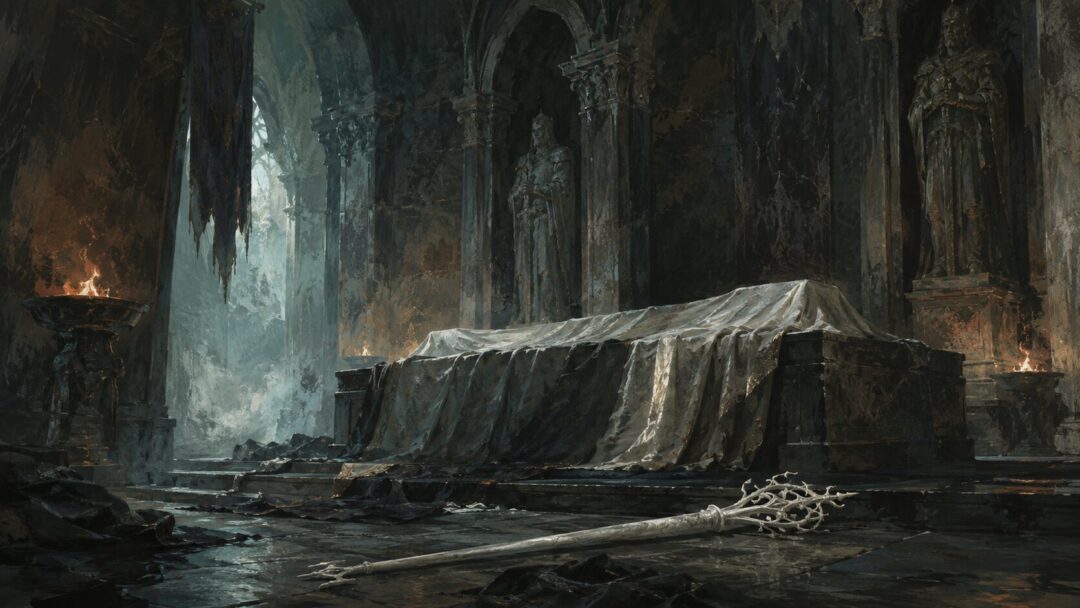
Denethor’s death is different. It is enclosed, bitter, and sterile. He goes not to a battlefield but to a tomb. The House of Stewards becomes the setting of his final refusal: refusal of counsel, refusal of mercy, refusal to wait, refusal to believe that anything remains beyond the evidence he has accepted as final.
The contrast is not that Théoden loves death and Denethor fears it. Denethor chooses death. The contrast is that Théoden’s acceptance of death leaves room for duty, fellowship, and grace. Denethor’s despair leaves room only for control.
Counsel Is Another Form of Hope
One of Théoden’s great recoveries is that he becomes able to receive counsel again.
Before Gandalf’s arrival, Wormtongue’s influence has narrowed Théoden’s world. He is surrounded by words that make action seem foolish, loyalty seem suspect, and age seem like defeat. When he is restored, he does not become all-knowing. Instead, he becomes capable of listening rightly: to Gandalf, to Aragorn, to the needs of his people, and to the demands of honor.
At Helm’s Deep, this matters. Théoden does not survive because he privately possesses perfect wisdom. He survives because he is rejoined to a web of faithful relationships.
Denethor also receives counsel, but he rejects the counsel that would limit his despair. Gandalf challenges him. Pippin runs for help. Beregond breaks the law to save Faramir. The story surrounds Denethor with witnesses against his final act, yet he treats contradiction as insult. His isolation becomes almost kingly in its pride, though he is Steward.
This is another thing Théoden understands: a ruler is not diminished by needing others. Denethor increasingly behaves as though dependence itself is humiliation.
The Palantír and the Trap of Total Knowledge
The palantír is one of the most dangerous objects in this comparison because it tempts Denethor with the illusion of completeness.
A seeing-stone can expand sight without granting wisdom. It can reveal movement without revealing meaning. It can show armies without showing pity, ships without showing who commands them, darkness without showing the hidden road by which hope travels.
This is especially important because the War of the Ring turns on hidden, unlikely, and humble acts. The fate of Sauron is not decided by the strongest army in open war. It is bound to the secret journey of two small figures into Mordor, to mercy shown earlier, and to a final turn that no commander could safely predict.
Denethor’s imagination has no room left for that kind of victory. He thinks like a ruler of states, armies, bloodlines, and visible power. Those things matter in the story, but they are not ultimate.
Théoden does not understand the whole design either. But he does not need to. His ignorance leaves space for obedience. Denethor’s knowledge leaves no space for wonder.
What Théoden Understands
So what does Théoden understand at Helm’s Deep that Denethor never does?
He understands that hope is not a prediction.
Hope is not the belief that the walls will hold. It is not the certainty that Gandalf will arrive. It is not confidence that one’s house, kingdom, or body will survive the night.
Hope is the refusal to grant darkness the final authority over one’s choices.
At Helm’s Deep, Théoden learns to act without owning the ending. He can ride out because the deed is right, not because the result is guaranteed. He can accept counsel without surrendering kingship. He can face death without making death his master. He can spend himself for others without trying to possess them.
Denethor, for all his strength, cannot do this at the end. He mistakes sight for judgment, stewardship for ownership, realism for wisdom, and despair for truth.
That is the tragic irony: Denethor sees farther than Théoden, but Théoden sees more rightly.
The king in the mountain fortress does not know that dawn will save him. He only knows that the gate must open, the horn must sound, and a king must not meet the end seated in darkness.
And in Middle-earth, that is often where hope begins.
Sources & Notes
- Tolkien Gateway, “Théoden” — summarizes Théoden’s restoration, leadership at Helm’s Deep, and final choices in the War of the Ring. https://tolkiengateway.net/wiki/Th%C3%A9oden
- Tolkien Gateway, “Denethor II” — explains Denethor’s stewardship, despair, and contrast with active hope. https://tolkiengateway.net/wiki/Denethor_II
- Tolkien Gateway, “Hornburg” — provides the setting and events of the Battle of Helm’s Deep. https://tolkiengateway.net/wiki/Hornburg
Sources added for Théoden, Denethor, and Helm’s Deep context.