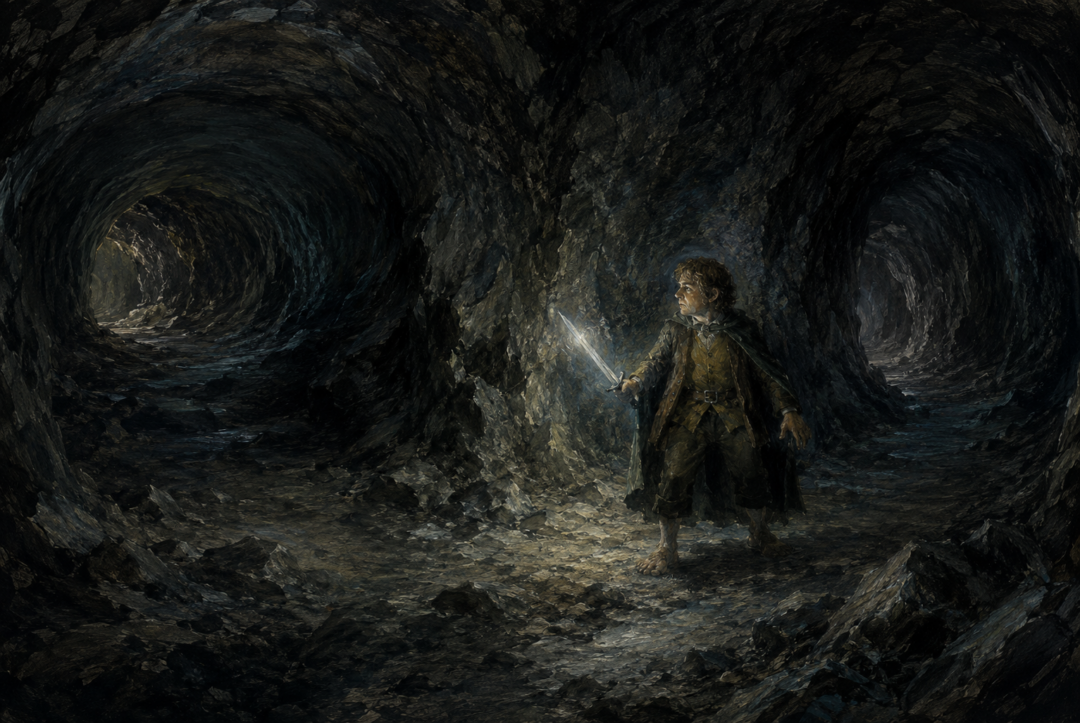
Bilbo Baggins is completely lost beneath the Misty Mountains.
He has no map of the goblin tunnels. He has been separated from Gandalf and the dwarves. He does not know which direction leads toward daylight, and the creature who knows these passages better than anyone has every reason to stop him from escaping.
Yet Bilbo gets out.
The remarkable detail in “Riddles in the Dark” is that he does not escape because he suddenly becomes an expert pathfinder. He escapes because he listens. Gollum, believing himself unseen and increasingly consumed by panic over his missing Ring, reveals the existence and direction of the goblins’ back-door. Then he unknowingly leads Bilbo toward it.
It is one of the earliest moments when Bilbo’s survival depends less on strength than on patience, observation, restraint, and the ability to understand what another creature is doing.
And immediately before reaching freedom, he makes a choice that will matter far beyond his own adventure.
Bilbo Is Lost Before He Ever Meets Gollum
The problem begins during the Company’s flight from the goblins beneath the Misty Mountains.
Bilbo is knocked unconscious and left behind. When he wakes, he is alone in complete darkness. Gandalf is gone. Thorin and the other dwarves are gone. Bilbo does not know where he is.
There is no convenient route marked for him.
This matters because maps play an important role elsewhere in The Hobbit. Thrór’s Map gives Thorin’s Company crucial information about the Lonely Mountain and its secret door. Elrond is able to read the Moon-letters that reveal how that door may be opened.
Under the Misty Mountains, Bilbo has nothing comparable.
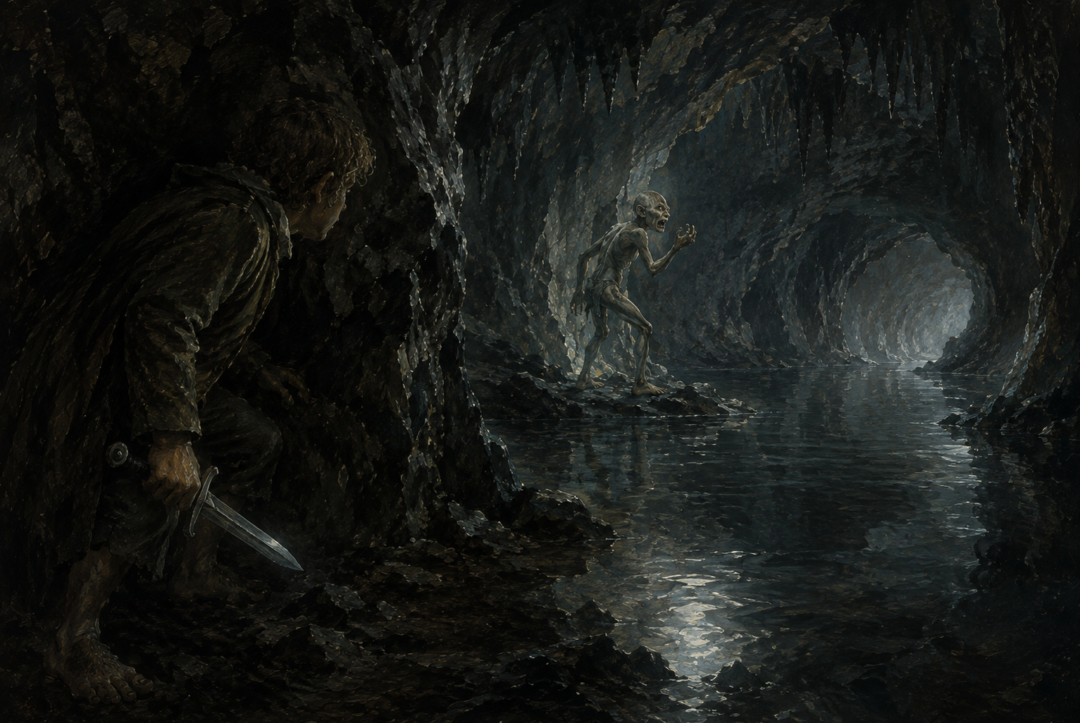
He begins moving through the darkness and eventually reaches the underground lake inhabited by Gollum. By this point, his problem is no longer simply surviving the goblins. He needs someone who actually knows the underground world.
Gollum does.
That makes their riddle-game more than an exchange of clever questions. Bilbo needs knowledge.
The Original Bargain Is Supposed to Solve the Problem
In the revised form of the chapter familiar to modern readers, Gollum proposes that if Bilbo wins their contest, Gollum will show him the way out. If Gollum wins, he intends to eat Bilbo.
Bilbo therefore has a potential guide.
After a series of riddles, Bilbo finally asks what he has in his pocket. It is not really a traditional riddle, and Gollum objects, but the contest proceeds. Gollum cannot answer correctly.
The thing in Bilbo’s pocket is, of course, the Ring.
Bilbo himself does not yet understand what he has found.
Gollum does.
When Gollum goes back to his island and discovers that his “precious” is missing, the entire situation changes. His desire to recover the Ring overwhelms the earlier game. He suspects that Bilbo has found it.
Bilbo is now in greater danger than before.
But Gollum’s obsession also gives Bilbo something almost as valuable as the Ring itself: information.
Gollum Accidentally Reveals the Escape Route
Once Bilbo discovers that the Ring makes him invisible, he is able to remain near Gollum without being seen.
That allows him to overhear Gollum arguing with himself.
Gollum knows that Bilbo had admitted being lost. Yet he begins reasoning that perhaps the hobbit was deceiving him. If Bilbo knows some way into the tunnels, Gollum thinks, perhaps he also knows a way out.
His conclusion is crucial.
Bilbo must be heading for the back-door.
This is the moment when Bilbo effectively learns how he can escape the Mountain.
Not from a map.
Not from Gandalf.
Not through his own knowledge of the tunnels.
He learns it from the creature hunting him.
Gollum is terrified that Bilbo will reach the goblins while carrying the Ring. If the goblins obtain it and discover its power, Gollum believes that his own safety will be destroyed. So he rushes toward the back-door in an attempt to intercept Bilbo.
He does not realize that the invisible Bilbo is following him.
The hunter becomes the guide.
Bilbo Does Not Memorize the Mountain — He Follows the One Who Has
The distinction is important.
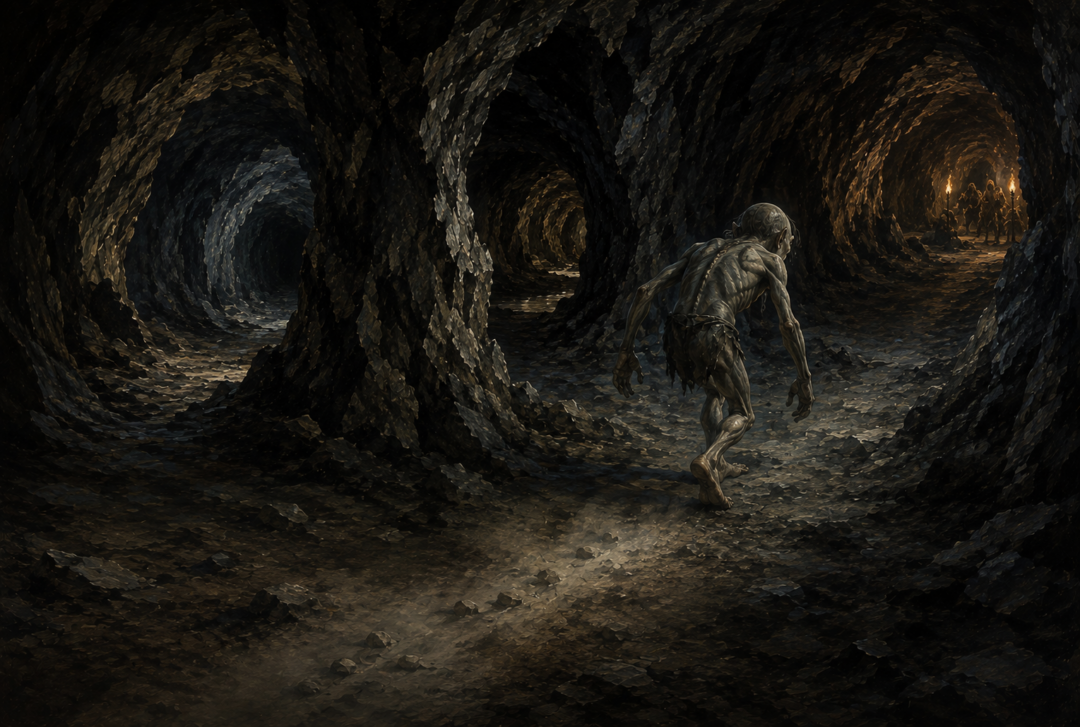
Bilbo never suddenly understands the entire goblin tunnel system. Gollum does.
As Gollum moves through the passages, he keeps track of turns. The text gives fragments of his route-counting as he travels farther from his underground lake and toward the exit.
Bilbo simply follows.
This fits a pattern that increasingly defines him throughout The Hobbit. His greatest successes rarely come from overpowering his enemies. He notices things. He listens. He improvises.
Later, he will discover how to rescue the dwarves from the Elvenking’s halls by studying the routines around him. At the Lonely Mountain, he will notice something important about Smaug that the dragon does not realize he has revealed.
Here beneath the Misty Mountains, that skill is still developing.
Bilbo survives because he lets Gollum’s knowledge solve the problem that Bilbo himself cannot solve.
Eventually Gollum reaches a low opening and identifies it as the passage toward the back-door.
Bilbo now knows where freedom lies.
Unfortunately, Gollum is sitting directly in his path.
The Way Out Leads Through Gollum
This is where the escape becomes something more than navigation.
Bilbo is invisible. He has Sting. Gollum cannot see him.
Bilbo considers killing him.
From a purely practical perspective, violence would appear to solve the immediate problem. Gollum is blocking the passage, and Bilbo desperately wants to escape. Yet Bilbo recognizes the terrible imbalance between them. Gollum has no sword and cannot see his opponent.
Then Bilbo experiences pity.
He imagines, however briefly, the misery of Gollum’s existence: endless darkness, isolation, cold stone, and a life stripped of ordinary hope.
Bilbo does not know Gollum’s full history. At this point he cannot possibly understand the enormous consequences attached to the creature before him.
He simply chooses not to kill him.
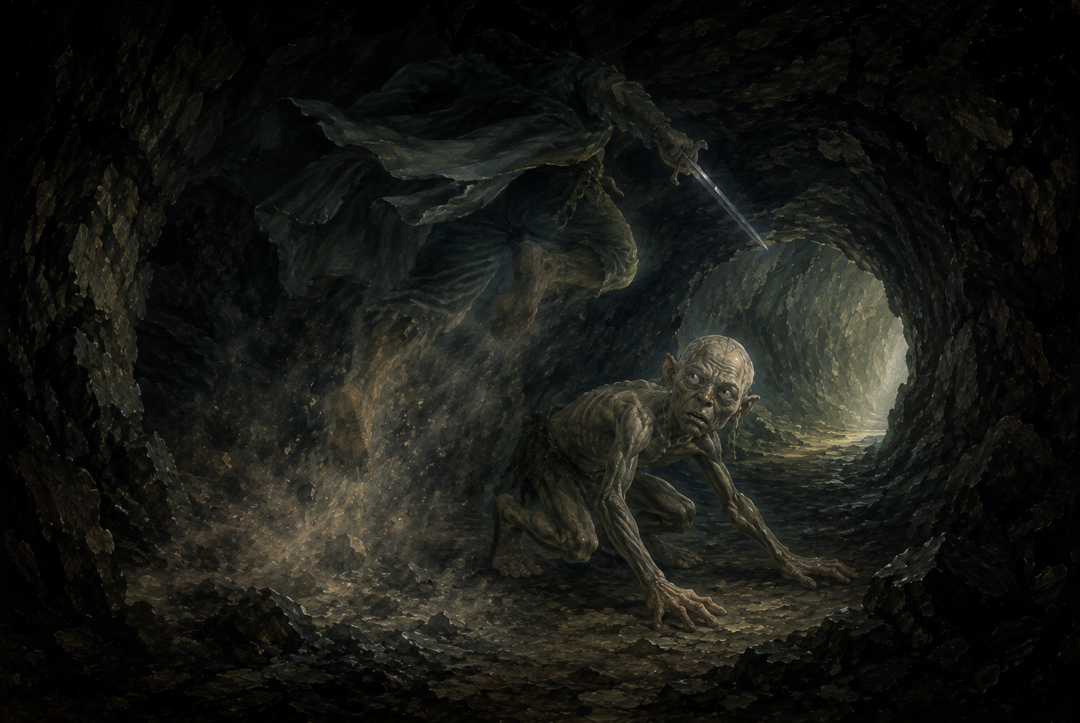
Instead, Bilbo leaps over Gollum and runs down the passage.
The physical route out of the Mountain has been found through Gollum’s knowledge.
The moral route out passes over him rather than through his death.
The Ring Helps Bilbo Escape — But It Does Not Make the Choice for Him
It would be easy to reduce the episode to a magical escape: Bilbo finds an invisibility ring and therefore gets away.
But that misses most of what actually happens.
The Ring allows Bilbo to follow Gollum unseen. It gives him an enormous advantage against the goblins. Yet the Ring does not tell him which tunnels to take. Gollum provides that knowledge.
Nor does invisibility decide what Bilbo should do when Gollum blocks the passage.
Bilbo could exploit his advantage and attack.
He refuses.
That distinction becomes especially significant when The Hobbit is read alongside The Lord of the Rings. Gandalf later identifies Bilbo’s pity in sparing Gollum as profoundly important. Frodo will eventually face the consequences of that mercy.
At the time, however, Bilbo knows none of this.
That is precisely why the moment matters. He does not spare Gollum because someone has shown him the future. He does it because, in the darkness, he recognizes the misery of another living creature.
Finding the Passage Is Not the Same as Escaping
Even after Bilbo gets past Gollum, he is not safe.
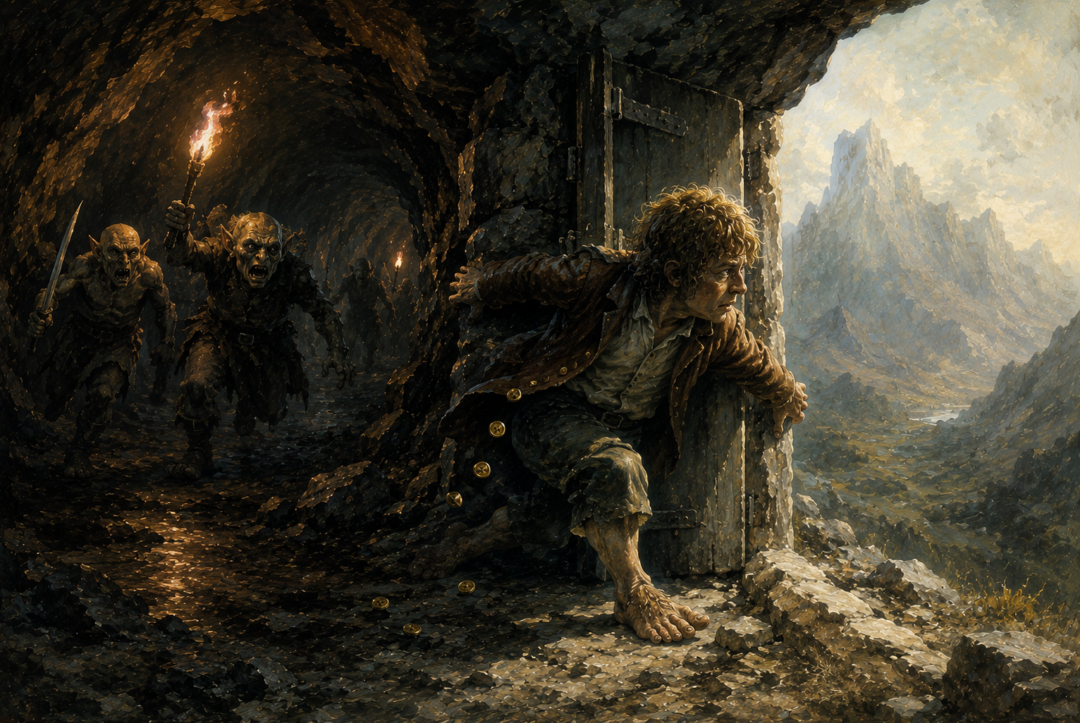
He follows the passage until he begins to see daylight coming through a doorway. But goblins are guarding the exit.
His strange new treasure again becomes essential.
Bilbo uses the Ring’s invisibility to evade the guards and reach the door. Even then, the escape is painfully physical rather than elegant. The opening is narrow enough that he struggles to squeeze through, and the brass buttons on his coat become caught.
The goblins notice evidence that someone is at the doorway.
Bilbo tears himself free, leaving buttons behind, and finally emerges into daylight on the eastern side of the Misty Mountains.
He has no idea where the dwarves are.
But he is outside.
The hobbit who woke alone beneath the mountains has found his own way back into the world.
Gollum Gives Bilbo Two Things Without Meaning To
Bilbo enters Gollum’s world possessing neither the Ring nor a route to freedom.
He leaves with both.
That parallel is one of the most striking features of the chapter.
Gollum does not willingly give Bilbo the Ring in the version of the story incorporated into The Lord of the Rings. Bilbo finds it after Gollum has lost it.
Likewise, Gollum does not willingly guide Bilbo safely out. His fear that Bilbo is escaping with the Ring causes him to hurry toward the very passage Bilbo needs.
In both cases, Gollum’s loss becomes Bilbo’s opportunity.
Yet Bilbo does not leave the encounter merely as a thief who has outwitted a weaker creature. At the decisive moment, when killing Gollum would make escape easier, he refuses.
That prevents the chapter from becoming a simple victory of cleverness.
Bilbo wins, but he also shows mercy.
The Hobbit Who Emerges Is Already Changing
When Bilbo later rejoins the dwarves, he astonishes them by appearing without assistance. His successful escape contributes to the Company’s growing realization that their supposedly unlikely burglar is far more capable than they had expected.
But the deeper change has already happened underground.
Bilbo has been separated from every protector he possessed. Gandalf cannot rescue him. Thorin cannot command a way forward. No dwarf can fight for him.
He has to listen, think, decide, and act alone.
He does not escape the Misty Mountains because he knows the road.
He escapes because he recognizes who does.
Gollum’s obsession reveals the back-door. The Ring allows Bilbo to follow. His courage carries him toward the goblin guards. And his pity determines how he passes the last creature standing between him and freedom.
That combination is what makes “Riddles in the Dark” so important.
Bilbo enters the darkness as a lost hobbit looking for a way out.
He emerges having discovered something much more useful than a map: the ability to find a path when no path has been given to him.
Sources & Notes
- https://www.encyclopedia-of-arda.com/b/bilbobaggins.php — The Encyclopedia of Arda: Bilbo Baggins (his separation beneath the Misty Mountains, riddle-game, and escape).
- https://www.encyclopedia-of-arda.com/g/gollum.php — The Encyclopedia of Arda: Gollum (his underground life, loss of the Ring, and pursuit that inadvertently guides Bilbo).
- https://www.encyclopedia-of-arda.com/g/goblintown.php — The Encyclopedia of Arda: Goblin-town (the tunnel complex and concealed back-door through which Bilbo escapes).
- https://www.encyclopedia-of-arda.com/o/onering.php — The Encyclopedia of Arda: One Ring (the invisibility that lets Bilbo follow Gollum and the pivotal choice not to kill him).
Sources checked for relevance and availability.