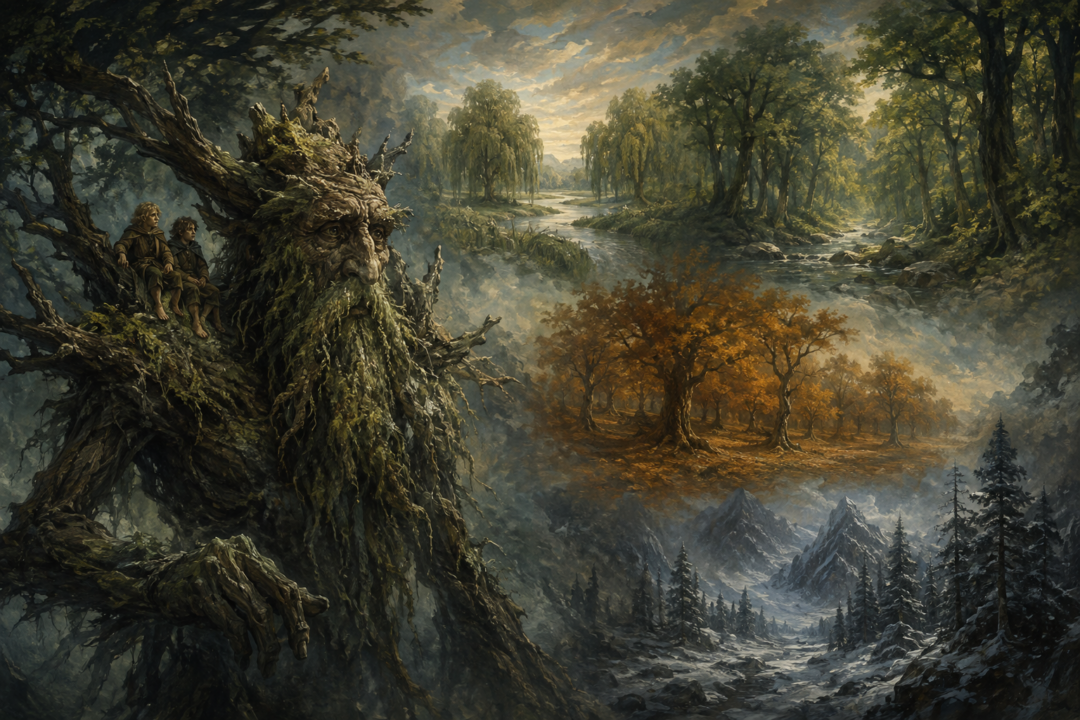
When Merry and Pippin meet Treebeard in Fangorn, one of the strangest things about him is not his size, his age, or even the fact that he can speak. It is the way he remembers.
Treebeard does not remember the Elder Days as a sequence of kings and battles. He remembers willow-meadows, elm-woods, beech forests, pine-covered highlands, rivers, seasons, smells, wind, and the quality of the air. Even his ancient lore of living creatures classifies beings through characteristic places and behaviors: eagles belong to eyries, oxen to pasture, Dwarves to their delvings.
Taken together, these lists, songs, and recollections preserve something rare in Middle-earth: fragments of environments that no longer exist.
Treebeard is therefore more than a witness to lost history. He is a surviving memory of lost habitats.
The Long List Is a Map of Relationships, Not Just Names
In The Two Towers, Treebeard tries to identify Merry and Pippin through an ancient piece of Entish lore: the Long List of living creatures.
He learned it when he was young, which makes its tradition extraordinarily old. Its surviving portion begins with the Free Peoples and moves through animals. Beaver, bear, boar, hare, eagle, ox, hart, hawk, swan, and serpent all appear.
The text does not give us the complete Long List, so it would be unsafe to claim that Treebeard possessed a comprehensive catalogue of every plant and ecosystem in Arda. We are never shown such a botanical inventory.
Yet the form of the list matters.
Creatures are often identified through what they do or where they belong. The beaver builds. The eagle occupies the eyrie. The ox stands in pasture. Even the Free Peoples are described through characteristic modes of life: the Dwarf delves, while Man is associated with horses.
This is classification through relationship.
Treebeard does not divide life from landscape as neatly as a modern catalogue might. Creatures are remembered together with their habits, dwellings, and environments. The Long List therefore hints at an Entish way of knowing the world: to know a living thing is partly to know the conditions in which it lives.
That becomes much clearer when Treebeard begins remembering trees.
His Memories of Beleriand Are Almost Ecological Records
While carrying the hobbits through Fangorn, Treebeard recalls the immense woods of earlier ages and then sings of places he once walked.
His memories are remarkably specific.
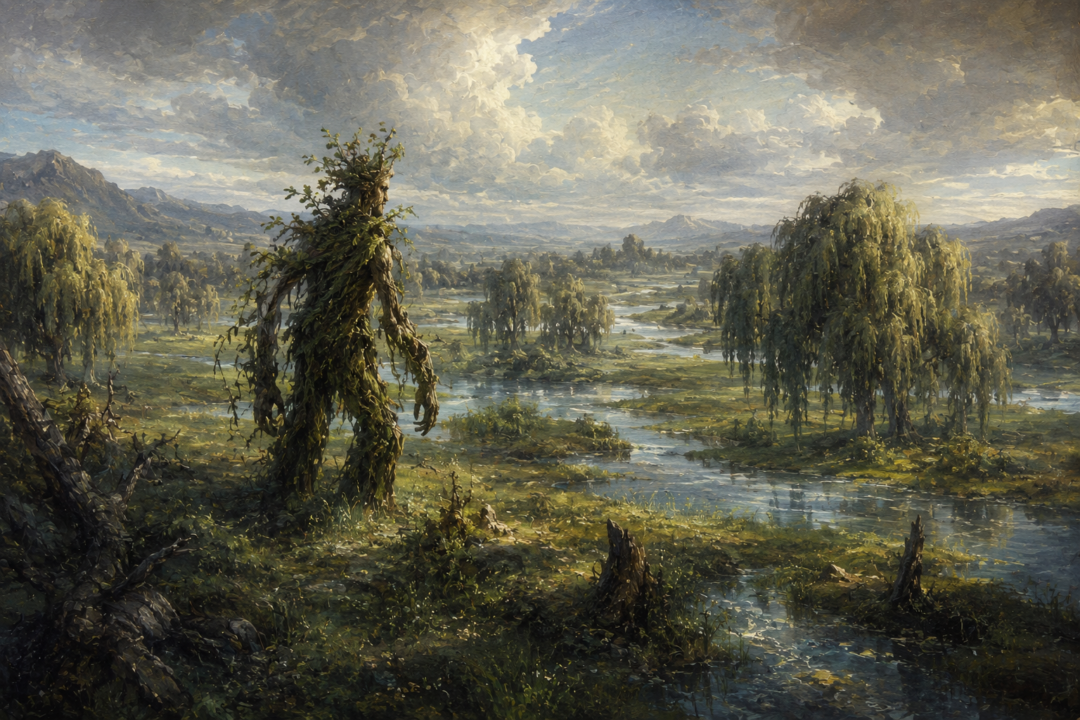
Tasarinan is remembered through willows and spring. Ossiriand through elm-woods, summer, and the Seven Rivers. Neldoreth through beeches and autumn leaves. Dorthonion through pine trees on cold highlands in winter.
These are not interchangeable fantasy forests.
Each place has a dominant tree, a terrain, a season, and a sensory identity.
Tasarinan is low and watery enough to be remembered as willow-meads. Dorthonion is elevated, windy, snowy, and pine-covered. Neldoreth becomes a place of beech leaves turning gold and red. Ossiriand is inseparable from its rivers and its summer woods.
Treebeard is effectively preserving associations between species and landscape.
The text never presents this as formal natural history. It is memory expressed as song. But that may be precisely why it is so powerful: Treebeard remembers these places as lived environments rather than coordinates on a vanished map.
The Most Important Detail Is That These Places Are Gone
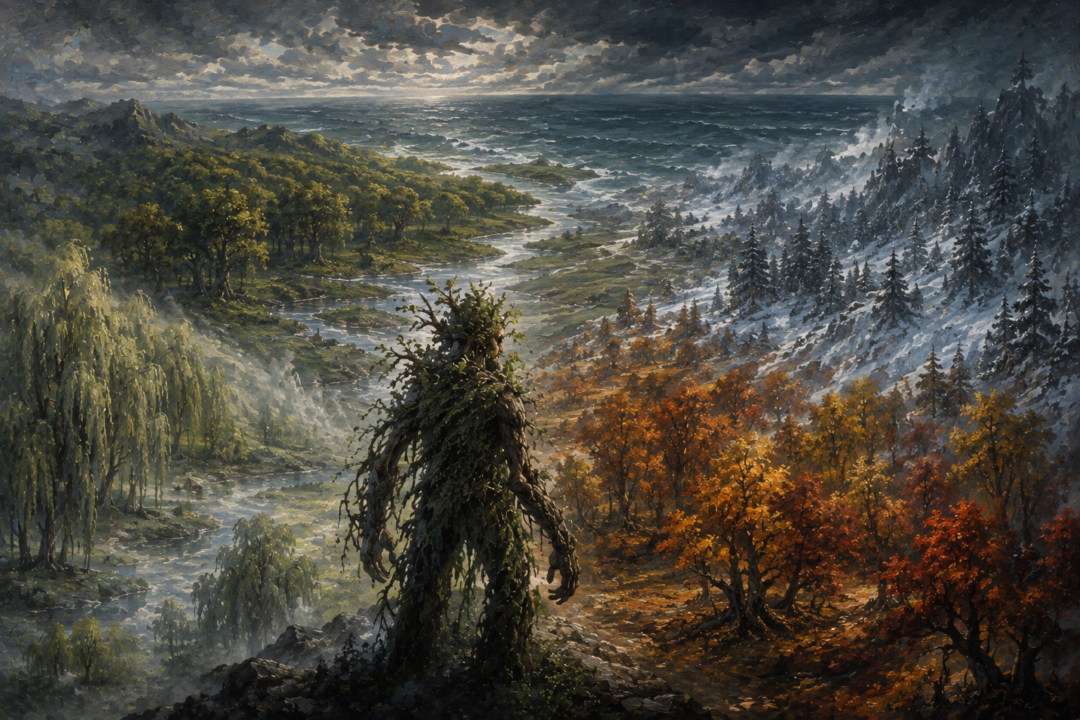
Treebeard’s song turns abruptly from abundance to loss.
The regions he has just remembered belonged to Beleriand, much of which was overwhelmed at the end of the First Age. His recollections therefore describe environments that cannot simply be revisited.
The willows of Tasarinan and the beeches of Neldoreth are not distant tourist destinations in the Third Age. The lands themselves have passed away beneath the sea.
That gives Treebeard’s tree-memory an unusual weight.
Most historical memory in Middle-earth preserves people: Túrin, Beren, Lúthien, Gondolin, Númenor, lost kings, ruined realms. Treebeard also preserves what stood around those people.
The forest has its own history of extinction and survival.
He remembers not merely that Beleriand existed, but what kinds of woodland existed within it.
For a reader in the late Third Age, that distinction matters. A map can say where Dorthonion once lay. Treebeard can remember winter moving through its black pine branches.
Fangorn Is a Refuge From a Much Larger Woodland World
Treebeard’s grief is not restricted to drowned Beleriand.
He tells Merry and Pippin that forests had once extended enormously farther across the western lands. He describes a time when woodland stretched from the region of Fangorn far toward the Mountains of Lune, with Fangorn surviving as only the eastern end of something much greater.
The precise history of every portion of that ancient forest cannot be reconstructed from Treebeard’s remarks alone. But the central point is explicit: the woodland world known to the Ents had drastically contracted.
By the end of the Third Age, Fangorn is therefore not simply an old forest.
It is a remnant.
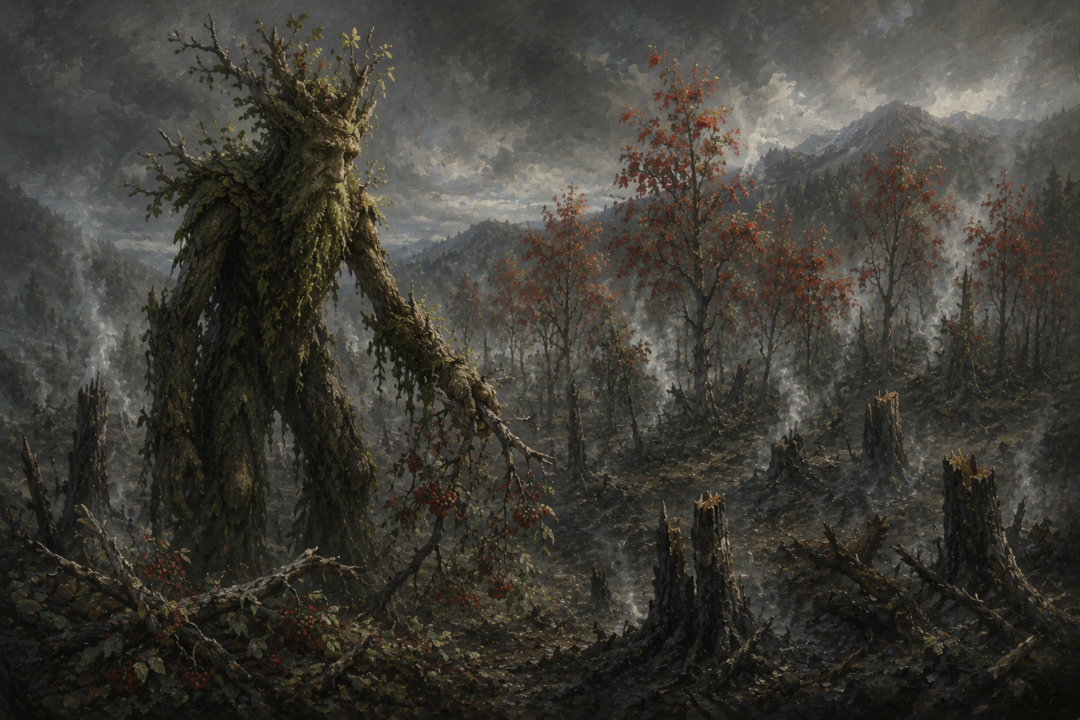
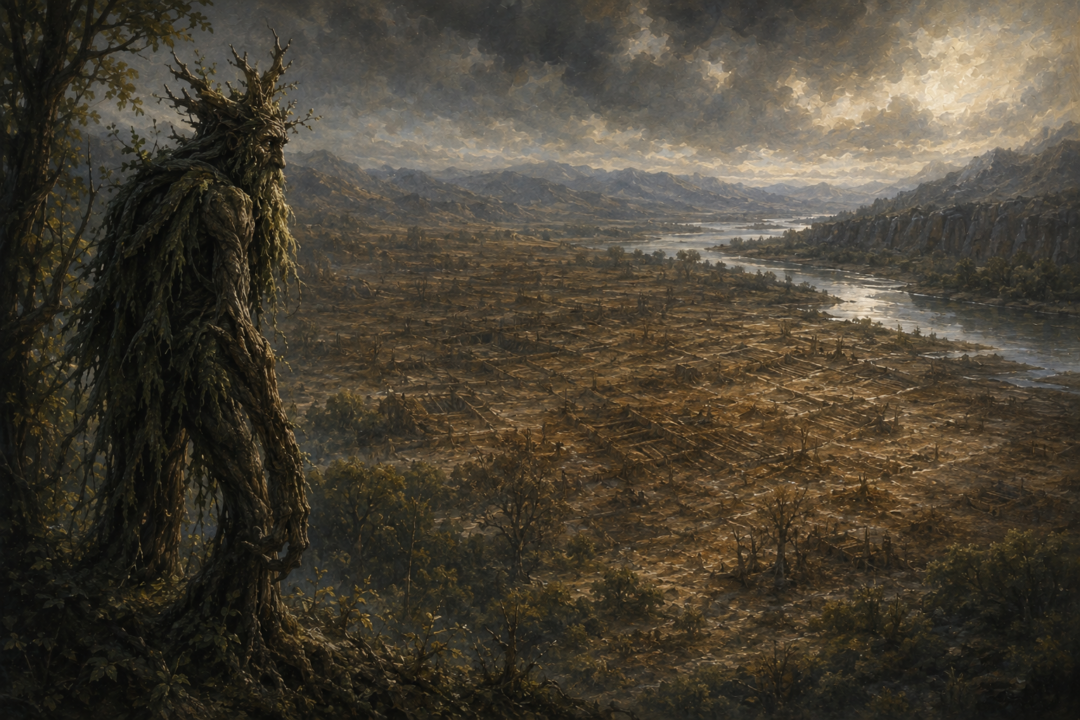
That changes the meaning of Treebeard’s protectiveness. When Saruman’s Orcs begin cutting trees around Fangorn and destroying the trees tended by individual Ents, they are damaging what remains after ages of previous loss.
The Ents are not defending limitless wilderness. They are defending fragments.
Individual Ents Preserve Smaller Habitats Too
The Ents themselves are associated with particular kinds of trees.
Quickbeam, or Bregalad, especially loves rowans. He tells Merry and Pippin of rowan-trees destroyed by Saruman’s servants near Isengard, and his unusually swift anger is bound to that loss.
Skinbark loves the birches of the mountain slopes west of Isengard. Treebeard explains that he withdrew higher into the mountains after suffering wounds and after many of the trees under his care were destroyed.
These details make Fangorn less uniform than the single word “forest” suggests.
There are rowan stands, upland birches, dark interior woods, watercourses, open dells, and trees with different Entish guardians and affinities.
One reasonable reading is that the Ents preserve a kind of place-specific memory. Their attachment is not merely to “trees” as an abstract category. Particular Ents love particular trees growing in particular parts of the landscape.
When those trees disappear, something closer to a local community disappears with them.
The Entwives Remember a Completely Different Landscape
Treebeard’s memories also preserve another vanished environment: the gardens of the Entwives.
The Ents and Entwives developed different preferences. The Ents loved the great trees and wilder forests. The Entwives became increasingly interested in smaller plants, fields, orchards, gardens, and ordered growth.
They eventually crossed the Anduin and established lands of their own. Treebeard remembers those regions as cultivated and fruitful, and Men learned from the Entwives.
But when the Ents later searched for them, their gardens had been devastated. The country became associated with the desolation later called the Brown Lands.
The ultimate fate of the Entwives is never confirmed.
That uncertainty should remain uncertainty.
What is clear is that their former habitat had been destroyed.
This creates a striking contrast within Entish memory. Treebeard remembers both enormous wild forests that contracted or vanished and cultivated landscapes that were ruined by war.
Neither wilderness nor garden is guaranteed survival.
Treebeard Remembers What Maps Cannot
Treebeard’s greatest ecological significance may lie in the kind of information his memory retains.
Maps preserve boundaries.
Chronicles preserve events.
Genealogies preserve descent.
Treebeard preserves atmosphere.
He remembers the smell of ancient woods. He remembers the sound of leaves. He distinguishes low willow country from pine-covered heights. He connects trees to seasons and creatures to characteristic places.
These details make environmental loss visible in a way that political history usually does not.
The sinking of Beleriand is not only the destruction of cities and kingdoms. It is also the disappearance of entire woodland landscapes.
Saruman’s assault on Fangorn is not only strategically dangerous. It destroys living communities already surviving at the edge of a much older decline.
The disappearance of the Entwives is not only a broken relationship between two peoples. It is tied to the destruction of the garden-country in which they had chosen to live.
The Tragedy Hidden Inside the Lists
There is a quiet irony in Treebeard’s ancient Long List.
When he meets hobbits, they are absent from it.
The old lore must be changed.
Treebeard eventually accepts them into his remembered ordering of living creatures, showing that Entish memory is ancient but not completely frozen. New knowledge can enter it.
At the same time, much of what Treebeard already remembers belongs to worlds that can never return.
That is the tension at the heart of his lists.
They can add what is newly discovered, but they cannot restore what has vanished.
By the War of the Ring, Treebeard stands inside one surviving fragment of an older Middle-earth, carrying names whose landscapes have disappeared beneath seas, axes, fire, war, and the slow contraction of the forests.
His memory therefore preserves more than species.
It preserves relationships: willow and meadow, elm and river, pine and snowy upland, beech and autumn, rowan and grieving Ent.
And through those relationships, Treebeard preserves something that almost no one else in the story can provide.
He remembers not merely what the lost world was called.
He remembers what it was like to live there.
Sources & Notes
- https://www.encyclopedia-of-arda.com/t/treebeard.php — The Encyclopedia of Arda: Treebeard (the ancient Ent whose songs and memories preserve forests across multiple ages).
- https://www.encyclopedia-of-arda.com/f/fangornforest.php — The Encyclopedia of Arda: Fangorn Forest (the surviving remnant of once-vast western woodlands).
- https://www.encyclopedia-of-arda.com/b/beleriand.php — The Encyclopedia of Arda: Beleriand (the drowned First Age lands containing the habitats Treebeard remembers).
- https://www.encyclopedia-of-arda.com/d/dorthonion.php — The Encyclopedia of Arda: Dorthonion (the pine-covered highlands recalled in Treebeard’s seasonal song).
Sources checked for relevance and availability.