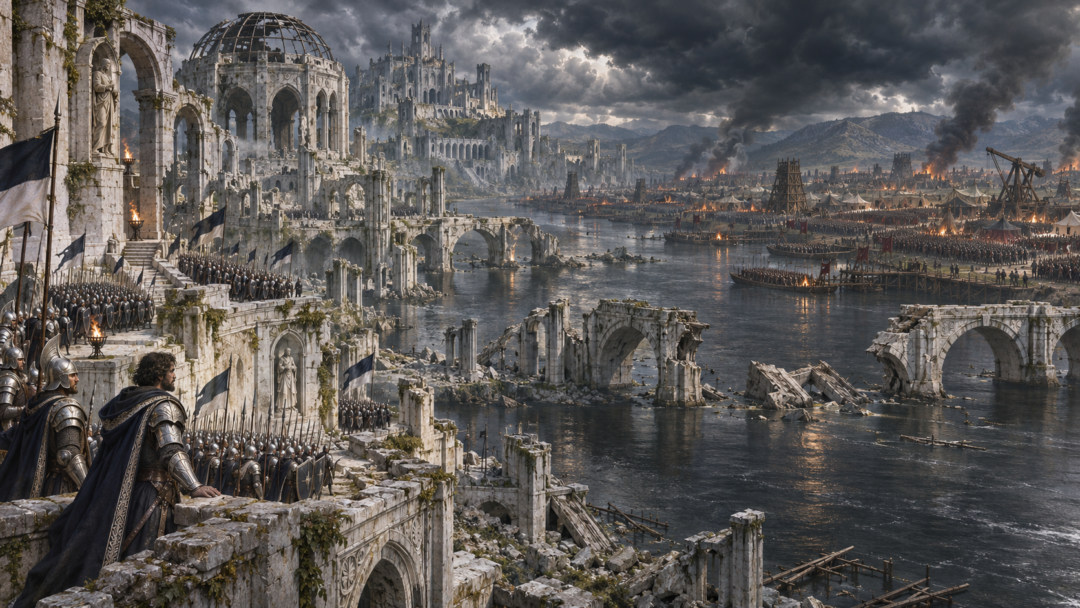
Faramir was sent to defend one of Gondor’s most important river crossings as Mordor prepared its decisive assault. He knew the danger: he had already explained why the defense could fail even if Gondor’s soldiers fought exceptionally well.
But how many men did he command at Osgiliath, and how badly were they outnumbered?
**Tolkien never gives an exact number for Faramir’s force at Osgiliath, but explicitly describes him as ten times outnumbered during the subsequent retreat.** Peter Jackson’s film presents a different mission, with specific figures in its screenplay that cannot be transferred to the novel. The key is to distinguish the city’s garrison, Faramir’s reinforcements, the retreating companies, and the film’s cavalry.
Osgiliath Was Already a Contested City
Once Gondor’s capital, Osgiliath was by the War of the Ring a ruined city divided by the Anduin. It remained strategically vital because its crossing controlled a major approach to Minas Tirith. Gondor held the western side, while the eastern side was exposed to Mordor. The ruins had been fought over before; this was no intact city awaiting its first invasion.
In *The Fellowship of the Ring*, Book II, Chapter 2, ‘The Council of Elrond,’ Boromir recalls an earlier attack. He and Faramir fought to defend Osgiliath, and the bridge was destroyed to prevent the enemy from using the crossing. Both brothers survived, but Gondor’s position remained precarious.
By March 3019, Sauron’s armies needed to cross the Anduin in strength and advance across the Pelennor toward Minas Tirith. Denethor would not surrender the river and outer defenses without resistance. Delay might allow Minas Tirith to prepare or Rohan’s reinforcements to arrive. The dispute was how many scarce Gondorian soldiers that delay was worth.
Faramir Had Already Warned Denethor
In *The Return of the King*, Book V, Chapter 4, ‘The Siege of Gondor,’ Denethor insists that the enemy must pay heavily to cross the river. He expects Osgiliath to be the main attack point and refuses to abandon the forward defenses without fighting.
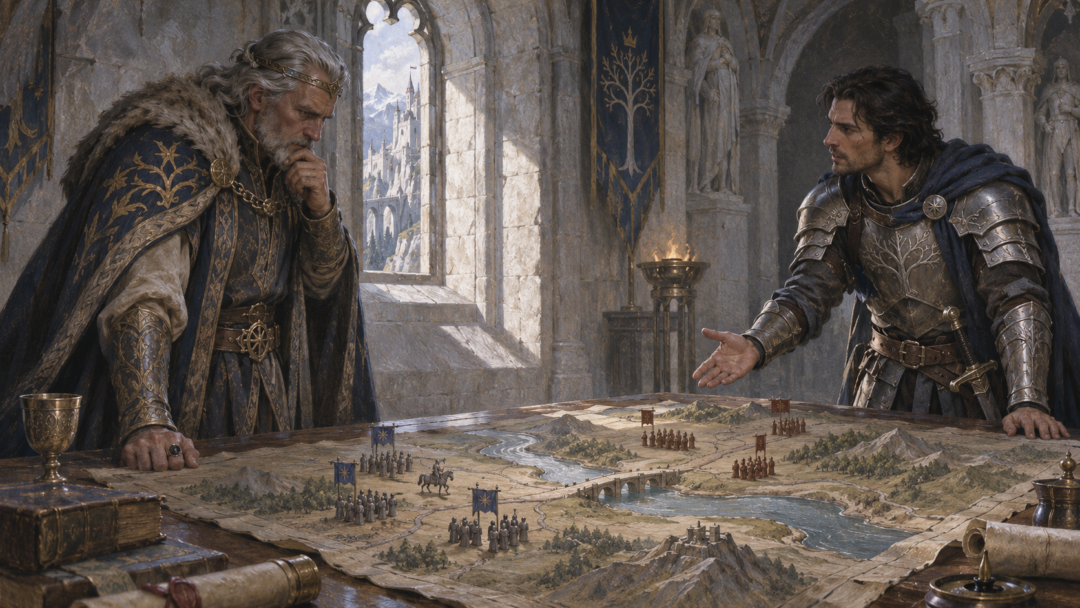
Faramir questions the calculation, not Gondor’s need for defense. Even a favorable exchange of casualties might hurt Gondor more: Sauron could replace an army more readily than Gondor could replace one company. It is the assessment of a commander who knows that vastly unequal reserves make each casualty count differently.
Their exchange is also personal. Denethor has expressed disappointment in Faramir, and Boromir’s death hangs over them. But Faramir is not seeking an excuse to avoid danger. He foresees another risk: if Mordor forces the crossing, defenders far ahead of Minas Tirith may be pursued across open ground by a much larger army.
Denethor orders him to command the defense, and Faramir obeys despite his objections. The narrative says he takes such strength as can be spared and is willing to accompany him, **without identifying a headcount**. Tolkien describes available troops, not a numbered expedition.
How Many Gondorian Soldiers Were There?
The novel never supplies a definitive total. A garrison already guarded Osgiliath; Faramir brought additional men; and other reinforcements were in motion. Earlier in Book V, Chapter 4, Faramir reports that he sent the remainder of his company south to reinforce Osgiliath while he rode to Minas Tirith with three companions. Thus the defenders were not necessarily just the men who accompanied him after Denethor sent him back.
Nor can the strength of Faramir’s Ithilien company stand for the whole garrison. His Rangers were a distinct force operating behind enemy lines, while the Osgiliath defense involved a wider organization. Tolkien never totals the existing garrison, previously dispatched reinforcements, and troops sent under Faramir’s command.
A hypothetical **500, 1,000, or 2,000 Gondorians** can illustrate the arithmetic, but none is established as the force’s actual strength. The evidence indicates a substantial defense, not a reliable roster. Even the wording about men who could be spared and would accompany Faramir leaves open how many were already stationed at the river and how those detachments were organized. Counting only the men dispatched from Minas Tirith would overlook the soldiers defending the crossing before he arrived.
Tolkien Does Give the Enemy’s Advantage
After Mordor captures the river passage, word reaches Minas Tirith that Faramir is withdrawing and trying to rally his men at the Causeway Forts, near the wall enclosing the Pelennor. Tolkien then describes him as **ten times outnumbered**: approximately ten enemies for every Gondorian during that fighting retreat.
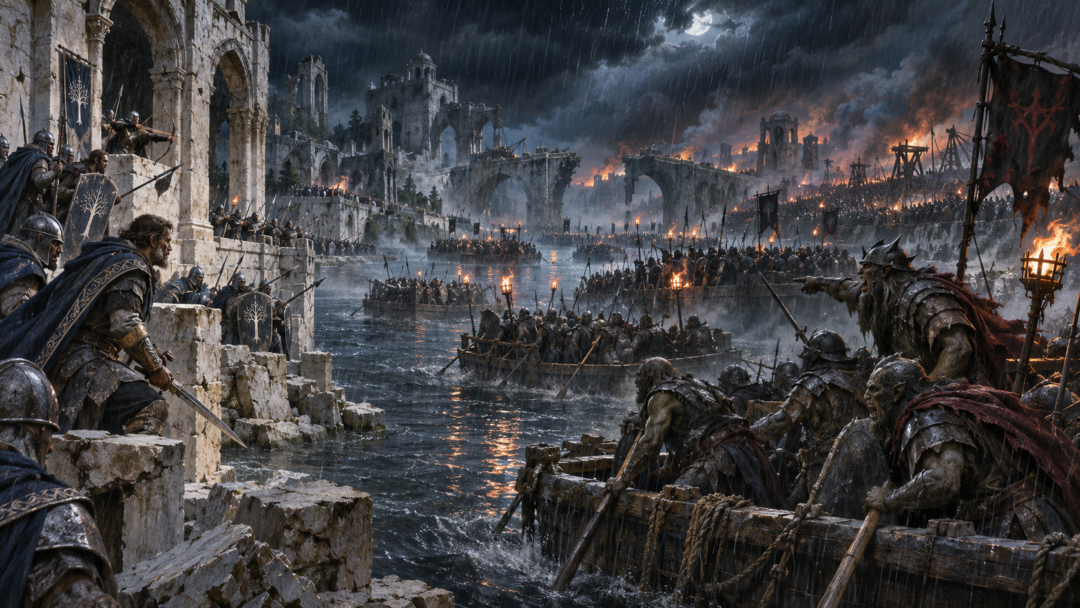
If Faramir commanded 500 men, the ratio would imply about 5,000 enemies; if he commanded 1,000, about 10,000. **These are arithmetic illustrations, not historical troop counts.** The ten-to-one statement comes after the passage falls; Tolkien does not separately quantify the balance at the battle’s opening or at every position within ruined Osgiliath. It describes the retreat situation, not an exact battlefield census. The phrase is still unusually informative: while the precise Gondorian total is absent, readers can establish the order of magnitude of the enemy advantage without relying on a fan estimate or importing a film figure.
Mordor Had More Than Numerical Superiority
A messenger reporting the defeat says Mordor secretly prepared numerous floats and barges in eastern Osgiliath, enabling troops to cross the Anduin in greater numbers than Gondor hoped to contain. The assault also drew on forces from Minas Morgul and regiments of Haradrim from the south. It was a coordinated operation, not simply a disorganized mass of Orcs.
The Witch-king commanded it. His supernatural terror spread ahead of him, eroding resistance even among soldiers who might otherwise have stood. Alongside the ten-to-one disadvantage, Mordor possessed prepared crossing equipment, multiple supporting forces, and a commander capable of shattering morale.
Faramir’s warning was realized: once the crossing fell, his men faced pursuit across exposed country. Their objective changed from holding Osgiliath to preserving enough soldiers to help defend Minas Tirith.
How Many Men Did Faramir Lose?
When Faramir’s companies finally return to Minas Tirith, Tolkien says he has **lost one-third of his men**. Roughly two-thirds therefore remained with the returning companies, but the account does not specify how many had died, been wounded, captured, or otherwise lost. Wounded soldiers had also been evacuated separately. The one-third figure must not be presented as a precise death toll. A diminished company might include men missing from its ranks for different reasons, and the narrative gives no table separating those categories. Even a perfectly known percentage would not distinguish killed from wounded without additional evidence.
Nor should all these losses be assigned to fighting inside Osgiliath. The collapse of the forward defense involved the Causeway Forts, the Rammas Echor, and the withdrawal across the Pelennor. The percentage covers the campaign and retreat culminating in the surviving companies’ return. Without their starting strength, it cannot yield a total number of casualties.
Taken together, Tolkien’s ten-to-one disadvantage and one-third loss show how unequal and costly the operation became, but neither reveals how many men initially defended the crossing.
Faramir’s Retreat Was Not a Cowardly Flight
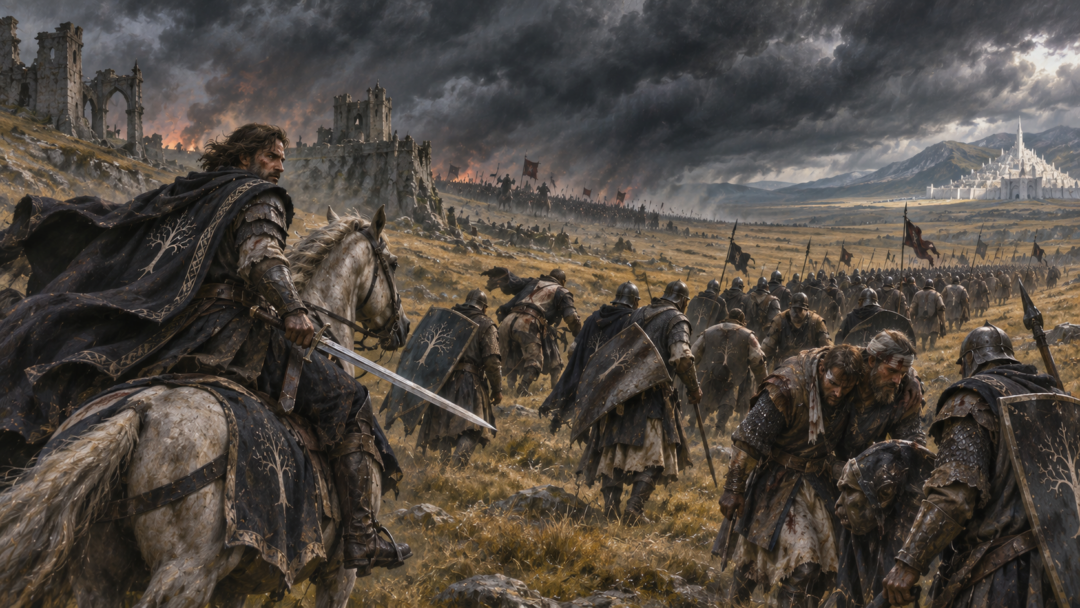
The novel portrays Faramir’s final actions differently from the film. He stays with the rearguard because he fears the retreat across the Pelennor may become a rout. Under pursuit, disengaging troops must maintain formation; if their rearguard collapses, the retreat can dissolve into isolated fugitives. Faramir endangers himself to prevent that.
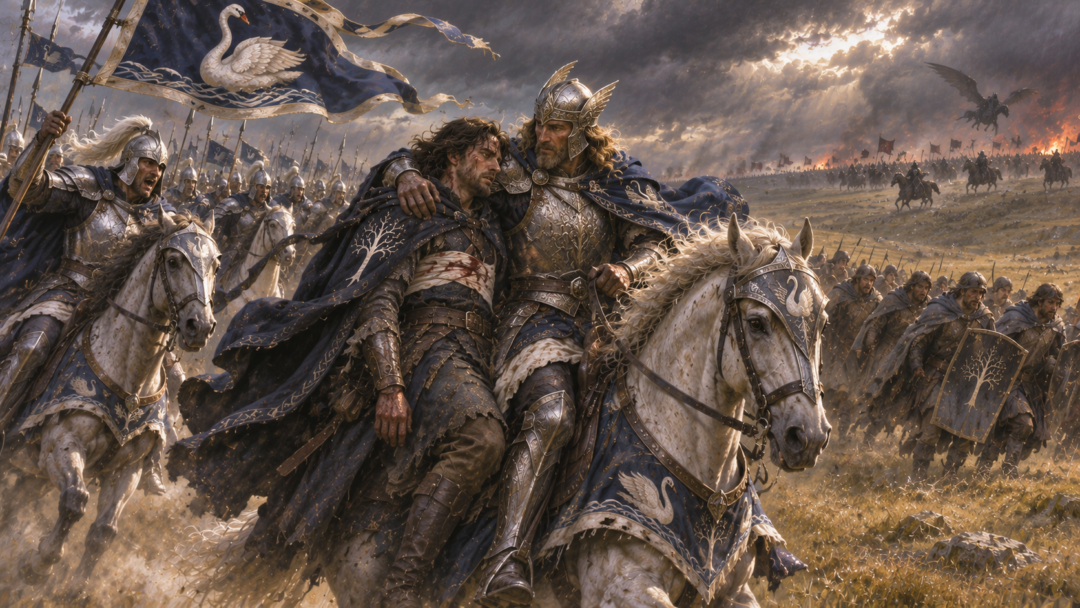
Gandalf sees the danger and rides to help. Prince Imrahil also leads the knights of Dol Amroth into battle, checking the pursuit long enough for the diminished Gondorian companies to reach Minas Tirith.
Faramir is struck by a missile while fighting a mounted warrior of Harad. Imrahil rescues him and brings him back to the city. Tolkien’s emphasis is not a spectacular attack against overwhelming archers, but a commander protecting his men after the original mission has failed. His force suffers terribly, yet it is not annihilated. The assistance of Gandalf and Imrahil matters to the outcome: Faramir does not single-handedly halt Mordor, but his effort to hold the withdrawal together enables others to intervene and helps prevent a defeat at the river from immediately destroying the remaining defenders.
The Film Gives a Different Numerical Picture
Peter Jackson’s *The Return of the King* compresses and rearranges these events. Faramir is driven out of Osgiliath and returns to Minas Tirith. Denethor then orders him to retake the city, and Faramir leads a seemingly hopeless cavalry charge against prepared Mordor defenses.
The **October 2003 screenplay revision, pages labeled 59–61**, specifies **200 mounted knights** riding under Faramir toward Osgiliath and **5,000 Orc archers** waiting among the ruins. That is **25 archers per rider** in the screenplay’s described confrontation.
But the 200 represent the film’s cavalry, not Tolkien’s entire Osgiliath garrison. The 5,000 are archers in that scene, not a verified total for all Mordor’s troops at the crossing. And screenplay numbers document the production’s written conception; the finished film supplies no on-screen military census independently confirming them. These figures explain the cinematic charge, not the novel’s unspecified force strength.
Why the Difference Matters
The film concentrates Denethor’s disastrous judgment into a single image: a small cavalry force riding toward a ruined city packed with enemy archers while Denethor stays behind. The novel develops the military dilemma more fully.
Denethor has a genuine strategic rationale. Osgiliath guards access to the Pelennor; yielding it without a fight would expose Minas Tirith earlier. Faramir agrees that Gondor must resist but doubts that sacrificing irreplaceable soldiers can purchase enough time to justify the price.
The result vindicates his warning. Gondor inflicts losses, yet Mordor forces the passage, drives the defenders backward, and reduces Faramir’s companies by a third. Courage cannot eliminate an enormous disparity in resources. The ten-to-one figure explains why even brave resistance could become ruinously expensive.
Once the crossing is lost, Faramir’s responsibility shifts. Preserving the survivors becomes his achievable success, and his decision to remain in the rearguard gives that responsibility its clearest expression.
What Can We State With Confidence?
**In Tolkien’s novel, Faramir’s exact Osgiliath headcount is unknown.** During the subsequent retreat toward the Causeway Forts, he is **outnumbered ten to one**; by the time his surviving companies return to Minas Tirith, he has **lost one-third of his men**. Neither figure fixes the army’s starting size or an exact death toll.
The film screenplay instead describes **200 mounted knights facing 5,000 Orc archers**, a 25-to-1 ratio for that cinematic confrontation alone. It cannot fill the novel’s numerical gap.
Faramir’s story turns less on an exact count of swords and spears than on his foresight. He warned Denethor that Mordor’s superiority could make even courageous resistance devastating; the defeat proved him right. When the crossing fell, he stayed behind to prevent the retreat from becoming a still greater catastrophe.
Sources
• J.R.R. Tolkien, *The Fellowship of the Ring*, Book II, Chapter 2, ‘The Council of Elrond’ — Boromir’s account of the earlier defense of Osgiliath. • J.R.R. Tolkien, *The Return of the King*, Book V, Chapter 4, ‘The Siege of Gondor’ — Denethor’s orders, Faramir’s warning, the ten-to-one disadvantage, and the one-third loss. [Book text reference](https://bookwise.io/j-r-r-tolkien/the-lord-of-the-rings-volume-3). • *The Lord of the Rings: The Return of the King*, October 2003 screenplay revision, pages labeled 59–61 — the 200 knights and 5,000 Orc archers. [Screenplay PDF](https://assets.scriptslug.com/live/pdf/scripts/the-lord-of-the-rings-the-3-return-of-the-king-2003.pdf). • [The Thain’s Book: Faramir](https://thainsbook.minastirith.cz/faramir.html) — supporting chronology of the Osgiliath defense and retreat.
Sources & Notes
This article is based on close reading and interpretation of Tolkien's published works and related source material where relevant.