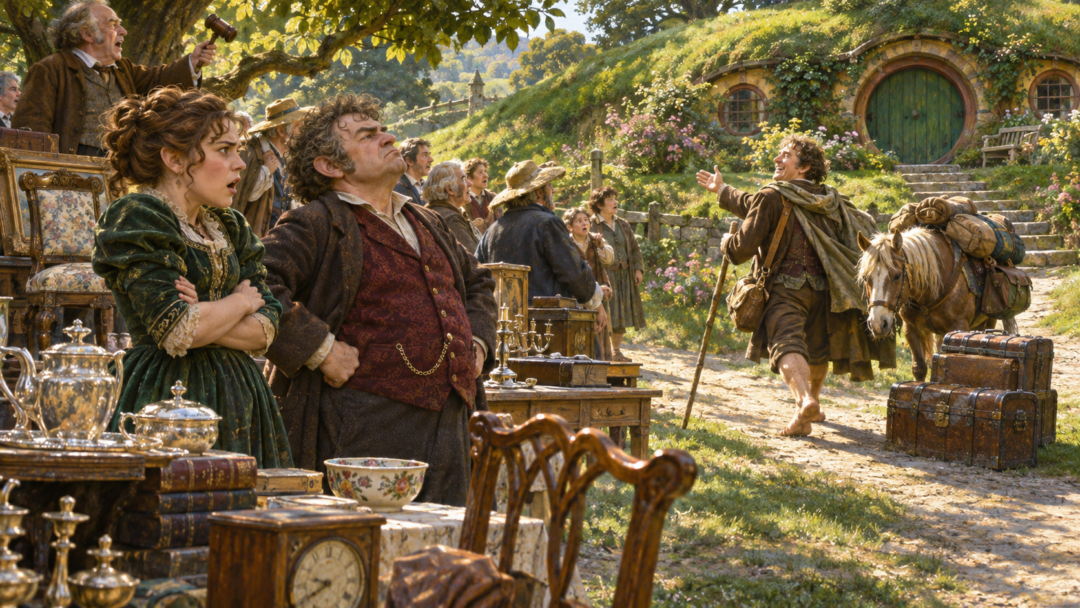
Lobelia Sackville-Baggins spent most of her life trying to acquire a house that already had an owner. Not just any house, either. Bag End was one of the most desirable homes in Hobbiton, and its owner, Bilbo Baggins, showed an irritating determination to remain alive.
It is tempting to imagine Lobelia as a jealous little girl, looking up at the grand hobbit-hole on the Hill and deciding that one day it would be hers. There is just one problem: Tolkien never tells us that story.
**The stronger explanation is that Lobelia’s obsession grew from a combination of social ambition, an expected inheritance, and the humiliation of repeatedly losing something she believed her family ought to possess.** Bag End was valuable property, but it also represented a particular kind of respectability. For the Sackville-Bagginses, owning it would mean taking their place at the center of respectable Hobbiton society.
And once that prospect had been snatched away, acquiring Bag End became personal.
Was Lobelia actually a child when it began?
The dates matter because they change the story considerably.
Lobelia was born in Third Age 2918, while Bilbo was born in 2890. When Bilbo departed on his adventure with Thorin’s company in 2941, Lobelia was approximately twenty-three years old. By hobbit standards, that was still before adulthood, which arrived at thirty-three. Tolkien calls the years between childhood and coming of age the ‘tweens.’
So Lobelia was young when the original inheritance dispute developed, but not a small child. There is no canonical account of her childhood visits to Bag End, no recorded promise that it would someday belong to her, and no explanation of an early psychological attachment to the house.
The familiar idea that she coveted Bag End from childhood is therefore an interpretation, not an established fact. Her desire may have developed earlier, but the books do not say so.
What Tolkien does establish is much more interesting: Lobelia and her husband, Otho Sackville-Baggins, believed they had a serious prospect of inheriting Bilbo’s property. Then Bilbo made the spectacular mistake of coming home.
The inheritance that nearly happened
In The Hobbit, Bilbo returns from the Lonely Mountain to discover that his possessions are being auctioned. He has been presumed dead, and the Sackville-Bagginses are among those expecting to benefit from the disappearance.
Bilbo’s arrival ruins the entire arrangement.
The comedy is magnificent because it rests on an understandable grievance attached to rather unpleasant behavior. Imagine believing that a desirable family property is finally about to become yours, only to see the supposedly deceased owner walking up the road with luggage.
Bilbo has every right to reclaim his home. The Sackville-Bagginses have no right to treat his survival as an inconvenience. Nevertheless, from their perspective, the future they had been preparing for suddenly vanishes.
That disappointment supplies a concrete beginning for the feud. There is no need to invent a childhood incident involving Lobelia staring through the windows. Tolkien already gives us a family that comes extraordinarily close to gaining Bag End and then loses its opportunity.
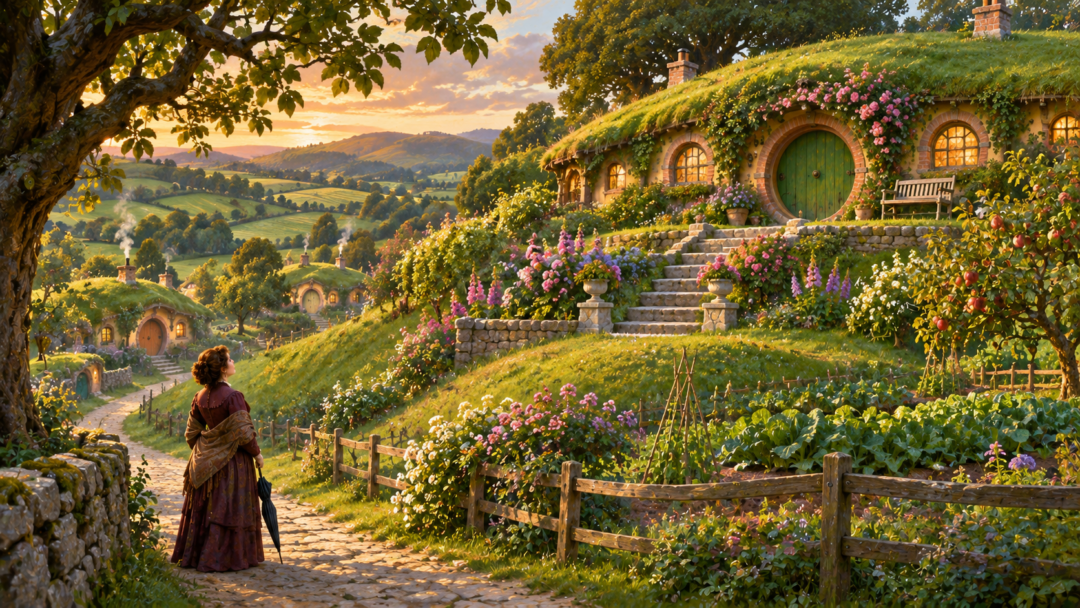
The important distinction is between having a legitimate expectation of possible inheritance and having a legal entitlement to the house. Otho’s position in Bilbo’s family made his hopes understandable, but those hopes did not make Bag End his property while Bilbo was alive.
The Sackville-Bagginses seem to have had considerable difficulty accepting that distinction.
Bag End was more than an expensive hobbit-hole
To understand Lobelia’s persistence, consider what Bag End represented in the Shire.
It occupied a prominent position on the Hill above Hobbiton. It was a comfortable, substantial residence associated with an established Baggins family. Bilbo inherited it from his parents, Bungo Baggins and Belladonna Took, and it contained the kind of domestic comforts that respectable hobbits valued.
In a society where family connections, reputation, meals, gardens, and property mattered enormously, Bag End was an unusually attractive prize.
But the distinction between wealth and status is essential. Lobelia was not merely chasing a place with enough rooms for her possessions. Ownership would have placed her household in a conspicuous position within the local social order.
Otho was a Baggins relation, while Lobelia had been born a Bracegirdle of Hardbottle. Marriage connected her to the Sackville-Baggins branch of the family. Inheriting Bag End would have given that connection an unmistakable physical symbol.
The house would announce that the Sackville-Bagginses were not merely distant relations waiting for invitations. They had become the family occupying the famous residence.
Tolkien does not explicitly give Lobelia a private speech about social advancement. This is an inference from her conduct and the importance of property throughout the opening chapters. Yet it explains why this particular home remained so desirable when other comfortable hobbit-holes presumably existed.
She wanted Bag End itself, with everything its ownership implied.
Bilbo made the disappointment worse by living too long
Ordinarily, disappointed heirs can comfort themselves with the passage of time. Their prospects may improve as the older generation ages.
Bilbo made even that consolation difficult.
After returning from his adventure, he continued living at Bag End for decades. He remained unusually vigorous and apparently youthful. The opening chapter of The Fellowship of the Ring shows that his neighbors regarded this as remarkable, even unnatural.
Readers know that the One Ring helps explain Bilbo’s prolonged preservation. Lobelia does not know this. To her, Bilbo simply refuses to become the elderly, declining relative that inheritance expectations require.
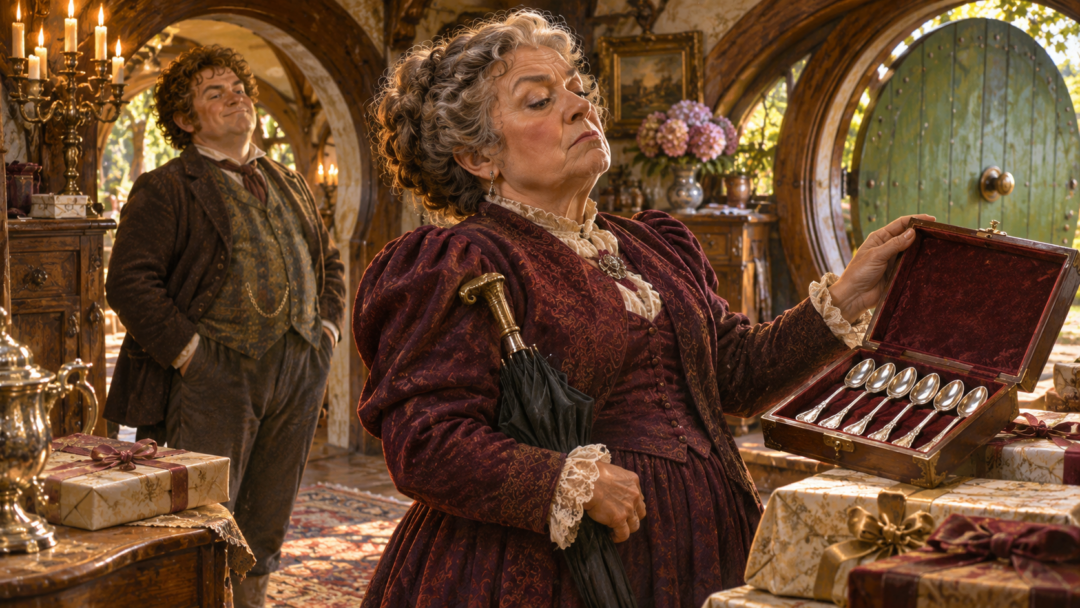
This turns an ordinary family quarrel into a running joke with a distinctly cruel edge. Every additional year of Bilbo’s life frustrates people who would benefit from his death.
Meanwhile, Bilbo’s reputation expands. His adventures make him famous, and stories circulate about treasure hidden beneath the Hill. The Gaffer questions the more extravagant rumors, but their popularity reveals how closely Bag End has become associated with fabulous wealth.
The gossip does not prove Lobelia believed every rumor about buried treasure. It does, however, strengthen the larger picture: Bag End was a prestigious property whose owner appeared both exceptionally prosperous and remarkably difficult to dislodge.
Lobelia’s envy had excellent conditions in which to mature.
Then Bilbo chose Frodo
The decisive blow came when Bilbo adopted Frodo as his heir.
In The Fellowship of the Ring, Tolkien explains that Bilbo brought Frodo to live at Bag End when Bilbo was ninety-nine. The arrangement transformed a distant hope into an effectively defeated inheritance plan.
The Sackville-Bagginses could no longer assume that Bilbo’s eventual death would deliver the property to their branch of the family. He had selected someone else and made the necessary arrangements.
This matters because Frodo was not an outsider without family connections. He was Bilbo’s young cousin, and Bilbo was genuinely fond of him. Choosing Frodo was a personal decision about affection and companionship, not a random legal trick invented simply to annoy Lobelia.
Yet to an already resentful relative, the effect would have been unmistakable. Bag End had slipped away for a second time.
First Bilbo returned alive. Then he supplied an heir.
The pattern helps explain why the feud lasted so long. Lobelia was not waiting patiently for an uncomplicated inheritance. She was repeatedly confronting evidence that Bilbo preferred almost any outcome to seeing Bag End pass into Sackville-Baggins hands.
Whether Bilbo deliberately intended every decision as a slight is another question. But his choices certainly made the family’s expectations increasingly unrealistic.
The silver spoons reveal the character of the feud
Bilbo’s eleventy-first birthday provides one of Tolkien’s sharpest demonstrations of this hostility.
When Bilbo leaves the Shire in The Fellowship of the Ring, he distributes presents among his relations. Lobelia receives a case of silver spoons. The gift is a pointed reference to Bilbo’s suspicions about spoons disappearing during the confusion surrounding his earlier return.
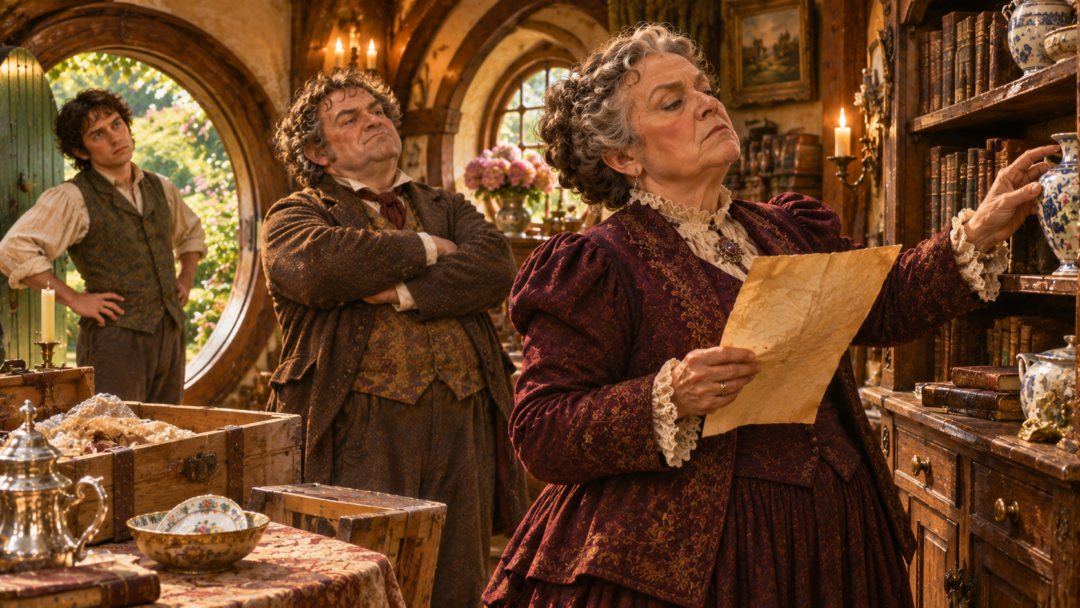
The humor is not especially subtle. Bilbo has remembered the offense for decades and arranged a final domestic insult.
Lobelia, meanwhile, has not forgotten her grievance either. She arrives at Bag End after Bilbo’s departure and is furious to discover that Frodo, rather than the Sackville-Bagginses, possesses the house.
The ensuing confrontation includes her attempted removal of belongings to which she has no claim. Frodo and Merry have to deal with a visitor whose sense of entitlement has again outrun her actual rights.
These details make greed part of the portrait. Lobelia cares about valuable objects, and Tolkien plainly enjoys exposing her petty acquisitiveness.
Yet the spoons also reveal something beyond greed. The original disappointment has become a family ritual of accusation, mockery, and remembered humiliation. Bilbo and Lobelia have spent years preserving the quarrel through small gestures.
By this stage, Bag End is both the desired possession and the symbol of a dispute neither party seems willing to forget.
She finally bought it, but that was not victory
In 3018, Frodo prepares to leave the Shire. To explain his departure, he sells Bag End to Lobelia, whose husband Otho has already died.
She is now one hundred years old.
Tolkien observes in ‘Three Is Company’ that she has waited approximately seventy-seven years longer than she originally expected. The remark is particularly revealing because it connects her eventual purchase directly to the opportunity lost around Bilbo’s adventure.
It also undercuts the childhood explanation. The original expectation belongs to the period when Lobelia was a young hobbit, not to an explicitly described childhood fantasy.
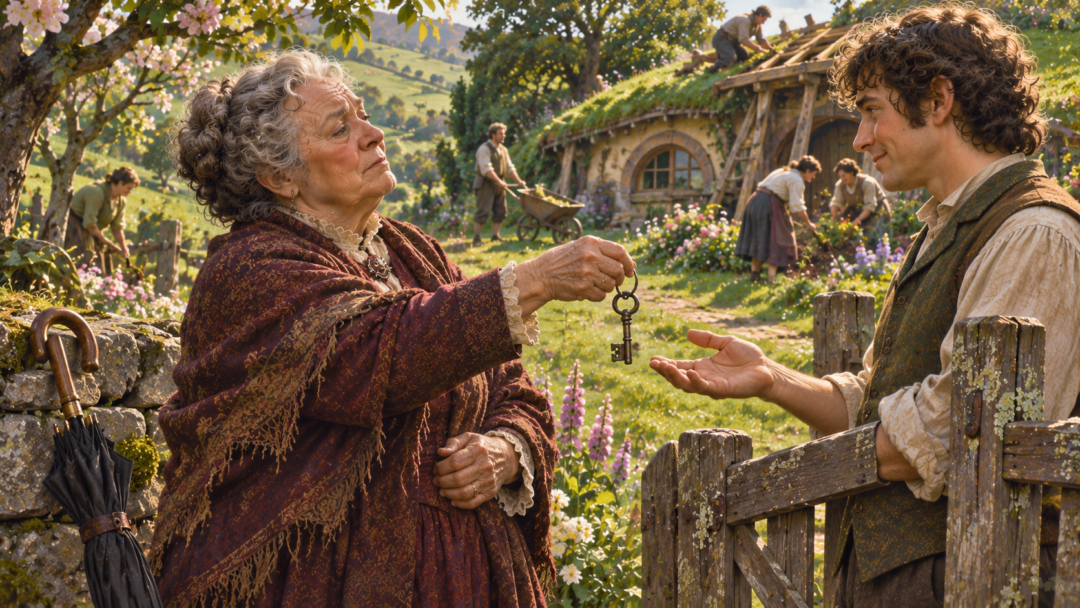
Even after paying for the property, she behaves as though she expects to be cheated. She arrives with an inventory, inspects the contents, and presses Frodo about the keys. The acquisition of Bag End does not immediately produce generosity or serenity.
There is a delicious irony here. Lobelia has spent decades treating possession of the house as a triumph over Bilbo’s family. When she finally obtains it, the owner is not reluctantly surrendering an inheritance. Frodo has voluntarily sold it because his attention is fixed on dangers far beyond Hobbiton.
The great prize of Lobelia’s life has become, for Frodo, something he must leave behind.
The film gives us the joke, but not the explanation
Peter Jackson’s film The Fellowship of the Ring preserves the hostile relationship through brief appearances by the Sackville-Bagginses and Bilbo’s anxious reaction to their presence.
The visual joke is immediately understandable: these are relatives Bilbo would rather avoid.
However, the films do not provide a childhood history for Lobelia or establish a secret reason for her fixation. Their treatment of the Sackville-Bagginses is far briefer than the novels’, and the later story of Lobelia’s resistance to the Shire’s occupiers is omitted.
That is why the books must carry the argument. The film helps establish the family’s reputation for unwelcome visits, but it cannot answer a question about motives Tolkien never explicitly assigned to Lobelia as a child.
The temptation to turn an amusing supporting character into the victim of a forgotten childhood humiliation should be resisted unless the story supplies evidence for it.
The ending changes how we judge her
Lobelia’s final appearance makes her a more complicated character than the unpleasant woman carrying away spoons.
During the occupation of the Shire, her son Lotho becomes involved in the machinery of control that eventually falls under Saruman’s influence. Bag End itself is drawn into that corruption.
Lobelia resists the ruffians. Her familiar umbrella, previously associated with her comic unpleasantness, becomes a weapon of defiance. She is imprisoned in the Lockholes, and her eventual release earns an unexpectedly warm reception from the hobbits.
In ‘The Grey Havens,’ she is devastated by news of Lotho’s murder and does not wish to return to Bag End. She gives the property back to Frodo and later leaves her remaining money to help hobbits made homeless by the troubles.
That conclusion is crucial. Tolkien does not reveal that Lobelia never cared about property. Instead, he shows that her attachment to property was capable of changing when confronted with violence, grief, and real dispossession.
Her final generosity does not erase decades of selfish behavior. But it prevents those decades from being the whole story.
What Lobelia really wanted
There is no documented childhood incident that explains why Lobelia coveted Bag End. The books support a simpler, more persuasive account: as a young hobbit, she and Otho expected to inherit a valuable and prestigious family home. Bilbo’s survival destroyed that expectation, his longevity prolonged the disappointment, and his adoption of Frodo finally closed the obvious route to inheritance.
Over time, what began as an attractive prospect hardened into resentment and a demand for recognition.
Bag End represented comfort, standing, family legitimacy, and the satisfaction of finally defeating an old humiliation. That is why the quarrel could survive for so many years, even when the original expectation had become hopeless.
But Tolkien grants Lobelia one last reversal. The woman who spent much of her life wanting a particular home ultimately gives it away, then uses her wealth to help other hobbits recover theirs.
**She began by measuring her happiness against a house she did not own. She ended by recognizing what losing a home could mean to other people.**
Sources & Notes
This article is based on close reading and interpretation of Tolkien's published works and related source material where relevant.