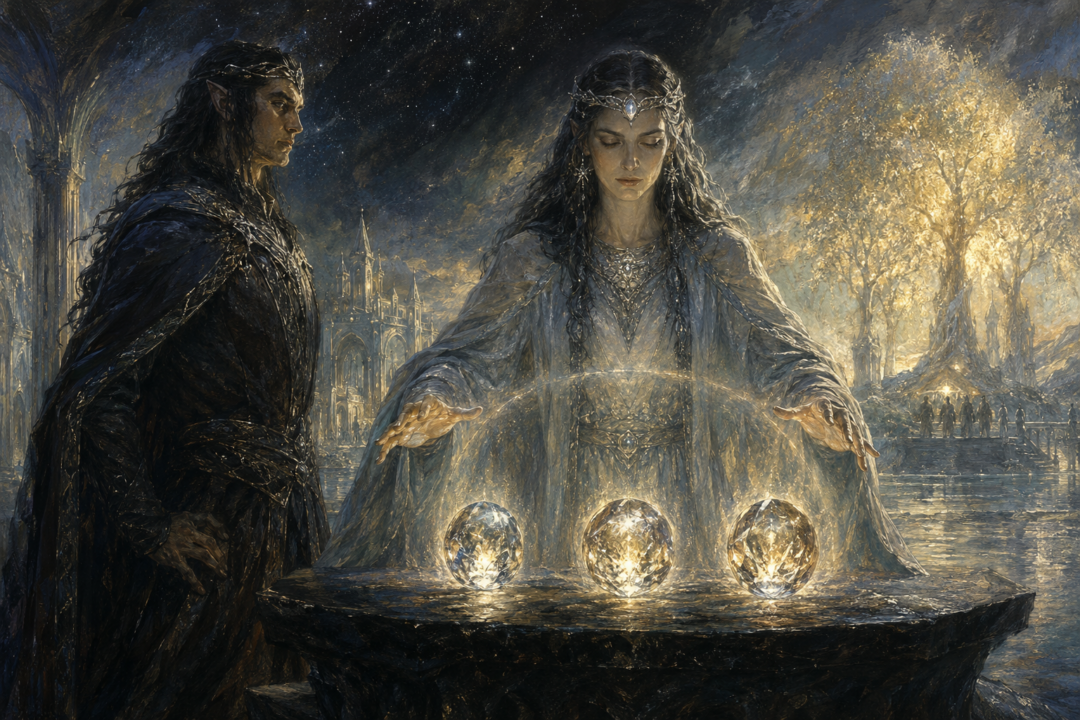
The Silmarils are remembered as Fëanor’s supreme achievement: three jewels containing the blended light of the Two Trees, fashioned from a substance whose making no one else could reproduce. Their beauty was so extraordinary that almost the whole tragedy of the First Age came to revolve around their possession.
Yet one of their most consequential properties did not come from Fëanor at all.
After the Silmarils were made, Varda hallowed them. The distinction is easy to pass over because the jewels are so closely identified with their maker. But the text separates Fëanor’s craftsmanship from Varda’s act very clearly. Fëanor made the vessels and captured within them the light of Telperion and Laurelin. Varda then placed upon those finished works a condition that Fëanor’s craft, as described, had not supplied.
From that point onward, the Silmarils could judge the hands that touched them.
That added property eventually burned Morgoth, tortured Carcharoth from within, and—most tragically of all—rejected the surviving sons of the very Elf who had created them.
What Fëanor Actually Made
Fëanor’s achievement should not be diminished in order to understand Varda’s contribution.
In The Silmarillion, the Silmarils are presented as the greatest works of the Noldor. Fëanor devised the substance called silima, crystal-like and extraordinarily strong, and within the three jewels he preserved the mingled radiance of the Two Trees.
Their internal fire was astonishing. They reflected and amplified surrounding light, yet they also contained light of their own. What Fëanor achieved was therefore far more than ordinary jewel-making: something living in appearance had been enclosed within an imperishable work of craftsmanship.
The manner of their creation remained Fëanor’s secret. Later, after the Darkening of Valinor, he believed that even he could not make their like again. When the Valar asked whether he would surrender the jewels so their light might be used to restore the Trees, Fëanor regarded their destruction as the destruction of something uniquely bound to himself.
None of this, however, explains why evil flesh should burn when touching them.
That is introduced separately.
Varda Does Something After Their Creation
The crucial passage comes in “Of the Silmarils and the Unrest of the Noldor.”
After describing their making, the narrative says that Varda hallowed the Silmarils so that no mortal flesh, nor hands unclean, nor anything evil, could touch them without being scorched and withered.
The sequence matters.
Fëanor first creates the Silmarils. Varda subsequently hallows them.
The most conservative reading is therefore that the jewels’ extraordinary substance, captured light, permanence, and beauty belong to Fëanor’s workmanship, while this particular resistance to unclean or evil contact belongs to Varda’s hallowing.
The text never describes Fëanor engineering a moral detection system into the jewels. Nor does it say that the Light of the Trees automatically burns evil beings simply because it is holy or beautiful. Instead, the prohibition is explicitly connected to Varda.
She does not remake the Silmarils. She alters their relationship with those who may touch them.
That difference becomes enormous once the jewels leave Valinor.
Hallowing Is Not the Same Thing as Ownership
Varda’s act is especially important because the Silmarils later become objects of competing claims.
Fëanor calls them his. His sons swear an oath to pursue anyone who possesses them without surrendering them. Thingol demands one as the price for Lúthien’s hand. Morgoth steals all three. Beren removes one from Morgoth’s crown. The Sons of Fëanor eventually recover two after the War of Wrath.
But the hallowing does not appear to care who believes he possesses a legal, hereditary, or personal claim.
It responds to moral condition.
This becomes the deepest irony surrounding the jewels. Fëanor’s descendants may inherit his claim, but they do not inherit immunity from Varda’s hallowing.
The Silmarils therefore cease to be merely masterpieces that can be possessed by whoever successfully captures them. Their own nature places a limit upon possession.
A hand may seize one and still prove incapable of bearing it.
Morgoth Can Wear Them, but He Cannot Escape Their Judgment
Morgoth provides the first great demonstration.
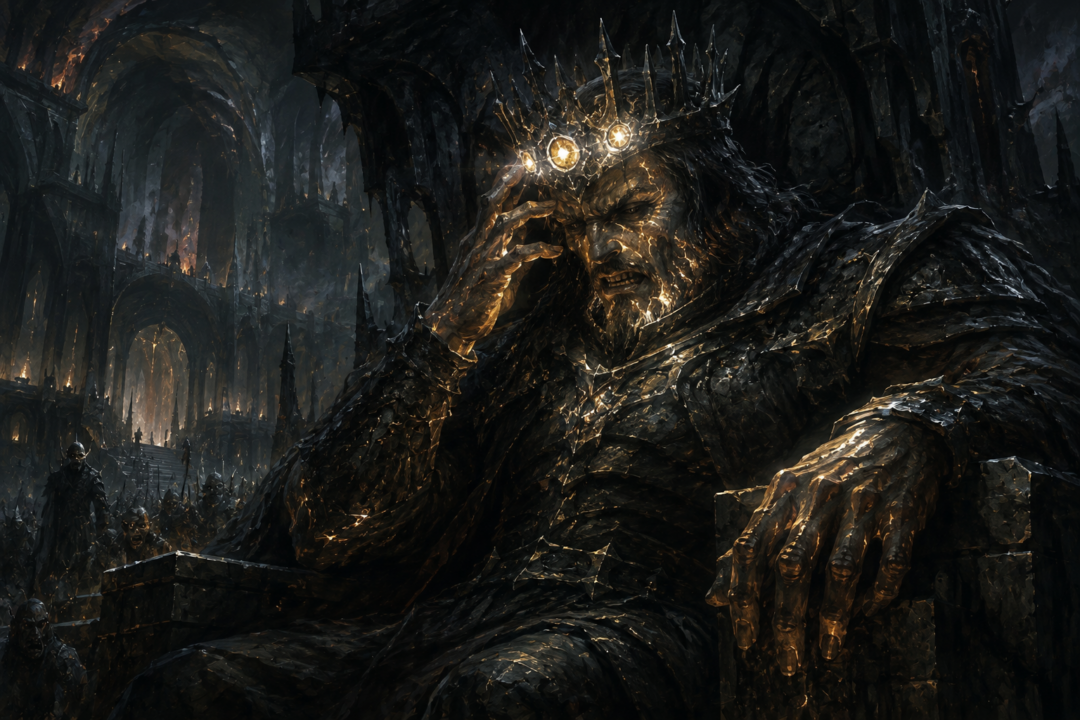
After murdering Finwë and stealing the Silmarils from Formenos, he returns to Middle-earth and sets the three jewels into his Iron Crown. Yet the Silmarils burn him.
This is a remarkably important distinction. Varda’s hallowing does not make theft physically impossible. Morgoth can take the jewels. He can transport them. He can mount them in his crown. He can keep them for centuries.
But possessing them hurts him.
Their sanctity does not function like an impenetrable magical barrier. Instead, evil contact carries a consequence.
Morgoth therefore becomes an image of corrupted possession: he has what he desires, yet what he desires continually wounds him.
That condition fits a pattern found repeatedly in Middle-earth. Power obtained through domination often fails to produce true mastery. Morgoth possesses the Silmarils materially, but he can never make them compatible with what he has become.
Fëanor’s craft made jewels that Morgoth desperately wanted.
Varda’s hallowing made them jewels that Morgoth could never comfortably possess.
Why the Silmaril Does Not Burn Beren
The story of Beren makes the distinction sharper.
Beren enters Angband with Lúthien, cuts one Silmaril from Morgoth’s crown, and takes it in his hand. The jewel does not burn him.
This matters because Beren is mortal.
The wording concerning Varda’s hallowing can initially sound as though mortality itself excludes someone from touching the jewels. Yet Beren’s successful handling of the Silmaril shows that the prohibition cannot be reduced to a simple rule that every mortal is automatically scorched.
Whatever complexities lie in the phrasing, the narrative’s moral contrast is unmistakable: Morgoth suffers from contact with the jewel; Beren does not.
The texts do not give us a technical mechanism explaining precisely how the Silmaril assesses every bearer, and it is safer not to invent one. What the story demonstrates is that Beren’s handling of the jewel is permitted in a way Morgoth’s is not.
And immediately afterward, the hallowing reveals its destructive force even more dramatically.
Carcharoth Swallows What Evil Cannot Contain
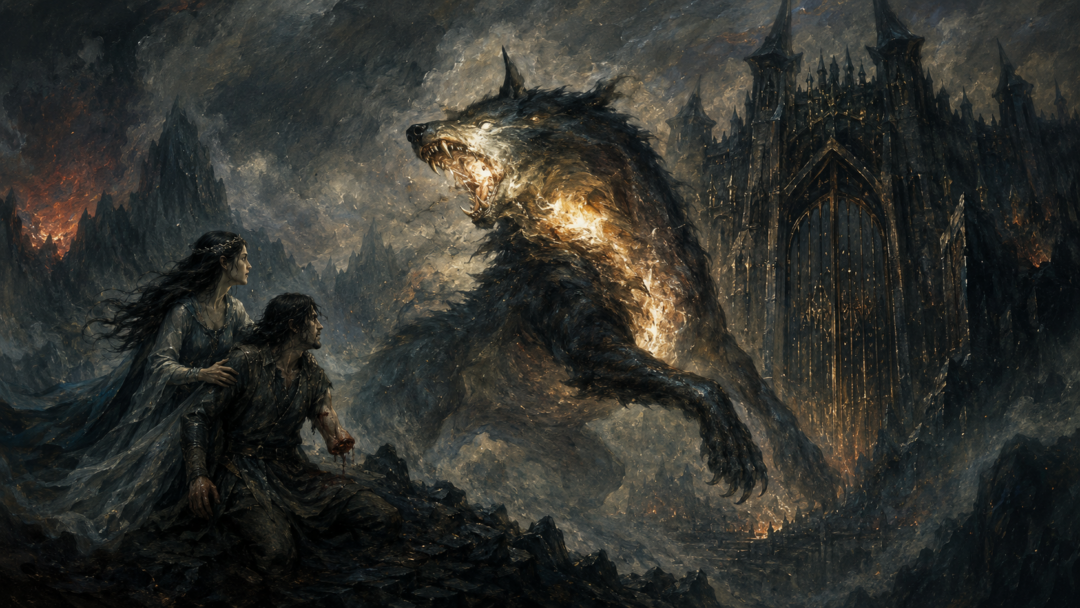
At the gates of Angband, Carcharoth attacks Beren and bites off the hand holding the Silmaril.
The great wolf swallows both hand and jewel.
Then the Silmaril begins burning him from within.
Carcharoth becomes maddened by torment and races across Beleriand, eventually entering Doriath. The Silmaril has not merely become hot because it was swallowed. Its effect follows the condition established by Varda’s hallowing: evil cannot touch it without suffering.
The scene turns the Silmaril into something almost paradoxical.
It is physically inside one of Morgoth’s monstrous servants, yet it cannot truly be absorbed by him.
Carcharoth can swallow the jewel, but he cannot incorporate it.
His attempt at possession becomes self-destruction.
That is something Fëanor’s craftsmanship alone is never said to have guaranteed. Silima made the Silmarils extraordinary vessels. The light of the Trees made them unique treasures. Varda’s hallowing made evil contact itself dangerous.
The Cruelest Test Comes After the War of Wrath
The most devastating consequence appears near the end of The Silmarillion.
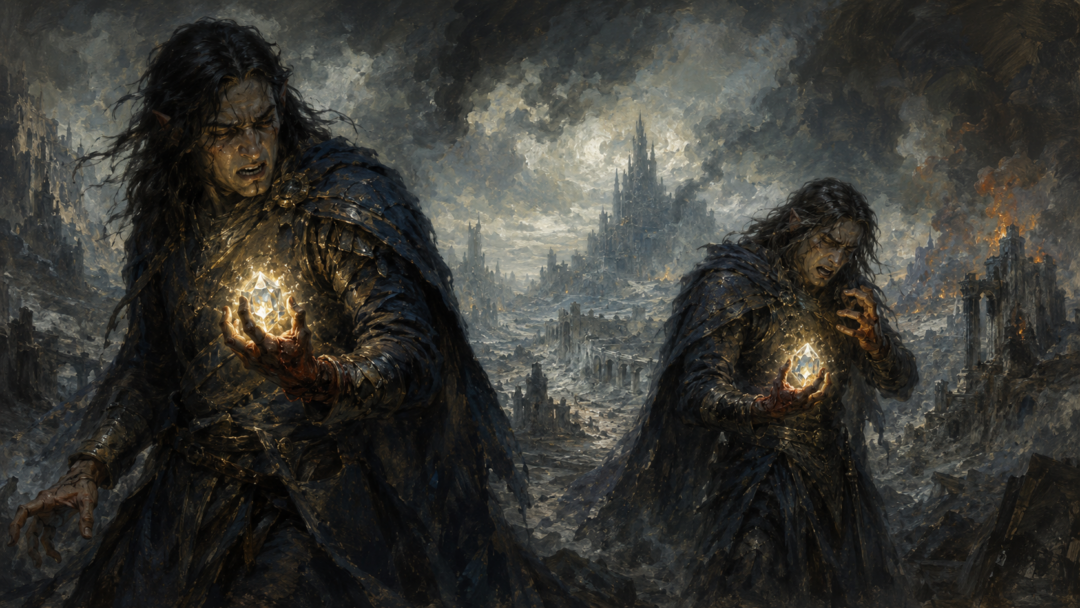
After Morgoth’s defeat, only Maedhros and Maglor remain of Fëanor’s seven sons. Their oath still binds them to recover the Silmarils, and they demand the two remaining jewels from Eönwë.
Their claim is rejected because of the evil committed in pursuit of the oath.
Even Maedhros questions whether the oath may have become impossible to fulfill without committing further wickedness. Yet the brothers ultimately steal the Silmarils.
Then comes the judgment they cannot argue away.
The jewels burn them.
This is one of the strongest confirmations that Varda’s hallowing added something fundamentally independent of Fëanor’s original relationship with his creations.
Maedhros and Maglor are not Morgoth. They are Fëanor’s own sons. They have spent centuries believing that recovering the Silmarils is their sacred obligation.
Yet by the end, the deeds committed under that obligation have made them unable to bear the very objects they claimed.
The tragedy is almost mathematically exact.
Their oath says the Silmarils must belong to them.
The Silmarils themselves say otherwise.
The Jewels Become Witnesses Against the Oath
It would go too far to describe the Silmarils as conscious judges. The texts never say that they think, choose, or pronounce verdicts.
But Varda’s hallowing allows them to function narratively as witnesses to moral corruption.
Without that hallowing, Maedhros and Maglor might have recovered two pieces of their father’s property at terrible cost and still claimed, however bitterly, that the oath had finally been accomplished.
Instead, the jewels burn them.
Their physical reaction exposes the failure of the entire enterprise. The sons have pursued possession so ruthlessly that they have become incapable of possessing what they pursued.
Maedhros finally casts himself with his Silmaril into a fiery chasm. Maglor throws his into the Sea.
The Oath of Fëanor does not end in triumphant recovery.
It ends with Fëanor’s heirs unable to hold Fëanor’s works.
Craft Can Make Something Great Without Giving Its Maker Final Authority
This is the larger significance of Varda’s hallowing.
Fëanor truly made the Silmarils. Nothing in the story denies his genius or his unique role in their creation. But making something does not give him—or his descendants—absolute control over everything that object may become.
The jewels incorporate realities beyond Fëanor himself.
Their light originates in the Two Trees, which Fëanor did not create. Their hallowing comes from Varda. Their destiny becomes entangled with Beren, Lúthien, Thingol, Eärendil, the Valar, and ultimately the fate of Arda.
Fëanor’s great error is therefore not simply that he loves beautiful objects too strongly. One deeper problem is his increasingly absolute conception of possession.
The Silmarils are his works, but they are never merely his.
Their very nature proves it.
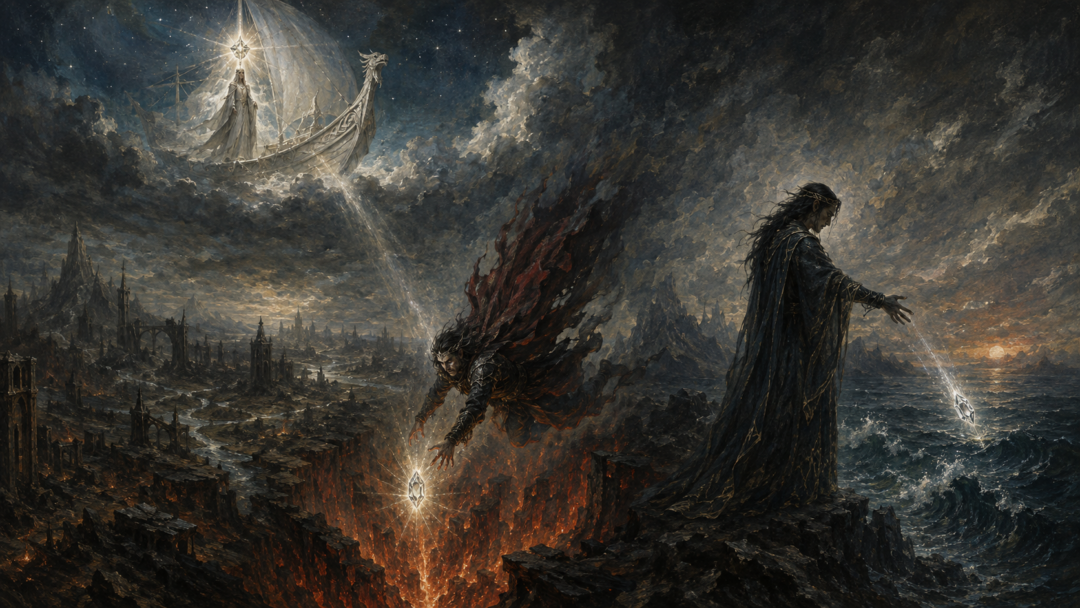
The Property Fëanor Could Not Claim as His Own
Fëanor gave the Silmarils form.
He devised their substance. He captured within them the blended radiance of Laurelin and Telperion. His craftsmanship made them unmatched among the jewels of the Eldar.
Varda added something different.
Her hallowing placed a moral boundary around physical possession: evil or unclean contact could not remain painless.
That boundary survives Fëanor’s death.
It survives Morgoth’s theft.
It survives the fall of kingdoms, the destruction of Beleriand, and even the desperate insistence of Fëanor’s surviving sons.
In the end, this added property produces one of the First Age’s harshest ironies. Fëanor created objects of such greatness that his sons believed no power in Arda could cancel their claim to them.
Yet when they finally held the Silmarils again, the jewels burned their hands.
Fëanor’s craft had made them.
Varda’s hallowing helped determine who could bear them.
Sources & Notes
- https://www.encyclopedia-of-arda.com/s/silmarils.php — The Encyclopedia of Arda: Silmarils (their making, Varda’s hallowing, and their judgment of unclean hands).
- https://www.encyclopedia-of-arda.com/v/varda.php — The Encyclopedia of Arda: Varda (the Vala whose hallowing added the jewels’ scorching prohibition).
- https://www.encyclopedia-of-arda.com/f/feanor.php — The Encyclopedia of Arda: Fëanor (the maker of the Silmarils and inventor of their unique material craft).
- https://www.encyclopedia-of-arda.com/c/carcharoth.php — The Encyclopedia of Arda: Carcharoth (the wolf tormented after swallowing a hallowed Silmaril).
Sources cover Fëanor’s making of the Silmarils, Varda’s hallowing, and the consequences for those who touched or swallowed one.