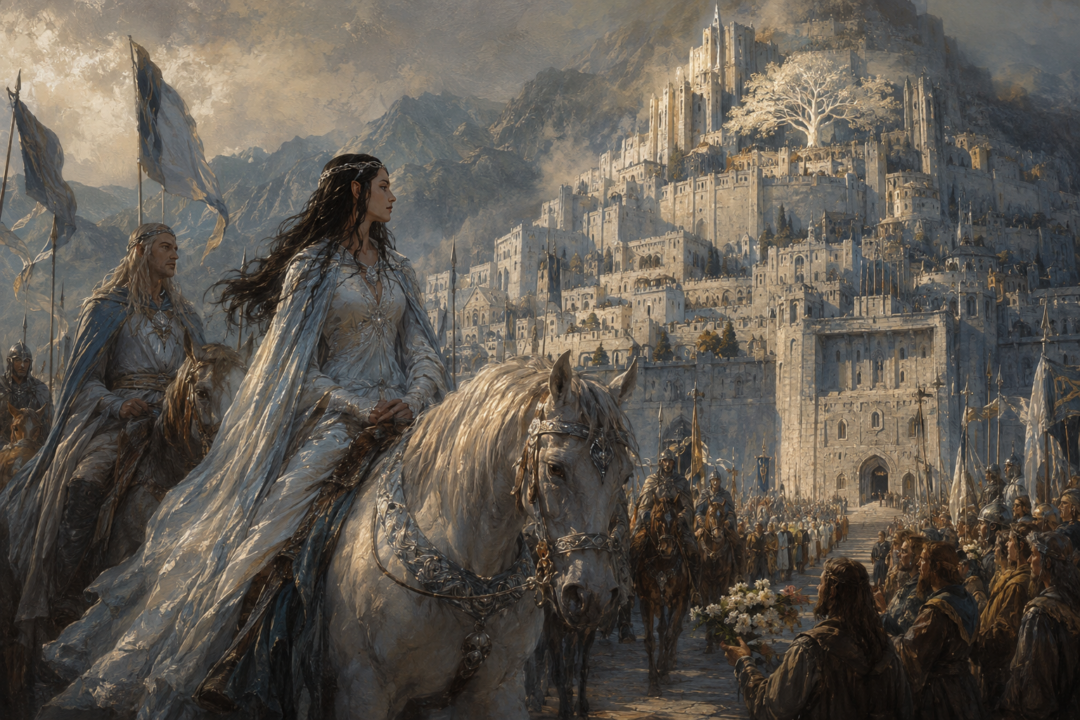
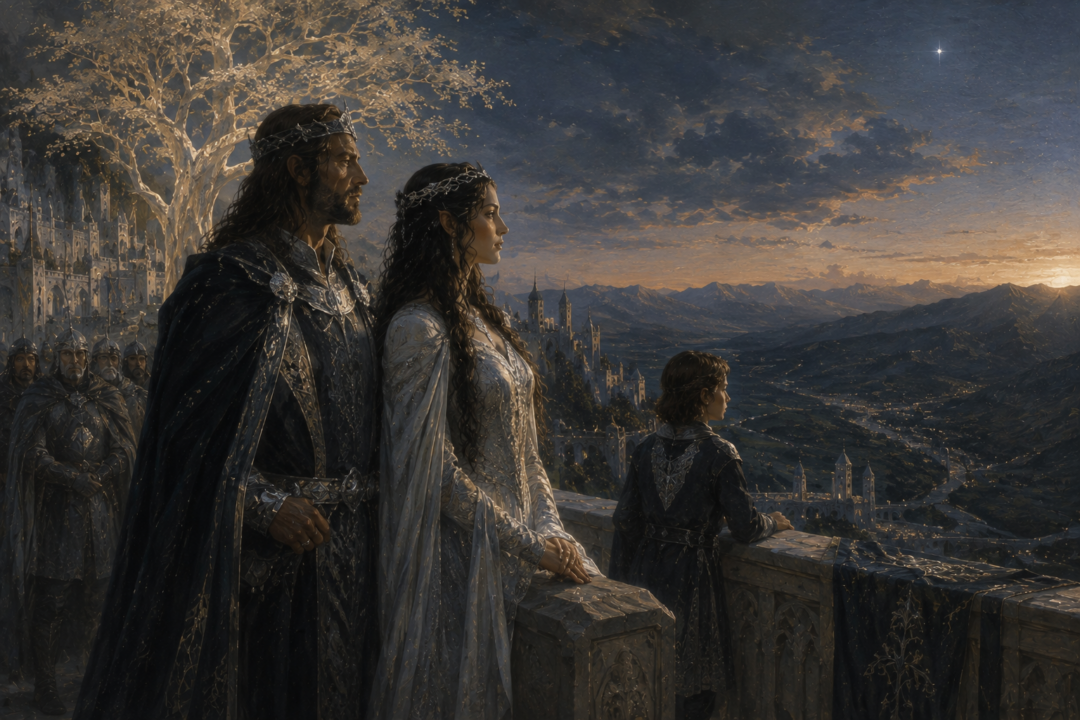
When Arwen Undómiel entered Minas Tirith as the bride of King Elessar, she did not simply move from an Elvish refuge into a human capital. She crossed between two worlds whose histories had been intertwined for thousands of years—and whose futures were now moving in opposite directions.
Behind Arwen stood Rivendell and Lothlórien, Elrond and Galadriel, the memory of the Elder Days, and a culture whose greatest surviving figures were preparing to leave Middle-earth. Around Aragorn stood Gondor, the Dúnedain, the Crown of the South-kingdom, the Sceptre of Annúminas, and the restoration of a kingship descended from Númenor.
Their marriage therefore created something extraordinary: a royal household in which the surviving inheritance of the Eldar met the restored political traditions of the Númenórean kingdoms.
The texts never provide a handbook describing Arwen's court, its servants, ceremonies, etiquette, or daily routines. We should not invent one. But the evidence they do provide makes the larger problem surprisingly clear.
The household of Elessar and Arwen could not represent only Gondor's past. Nor could it simply reproduce Rivendell.
It stood at the point where the two traditions met—and where one of them was beginning to disappear.
Arwen Did Not Arrive as a Foreign Princess
Arwen's ancestry makes the usual idea of a diplomatic royal marriage inadequate.
She was the daughter of Elrond and Celebrían, granddaughter of Galadriel and Celeborn, and through Elrond descended from the great unions of Elves and Men in the First Age. Aragorn belonged to the other surviving branch of that same ancient family.
Appendix A emphasizes the significance directly: there were three great unions of the Eldar and Edain—Beren and Lúthien, Tuor and Idril, and Aragorn and Arwen. Through the last union, the long-separated branches of the Half-elven were reunited.
That matters politically as well as genealogically.
Aragorn's Númenórean inheritance ultimately descended through Elros, Elrond's brother, who chose the fate of Men and became the first King of Númenor. Arwen descended directly from Elrond.
The royal marriage at the beginning of the Fourth Age therefore reunited descendants of two brothers whose choices had separated their lines near the beginning of the Second Age.
Arwen was not bringing an unrelated Elvish dynasty into a Númenórean court. She was entering a royal line that was, in a profound historical sense, already part of her own family.
Aragorn Himself Had Already Been Formed by Both Worlds
The bridge between Elvish and Númenórean traditions did not depend upon Arwen alone.
Aragorn had been raised in Rivendell.
After the death of his father Arathorn, the young heir was fostered by Elrond and known for years as Estel. His identity and ancestry were deliberately concealed during his childhood. When Elrond eventually revealed his true name and lineage, he gave Aragorn the heirlooms of his house.
This produces one of the most important ironies of the restored kingship.
The man who would restore the kingdoms founded by the Númenórean Exiles was educated within an Elvish household.
Aragorn was therefore not culturally entering Arwen's world for the first time through marriage. Imladris had shaped him long before he became King.
Nor was Arwen unfamiliar with different Elvish traditions. She had spent considerable time in Lothlórien with her mother's kin before returning to Rivendell. Her own experience already connected two of the greatest surviving Elvish households of the late Third Age.
Their future court in the Reunited Kingdom consequently emerged from people whose lives had already crossed cultural boundaries.
Gondor Still Possessed a Powerful Ceremonial Memory
The restoration of the King did not erase Gondor's institutions.
Quite the opposite.
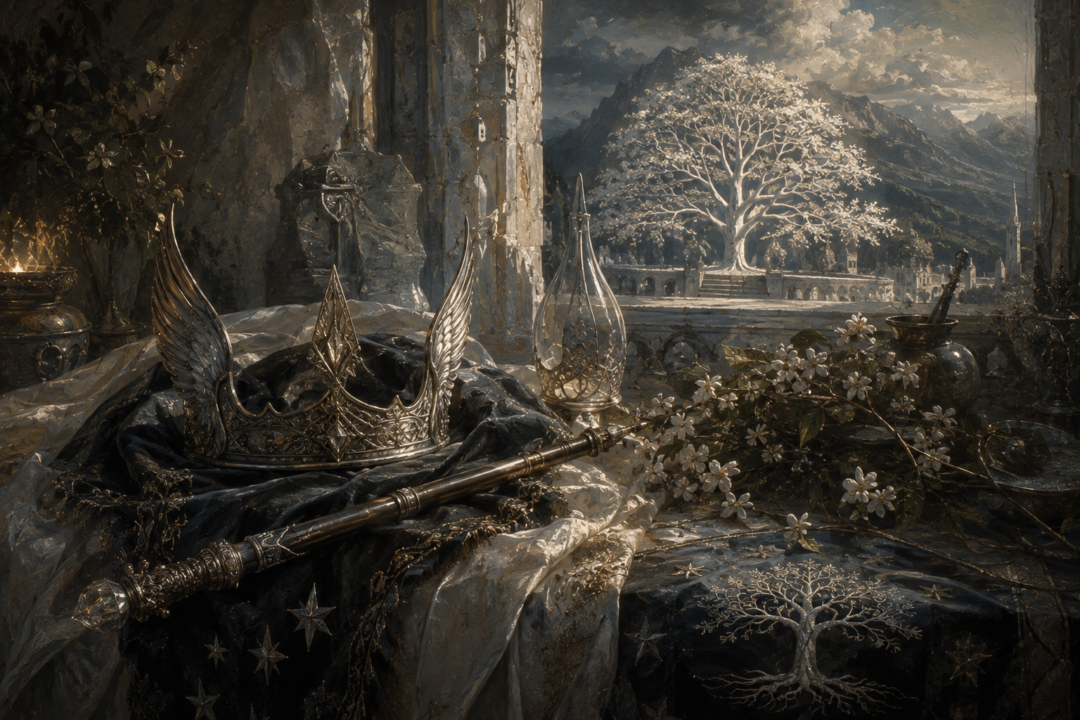
The coronation of Aragorn shows how seriously continuity mattered. The city still possessed the Crown associated with its ancient kings, while Aragorn also bore the Sceptre of Annúminas as the heir of the northern kingdom. Faramir, as Steward, formally participated in the restoration of royal authority.
Aragorn's kingship was therefore presented not as the invention of a new monarchy but as the renewal of an old one.
The symbols surrounding him carried enormous historical weight.
Gondor remembered Númenor through descent, names, monuments, heraldry, political institutions, and the traditions of the House of Elendil. The White Tree itself connected the restored kingdom to a history reaching through Númenor toward the Eldar and ultimately the Blessed Realm.
That meant Arwen was entering a court whose human customs already contained Elvish echoes.
The distinction between "Elvish" and "Númenórean" was never absolute.
Númenor had originally been profoundly shaped by friendship with the Eldar. Its tragedy came partly through estrangement from that friendship. The Faithful preserved reverence for the West and friendship with the Elves even as Númenórean society fell under the Shadow.
Aragorn's restored monarchy therefore did not need to choose between Elvish influence and legitimate Númenórean tradition. At their deepest historical level, the two belonged together.
Arwen Had Already Helped Create Aragorn's Royal Image
One easily overlooked detail reveals how actively Arwen understood Aragorn's inheritance.
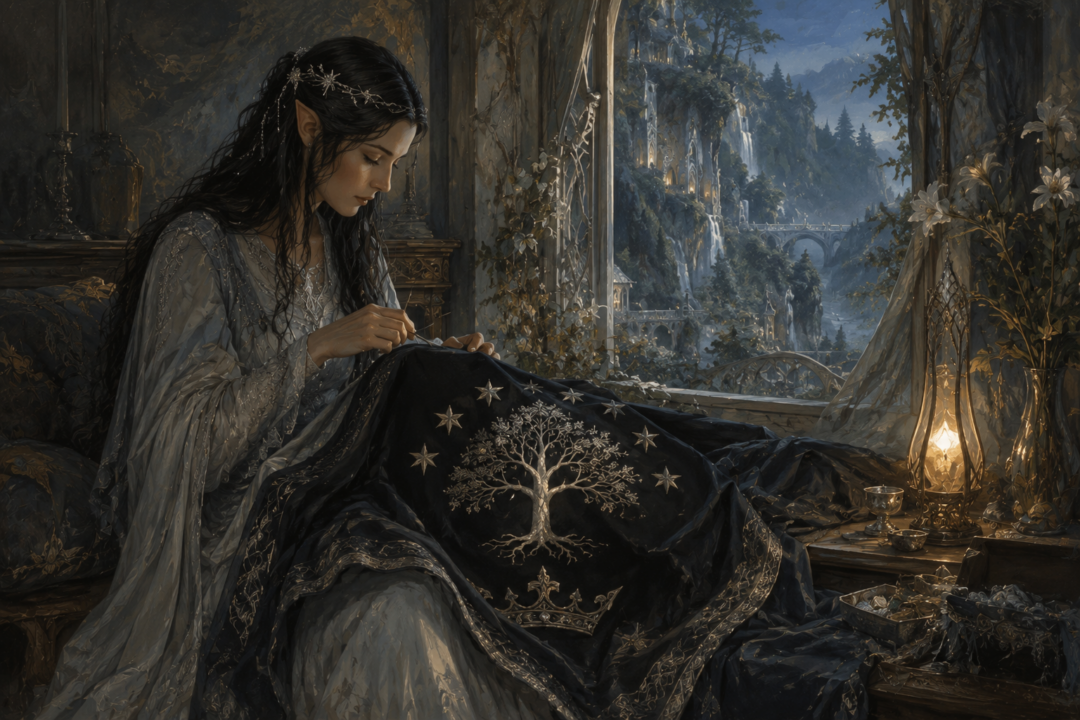
While Aragorn was still wandering and struggling against Sauron, Arwen made a great standard for him.
When it was eventually unfurled after Aragorn came from the Paths of the Dead, it displayed the signs of his claim: the White Tree, the Seven Stars, and a crown.
This was not merely a romantic gift.
Appendix A describes it as a great and kingly standard appropriate to one claiming the lordship of the Númenóreans and the inheritance of Elendil.
Arwen, daughter of Elrond, was therefore using her own skill to embody Aragorn's human royal legitimacy before he possessed a throne.
That is perhaps the clearest surviving image of the cultural bridge her later queenship represented.
Elvish craft was not replacing Númenórean symbolism. It was expressing it.
The two traditions strengthened rather than cancelled one another.
The Wedding Makes the Transition Visible
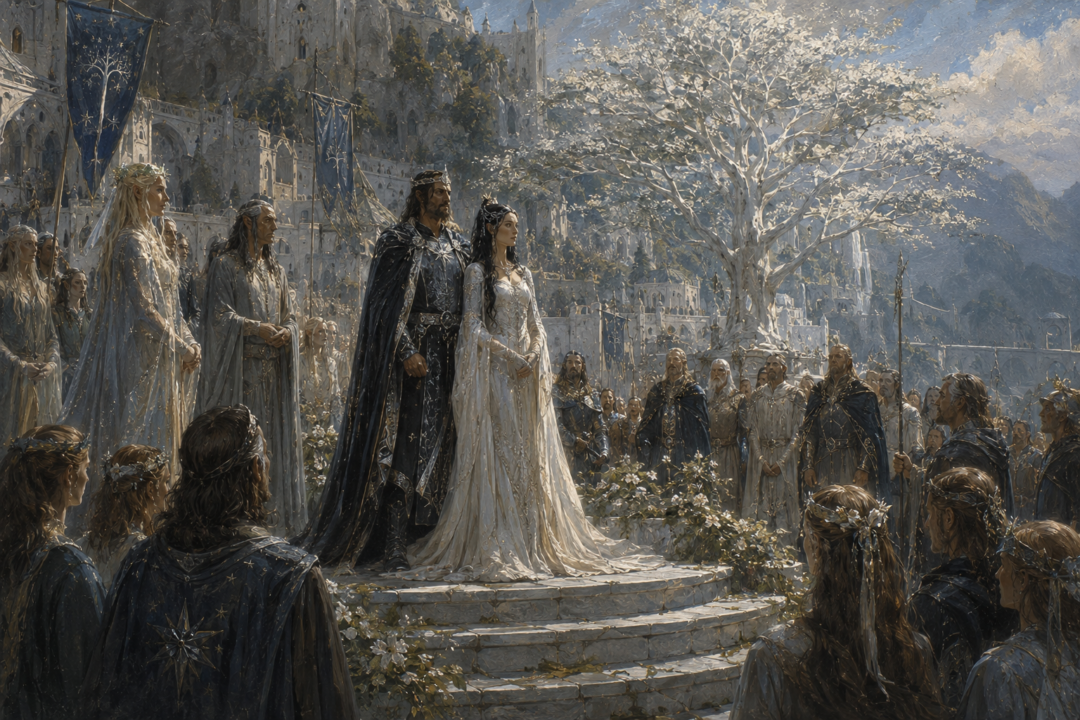
Aragorn and Arwen were married at Midsummer in Minas Tirith after the fall of Sauron.
The location matters.
Their union was not completed in Rivendell or Lothlórien but in the capital of Gondor, after Aragorn's coronation. Elrond, Galadriel, Celeborn and other members of the northern company had come south, bringing Arwen with them.
For a brief moment, Minas Tirith became a meeting place of the great surviving peoples and houses of the West.
But this was not the beginning of a permanent Elvish presence at court.
It was almost a farewell.
Elrond would soon depart over Sea. Galadriel would depart. Gandalf would depart. Eventually the great Ring-bearers would also pass into the West. The power that had preserved places such as Rivendell and Lothlórien was ending with the Three Rings.
Arwen remained.
That gives her position a melancholy significance. She became Queen precisely as the Elvish world that had formed her was withdrawing.
Any Elvish inheritance within her household would therefore belong to a culture no longer maintaining its former place in Middle-earth.
What “Bridging the Courts” Can Actually Mean
This is where caution is necessary.
The surviving narratives do not tell us that Arwen introduced particular Rivendell ceremonies into Minas Tirith. They do not describe an Elvish wing of the royal palace, prescribe bilingual court etiquette, list her attendants, or explain how household offices were reorganized after her marriage.
Claims of that kind belong to imaginative reconstruction, not established lore.
What the texts do establish is a deeper cultural bridge.
Arwen carried the lineage of Elrond into the House of the King. Aragorn carried the lineage of Elros. Aragorn had been fostered in Elrond's house. Arwen had fashioned the standard proclaiming his Númenórean inheritance. Their marriage united the separated lines of the Half-elven. Their descendants continued the restored royal house.
Even language reflects this layered inheritance. Aragorn's royal identity is surrounded by names and titles from the Elvish languages as well as the Common Speech, just as the history of the Dúnedain had long preserved Elvish linguistic influence.
The new royal household was therefore neither simply "Elven" nor simply a reconstruction of ancient Númenor.
It was the culmination of their shared history.
Arwen's Choice Changes the Meaning of Her Household
There is another crucial difference between Arwen and the Elves from whom she came.
She chose mortality.
Aragorn warns her of the consequence when their commitment becomes clear: if she cleaves to him, she must also renounce the fate available to her among the Eldar. Arwen accepts that choice.
Her royal household consequently cannot be understood as an Elvish colony inside the kingdom of Men.
Arwen has chosen the destiny of Aragorn's people.
She becomes, in Appendix A's striking formulation, a "Queen of Elves and Men," yet her future lies with mortal humanity. She and Aragorn have a son, Eldarion, and daughters, and Eldarion becomes heir to the restored kingdom.
The direction of history is unmistakable.
Elrond departs.
Arwen remains.
Eldarion succeeds.
The Elvish inheritance enters the renewed line of Men rather than establishing another enduring Elven realm.
The Restored Court Corrects an Ancient Estrangement
There is an even larger historical pattern behind the marriage.
The Númenóreans had once enjoyed friendship with the Eldar. As the Shadow grew in Númenor, fear of death helped turn many Númenóreans against the Valar and the Elves. Under Sauron's influence, that estrangement became catastrophic.
The Faithful resisted it.
Elendil and his sons survived Númenor's downfall and established the kingdoms in exile. Their descendants preserved a memory of the friendship that Númenor had betrayed.
At the beginning of the Fourth Age, the heir of Elendil marries the daughter of Elrond.
The symbolism is difficult to miss, even though the texts do not present it as a formal political program.
A royal line descended from Númenor reaches its restoration not by rejecting the Elves but through renewed intimacy with them.
The King was fostered by Elrond.
The Queen was Elrond's daughter.
The two lines descended from Elrond and Elros became one family again.
What Númenor had once torn apart through pride and fear was, in a smaller and more mortal form, joined again.
The Greatest Bridge Was Their Son
Ultimately, the most important feature of Arwen's household was not ceremonial.
It was genealogical.
Eldarion inherited the kingship from Aragorn. Through his father came the long line of the Dúnedain and the heirs of Elros. Through his mother came the line of Elrond.
Behind both stood still older houses: Beren and Lúthien, Tuor and Idril, Eärendil and Elwing.
The royal household of the Fourth Age thus gathered extraordinary strands of the history of Elves and Men into one mortal dynasty.
That is why imagining Arwen merely adapting to a Gondorian court misses the larger point.
She entered a Númenórean kingdom, certainly. Its crown, stewardship, history and political traditions mattered. But those traditions themselves reached backward toward an ancient friendship with the Eldar.
Arwen did not need to make Gondor Elvish.
Nor did becoming Queen require her past to vanish.
The household founded by Arwen and Aragorn stood precisely where the story of the Eldar was giving way to the dominion of Men. It preserved something of the older world without preventing that transition.
And perhaps that is the most fitting way to understand Arwen's place in Minas Tirith.
She was not there to preserve Rivendell forever.
She was there when the things Rivendell had guarded—memory, lineage, friendship, wisdom and hope—passed into the keeping of mortal hands.
Sources & Notes
- https://www.encyclopedia-of-arda.com/a/arwen.php — The Encyclopedia of Arda: Arwen (her ancestry, life in Rivendell and Lórien, marriage to Aragorn, and role as Queen of the Reunited Kingdom).
- https://www.encyclopedia-of-arda.com/a/aragorn.php — The Encyclopedia of Arda: Aragorn (his upbringing by Elrond, Númenórean royal descent, coronation, and marriage to Arwen).
- https://www.encyclopedia-of-arda.com/e/elrond.php — The Encyclopedia of Arda: Elrond (the Half-elven genealogy linking Arwen’s Elvish inheritance with the line of Elros and Númenor).
- https://www.encyclopedia-of-arda.com/r/reunitedkingdom.php — The Encyclopedia of Arda: Reunited Kingdom (the restored northern and southern Dúnedain realms ruled by Elessar and Arwen).
Sources document Arwen and Aragorn’s intertwined Elvish and Númenórean ancestry, their backgrounds, and the restored kingdom they ruled.