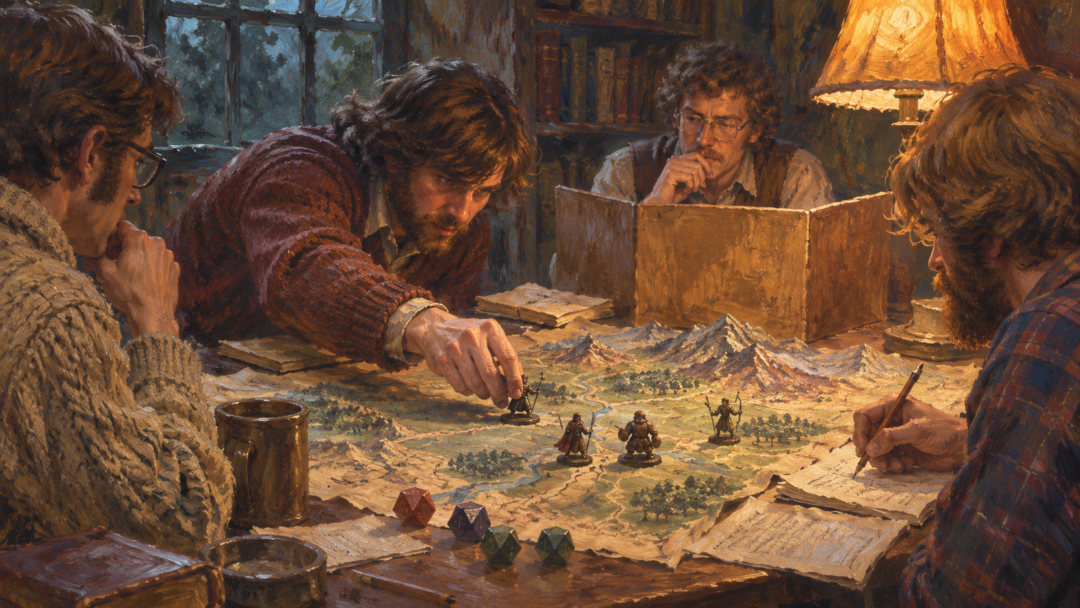
When Merry and Pippin meet Treebeard in Fangorn Forest, they hear centuries in his voice. He is not merely a walking tree waiting to be defeated. His memories, his missing Entwives, and his deliberation belong to a world with a history far older than the hobbits. Now imagine a similar creature appearing on a tabletop map, while players reach for dice and decide what to do next. Would the creator of Middle-earth have been delighted, or horrified?
The answer is less certain, and more interesting, than either reaction. J.R.R. Tolkien died on 2 September 1973, just as the game that became Dungeons & Dragons was emerging. No evidence considered here records him encountering or judging it. His books plainly helped shape the game's early fantasy vocabulary, while his letters reveal what he cherished about storytelling. Those clues can illuminate a hypothetical response, but they cannot supply one.
The Timing Leaves Us Without a Verdict
The Strong National Museum of Play places the introduction of Dungeons & Dragons in 1973. Other historical accounts, including the museum's own anniversary materials, date its published rules to 1974. The precise boundary matters less than the fact that there is no established account of Tolkien reading the rules, meeting the creators, or observing a session before his death. The familiar image of the Oxford professor inspecting a twenty-sided die belongs to imagination, not biography.
The game was developed by Gary Gygax and Dave Arneson out of a lively culture of miniature battles and fantasy campaigns. Instead of commanding armies alone, players could guide individual adventurers through imagined places. A referee, later familiar as the Dungeon Master, described the setting and adjudicated uncertain actions; dice helped determine outcomes. A door might conceal treasure, a trap, or a conversation nobody planned beforehand. That flexibility became central to its appeal.
The Middle-earth Creatures at the Gaming Table
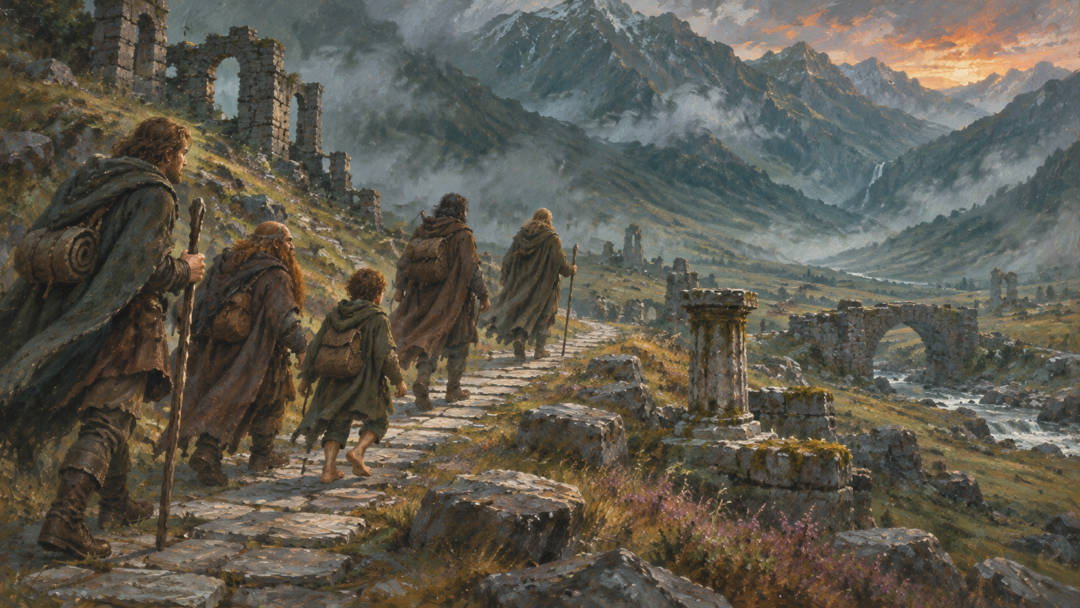
The resemblance was visible from the beginning. Early Dungeons & Dragons used hobbits and ents, names closely associated with Tolkien's fiction. The Strong preserves early game sets showing the original terms and editions that followed with replacements. Hobbits became halflings; ents became treants. Those changes are unusually tangible evidence that a piece of Middle-earth had traveled into a new medium, even if the resulting game was not set in Middle-earth.
The resemblance reaches further than names, though it becomes less exact with every comparison. Tolkien's hobbits are small people with ordinary appetites and habits, unexpectedly drawn into events of enormous consequence. They make enticing models for adventurers, but Bilbo and Frodo are not characters built to gain levels and equipment. Their particular choices, relationships, and limitations are the substance of their stories. A halfling player-character can resemble them without reenacting their roles.
Ents make the difference especially clear. Treebeard's march on Isengard follows the destruction of trees and the long frustration of a people dwindling in the world. A treant in a game can be a guardian, an ally, or an obstacle, depending on the campaign. The borrowed shape is recognizable; the narrative function is not fixed. Influence does not transfer every meaning.
Nor did Tolkien invent all the fantastic beings that appeared on gaming tables. Elves and dwarves had deep roots in older European traditions, which his fiction reshaped with distinctive languages, histories, and cultures. Gygax likewise drew from an assortment of sources. Early D&D looked Tolkienesque, but its universe also drew from folklore and pulp adventure.
The Worlds Tolkien Wanted to Make
For a firmer sense of his priorities, there is his 1951 letter to publisher Milton Waldman. Discussing the long development of his mythology, he wrote: “Behind my stories is now a nexus of languages (mostly only structurally sketched).” Names were not decoration added after the adventure. His invented tongues had histories that made peoples and places feel rooted in a continuous past.
That ambition changes how we read a map of Middle-earth. Rivendell and Gondor are not simply attractive destinations separated by dangerous terrain. Their names, ruins, memories, and peoples suggest ages of migration, loss, and survival. Moria is more than a dark place to explore: its halls preserve the grandeur of Khazad-dûm and the tragedy of Balin’s failed colony. Readers feel the weight of something older than the plot. A game master who spends evenings inventing forgotten kingdoms, local legends, and plausible place-names is working in a related imaginative territory.
In that same letter, Tolkien explained that another passion of his “was for myth (not allegory!) and for fairy-story, and above all for heroic legend on the brink of fairy-tale and history”. His legendarium was meant to connect grand mythic events with more intimate stories. The remote wars of the First Age form part of the background against which a hobbit's decision in a much later age can matter. Coherence is emotional as well as geographical: old griefs and old promises survive into the present.
One passage offers a particularly intriguing complication. He envisioned a connected body of legend in which some stories would be fully told and others only sketched, leaving room for other creative hands in painting, music, and drama. That is not an endorsement of role-playing games, but it challenges any caricature of him as demanding one rigid form. His own stated hope allowed artistic responses beyond prose, even though it tells us nothing definite about shared authorship at a gaming table.
Where Dungeons & Dragons Takes Another Road
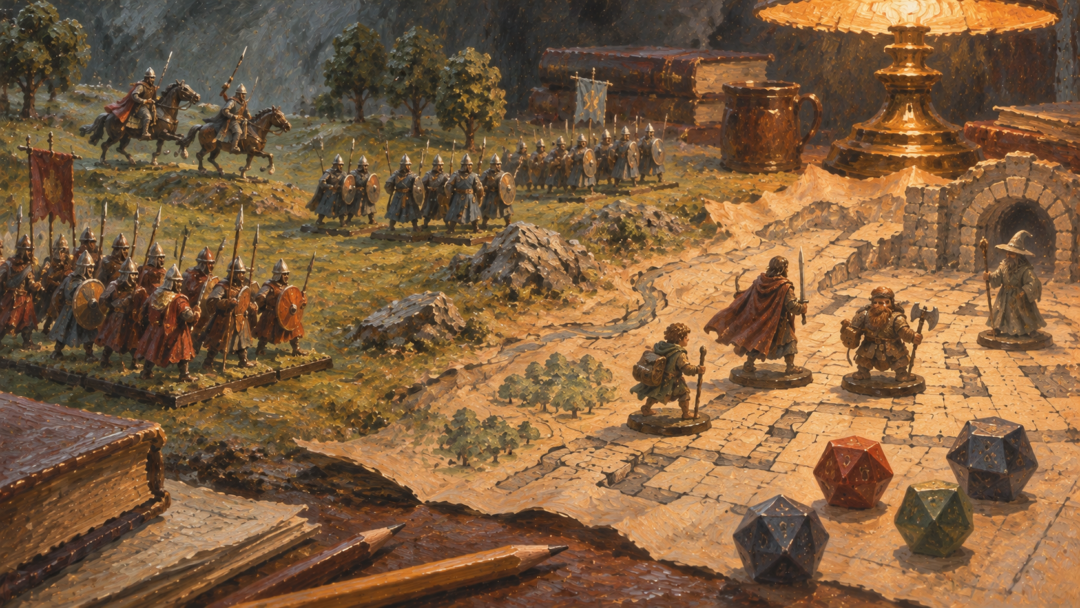
Gygax's account of his influences helps explain why the resemblance has limits. In an essay on Tolkien's impact, he said the novels' popularity encouraged him, while judging their overall creative influence on his games comparatively small. He emphasized Robert E. Howard, Fritz Leiber, Poul Anderson, H. P. Lovecraft, and other writers, alongside his enthusiasm for military simulation games. Those are the ingredients of sword-and-sorcery peril, tactical choices, and open-ended adventure, not an attempt to reproduce the structure of The Lord of the Rings.
Yet Gygax's comments cannot be reduced to a flat denial. He acknowledged substantial inspiration for game halflings from hobbits and recognized the striking conception of ents. The Strong also reports that in 2000 he described Tolkien's work as having a strong impact on the game's development. Those judgments emphasize borrowings, literary popularity, and the deeper mechanics of play. There is no need to select one sentence as the last word on a complicated inheritance.
Consider Gandalf. In the novel, his importance cannot be measured by how often he casts a spell. He counsels, gathers allies, resists temptation, and helps others act when their own courage falters. In D&D, a wizard's abilities operate under rules; the same spell may be used by many different characters. Gygax assessed some Tolkien characters by the needs of action-oriented play. That tells us about his design perspective, not how Tolkien would have rated game mechanics.
Role-playing places uncertainty elsewhere. The author of a finished novel can revise earlier chapters so a late revelation feels inevitable. Players make decisions before anyone knows how the adventure will end. A failed roll can send the party down a road no storyteller originally intended. Choosing to bargain with an enemy rather than fight can redirect the evening altogether. For a reader, this can look less like a crafted epic than a collection of detours; for a player, those detours may become the most memorable story of all. Neither form is obliged to imitate the other.
Adaptation, Ownership, and a Dispute After His Death
There is evidence that Tolkien cared intensely about what happened when his own stories were adapted. In a letter dated 10 August 1964, described in a Christie's auction listing, he objected to the prospect of a television dramatization of The Lord of the Rings because severe cutting might damage its closely woven narrative. His concern was specific: compressing an existing story for a different medium risked losing the connections that made it work. It was not a statement about games.
That distinction matters if we imagine a hypothetical campaign. Turning Frodo's journey into a sequence of encounters, with an alternate ending and a different cast, would be an adaptation of a particular literary work. Inventing an unrelated world in which friends explore ruins and negotiate with forest creatures is something else. The first raises questions about fidelity; the second can stand independently, even when inspired by Middle-earth. His 1964 letter settles neither case.
There was, however, a real confrontation over borrowed material. According to The Strong, rights representatives issued a cease-and-desist order in 1977, after which TSR changed terminology associated with Tolkien's works. The museum recounts a scholarly suggestion that another wargame, The Battle of Five Armies, helped draw legal attention: TSR had acquired rights to publish that game, whose title came directly from The Hobbit. The proposed trigger is an explanation offered by scholars, not an established cause proved by the available account.
The dates are decisive here. The legal action came almost four years after the novelist's death. Representatives protecting rights were making business and legal decisions; their choices cannot be converted into his personal opinion. Nor does changing hobbit to halfling prove that an author would have objected to every fantasy adventure played with pencil and paper. It shows that the use of particular material raised an ownership dispute, a narrower claim than moral or artistic disapproval.
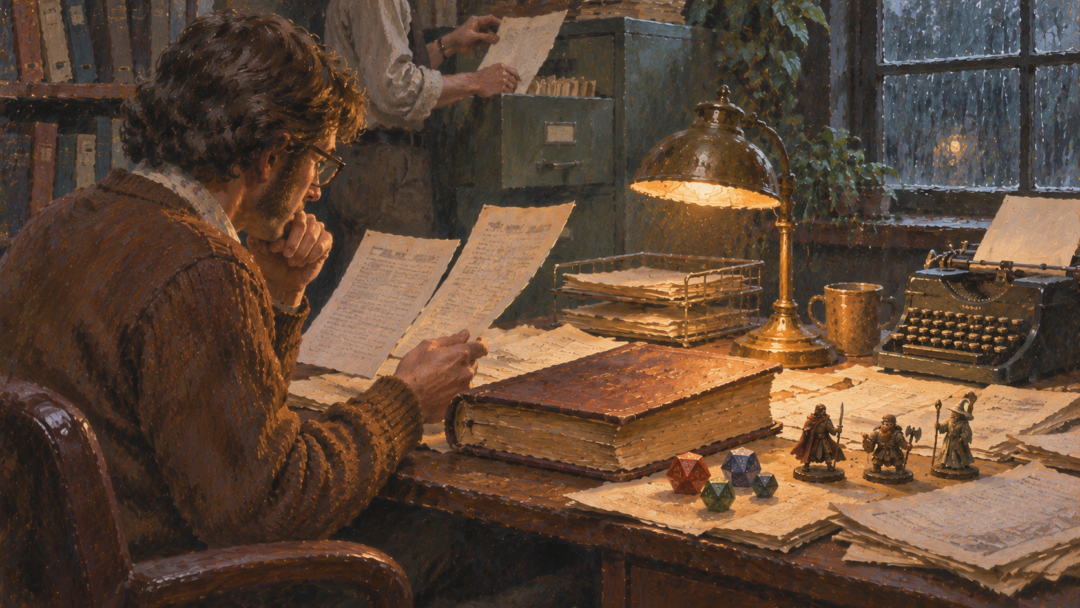
Three things remain solid: early D&D borrowed recognizable elements from Middle-earth; its creator prized language, myth, and coherence; and no documented response to the game appears in the evidence considered here. He might have found both delight and frustration in a table of players inventing their own legends. But the fitting final image is not the professor passing judgment. It is a fresh map unfolding beside the dice, full of paths he never had the chance to see.
Sources & Notes
This article is based on close reading and interpretation of Tolkien's published works and related source material where relevant.