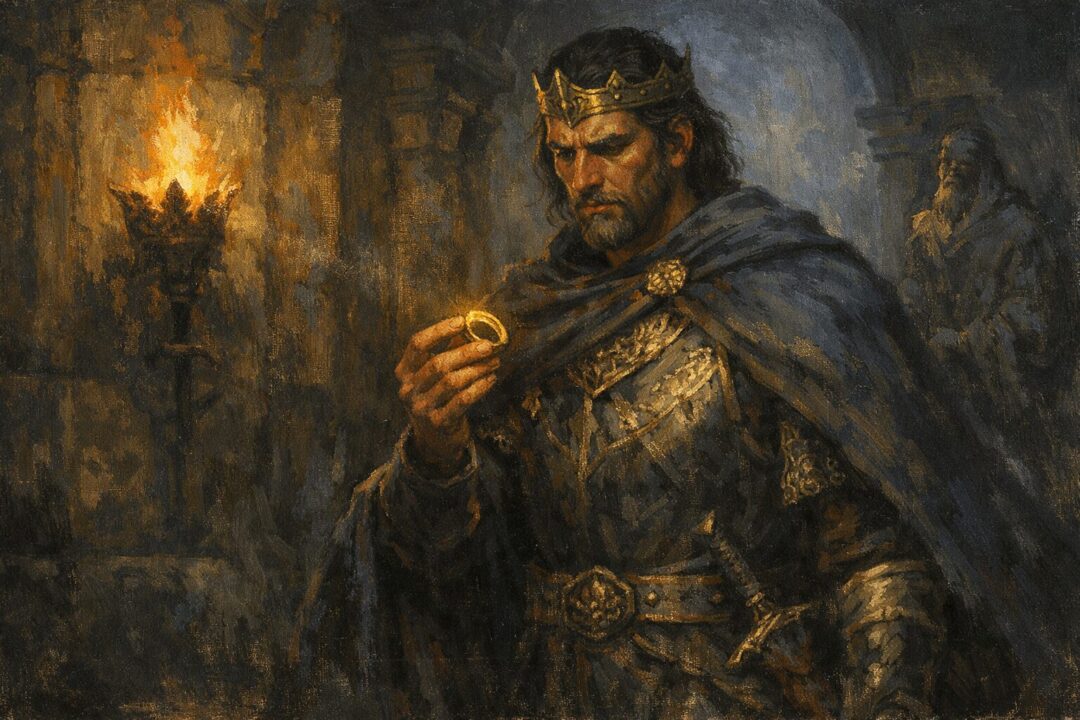
Among all the terrors of Middle-earth, few inspire the same dread as the Witch-king of Angmar.
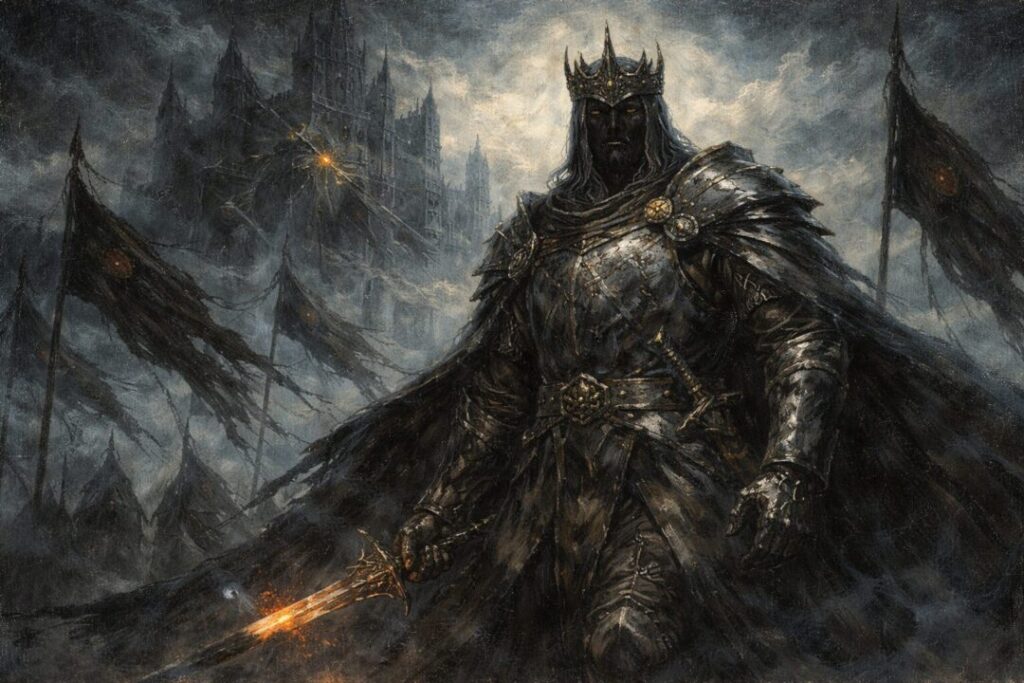
He shatters the gates of Minas Tirith.
He commands the Nazgûl with absolute authority.
He stands untouched by mortal blades, bound to a power that seems beyond death itself.
And yet, Tolkien’s most unsettling choice is not how powerful the Witch-king becomes—but how little we are told about who he once was.
Because the truth is this: the Witch-king was not born a wraith. He was once a Man of remarkable stature, and his fall was neither sudden nor inevitable. It was slow, deliberate, and frighteningly quiet.
A Lord of Númenórean Blood
Tolkien tells us that the Nazgûl were once kings, warriors, and sorcerers among Men. Several of them—possibly including the Witch-king himself—were Númenóreans, or descended from Númenórean bloodlines.
This matters.
The Númenóreans were not ordinary Men. They were the greatest civilization humanity ever produced in Tolkien’s world. Blessed with long life, wisdom, strength, and skill far beyond other peoples, they ruled vast lands along the coasts of Middle-earth. Their kings were mighty, their scholars unmatched, and their lineage carried a lingering echo of the West.
But the Númenóreans were also defined by a fatal flaw.
They feared death.
Even with lifespans far longer than other Men, they could not escape the knowledge that their years were numbered. Over time, this fear turned into resentment—and eventually into rebellion against the natural order of the world.
It is within this cultural context that the Rings of Power were offered.
For a Númenórean lord—already powerful, already respected—the Ring would not have appeared as a trap. It would have appeared as a solution.
A way to preserve rule.
A way to delay fading.
A way to hold on just a little longer.
Ambition, Not Desperation
One of the most important things to understand about the Witch-king’s fall is that it did not begin in weakness.
The Men who accepted the Nine Rings were not beggars or outcasts. They were already great. Kings with realms. Lords with followers. Sorcerers with knowledge.
The future Witch-king likely saw himself as worthy of such a gift.
In Tolkien’s world, evil rarely tempts by offering something new. It tempts by offering more of what someone already values.
Power becomes permanence.
Wisdom becomes mastery.
Authority becomes dominion.
At first, the Ring delivered exactly what it promised.
The Slow Nature of the Trap
This is where many modern interpretations go wrong.
The Nine Rings did not enslave their bearers overnight. Tolkien is clear that the process unfolded over many years—possibly even generations. The Rings extended life, enhanced authority, and sharpened perception. Their corruption was subtle, not violent.
The bearer did not feel evil.
He felt empowered.
Time seemed to slow.
Influence grew.
Fear of death receded—temporarily.
But the Ring also bound its bearer invisibly to Sauron. Each use weakened independence. Each year pulled the bearer further into the unseen world, where Sauron’s influence was strongest.
The tragedy is not that the Witch-king chose darkness in a single moment.
The tragedy is that he kept choosing not to let go.
When Identity Begins to Fade
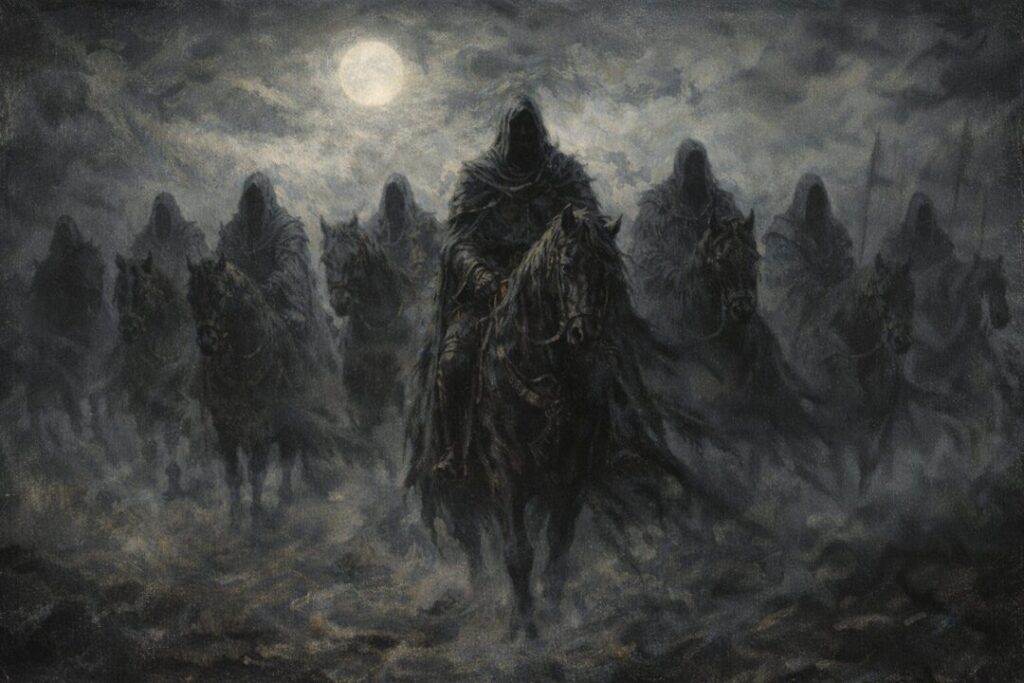
Over time, the Ring-bearers began to slip out of the mortal world. They became unseen to ordinary eyes, existing more fully in the shadow realm than in the physical one. Their wills diminished. Their fear deepened.
At some point—Tolkien never specifies when—the man who would become the Witch-king crossed a line he could no longer see.
His name vanished.
His face vanished.
Even his ability to die vanished.
This loss was not dramatic. It was not marked by ceremony or realization. Identity eroded quietly, until nothing remained but obedience and purpose.
What survived was function.
He was no longer a ruler with a realm.
He was no longer a man with a future.
He was a servant.
The Birth of the Witch-king
By the Third Age, Sauron no longer needed persuasion.
The Witch-king was entirely bound to him.
Sent north, he founded the realm of Angmar—not as a king of Men, but as a weapon. His mission was not conquest for its own sake, but annihilation: the slow destruction of Arnor and the bloodline of Isildur.
This is one of the most bitter ironies in Tolkien’s history.
The man who once sought to preserve power becomes an agent of ruin.
The man who feared death becomes something worse than dead.
The man who ruled becomes incapable of refusing command.
Angmar was not a kingdom in the human sense. It was a campaign of terror, sustained for centuries, designed to erase hope and fracture resistance through fear alone.
And the Witch-king was perfectly suited to this task—because fear had become his very essence.
Could He Have Resisted?
Tolkien never gives us a definitive answer.
But the timeline itself suggests something crucial: resistance was possible—for a time. The Rings worked gradually. The fall was not immediate.
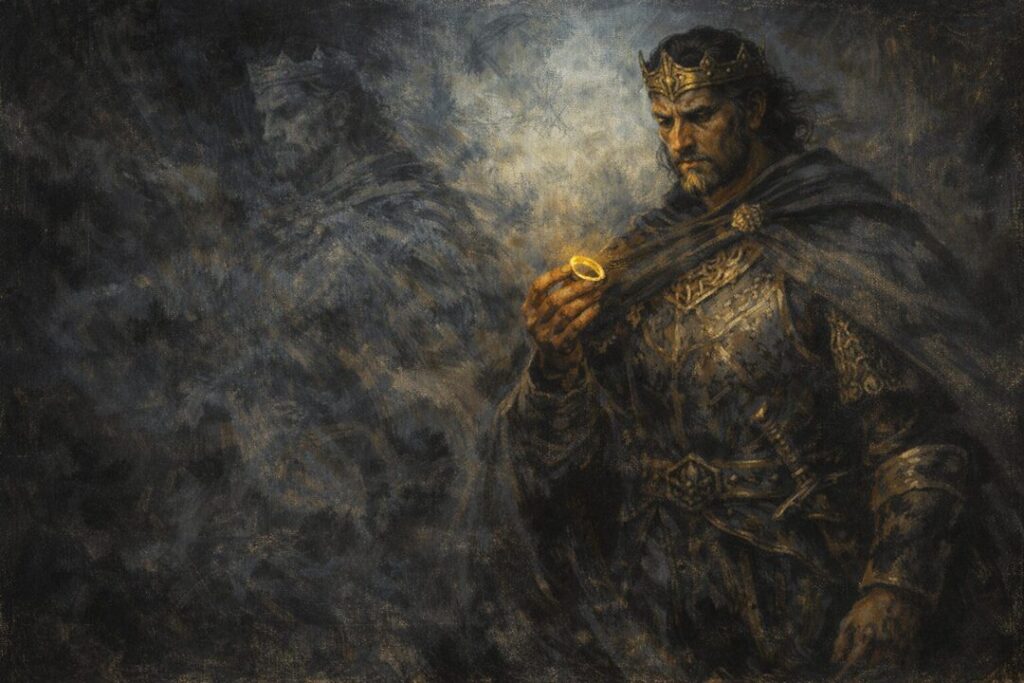
Which means that once, the Witch-king stood at a crossroads.
He could have relinquished the Ring.
He could have accepted mortality.
He could have stepped back from the promise of endless authority.
Instead, he chose endurance over surrender.
Power over humility.
Delay over acceptance.
That choice, repeated quietly across years, sealed his fate.
Why Tolkien Leaves This Unsaid
Tolkien does not dramatize the Witch-king’s fall because that is not how corruption works in Middle-earth.
Evil rarely arrives as a thunderclap.
It arrives as convenience.
As compromise.
As the refusal to let go when the time comes.
By the time the Witch-king appears in the story as a figure of terror, the tragedy is already complete.
The man is gone.
What remains is the consequence of long-avoided endings.
The Warning Beneath the Legend
The Witch-king’s story is not about monsters.
It is about Men who refuse to accept limits.
It is about the fear of death, the hunger for control, and the quiet belief that this rule should be the exception.
That is why Tolkien leaves his past unnamed.
Because the Witch-king could have been anyone powerful enough—and afraid enough—to take the Ring and keep it.
And in that silence, Tolkien leaves us with his most unsettling warning:
Evil does not begin with hatred.
It begins with refusal.
Refusal to let go.
Refusal to accept loss.
Refusal to end.
And once that refusal hardens into identity, the man is already lost.