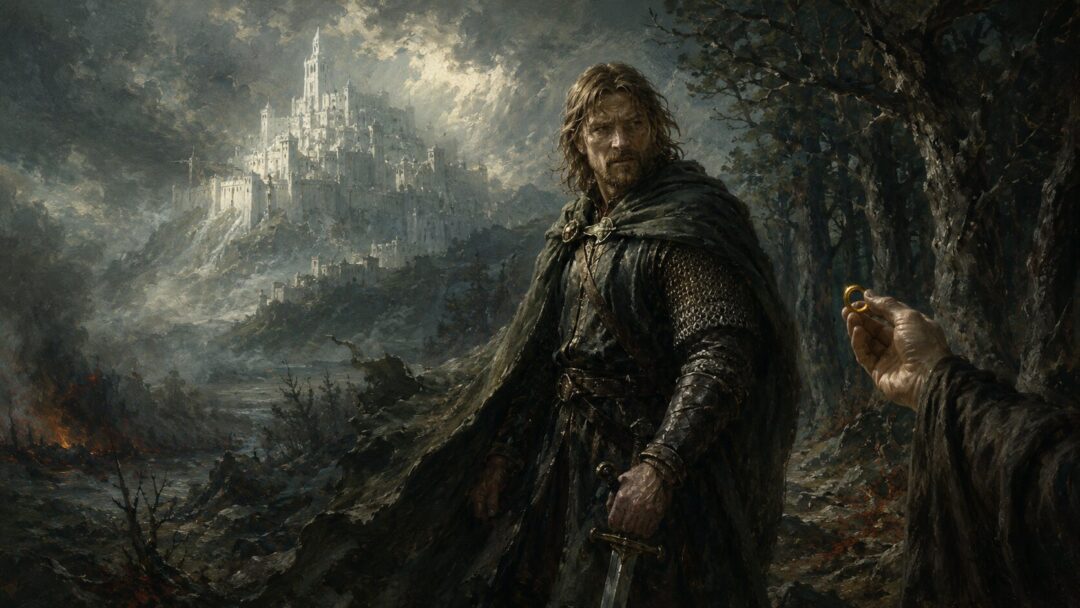
The One Ring is often imagined as a simple lure: a golden circle promising power to anyone foolish enough to want it. But Boromir’s fall is more troubling than ordinary greed. He does not first look at the Ring and dream of palaces, treasure, long life, or private dominion. He thinks of Minas Tirith. He thinks of walls, soldiers, fathers, sons, and the long war against Mordor. His temptation begins in one of his noblest qualities: the fierce desire to defend his people.
That is why Boromir’s tragedy cuts so deeply. The Ring did not need to invent a darkness in him from nothing. The texts imply something more dangerous: it found a real virtue, pressed on it, magnified it, and bent it until love of country began to sound like a claim of ownership over someone else’s burden.
Boromir’s Virtue Was Not False
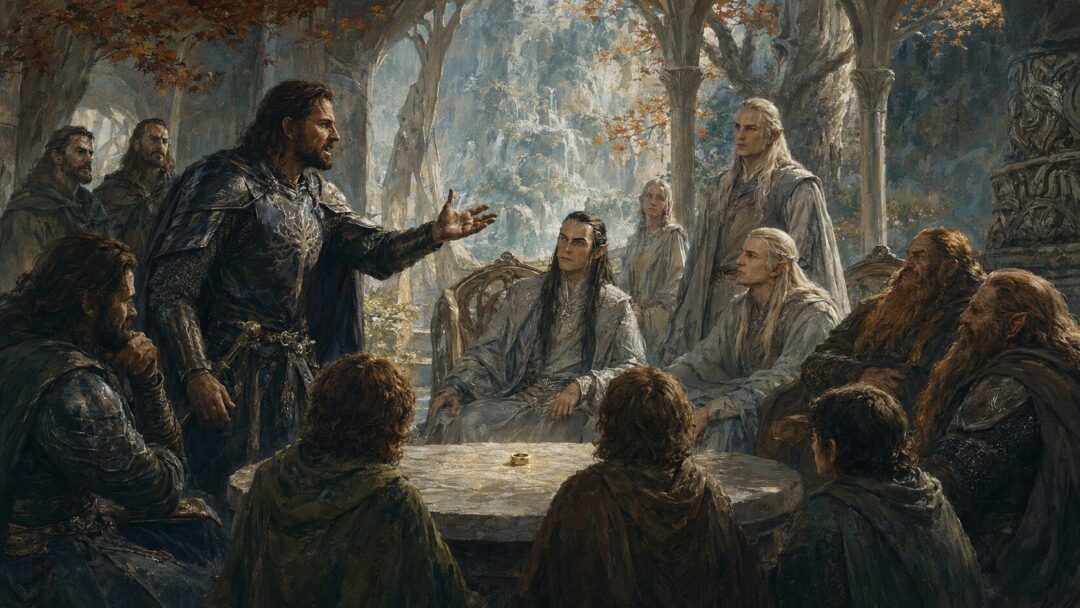
Boromir enters the story as a man of Gondor under pressure. He is no idle prince seeking glory for its own sake. He comes to the Council of Elrond after the strange dream that also came to Faramir, bearing the urgency of a realm that has long stood near the Shadow. At the Council, he speaks from the perspective of a soldier whose land has paid for the safety of others with blood, vigilance, and loss.
That context matters. Boromir’s love for Gondor is not treated as ridiculous. Gondor really is under threat. Mordor really is rising. Minas Tirith really does stand as one of the great barriers against Sauron’s return. Boromir’s courage, physical strength, and loyalty to his city are not inventions of the Ring. They are part of who he is before the Ring ever comes close to him.
This is why his fall should not be reduced to “Boromir was weak.” He was vulnerable, but his vulnerability came through a virtue placed under unbearable strain. The stronger his duty felt, the easier it became for the Ring to offer him a corrupted version of that duty.
The Ring Does Not Tempt Everyone the Same Way
The One Ring is not merely an invisibility device or a magical weapon waiting to be used by the wise. It was made by Sauron and belongs, in its deepest purpose, to domination. The Council understands this. Elrond rejects the idea that the Free Peoples can simply wield the Ring against its maker. The danger is not only that the Ring might reveal itself to Sauron, but that its use would corrupt the user according to the logic of its making.
The Ring tempts through desire. It does not have to offer the same dream to every bearer or potential bearer. To Gollum, it becomes possession and secrecy. To Galadriel, the danger appears in the image of overwhelming power and worshipful rule. To Sam, briefly, it touches even his humble love of growing things and enlarges it into a vision far beyond ordinary gardening. These moments suggest a pattern: the Ring reaches toward what the heart already values.
For Boromir, that value is Gondor’s survival.
He does not argue at the Council like someone seeking evil for evil’s sake. He argues like a captain who cannot understand why a weapon should be thrown away when his people are desperate. From a purely military angle, his question has force: if the Enemy fears this thing, why not use it? But Middle-earth is not governed only by battlefield logic. Some weapons change the hand that grasps them.
“Strength” Becomes the Trap
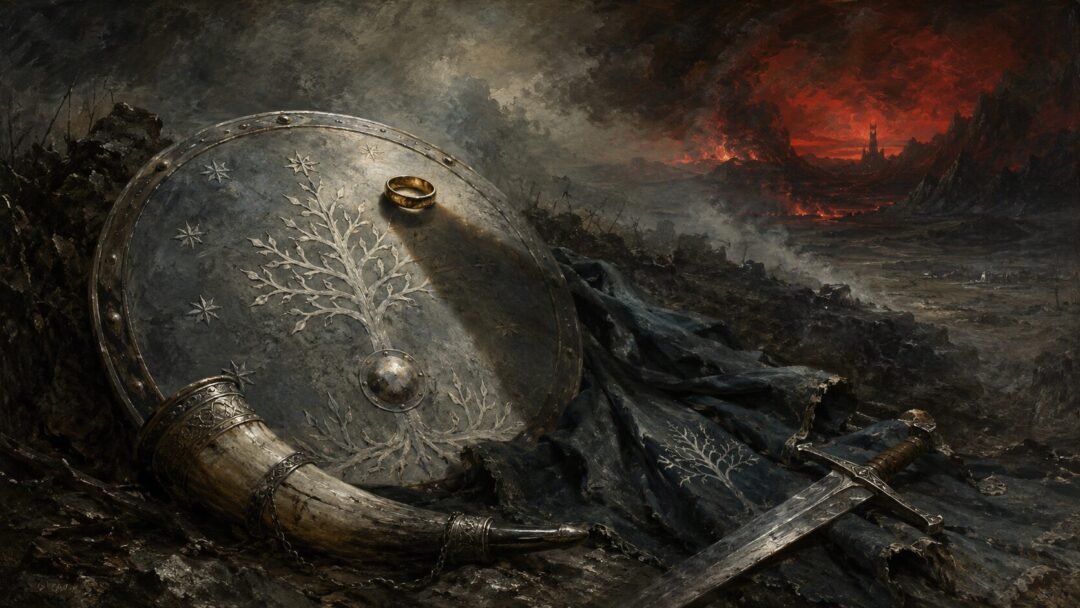
Boromir’s famous mistake is not cowardice. It is the belief that strength can remain pure while using an evil thing for a good end. He sees valour, need, and power as parts of one chain: Gondor is valiant, valour needs strength, and strength needs a weapon. The Ring slides neatly into that reasoning.
That is the subtle horror. The Ring does not need Boromir to stop loving Gondor. It only needs him to believe that love gives him the right to override the appointed path of the Ring-bearer. It turns protection into pressure. It turns urgency into entitlement. It turns “my people must be saved” into “therefore I may take what is not mine.”
Boromir’s strongest virtue is his willingness to stand between his home and destruction. Yet under the Ring’s influence, that same willingness begins to deform. If he is the shield of Gondor, then perhaps he must seize the one weapon that might save it. If others do not understand the war as he does, perhaps they are naïve. If Frodo refuses, perhaps Frodo must be compelled for the good of all.
The texts do not require us to imagine the Ring whispering specific words into Boromir’s ear. It is enough to see the moral movement. His good desire becomes impatient. His patriotism becomes possessive. His courage becomes aggression.
The Council Shows the Fault Line Early
Boromir’s fall at Amon Hen does not come out of nowhere. The fault line appears at the Council of Elrond. He is told that the Ring cannot be safely used, yet the answer never fully satisfies the part of him shaped by siege, command, and immediate danger.
This is understandable, though dangerous. The Wise speak from long knowledge of the Ring’s nature. Boromir speaks from the front line of a war. He has seen what delay costs. He has every reason to mistrust plans that sound, to a soldier, like surrendering the strongest piece on the board.
But the Quest is built on a paradox that Boromir struggles to accept: the Ring must not be used, even in desperation. Victory will come not through seizing power but through renouncing it. For a warrior of Gondor, trained to defend stone by stone and field by field, this is a terrible lesson. The very thing that makes him admirable also makes the Quest almost unbearable to him.
Frodo Becomes the Point of Pressure
By the time the Fellowship reaches the breaking point, Frodo is no longer simply a companion to Boromir. He has become, in Boromir’s tempted imagination, the small figure standing between Gondor and salvation. That is a crucial corruption. The Ring makes the Ring-bearer appear not as someone carrying a burden, but as someone withholding a necessary answer.
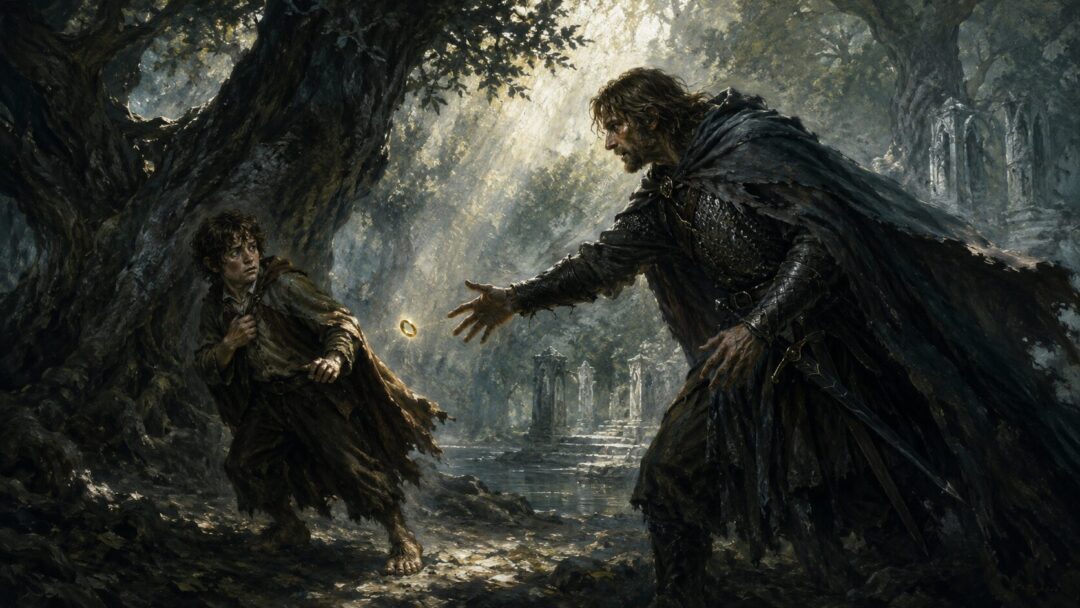
At Amon Hen, Boromir first tries persuasion. This matters. He does not begin with a drawn sword. He reasons, pleads, and frames his desire as service. He speaks of using the Ring against the Enemy and saving his people. But when Frodo refuses, Boromir’s language and behavior darken. The pressure rises. The protector becomes a threat.
That moment exposes the Ring’s method with terrible clarity. Boromir can still tell himself he wants the Ring for Gondor. He can still imagine his motive as noble. Yet his actual deed turns against innocence. He frightens the very person he should protect. The moral contradiction breaks into the open: if saving Gondor requires assaulting the Ring-bearer, then the imagined salvation has already begun to rot.
The Ring Did Not Erase Boromir
One reason Boromir remains so compelling is that his failure is not final proof that he was secretly evil. The Ring overcomes him for a moment, but it does not erase him. After Frodo escapes, Boromir comes back to himself. His repentance is immediate and painful. He recognizes that he has done wrong.
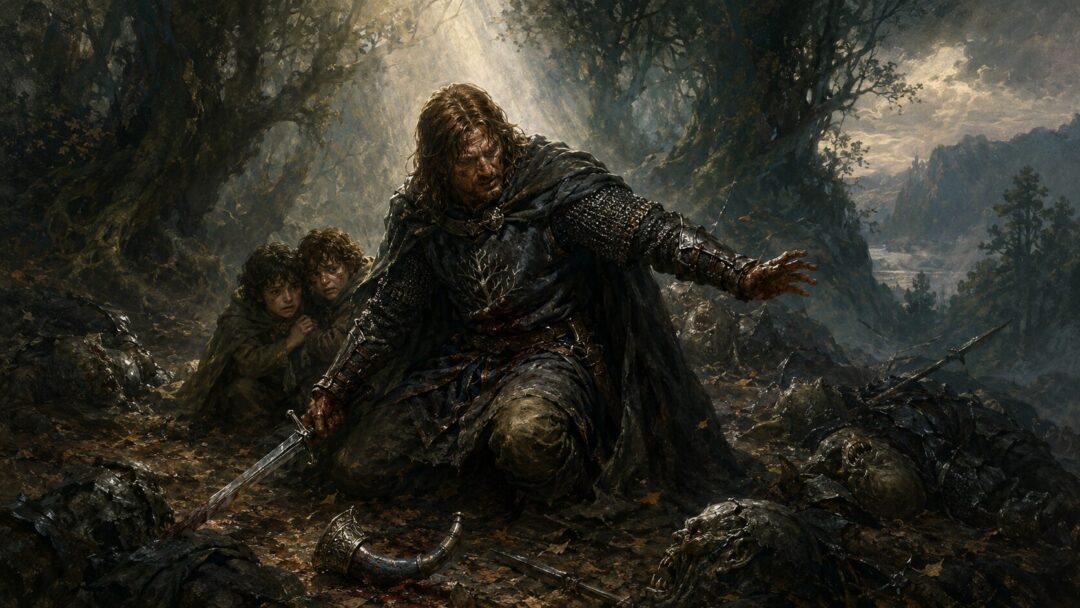
His final actions matter as much as his failure. When Orcs attack, Boromir defends Merry and Pippin. He blows the great horn. He fights until he is overwhelmed. His death is not a neat cancellation of his sin, but it is a true return to his best self. He becomes again what he was meant to be: a defender who spends his strength for the vulnerable rather than seizing power in their name.
His confession to Aragorn is also essential. Boromir does not excuse himself by saying only that the Ring made him do it. He admits that he tried to take the Ring from Frodo. That honesty restores moral weight to his character. He was tempted. He fell. He repented. He died defending others.
Why Boromir’s Fall Is So Human
Boromir’s tragedy is frightening because it does not begin with an obviously wicked desire. Many readers can understand him. If your city were facing annihilation, if your people had held the line for generations, if a weapon of unimaginable power lay within reach, would destroying it seem wise—or mad?
That is the human tension at the center of his story. Boromir is wrong, but not absurd. He is tempted at the exact place where fear and responsibility meet. The Ring offers him a way to end helplessness. It tells him, in effect, that refusing power is betrayal, and that taking power is duty.
This is one of the deepest patterns in the story of the Ring. Evil does not always approach as cruelty. Sometimes it approaches as necessity. It says there is no other choice. It says mercy is weakness, humility is delay, and restraint is irresponsibility. For Boromir, the lie wears the face of Gondor’s need.
The Strongest Virtue, Bent Sideways
So did the Ring “choose” Boromir’s strongest virtue? Tolkien never states it in such mechanical terms, and the Ring should not be treated as a modern psychological machine. But as an interpretation, the phrase captures something true to the pattern of the text. Boromir’s love for Gondor is the place where temptation finds him. His protective courage becomes the road by which corruption enters.
The tragedy is not that virtue is secretly bad. It is that virtue without humility can be bent. Love of home can become possessiveness. Courage can become domination. Duty can become an excuse to silence conscience. The Ring does not create those dangers from nothing, but it draws them out and gives them a heroic mask.
Boromir’s story endures because it refuses easy judgment. He is neither a mere villain nor an innocent puppet. He is a great man who falls through the distortion of something genuinely noble. And in the end, he is also a man who turns back.
The Ring broke him by reaching for his strength. But it did not get the last word on who he was.
Sources & Notes
- J.R.R. Tolkien, The Fellowship of the Ring, Book II, Chapter 2, “The Council of Elrond” — Boromir speaks for Gondor’s peril and argues that the Ring might be used against Mordor.
- J.R.R. Tolkien, The Fellowship of the Ring, Book II, Chapter 10, “The Breaking of the Fellowship” — Boromir presses Frodo for the Ring at Amon Hen, then repents after Frodo escapes.
- J.R.R. Tolkien, The Two Towers, Book III, Chapter 1, “The Departure of Boromir” — Boromir’s confession to Aragorn and his death defending Merry and Pippin complete the pattern of fall and return.
- J.R.R. Tolkien, The Fellowship of the Ring, Book II, Chapter 7, “The Mirror of Galadriel,” and J.R.R. Tolkien, The Return of the King, Book VI, Chapter 1, “The Tower of Cirith Ungol” — Galadriel’s and Sam’s brief temptations show the Ring magnifying desires already present.
- J.R.R. Tolkien, The Silmarillion, “Of the Rings of Power and the Third Age,” and J.R.R. Tolkien, The Letters of J.R.R. Tolkien, Letter 131 — the Ring’s purpose is bound to Sauron’s will to domination, making “using it for good” morally perilous.