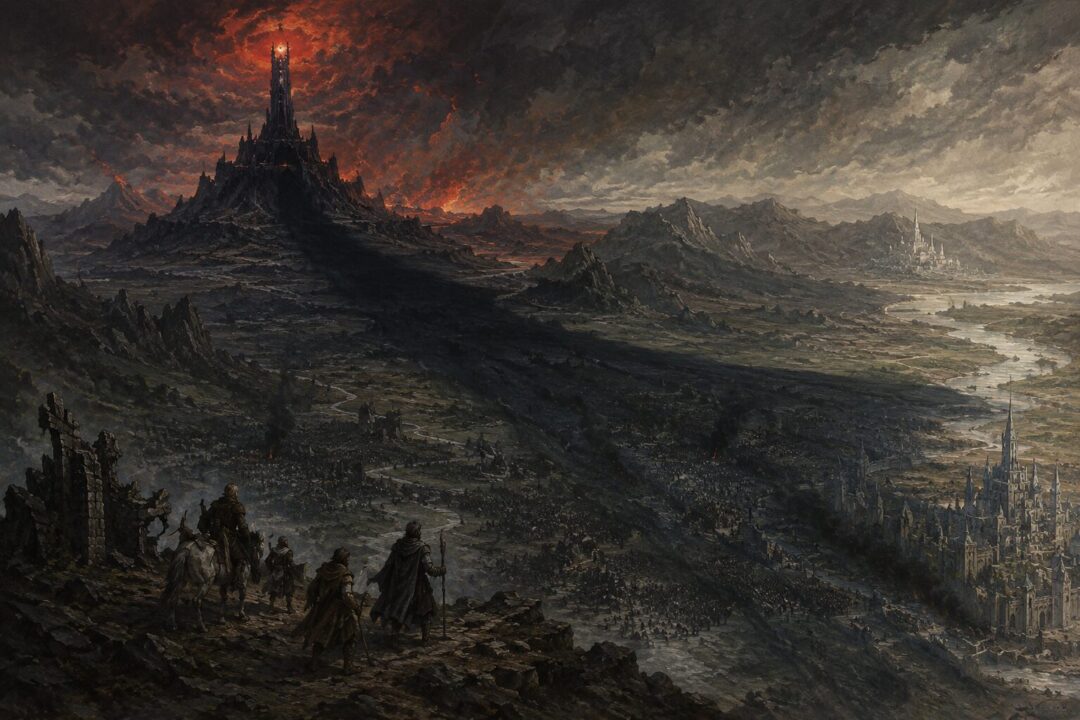
The Dark Lord is often imagined as an armored tyrant: towering, crowned, holding terrible power in his hand. Yet some of Sauron’s most frightening moments in Middle-earth come precisely when he lacks a visible body.
No throne room confrontation ends The Lord of the Rings. No duel with the Dark Lord decides the age. Instead, Sauron rules through rumor, distance, fear, corrupted wills, and an Eye that almost no one fully sees. That absence matters. Without a body, Sauron becomes less like a conqueror who can be killed and more like a pressure that seeps into thought, politics, geography, and desire itself.
Paradoxically, Sauron may have become more terrifying after losing the kind of physical presence readers expect from a fantasy villain.
The Fear of the Unseen Enemy
In Middle-earth, evil often grows more dreadful when it cannot be fully perceived.
The Nazgûl are frightening not because readers receive detailed anatomical descriptions, but because they blur the boundary between seen and unseen existence. The Dead Marshes terrify through uncertainty and memory. Moria becomes dreadful long before the Fellowship understands what waits beneath the mountain.
Sauron without a clearly encountered body belongs to this same pattern.
By the end of the Third Age, Sauron is undeniably embodied in some form. Gollum reports that he has only “four fingers on the Black Hand,” implying a physical shape after his return to Mordor. Yet the narrative almost never allows direct access to that body. This is a crucial distinction.
Sauron is present everywhere and nowhere.
He is the shadow behind military movements, the will directing spies, the pressure invading dreams, the force searching endlessly for the Ring. Characters react to him constantly, but almost nobody stands before him. That distance magnifies terror.
An enemy with a face can be challenged. An enemy who exists mainly as influence becomes harder to measure — and therefore harder to resist.
The Eye Was More Than an Eyeball
Popular culture sometimes reduces Sauron’s later form to a literal giant flaming eye. The texts are more nuanced.
The “Eye” functions repeatedly as a symbol of Sauron’s searching, dominating will.
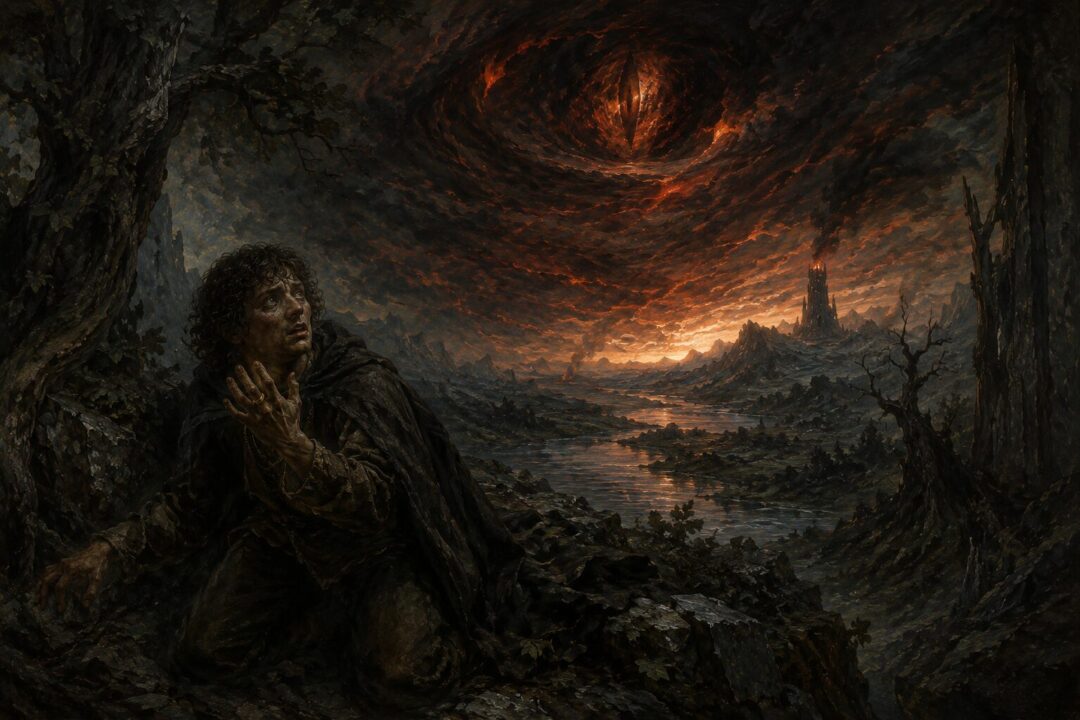
Frodo experiences the sensation of being hunted by a terrible attention. Galadriel speaks of perceiving the Dark Lord’s mind while resisting it. Aragorn dares to reveal himself through the palantír partly because Sauron’s gaze is strategic: powerful, but not omniscient.
The Eye represents relentless awareness.
That matters because awareness itself becomes frightening in Middle-earth. Sauron does not merely destroy cities. He wants knowledge, surveillance, control, and total ordering of resistance beneath his authority.
A king on a battlefield threatens your life.
A will that can search across continents for weakness threatens identity, secrecy, trust, and freedom.
The terror deepens because Sauron’s perception is incomplete. He misunderstands mercy, sacrifice, and voluntary renunciation. Yet his enemies do not know the limits of his sight. They must act under the assumption that the Eye could discover them at any moment.
Fear thrives in uncertainty.
Losing Fair Form Made Sauron More Dangerous
Earlier in his history, Sauron possessed something unexpectedly vulnerable: beauty.
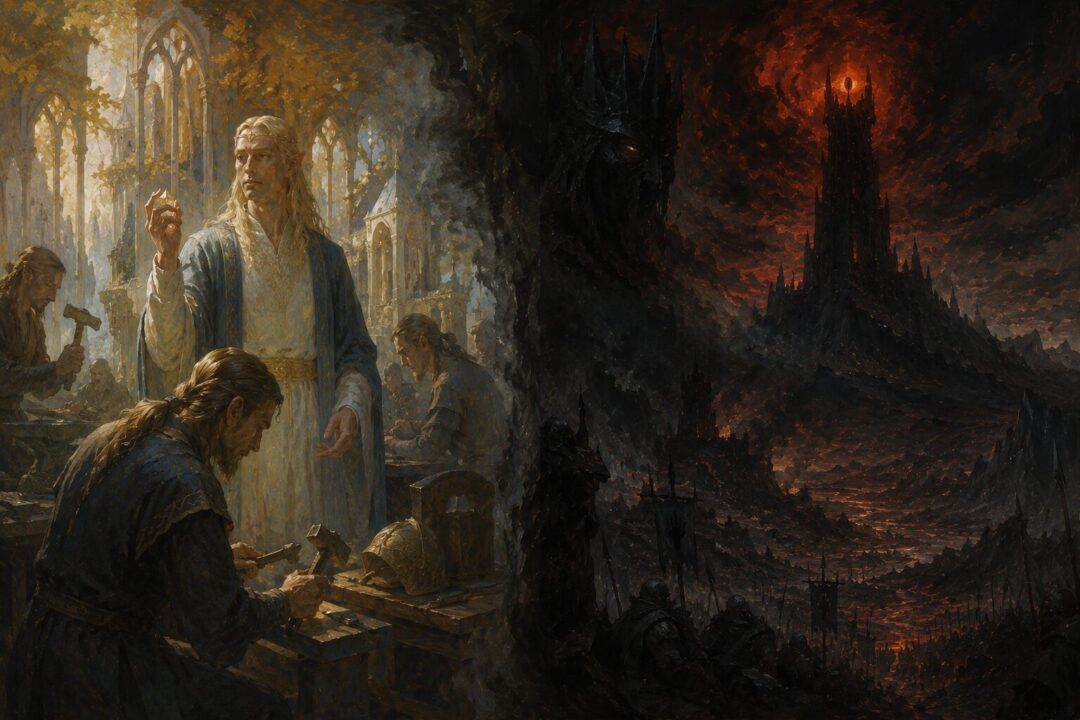
In the Second Age, he appears in fair form as Annatar, the “Lord of Gifts,” deceiving the Elves of Eregion through persuasion rather than open domination. His danger lies in charm, technical knowledge, and promises of order and achievement.
But after the downfall of Númenor, the texts state that he could no longer appear fair.
At first glance, this seems like a weakening.
In one sense, it was. Sauron lost an important tool of deception. He could no longer easily masquerade as benevolent wisdom.
Yet there is another reading grounded in the trajectory of the legendarium: once stripped of beauty, Sauron no longer needed to maintain the illusion of goodness.
He could become pure coercive power.
The kingdoms opposing him in the Third Age are not seduced by claims that he is a misunderstood benefactor. They know what he is. But that clarity does not make him easier to resist.
Instead, fear changes form.
Sauron becomes the enemy whose armies darken horizons, whose emissaries demand submission, whose influence corrodes already-fractured societies. Gondor fears invasion. Rohan fears isolation. Saruman imitates his methods. Even distant peoples must position themselves relative to his expanding shadow.
Without the soft mask of Annatar, Sauron evolves into something more elemental: domination openly acknowledged.
The Psychological War Was Worse Than the Physical One
One of the most overlooked aspects of Sauron’s terror is how often he wins without direct violence.
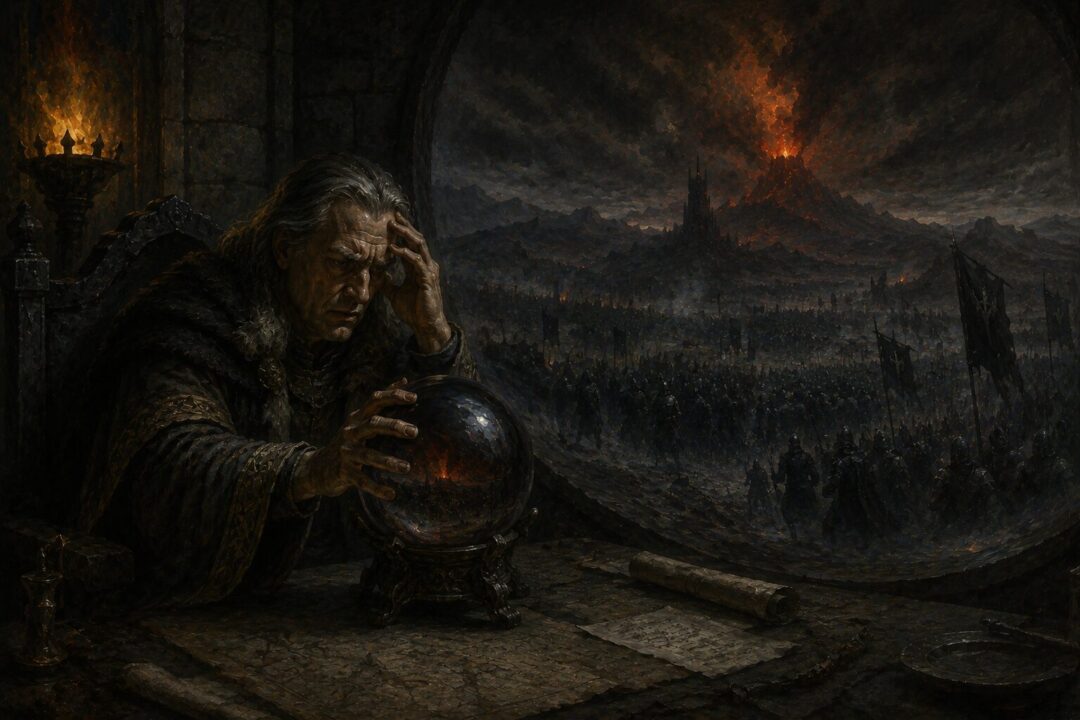
He manipulates Denethor through the palantír — not necessarily by telling direct lies, but by controlling what is shown and exploiting despair. Denethor sees real dangers but loses proportion, hope, and judgment.
That distinction is important.
Sauron does not always need falsehood when selective truth can break resistance more efficiently.
Saruman offers another example. Though not controlled like a puppet, he becomes spiritually aligned with Sauron’s logic: centralized power, industrial domination, contempt for weakness, belief that moral compromise is practical necessity.
Even Boromir, noble and courageous, falls under the gravitational pull of Sauron’s greatest psychological weapon: the idea that power must be used to defeat power.
Sauron’s most devastating victories occur inside minds before they appear on battlefields.
A visible monster can be fought with swords.
A worldview that infiltrates honorable people is far more difficult to defeat.
This is partly why the destruction of the Ring requires something almost inconceivable within Sauron’s assumptions: a mission centered not on wielding supreme power but on surrendering it.
He cannot fully imagine such a choice.
Why Not Seeing Sauron Makes the Story Stronger
Narratively, Sauron’s limited physical presence creates a specific kind of dread.
Readers encounter him largely through consequences.
Ruined lands. Militarized industry. Corrupted servants. Refugees. Ancient fear returning. The exhaustion of peoples who know they may be living through the final failure of the West.
This technique mirrors how enormous political or existential threats often function in real life. People rarely confront the ultimate source directly. They experience systems, pressures, shortages, propaganda, fear, and moral compromise.
Sauron becomes terrifying because he exceeds ordinary villain mechanics.
He is not simply “the strongest fighter.”
He is the organizing intelligence behind a civilization of domination.
The geography of Mordor reflects this. The ash, fortifications, labor, surveillance, and weaponized logistics all communicate a power that extends beyond one body. Even if a sword could strike Sauron’s flesh, the machinery of his will has already transformed entire regions.
The absence of a conventional final confrontation reinforces this truth.
The War of the Ring is not won by overpowering Sauron personally.
It is won by exploiting the hidden flaw in his understanding of power.
A Bodiless Enemy Feels Closer to Human Experience
There is also a deeper human reason why Sauron without a visible body unsettles readers.
Many of the most frightening forces in life do not wear identifiable faces.
Corruption spreads institutionally. Fear alters societies invisibly. Pride reshapes decisions long before catastrophe becomes visible. Systems of domination often persist through bureaucracy, surveillance, incentives, despair, and internalized obedience rather than through constant visible violence.
Sauron in the Third Age resembles this pattern more than a traditional battlefield tyrant.
He becomes a hostile presence woven into daily reality.
Farmers flee war zones they cannot fully comprehend. Rulers make decisions under unbearable pressure. Travelers alter routes because certain lands have grown spiritually dangerous. The shadow affects lives far from Barad-dûr.
That reach matters.
A villain confined to one body occupies one location.
A will diffused through fear, institutions, servants, symbols, and psychological pressure can dominate an entire world.
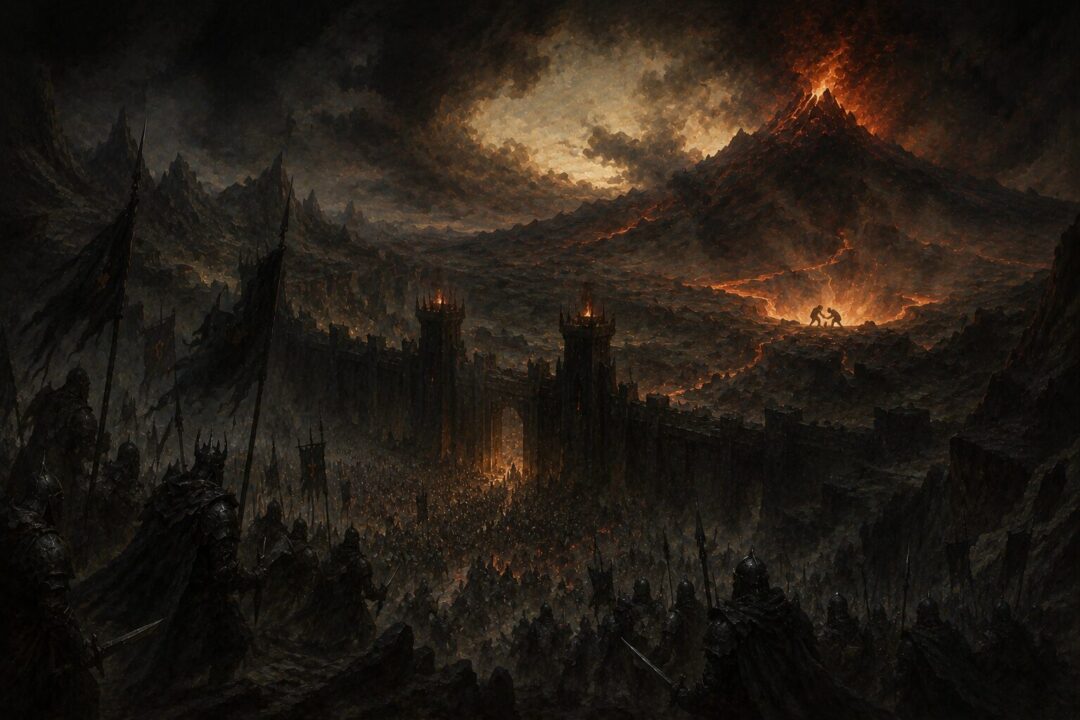
The Greatest Irony: Sauron’s Strength Reveals His Weakness
Yet the same bodiless terror that makes Sauron so frightening also exposes his fatal limitation.
Because he increasingly understands reality through domination, he assumes others do likewise.
When Aragorn reveals himself in the palantír, Sauron interprets events through the logic he knows: a rival power claiming the Ring.
When armies march toward the Black Gate, he reads challenge, diversion, military ambition.
What he struggles to imagine is deliberate weakness chosen for moral purpose.
His inability to conceive of willingly destroying absolute power becomes the central strategic blind spot of the age.
Ironically, becoming an almost abstract force of control makes Sauron less capable of understanding the very qualities that defeat him: pity, humility, endurance, and renunciation.
That may be the deepest reason his diminished physical presence increases his terror.
Without a visible body, Sauron becomes larger than a man, larger than a king, larger even than a monster.
He becomes the shadow cast by domination itself.
And shadows are hardest to fight when they no longer seem to come from a single source.
Sources & Notes
- J.R.R. Tolkien, The Lord of the Rings, Book V, Chapter 10, “The Black Gate Opens” — Gandalf’s remark about the “Black Hand” having only four fingers supports the article’s point that late Third Age Sauron is embodied but kept at a terrifying narrative distance.
- J.R.R. Tolkien, The Lord of the Rings, Book II, Chapter 7, “The Mirror of Galadriel,” and Book II, Chapter 10, “The Breaking of the Fellowship” — Frodo’s encounters with the searching Eye frame Sauron chiefly as attention, pressure, and will rather than as a conventional battlefield opponent.
- J.R.R. Tolkien, The Silmarillion, “Of the Rings of Power and the Third Age” — Sauron’s fair-seeming role as Annatar, the forging of the Rings, and his later rule from Mordor give the article its contrast between seductive disguise and open domination.
- J.R.R. Tolkien, The Silmarillion, “Akallabêth” — after Númenor’s downfall, Sauron can no longer take a fair form, matching the article’s discussion of beauty lost and coercive terror made plainer.
- J.R.R. Tolkien, The Letters of J.R.R. Tolkien, Letter 131 — Tolkien’s account of Sauron’s desire to order and dominate others supports the article’s storycraft reading of Sauron as a will of control, not merely a physical monster.