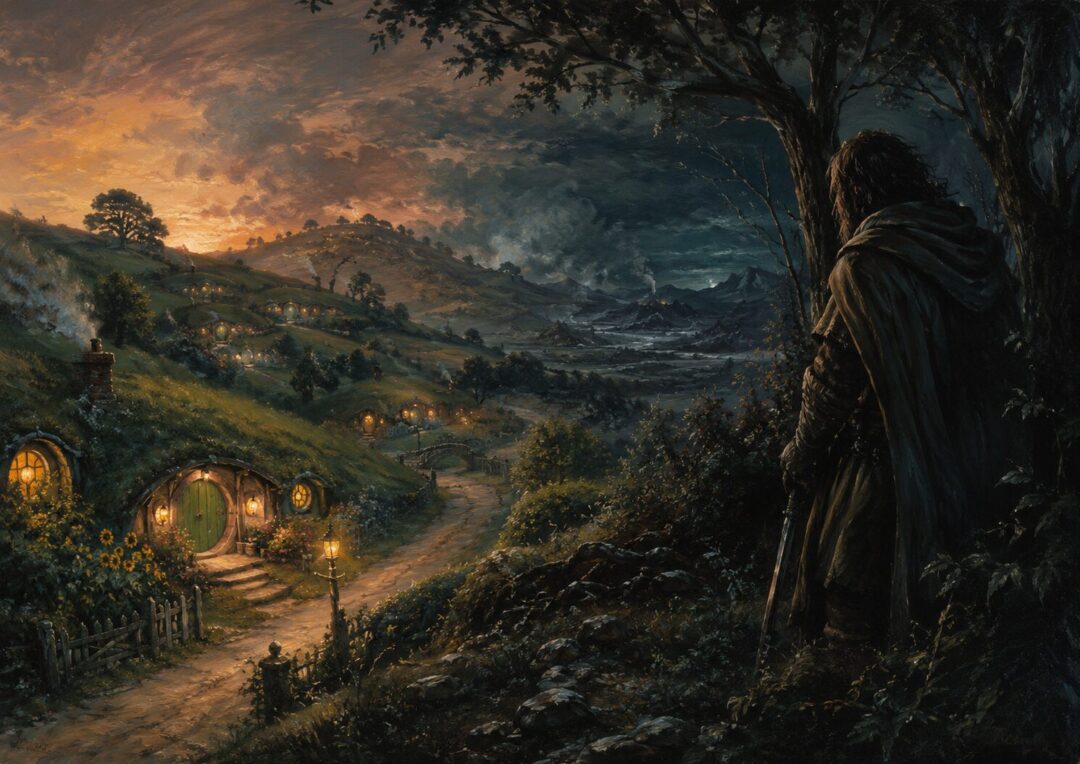
Bag End looks, at first, like the last place in Middle-earth where the fate of the world should be decided.
It has a round green door, a pantry worth remembering, and a master who cares more about visitors, walking parties, and the comfort of his own chair than about kingdoms in exile or wars in the East. The Shire itself seems almost designed to be overlooked: fields, hedges, mills, inns, birthday parties, pipe-weed, family gossip, and a population that mostly wishes the outside world would remain outside.
That is why it is easy to misunderstand the Shire’s safety.
The Shire was not safe because it was unimportant. By the time of The Lord of the Rings, it was one of the most important places in Middle-earth, though almost no one there understood why. Its peace was real, but it was not self-created. Its innocence was precious, but it was not invulnerable. And its apparent insignificance was not the same thing as protection.
The deeper truth is more uncomfortable: the Shire survived because other people watched the darkness for it.
The Illusion of a Small Place
The hobbits of the Shire largely believed they lived outside history. That belief is part of their charm, but also part of their blindness.
They knew old stories existed. They had heard of kings, wars, Elves, Dwarves, and strange lands beyond their borders. Dwarves still passed through on the East Road. Elves were sometimes glimpsed by those who paid attention. But for most hobbits, these things belonged to rumor rather than daily life. The Shire had become so comfortable that it mistook comfort for the natural order of the world.
The Prologue to The Lord of the Rings makes this point quietly but sharply. Hobbits had come to enjoy peace and plenty so long that they increasingly forgot the labor that made such peace possible. They were sheltered, but they did not remember the shelterers.
That distinction matters.
A land may feel peaceful from inside the fence, but that does not mean danger has vanished. It may only mean danger is being held back somewhere else. The Shire’s tragedy is that its people had inherited a long peace without understanding its cost.
The Shire Was Hidden, Not Irrelevant
The Shire’s modesty did protect it in one sense. It was not Gondor, standing openly against Mordor. It was not Rivendell, known to the Wise. It was not Lórien, preserved by Elven power. It had no great army, no lordly court, no famous stronghold, and no treasure that would obviously draw the eyes of the ambitious.
But being overlooked is not the same as being worthless.
The Shire was remote from the main roads of power, yet it was not outside the world. Gildor’s warning to Frodo expresses this perfectly: the wide world surrounds the Shire, and no people can fence it out forever. That is one of the great hidden rules of The Lord of the Rings. No homeland remains pure simply by pretending the rest of the world does not exist.
This is why the Shire’s peace carries a kind of tragic irony. Hobbits are not wrong to love gardens, meals, family, and ordinary pleasures. In fact, the story deeply honors those things. But the Shire’s ordinariness becomes dangerous when it hardens into ignorance. A small country can still be touched by enormous events. A quiet home can still contain the One Ring.
The Rangers Were the Unseen Wall
The clearest answer to the Shire’s safety is the Dúnedain of the North.
The Rangers are often treated by ordinary folk as suspicious wanderers: weather-worn, grim, poorly understood, and not especially welcome. In Bree, “Ranger” is almost a term of distrust. Yet these same hidden people are among the chief reasons the peaceful lands of the northwest are not overrun by darker things.
Aragorn’s words at the Council of Elrond reveal the moral burden of this hidden protection. If simple people are free from care and fear, then they remain simple; but those who guard them must often remain secret in order to keep them so. That is not a boast. It is a lonely truth.
The Shire did not maintain its safety by its own strength. Its internal defenses were almost comically small. The Shirriffs were more concerned with local order than warfare. The Bounders watched borders, but they were not a military force capable of resisting the great evils moving in the wider world. Against wolves, raiders, Orcs, or worse, the Shire would have been terribly exposed.
The Rangers stood between that vulnerability and the dark.
Their protection also explains why the Shire’s peace feels morally complicated. The hobbits enjoy the fruits of vigilance without honoring those who provide it. They are not cruel for doing so; most simply do not know. But the story does not let us confuse ignorance with innocence. The safety of the Shire depends on sacrifices the Shire barely notices.
Gandalf Saw What Others Missed
Gandalf’s interest in hobbits is another reason the Shire remains protected.
He does not value the Shire because it looks powerful. He values it because it preserves something the great often overlook: humility, resilience, pity, humor, and resistance to domination. Gandalf’s long attention to hobbits is not fully explained as a strategic calculation. It is partly wisdom, partly affection, and partly his ability to perceive strength hidden under plain surfaces.
That matters because the great powers of Middle-earth often misjudge small things. Saruman mocks what he does not control. Sauron searches for the Ring according to the logic of domination. Even many of the Wise do not initially imagine that the decisive answer to Sauron will come through hobbits.
The Shire is therefore not important in the way Mordor understands importance. It does not command armies. It does not forge Rings. It does not preserve ancient lore in visible splendor. Its importance lies in the moral shape of its people and in the fact that the Ring, through Bilbo and then Frodo, lies hidden there.
This is one of the central reversals of the story: the place that seems least fitted for power becomes the hiding place of the most dangerous object in the world.
The Ring Made the Shire a Target
Once the One Ring is understood, the idea that the Shire was safe because it was unimportant collapses completely.
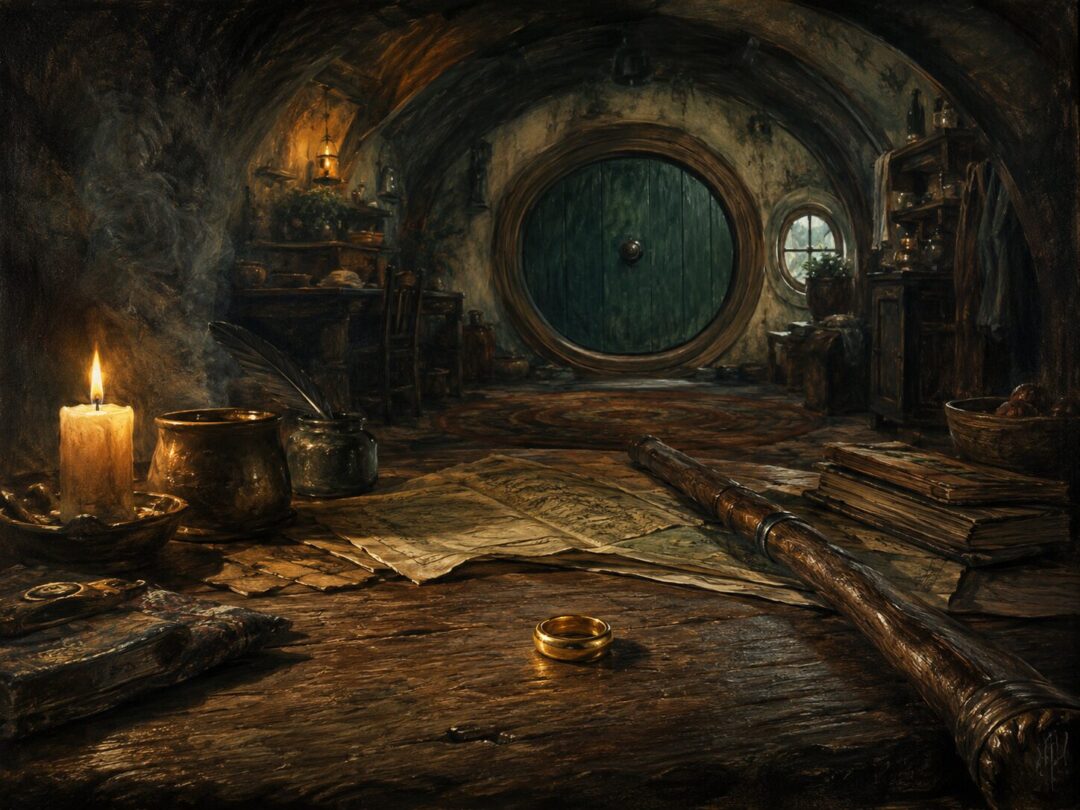
For many years, the Ring remains hidden in Bag End, and this secrecy is one of the Shire’s greatest protections. Sauron does not know where it is. The name “Baggins” eventually reaches hostile ears, but even then the geography is confused, delayed, and imperfectly understood. The enemy’s ignorance buys time.
But once the Black Riders begin hunting, the Shire’s vulnerability becomes terrifyingly obvious.
The Nazgûl do not treat the Shire as meaningless. They enter it because it may hold the Ring. They question, search, intimidate, and pursue. Their arrival reveals that the Shire’s borders were never magically sealed. They were guarded, watched, and defended by mortal effort; and when the pressure becomes too great, the danger enters.
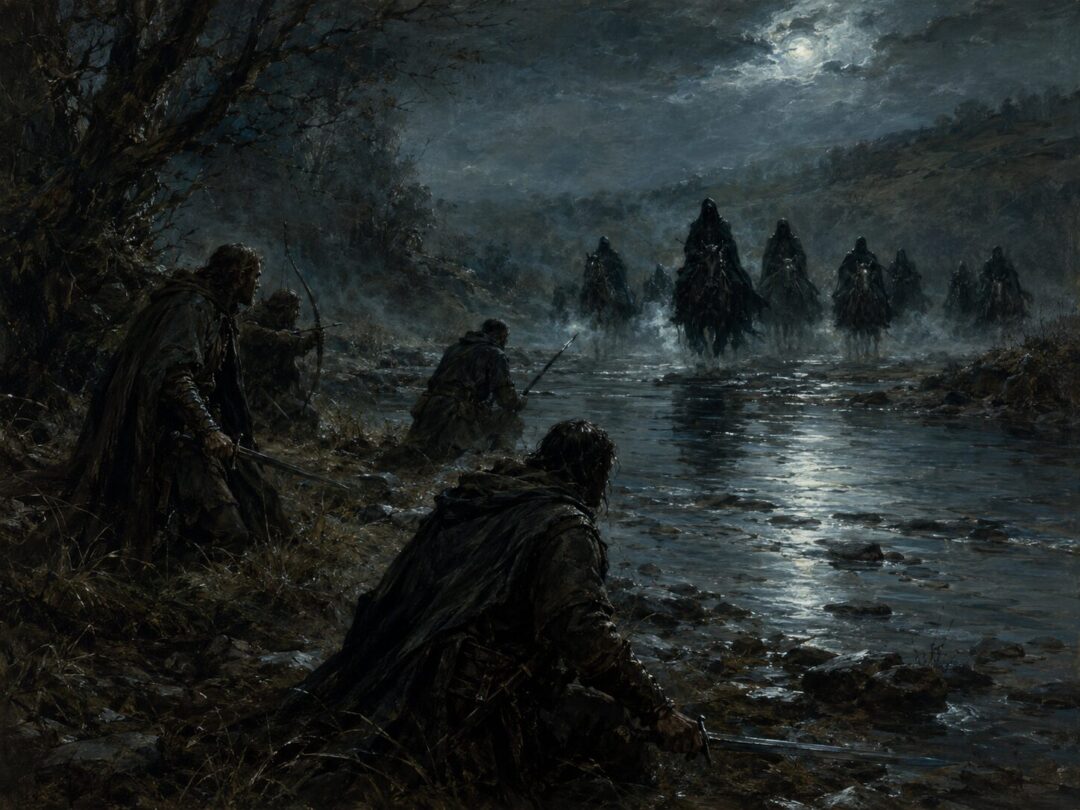
The encounter at Sarn Ford is especially important in this reading. The Rangers attempt to bar the passage of the Black Riders, but they cannot ultimately prevent their entry. This does not make their guarding meaningless. It shows the opposite. The Shire had been protected for a long time by people fighting battles that most hobbits never saw. But against the Nine, even that hidden wall could be broken.
The Shire is not a harmless dot on the map anymore. It is a place under search by the servants of Sauron.
Saruman Proves the Shire Could Be Conquered
The Scouring of the Shire is the final destruction of the comforting myth.
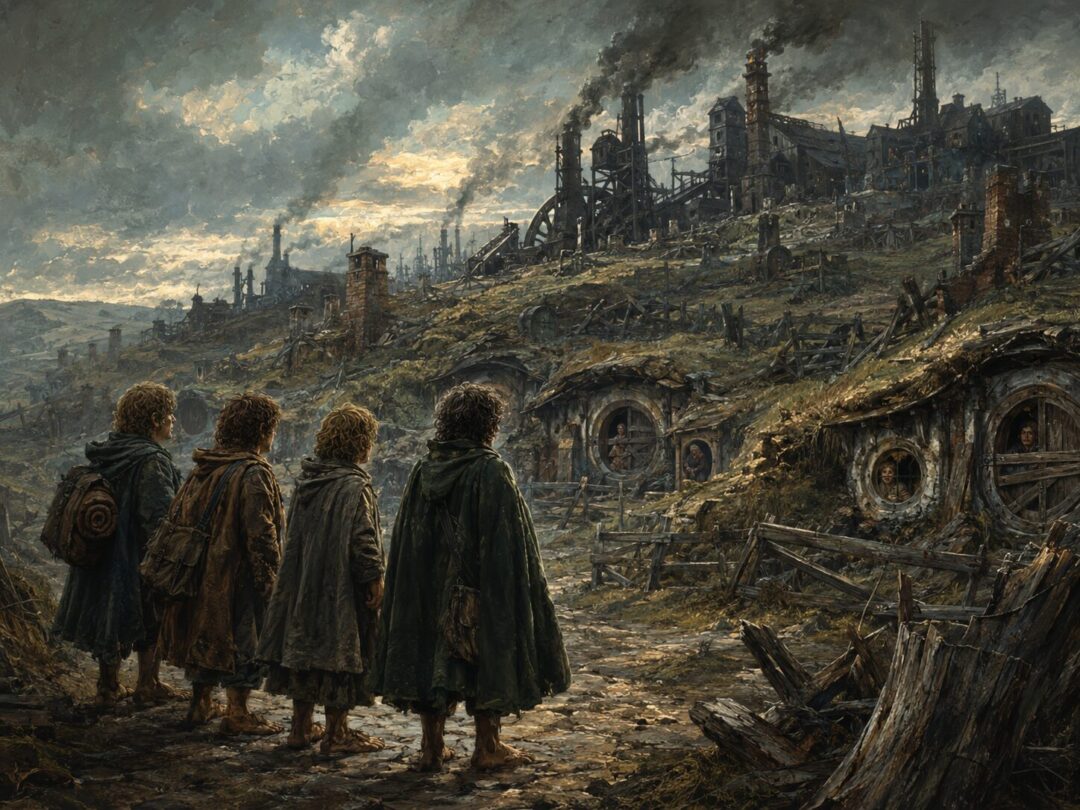
By the time Frodo, Sam, Merry, and Pippin return, the Shire has not been burned by Sauron’s armies, but it has still been invaded, corrupted, exploited, and humiliated. Saruman, working through Lotho Sackville-Baggins and Men brought into the Shire, shows how easily an unprepared society can be bent by greed, fear, bureaucracy, and petty tyranny.
This is not Mordor in full military form. It is something smaller and therefore more intimate: ugly new rules, ruined trees, ugly buildings, locked doors, suspicion, informers, confiscation, and the replacement of neighborly life with control. The Shire falls not because it was unimportant, but because it was vulnerable to forms of evil it had never learned to recognize.
That is why the Scouring matters so much.
The hobbits who return are not simply coming home for rest. They are bringing the lessons of the wider world back into the place that once ignored that world. Merry and Pippin have learned command and courage. Sam has learned endurance and hope. Frodo has learned mercy at a terrible cost. The Shire is saved from within, but only by hobbits who have passed beyond its innocence.
The old Shire could not have saved itself. The changed hobbits can.
The Moral Cost of Being Sheltered
The Shire’s safety raises a difficult question: is it good to be protected from fear?
The answer in The Lord of the Rings seems to be yes, but not without cost.
It is good that children can grow up without seeing war. It is good that fields are planted, meals are shared, and old people can sit at doors in peace. The story never sneers at ordinary life. On the contrary, ordinary life is what the great struggle is trying to preserve.
But peace becomes fragile when it forgets gratitude. It becomes foolish when it mistakes itself for the whole truth. The hobbits’ ignorance of the Rangers is not wicked, but it is incomplete. Their safety depends on a hidden fellowship between the humble and the watchful: gardeners and warriors, innkeepers and wanderers, those who preserve home and those who guard its edges.
The Shire is worth saving because it is ordinary. But it survives because some people understand that ordinary things must be defended.
Why Sauron Could Not Understand the Shire
Sauron’s failure is not merely geographical. It is moral and imaginative.
He understands power as possession, command, fear, and use. He expects the Ring to draw the mighty, because that is what it would do in the logic of domination. He can imagine a lord claiming it, a warrior wielding it, or a rival using it against him. He has far more difficulty understanding renunciation, pity, and the stubborn courage of the small.
The Shire is dangerous to him precisely because it does not look dangerous.
This does not mean hobbits are immune to corruption. Bilbo is strained by the Ring. Frodo is wounded by it beyond healing in Middle-earth. Gollum shows what long possession can do to a hobbit-like creature. The texts do not suggest that hobbits are morally invincible. But they do show that hobbits can carry forms of strength that the proud underestimate.
The Shire produces people who love things Sauron cannot properly value: food, gardens, songs, friendship, jokes, birthdays, and the memory of home. These are not weapons in the ordinary sense. Yet they help Frodo and Sam endure long after grander motives might have failed.
The Shire’s True Importance
The Shire matters because it gathers many of the story’s deepest tensions into one place.
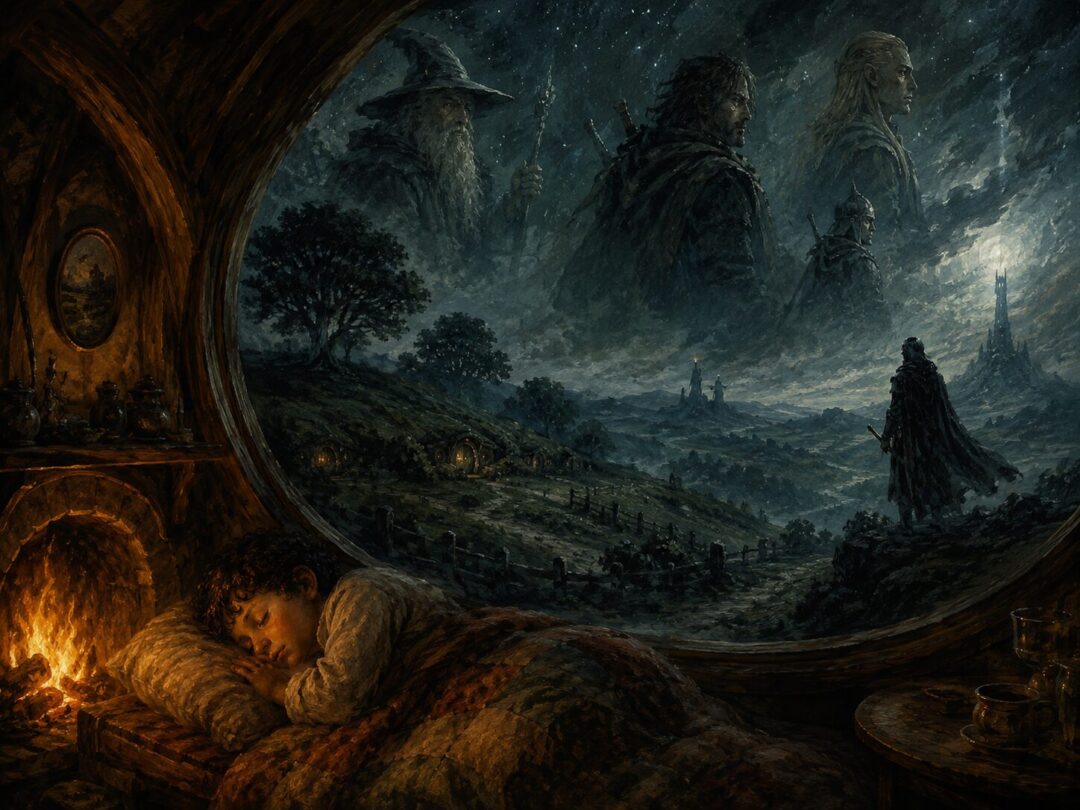
It is small, but not meaningless. Sheltered, but not safe by nature. Innocent, but not untouched. Hidden, but eventually found. Ordinary, but capable of producing extraordinary courage. It is a home that must be left in order to be saved, and a home that cannot remain unchanged once the wider world has entered it.
The Shire’s peace is therefore not a denial of the War of the Ring. It is one of the reasons the war matters.
If Minas Tirith shows what must be defended at the level of kingdoms, the Shire shows what must be defended at the level of daily life. A world without the Shire would not simply be less pleasant. It would be spiritually poorer. It would lose the vision of a life not organized around conquest.
But the Shire is never safe because evil politely ignores it. It is safe only for a time because of secrecy, distance, mercy, vigilance, and sacrifice.
That is the hidden sorrow beneath the green hills: the hobbits slept peacefully because others kept watch in the dark.
And when the watch failed, the Shire had to learn what the rest of Middle-earth had always known.
No beloved place is safe merely because it is small.
Sources & Notes
- J.R.R. Tolkien, The Lord of the Rings, Prologue, ‘Concerning Hobbits’ — for the Shire’s long peace, its local habits, and its modest border-watchers rather than military strength.
- J.R.R. Tolkien, The Lord of the Rings, Book I, Chapter 2, ‘The Shadow of the Past’ — Gandalf’s account of the Ring hidden in the Shire, and of Sauron’s servants learning the names ‘Shire’ and ‘Baggins.’
- J.R.R. Tolkien, The Lord of the Rings, Book I, Chapter 3, ‘Three Is Company’ — Gildor’s warning that the wide world is all about the Shire and cannot be fenced out forever.
- J.R.R. Tolkien, The Lord of the Rings, Book II, Chapter 2, ‘The Council of Elrond’ — Aragorn’s explanation that the Rangers secretly guarded simple folk from dangers they never understood.
- J.R.R. Tolkien, Unfinished Tales, ‘The Hunt for the Ring’ — for the Black Riders’ search for the Shire and the Rangers’ failed stand at Sarn Ford.
- J.R.R. Tolkien, The Lord of the Rings, Book VI, Chapter 8, ‘The Scouring of the Shire’ — Saruman’s takeover through Lotho, Men, rules, fear, and petty domination inside the Shire.