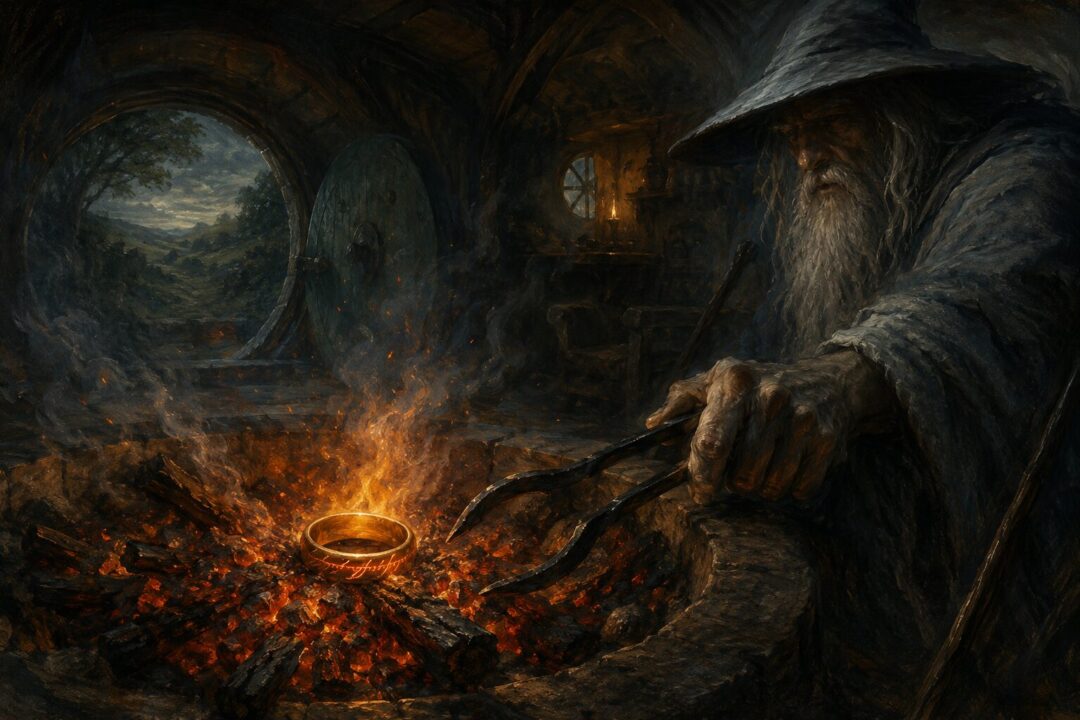
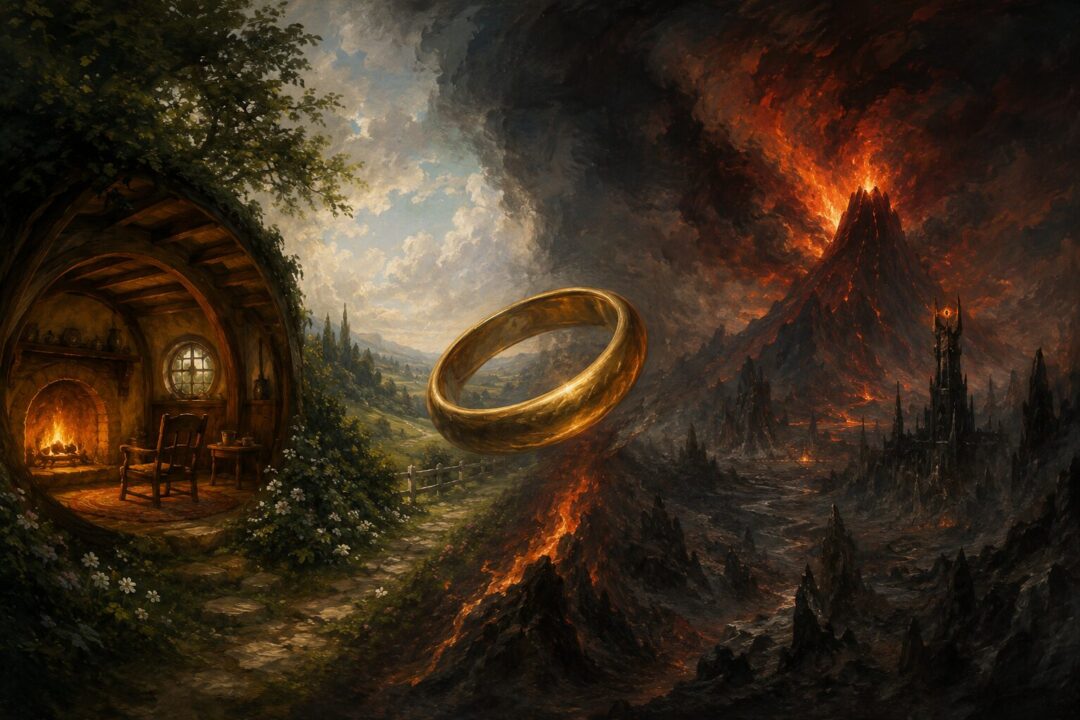
A small gold ring goes into a hearth in Bag End. Not into the furnace of a king, not into the hidden forge of an Elven-smith, not into the fire-mountain where it was made — just into the ordinary fire of a comfortable hobbit-hole.
That is the first great contradiction of the One Ring. It looks plain. It can be held in the palm. It can be hidden in a pocket, slipped on a finger, lost in a tunnel, inherited as a keepsake. Yet when Gandalf tests it, the fire does not master it. The flames reveal it.
The question is not simply why the Ring was “too strong” for normal fire. That answer is true, but shallow. The deeper tension is that the Ring is not merely a piece of worked gold. It is an object of craft, domination, and transferred power. Ordinary fire can heat metal. It cannot undo the will that was bound into this metal.
The Hearth Fire Was a Test, Not an Attempt at Destruction
In “The Shadow of the Past,” Gandalf casts the Ring into Frodo’s hearth fire. The scene is deceptively domestic. Frodo’s home is warm, familiar, and safe by Shire standards. But the fire produces the first visible proof that Bilbo’s ring is not an ordinary magic trinket.
The Ring is not destroyed. Instead, the hidden inscription appears: the Black Speech words of the Ring-verse, written in Elvish letters. This is one of the most important clues in the story. Fire can disclose the Ring’s identity without damaging it.
That distinction matters. Gandalf does not treat the hearth as a possible solution. He already knows that ordinary fire is powerless against it. The hearth test confirms what the Ring is; it does not threaten what the Ring is.
The texts imply a hard boundary between revealing and unmaking. A normal flame can bring forth the writing because the inscription belongs to the Ring’s own nature. But destruction requires more than heat. It requires the undoing of the thing at the level at which it was made.
The Ring Was Not Ordinary Gold
The One Ring appeared to be a simple band of gold, and that simplicity is part of its danger. It does not impress through ornament. It has no gem, no visible throne-like grandeur, no obvious monstrous form. It tempts by seeming usable, portable, and almost harmless.
But its plainness is misleading. The Ring was made by Sauron in the fires of Orodruin, Mount Doom, as the Ruling Ring over the other Rings of Power. In making it, Sauron put into it a great part of his own power. That is the central reason it cannot be treated like a normal artifact.
A goldsmith’s ring can be melted because its form is only material. Heat breaks the structure; the object ceases to be what it was. The One Ring is different. Its importance lies not just in its shape, but in the power and will bound into that shape. Its gold body is the vessel of something far more perilous.
This does not mean the Ring is indestructible in an absolute sense. It is destroyed in the end. But the means of destroying it are narrow because the thing itself is not merely physical.
“Normal Fire” Fails Because the Ring Belongs to a Higher Order of Craft
Middle-earth often treats craft as more than technical skill. Great works can carry the maker’s intention, power, and moral condition. The Silmarils, the palantíri, the Rings of Power, and weapons such as Narsil all belong, in different ways, to a world where making can become memory, authority, beauty, or peril embodied.
The One Ring is a darker version of that principle. It is not just forged; it is invested. It is not simply made to be beautiful or durable; it is made to rule. Its purpose is domination, and that purpose is inseparable from its maker.
Normal fire is therefore the wrong category of force. A kitchen hearth, campfire, or ordinary forge may affect ordinary matter, but the One Ring is protected by the nature of its making. It resists because it is bound to a power beyond common craftsmanship.
This is why the story never presents “make a hotter fire” as a serious plan among the Wise. The Council of Elrond does not debate building a larger furnace in Rivendell. The problem is not that no one has enough coal. The problem is that the Ring’s making has to be answered at its source.
Dragon-fire Shows the Scale of the Problem
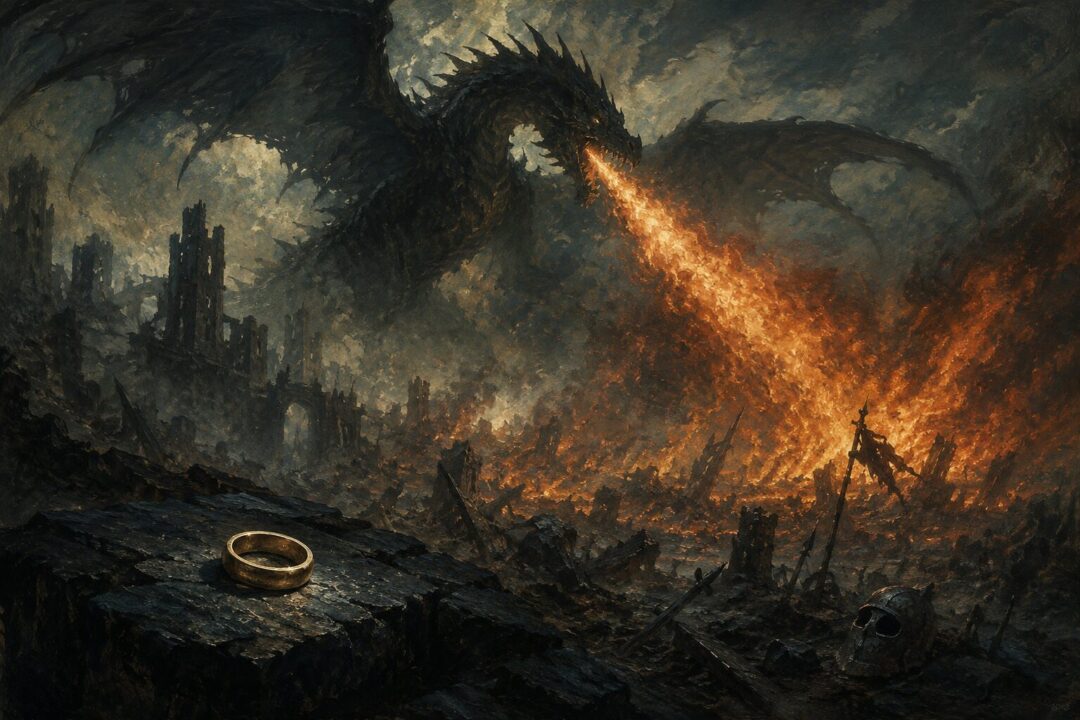
The clearest comparison in the text is dragon-fire. Gandalf explains that dragon-fire could melt and consume some Rings of Power. That is already an extraordinary statement. Dragons are not normal animals with hot breath; their fire belongs to the great terrors of the Elder Days and later ages. It is destructive in a way ordinary flame is not.
Yet Gandalf also makes the crucial limit clear: no dragon, not even Ancalagon the Black, could have harmed the One Ring.
That comparison tells us two things. First, the other Rings of Power, or at least some of them, were not beyond every form of destruction. Dragon-fire was a legendary destructive force capable of consuming great works. Second, the One Ring stands apart even among the Rings. It is not merely another Ring of Power with a stronger enchantment. It is the Ruling Ring, made by Sauron himself, containing his own invested power.
The mention of Ancalagon is especially important because it removes the easy escape route. The answer is not, “Find a stronger dragon.” The greatest dragon named in the lore is still not enough. The One Ring’s resistance is not just a matter of temperature.
Mount Doom Was Not Just Hotter
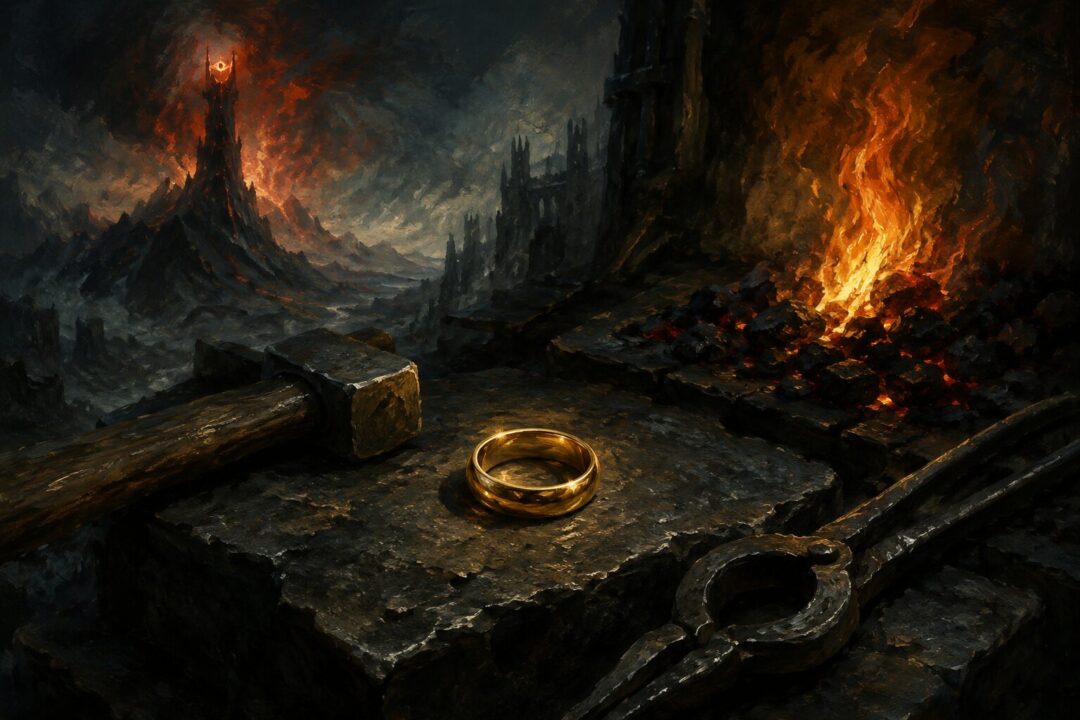
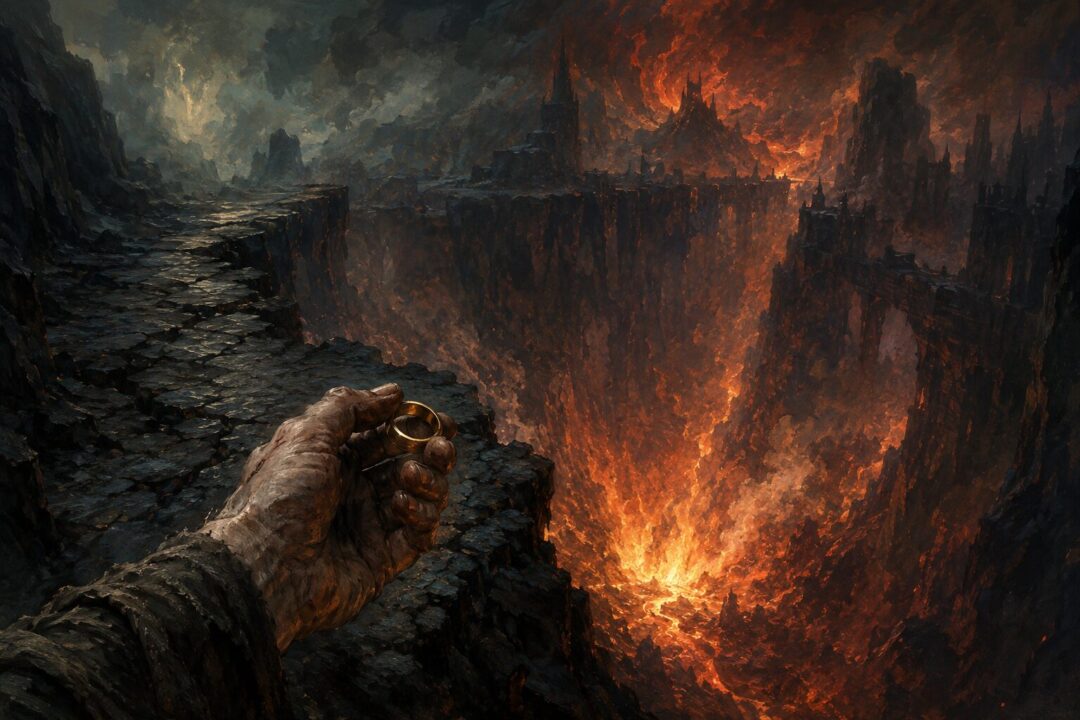
The Ring can be destroyed only in the fire where it was made: the Cracks of Doom in Orodruin. This is one of the hidden rules on which the entire quest depends.
It is tempting to imagine Mount Doom as simply the hottest available furnace. But the text points to something more specific. Orodruin is the place of the Ring’s making. The same fire in which Sauron forged it is the fire capable of unmaking it.
That does not require us to claim that Mount Doom is “magical lava” in a modern technical sense. The texts do not provide a scientific mechanism. What they do show is a deep connection between origin and destruction. The Ring must return to the place where its form and power were bound together.
This gives the quest its terrible shape. The Free Peoples cannot solve the problem from a safe distance. They cannot destroy the Ring in Rivendell, Lothlórien, Minas Tirith, or the Shire. They must carry it into the land of the Enemy, to the heart of the power that made it.
The Ring’s Durability Protects Sauron’s Survival
The Ring’s resistance to normal fire is not a random feature. It is tied to Sauron’s own fate.
Because Sauron placed so much of his power into the Ring, the Ring became both his greatest weapon and his greatest vulnerability. While it endured, he could not be fully defeated in the final sense. Even after his bodily overthrow at the end of the Second Age, his power was not annihilated, because the Ring remained.
This creates a tragic irony. The Ring is Sauron’s means of control, but it is also the one object whose destruction can bring about his final ruin. He makes a thing strong enough to resist almost every enemy, but by doing so he binds his own fate to it.
Normal fire cannot destroy the Ring because the Ring is designed to outlast ordinary assault. Its durability is part of Sauron’s strategy. Yet that same durability forces the only possible solution into one impossible path: into Mordor, into Orodruin, into the place where his own power was most dangerously externalized.
Why Didn’t Isildur Destroy It Immediately?
The Ring’s resistance to normal fire also helps explain why the story does not treat destruction as easy even after Sauron’s first defeat. Isildur cuts the Ring from Sauron’s hand, and Elrond later remembers urging him to cast it into the fire. But Isildur refuses.
This moment is sometimes simplified as a practical failure, as though Isildur merely missed an obvious chance. The lore makes it darker. The Ring was already exerting its claim. Isildur named it as weregild for his father and brother, and he kept it. The problem was not access alone. The problem was possession.
The Ring could not be destroyed by normal fire, but the greater horror is that it could hardly be willingly destroyed even when the right fire was near. The physical condition and the moral condition both had to be met. The Ring had to reach the Cracks of Doom, and someone had to surrender it there.
At the end, even Frodo cannot do that by simple will. This does not diminish his heroism. It reveals the true scale of the burden. The Ring’s power is not merely defensive; it reaches into desire, fear, pity, pride, and ownership.
Fire Reveals, But Possession Corrupts
The hearth scene at Bag End is therefore more than a test of metal. It is a warning about false comfort.
In the Shire, fire is associated with warmth, food, pipes, stories, and home. Gandalf turns that homely fire into a moment of revelation. The Ring emerges unchanged, but now it can no longer be misunderstood. Its inscription appears, and with it the truth that Frodo’s inheritance is tied to Mordor.
This is one of the story’s quietest shocks. The danger does not arrive first as an army at the gate. It arrives as knowledge. A harmless-looking possession is revealed as a link to an ancient evil.
Normal fire fails because the Ring is not the kind of evil that ordinary comfort can burn away. It must be named, carried, resisted, and finally brought to the one place where it can be unmade.
The Rule Makes the Quest Morally Sharper
If any hot enough fire could destroy the Ring, the story would become a problem of engineering. If any great warrior could break it, the story would become a problem of strength. If any wise ruler could master it safely, the story would become a problem of politics.
Instead, the rule of the Ring makes the quest moral and sacrificial. The Ring cannot be used against Sauron without becoming part of his pattern of domination. It cannot be hidden forever without remaining a threat. It cannot be broken by ordinary force. It must be renounced and returned to the place of its making.
That is why the Ring’s resistance matters so much. It strips away easy answers. It humbles the strong, confounds the wise, and places the fate of kingdoms in the hands of those least interested in power.
The Fire That Made It Had to Unmake It
The One Ring could not be destroyed by normal fire because it was never merely a normal object. Its gold form was bound to Sauron’s craft, will, and power. Ordinary flames could reveal its inscription, but they could not undo the act of making that gave it its terrible nature.
Dragon-fire, the great legendary fire of Middle-earth, helps prove the point. Even that was not enough for the Ruling Ring. The Ring had to return to Orodruin, where it was forged, because only there could its making be reversed.
That rule is not a technical footnote. It is the heart of the story’s danger. Evil has made itself small enough to carry and strong enough to survive nearly everything. The only road left is not the easiest, safest, or most glorious one. It is the road back into the fire where the evil began.
Sources & Notes
- J.R.R. Tolkien, The Lord of the Rings, Book I, Chapter 2, “The Shadow of the Past” — Gandalf’s hearth test reveals the Ring-inscription, and he explains why ordinary fire and even dragon-fire cannot destroy the One Ring.
- J.R.R. Tolkien, The Lord of the Rings, Book II, Chapter 2, “The Council of Elrond” — Elrond and Gandalf identify the Cracks of Doom in Orodruin as the only place where the Ring can be unmade.
- J.R.R. Tolkien, The Silmarillion, “Of the Rings of Power and the Third Age” — recounts Sauron forging the One Ring in Orodruin and passing much of his own power into it.
- J.R.R. Tolkien, The Lord of the Rings, Book VI, Chapter 3, “Mount Doom” — Frodo’s failure to surrender the Ring and its destruction in the Fire show that unmaking it requires both the right place and the breaking of possession.
- J.R.R. Tolkien, The Letters of J.R.R. Tolkien, Letter 131 — Tolkien’s storycraft account of Sauron’s will to domination supports the article’s distinction between ordinary matter and power deliberately invested for rule.