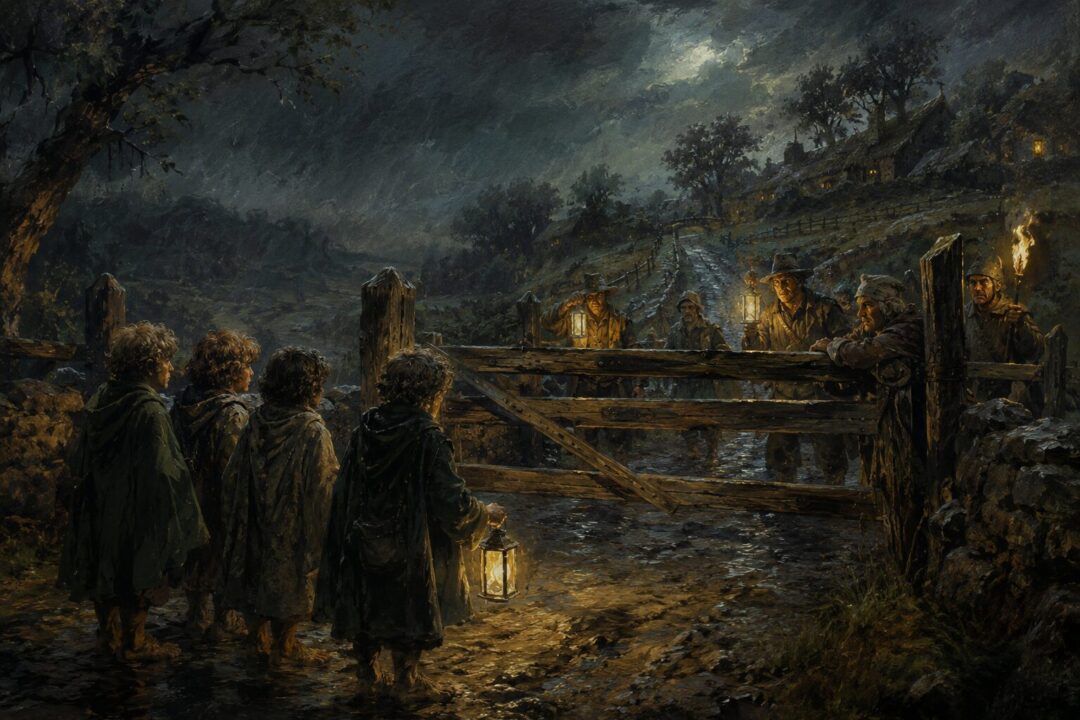
The Shire Was Not Saved Until the Hobbits Came Home
The One Ring is destroyed in fire. Barad-dûr falls. Sauron’s power passes away. By every obvious measure, the great trial of the hobbits should be over before they ever see the Brandywine again.
But Middle-earth is rarely so simple. The deepest test is not always the mountain, the battlefield, or the throne-room. Sometimes it is the front gate of home, locked against you by small-minded rules. Sometimes it is the mill smoking beside the Water. Sometimes it is the discovery that evil did not only live in Mordor; it could enter by contracts, fear, obedience, resentment, and the desire to be left alone.
That is why the Scouring of the Shire is not an afterthought. It is the moment when the hobbits must prove what their journey has actually made of them.
Gandalf Steps Aside for a Reason
On the road home, Gandalf does not ride into the Shire as the rescuer. That absence matters. He has guided, warned, rebuked, and rescued the hobbits before, but now he leaves them to face their own country’s trouble.
The reason is not indifference. The texts present the hobbits as changed by the wider world. Merry and Pippin have seen kingdoms at war. Sam has crossed Mordor. Frodo has borne the Ring to the point where pity, endurance, and loss are bound together. Gandalf’s confidence implies that they no longer need a wizard to solve what must now be their responsibility.
That makes the Scouring a coming-of-age test, but not in a childish sense. The hobbits are not proving that they can swing swords like Men. They are proving that courage learned abroad can be used without becoming domination at home.
The Shire’s Enemy Is Disturbingly Ordinary
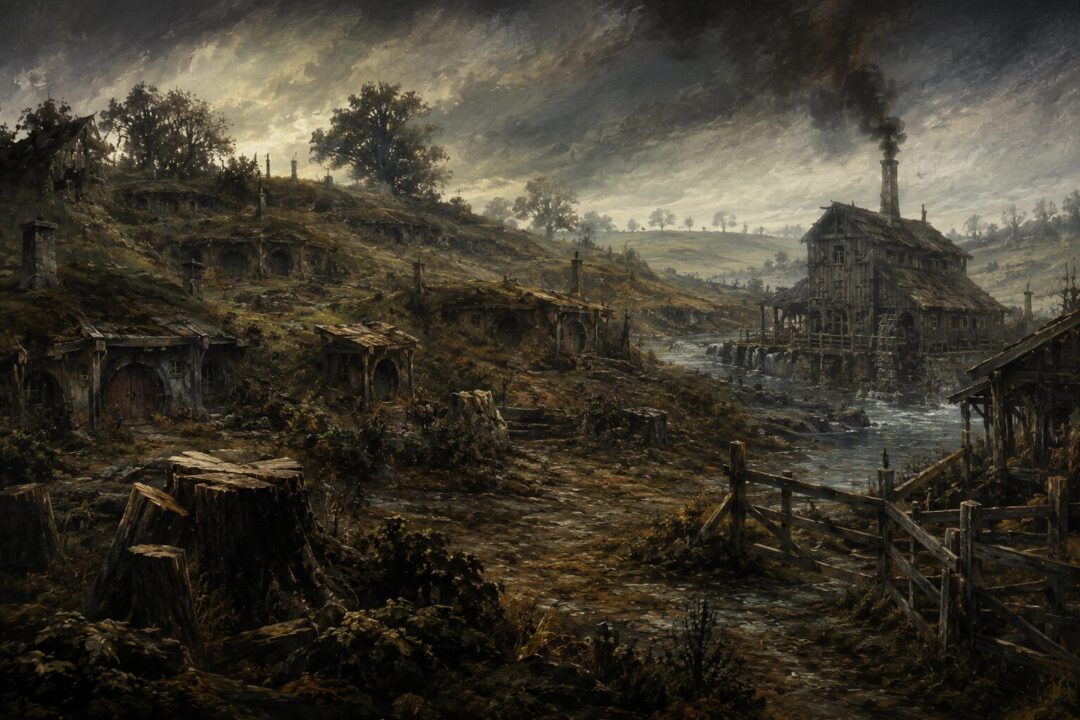
The Shire does not fall to a vast army. It is not conquered by Nazgûl or Orc-hosts. Its ruin comes through Lotho Sackville-Baggins, through bought property, gathered goods, new rules, locked gates, bullying “Shirriffs,” and Men called ruffians.
This is one of the chapter’s sharpest truths: corruption can look administrative before it looks violent. The Shire is smothered by notices, restrictions, confiscations, and fear. Hobbits who once lived by custom and neighborly habit find themselves trapped inside a system that rewards obedience and punishes resistance.
Saruman, under the name Sharkey, is eventually revealed behind the ugliness. Yet his power in the Shire is not the old grandeur of Isengard. He has become smaller, meaner, and more spiteful. He cannot build a new Orthanc; he can only spoil gardens, trees, homes, and memories. His revenge is petty because his spirit has shrunk.
Merry and Pippin Bring Back the Courage of the World
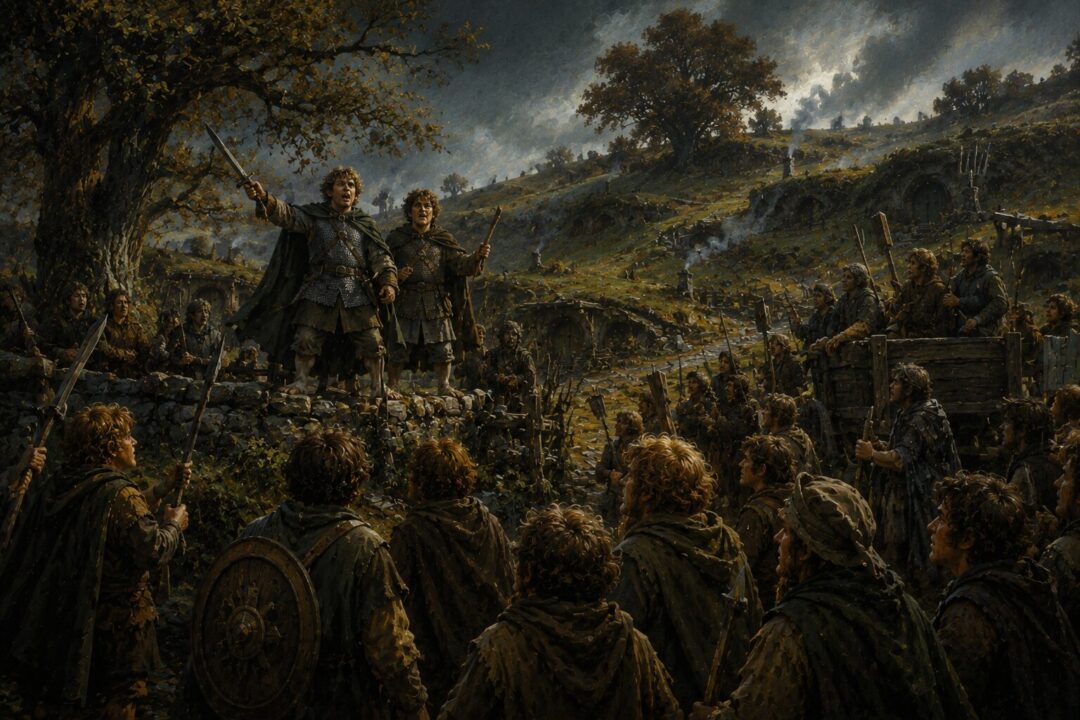
Merry and Pippin return as unmistakably altered hobbits. They are taller in bearing as much as body, seasoned by Rohan and Gondor, and no longer intimidated by local bullies. In the Scouring, their growth becomes practical.
They organize resistance. They understand that fear can be broken by confidence. They know how to rally people who have been isolated. The Battle of Bywater is not a grand epic clash like the Pelennor Fields, but it is strategically serious in miniature: the hobbits use knowledge of their own land, block roads, trap the ruffians, and fight with discipline.
This does not turn the Shire into a warrior culture. That distinction is important. Merry and Pippin do not import the glory of war into Hobbiton. They use hard-won experience to end a tyranny so ordinary people can stop living under threat. Their test is not whether they can become soldiers forever, but whether they can use strength and then put it down.
Sam’s Test Is Love Made Active
Sam’s part in the Scouring is easily overshadowed by his later restoration of the Shire, but the two belong together. In Lothlórien, Sam had seen a vision of damage to the Shire: trees felled, home in peril, the familiar world violated. When he returns, the fear is no longer a vision.
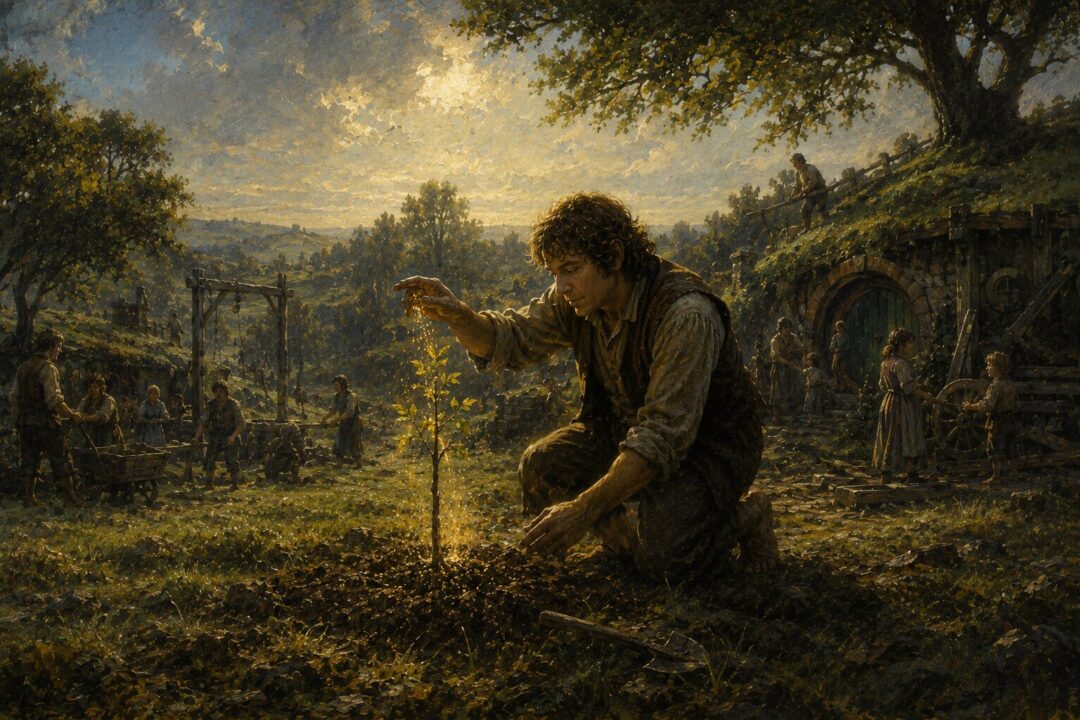
Sam’s test is whether love of home becomes mere grief or active repair. He fights when he must, but his deepest answer to Sharkey’s damage is cultivation. With the gift from Galadriel’s garden, he helps replant what was destroyed. The new mallorn in the Party Field becomes one of the most luminous signs that healing in Middle-earth does not erase loss, but it can answer loss with living beauty.
Sam’s heroism is therefore not only endurance in Mordor. It is also stewardship after victory. He understands that saving the world must finally mean saving fields, trees, families, and ordinary days.
Frodo’s Test Is the Hardest Because He Refuses Revenge
Frodo’s role in the Scouring is strange only if victory is measured by violence. He does not lead the fighting in the way Merry and Pippin do. His test is different: he must decide what mercy means when evil stands in his own doorway.
By this point Frodo has seen too much to treat enemies simply. He knows what corruption does from the inside. He has also seen that pity helped bring about the Ring’s destruction, because Gollum’s life was spared long before Mount Doom. In the Shire, Frodo applies that same moral vision to Saruman and Wormtongue.
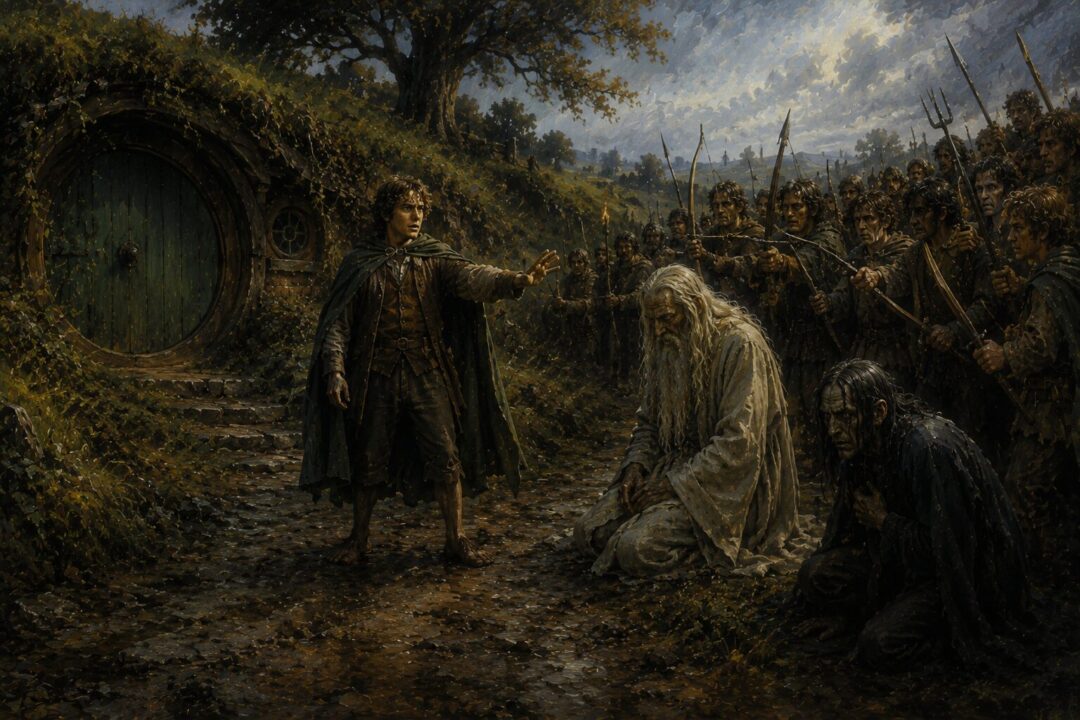
This does not mean he denies justice. He names evil plainly and commands Saruman to leave. But he resists execution when the crowd wants blood. One reading is that Frodo understands vengeance would give Saruman a final victory: the Shire would be free, but it would begin its freedom by imitating the cruelty it had overthrown.
Saruman recognizes the wound in this mercy. He hates being spared because it leaves him morally exposed. Frodo’s restraint deprives him of the satisfaction of becoming a martyr to hobbit rage. That is why Frodo’s mercy is not softness. It is judgment without hatred.
Saruman’s End Shows the Failure of Power Without Repentance
Saruman’s death in the Shire is deliberately diminished. The former White Wizard does not fall in a blaze of majesty. He dies after spite, insult, and degradation, brought down by the servant he has abused.
The mist that rises from his body and is blown away suggests a final rejection, though the full metaphysical meaning is not explained in simple terms. What is clear is the moral shape: Saruman has spent himself. His voice, cunning, and pride remain, but they no longer lead to greatness. They lead only to a ruined doorstep and a corpse.
Wormtongue’s end is also tragic. Frodo offers him a path away from Saruman, but the moment collapses into violence. The text does not ask readers to admire Wormtongue; it does, however, show how domination deforms both master and servant. Saruman cannot stop corrupting even when defeated, and Wormtongue cannot escape without one final act of destruction.
The Real Victory Is Not Innocence Restored
The Shire is healed, but it is not simply returned to ignorance. That is crucial. The Scouring proves that the Shire’s peace was never self-sustaining in the way many hobbits imagined. Earlier, the wider world had guarded it in ways most Shire-folk did not understand. Now the hobbits themselves must take responsibility for the peace they love.
This is why the chapter feels morally necessary. If the hobbits had returned to an untouched Shire, their adventure might have remained something that happened elsewhere. Instead, the war reaches the lanes, mills, inns, and holes of home. The boundary between “great matters” and “ordinary life” collapses.
The result is not despair. The Shire’s recovery is abundant: rebuilding, planting, marriages, children, and an extraordinary year of growth. Yet the healing comes through labor. The hobbits do not wake from a bad dream; they repair damage with their own hands.
Why This Is the Hobbits’ Final Exam
Each of the four returning hobbits faces a different question.
Merry must use battlefield courage without becoming hungry for command. Pippin must stand tall without turning status into vanity. Sam must turn love into restoration. Frodo must hold to mercy when his own home has been violated.
Together, they show that the quest did not merely remove the Ring from the world. It changed the people who carried the burden near it. The Scouring asks whether that change can survive the return to ordinary life.
That is often the harder test. It is one thing to be brave in Mordor because there is no other path. It is another to be brave among neighbors who are frightened, compromised, resentful, or slow to act. It is one thing to defy Sauron. It is another to resist the smaller shadows that grow wherever people trade freedom for comfort, kindness for rules, and memory for convenience.
The Scouring of the Shire matters because it brings the whole moral drama of The Lord of the Rings home. Power is defeated in Mordor, but the habits of domination still have to be uprooted in Hobbiton. The Ring is gone, but choices remain. Mercy, courage, stewardship, and responsibility must become local, practical, and costly.
In the end, the hobbits save the Shire not because they return unchanged, but because they return changed enough to protect what was worth loving in the first place.
Sources & Notes
- J.R.R. Tolkien, The Lord of the Rings, Book VI, Chapter 8, “The Scouring of the Shire” — the primary chapter in which the returning hobbits must defend and restore their own home. https://tolkiengateway.net/wiki/The_Scouring_of_the_Shire
- Tolkien Gateway, “Scouring of the Shire” — summarizes the occupation of the Shire, the hobbits’ uprising, and the moral/political test after the Ring quest. https://tolkiengateway.net/wiki/Scouring_of_the_Shire
- Tolkien Gateway, “Sharkey” — identifies Saruman’s Shire alias and role in the post-war degradation of the Shire. https://tolkiengateway.net/wiki/Sharkey
- The Encyclopedia of Arda, “Battle of Bywater” — independent reference account of the Shire uprising’s decisive battle against Sharkey’s Men during the Scouring. https://www.glyphweb.com/arda/b/battleofbywater.html
Sources cover the primary Scouring chapter, Sharkey/Saruman in the Shire, and the hobbits’ final home-front test.