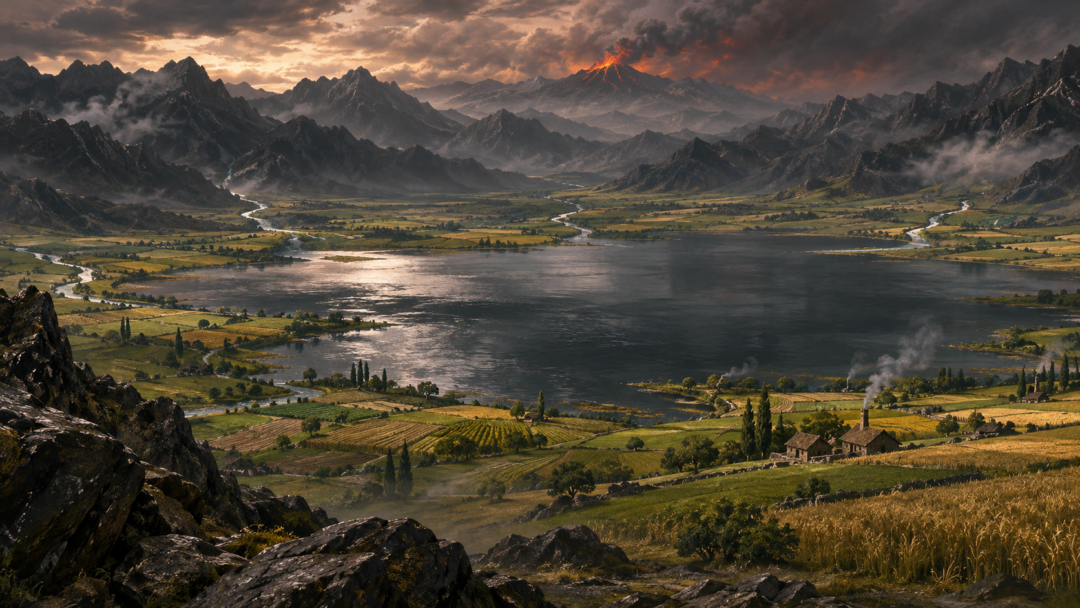
Most people picture Mordor as a wasteland of ash, fire, and armies marching beneath a black sky. That image makes sense around Mount Doom and the fortress of Barad-dur. But it leaves out something essential: Sauron controlled a vast military empire, and even an army of Orcs needs food, supplies, and labor.
Far to the south of the volcanic plains lies the Sea of Núrnen, an inland lake surrounded by a region that looks surprisingly different from the Mordor seen in Peter Jackson’s films. There are rivers, agricultural lands, roads, and people whose lives are tied to the Dark Lord’s military system.
The strongest way to understand Núrnen is not as another monster-infested wilderness. **It is the working heart of Sauron’s empire, where ordinary life is forced to support extraordinary evil.** And although later video games populate the region with terrifying creatures, Tolkien’s own account is much more concerned with what happens to the people living there.
Where Is the Sea of Núrnen?
The Sea of Núrnen, also called Lake Núrnen, lies in southern Mordor within a region known as Nurn. It is a large inland body of water, not an ocean connected to the western seas of Middle-earth.
The geography matters. Northern Mordor contains the Plateau of Gorgoroth, where Mount Doom rises amid volcanic devastation. Southern Mordor is lower, with rivers flowing toward the lake from the surrounding mountains.
The Ephel Duath, or Mountains of Shadow, form much of Mordor’s western and southern defenses. The Ered Lithui, or Ash Mountains, guard its northern side. Between these barriers, Nurn occupies land capable of supporting agriculture.
Tolkien’s map shows four principal rivers feeding the lake. Their presence helps explain why farming could exist within a country otherwise associated with barren rock and poisoned air.
The lake’s waters are described as dark and bitter. That description should not be turned into a claim that every stream, field, and creature in Nurn was poisonous. The landscape is harsh, but Tolkien explicitly establishes that its surrounding lands could produce food.
This contrast makes Núrnen important. It demonstrates that Mordor was not one uniform wasteland. Sauron’s kingdom contained different environments serving different purposes.
What Actually Happened Around the Lake?
The most revealing evidence appears in *The Return of the King*, Book VI, Chapter 2, ‘The Land of Shadow.’
As Frodo and Sam struggle through Mordor, Tolkien briefly explains that they know almost nothing about the southern portions of the country. Beyond Mount Doom lie extensive fields worked by slaves, together with roads connecting Mordor to territories farther east and south.
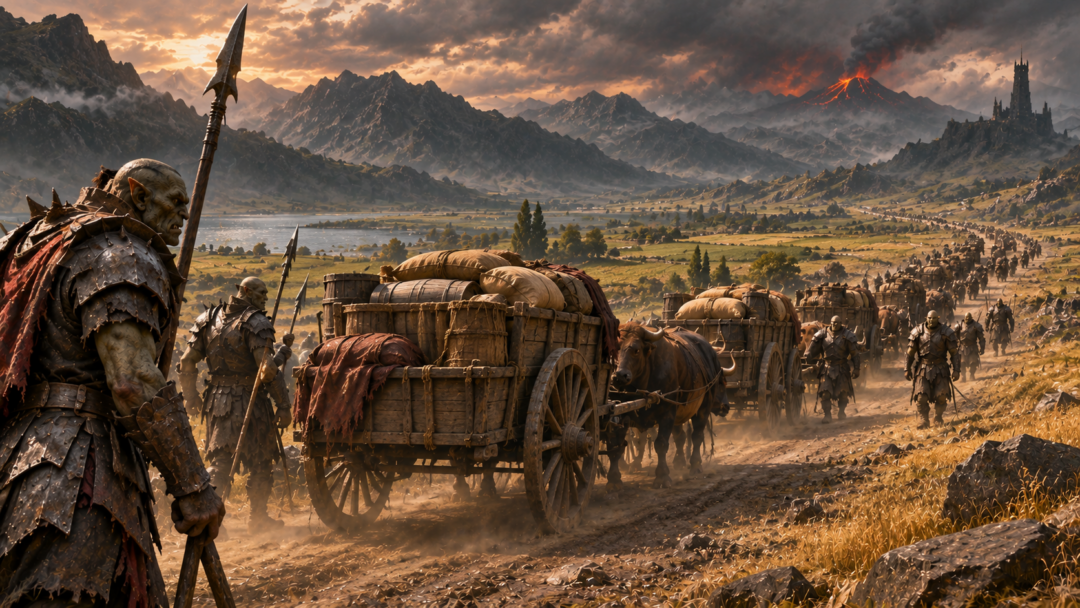
Those roads carry supplies, plunder, and new captives into Sauron’s dominion.
This is a remarkably important detail. The Dark Lord does not simply summon endless soldiers from the ground and send them into battle. His forces depend on a functioning system of production and transportation.
The lands around Núrnen help sustain that system.
Imagine the contradiction. In the north, armies gather beneath the shadow of a volcanic mountain. Hundreds of miles away, people must cultivate fields so those armies can continue fighting.
The work itself is not glamorous. Fields have to be tended, harvests gathered, food transported, and supplies distributed. Tolkien does not provide a detailed agricultural calendar or identify particular crops grown beside the lake. We should not invent either.
But the basic picture is unmistakable: southern Mordor supplies resources to the forces operating elsewhere in Sauron’s realm.
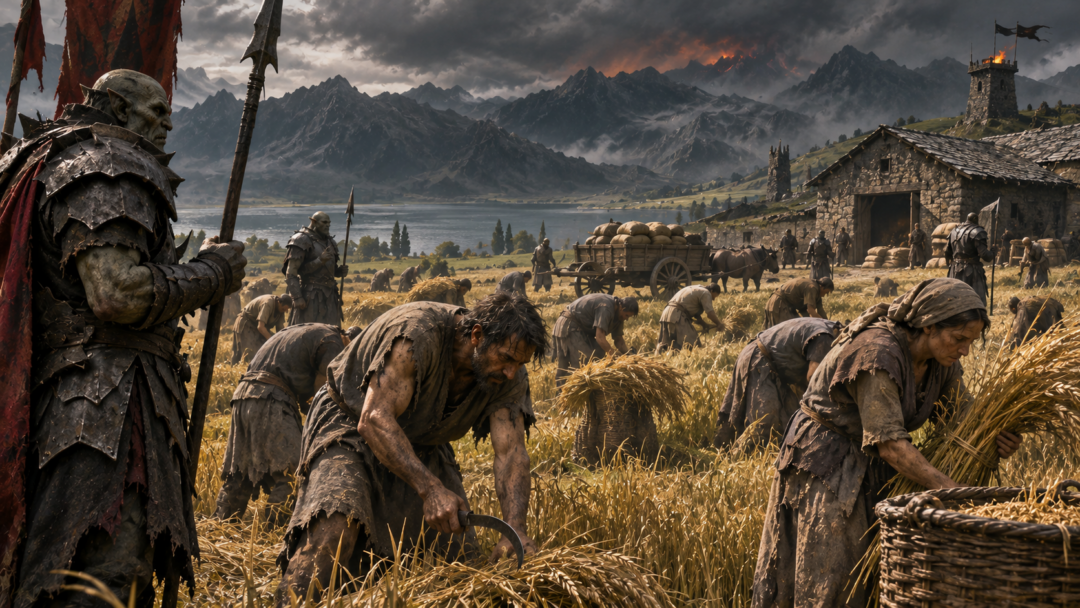
That makes the Sea of Núrnen strategically important without requiring a great fortress, a legendary monster, or a famous battle on its shores.
The People Who Lived Under Sauron
The population of Nurn is one of the most easily overlooked groups in *The Lord of the Rings*.
Tolkien explicitly identifies enslaved laborers working the southern fields. His account also establishes that Sauron’s soldiers brought additional captives into Mordor from outside territories.
However, he does not give us a complete description of their communities. We do not learn the names of prominent local families, the precise composition of the population, or the everyday customs of the people living around the lake.
It is reasonable to infer that this was an organized agricultural society under coercive rule, because extensive farming and transportation require sustained human labor. But those practical conclusions should remain distinct from details Tolkien actually wrote.
The distinction matters because Nurn gives Mordor a human dimension.
The enemies confronting Gondor and Rohan are not the only people living under Sauron’s power. Others suffer inside his territory, serving a regime they did not necessarily choose.
We should also resist assuming that every inhabitant of Mordor was an Orc, or that every human associated with Sauron’s territories willingly supported him.
The slaves of Núrnen make that assumption impossible.
Why Sauron Needed Fertile Land
Sauron’s military power looks almost supernatural when viewed exclusively through the main characters’ experiences.
The armies of Mordor seem immense. The Black Gate is fortified, Barad-dur dominates the land, and more forces arrive from distant territories. Yet Tolkien quietly supplies a practical explanation for how such power can operate.
Military strength requires logistics.
Orcs can be fierce, cruel, and terrifying, but they are still embodied creatures. They need provisions. Weapons must be made, equipment moved, and communication maintained across long distances.
Nurn’s agricultural lands address part of that problem. Meanwhile, the roads connecting Mordor with tributary territories reveal that the empire also depends on resources obtained through domination beyond its borders.
This does not mean Nurn alone fed every soldier Sauron commanded. Tolkien does not quantify its harvests or calculate the size of its workforce.
What he establishes is more interesting than a numerical estimate: Mordor’s military terror rested partly upon the coerced labor of people living far from its famous battlefields.
The supposedly all-powerful Dark Lord still needed a supply chain.
Are There Famous Creatures Around Núrnen?
Here the distinction between Tolkien’s books and later adaptations becomes essential.
**Tolkien does not identify a famous named monster as the guardian or inhabitant of the Sea of Núrnen.** There is no book passage describing a dragon nesting beside its waters, a unique lake serpent attacking travelers, or a Balrog ruling its shores.
The wider world of Mordor certainly contains monstrous beings. Orcs and Trolls serve Sauron, while the Nazgul ride terrifying winged creatures during the War of the Ring.
But those facts do not establish that any particular creature lived beside Núrnen.
It would be misleading, for example, to place Shelob on the lake’s shore. Her lair is associated with Cirith Ungol, far from the southern agricultural region. Likewise, the flying mounts of the Nazgul are associated with Sauron’s war, not with a documented breeding colony at Núrnen.
Ordinary wildlife almost certainly existed in a region containing rivers, farmland, and extensive open country. That is a reasonable ecological inference, not an inventory supplied by Tolkien.
The books leave the specific animals of Nurn largely undescribed.
For named monsters, the clearest examples come from video games rather than the original novels.
The Graugs of the Video Games
In *Middle-earth: Shadow of Mordor* and *Middle-earth: Shadow of War*, Nurn becomes a much more visually dramatic environment.
These adaptations introduce dangerous wildlife and large monsters that players can hunt, fight, or sometimes control.
One especially memorable creature is the Graug, a massive, powerful beast capable of overwhelming armed enemies. Graugs are central to several hunting encounters, and *Shadow of Mordor* features the Great White Graug in a mission involving the Dwarf hunter Torvin.
That encounter belongs to the game’s version of the Nurn wilderness. It is not an incident recorded in *The Lord of the Rings*.
The official *Shadow of War* creature guide also identifies graugs as native to Nurn, giving them a particularly strong association with the region in the game’s fictional ecology.
This helps explain why someone familiar with the games might imagine Núrnen as the home of enormous predators.
It is a memorable interpretation, but it should not be confused with Tolkien’s original description.
Caragors, Ghuls, and Other Dangers
Graugs are not the only threatening creatures associated with the game environments around Nurn.
Caragors are aggressive, predatory beasts that can attack travelers and serve as dangerous mounts. The games portray them as fierce enough to threaten even experienced warriors.
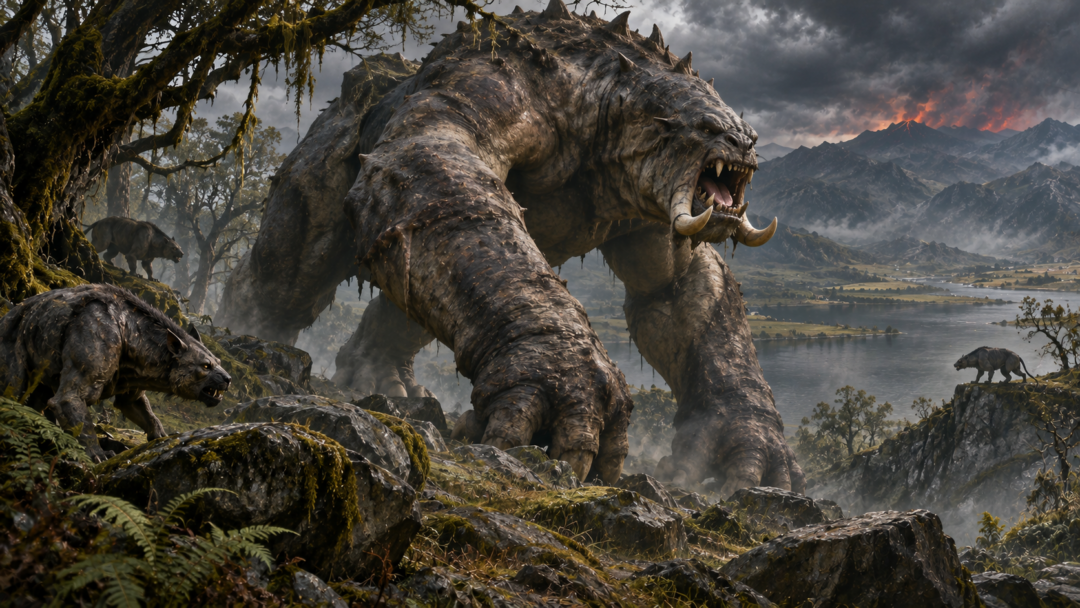
Ghuls are another major danger. These creatures can emerge in groups from underground, turning apparently empty ground into a hazardous hunting area.
The games also feature different varieties of creatures and regional encounters, including powerful graugs with unusual abilities. *Shadow of War*, for example, associates poison graugs with Núrnen.
These additions give players an environment where exploration can become a fight for survival at almost any moment.
Yet the games’ creature designs and ecological claims are part of their own adaptation continuity. Caragors, game-style graugs, and their associated hunting systems should not be presented as creatures Tolkien explicitly placed around the lake.
This difference is not a criticism of the games. A playable world needs hazards, recognizable enemies, and reasons to explore. The developers expanded areas that Tolkien had left comparatively open.
The problem arises only when that expansion is mistaken for book evidence.
What About the Peter Jackson Films?
Peter Jackson’s *The Lord of the Rings* films concentrate overwhelmingly on the journey toward Mount Doom and the military conflict involving Gondor and its allies.
The audience sees the volcanic north of Mordor, the threatening landscape surrounding the Black Gate, and the terrifying forces serving Sauron.
The fertile lands around the Sea of Núrnen do not receive a comparable on-screen exploration.
As a result, viewers can easily come away believing that Mordor consists almost entirely of ash-covered plains and fortifications.
That impression is understandable, but incomplete when measured against Tolkien’s text.
The films also portray famous creatures such as the Nazgul’s winged mounts and the giant spider Shelob. Neither supplies evidence of a special monster population around Núrnen.
The films leave this part of Mordor largely outside their narrative focus, while the games expand it substantially.
The novel occupies a different position: it reveals enough about southern Mordor to establish its political and economic importance, without turning the region into an extended adventure setting.
What Happened After Sauron’s Defeat?
The most consequential event associated with Núrnen takes place after the destruction of the One Ring.
In *The Return of the King*, Book VI, Chapter 5, ‘The Steward and the King,’ Tolkien describes Aragorn’s actions following his victory and coronation.
Among his acts of settlement and reconciliation, King Elessar releases the slaves of Mordor and grants them the lands around Lake Núrnen as their own.
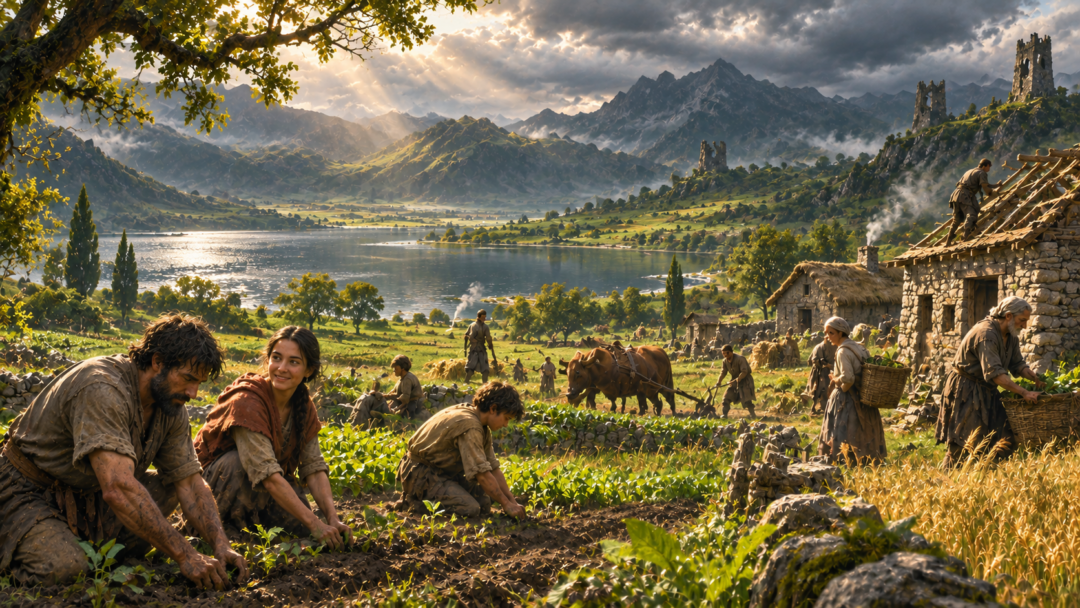
This decision changes the meaning of the region.
Under Sauron, its productive fields serve a system of conquest. Under the new order, those who were forced to work the land receive it for themselves.
Tolkien does not describe every stage of this transformation. We are not given a detailed account of the new communities, their government, or the difficulties involved in rebuilding their lives.
Nor should we assume the process was effortless. The text establishes the royal grant and liberation, not a complete history of the region’s future.
Still, the political meaning is powerful.
The destruction of the Ring does more than end a military campaign. It breaks a system of enslavement and gives its victims the possibility of determining their own future.
That consequence is easy to overlook because it receives so little narrative space.
Why Núrnen Changes How We See Mordor
The Sea of Núrnen exposes a weakness in the familiar picture of Sauron’s kingdom.
Mordor is often imagined as a landscape so completely ruined that nothing worthwhile could exist there. But Nurn contains productive land, human communities, and a future beyond the Dark Lord.
Its fields are not inherently evil because their harvests supported his armies. Their use was controlled by an evil system.
That distinction fits one of Tolkien’s larger concerns: domination corrupts relationships between rulers, peoples, and the world they inhabit. Freedom changes those relationships without requiring the physical world to be discarded.
Núrnen therefore matters for more than geography.
It demonstrates the hidden machinery behind Sauron’s armies, the human suffering concealed behind their apparent strength, and the possibility of liberation after his downfall.
The games offer memorable monsters. The films offer Mordor’s terrifying visual identity. Tolkien’s book offers something quieter and arguably more disturbing: a country whose fields were worked by captives so that its armies could continue marching.
And when Sauron’s power finally collapses, those same lands become part of the peace that follows.
The most important story around the Sea of Núrnen is not about a creature waiting beneath the water. It is about the people who were forced to sustain Mordor, and what became possible when they no longer had to.
Sources & Notes
This article is based on close reading and interpretation of Tolkien's published works and related source material where relevant.