A Small Ring and a Very Large Problem
Bilbo Baggins could give away his home, distribute his possessions, abandon a comfortable life in the Shire, and disappear into the night without much regret. But ask him to leave behind one plain gold ring, and suddenly the entire farewell became negotiable.
That contradiction sits at the heart of one of Tolkien’s most revealing character struggles. Bilbo is not a warrior corrupted by a promise of conquest. He is a fundamentally decent hobbit who has grown attached to something he considers useful, private, and rightfully his.
Both J.R.R. Tolkien’s books and Peter Jackson’s films understand the danger. They simply present it differently. The films turn Bilbo’s attachment into moments of visible horror. The books make his obsession disturbingly ordinary, building it through small acts of dishonesty, possessiveness, and self-justification.
For depicting what the Ring actually does to Bilbo, the books ultimately do it better. But Jackson comes remarkably close in two scenes that deserve serious credit.
The Obsession Begins Before Bilbo Understands It
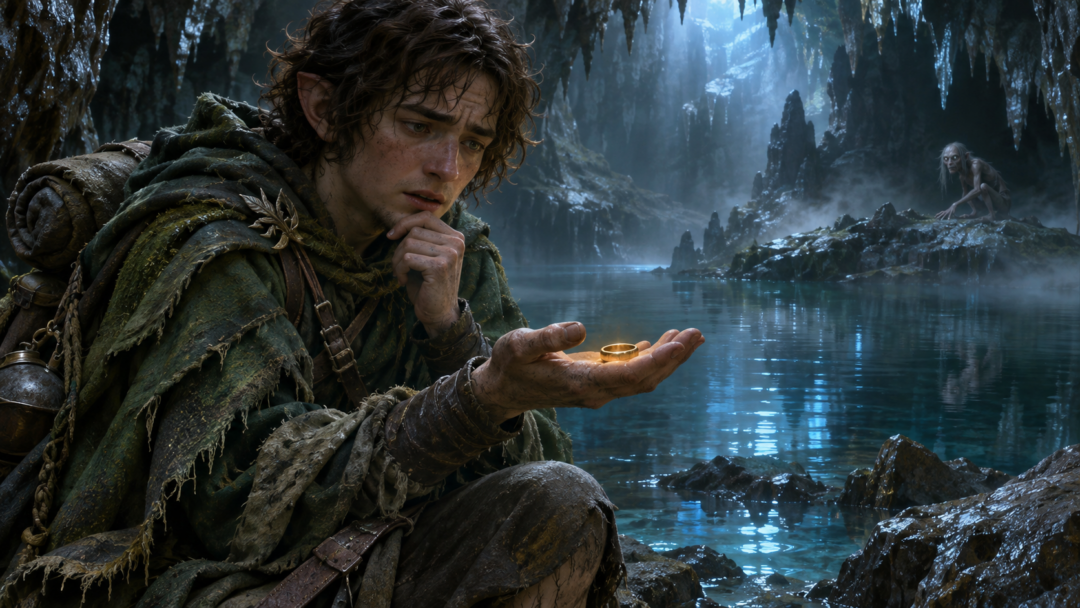
In The Hobbit, Bilbo initially encounters the Ring as a mysterious object that helps him survive. He finds it in the tunnels beneath the Misty Mountains, discovers that it can make him invisible, and uses it during an adventure that repeatedly places him in danger.
That matters because his original attachment is understandable. The Ring helps a frightened, inexperienced traveler accomplish things he otherwise could not. From Bilbo’s perspective, keeping it is perfectly sensible.
Tolkien later complicates that innocent explanation.
In The Fellowship of the Ring, the prologue explains that Bilbo originally gave an untruthful account of how he acquired the Ring. Rather than simply admitting that he found it and kept it, he claimed that Gollum had intended to give it to him as a prize for winning their riddle contest.
The distinction is important. Bilbo does not merely want to possess the Ring. He wants a story that makes his possession unquestionable.
He is protecting his claim before he understands the full nature of the thing he claims.
Tolkien’s revised version of the encounter in The Hobbit reinforces the difference between finding an object and feeling entitled to it. Gollum never willingly awards the Ring to Bilbo. The original published version presented the encounter differently, and Tolkien incorporated that earlier account into the larger story as Bilbo’s misleading version.
This gives the Ring a particularly unsettling influence. It does not need Bilbo to become openly cruel. It can work through his existing desire to appear reasonable.
The Films Make the Ring More Immediately Sinister
Jackson’s Hobbit trilogy approaches Bilbo’s discovery with the audience already aware of the Ring’s importance.
In The Hobbit: An Unexpected Journey, Martin Freeman’s Bilbo finds the Ring in Gollum’s cave. The encounter retains the essential mixture of danger, riddles, and unexpected survival. Bilbo’s decision to spare Gollum also remains a crucial expression of his character.
But the cinematic context changes how viewers interpret the discovery. The Ring is not just an unusual magical object awaiting explanation. Its sinister importance is already familiar to anyone who has watched The Lord of the Rings.
That recognition works against the gradual uncertainty of Tolkien’s prose. The audience knows more than Bilbo, and his acquisition becomes an ominous turning point almost immediately.
The films are effective at establishing danger. They are less interested in the slow process by which Bilbo makes the Ring part of his private understanding of himself.
That process becomes decisive at Bag End.
The Envelope at Bag End Is the Real Test
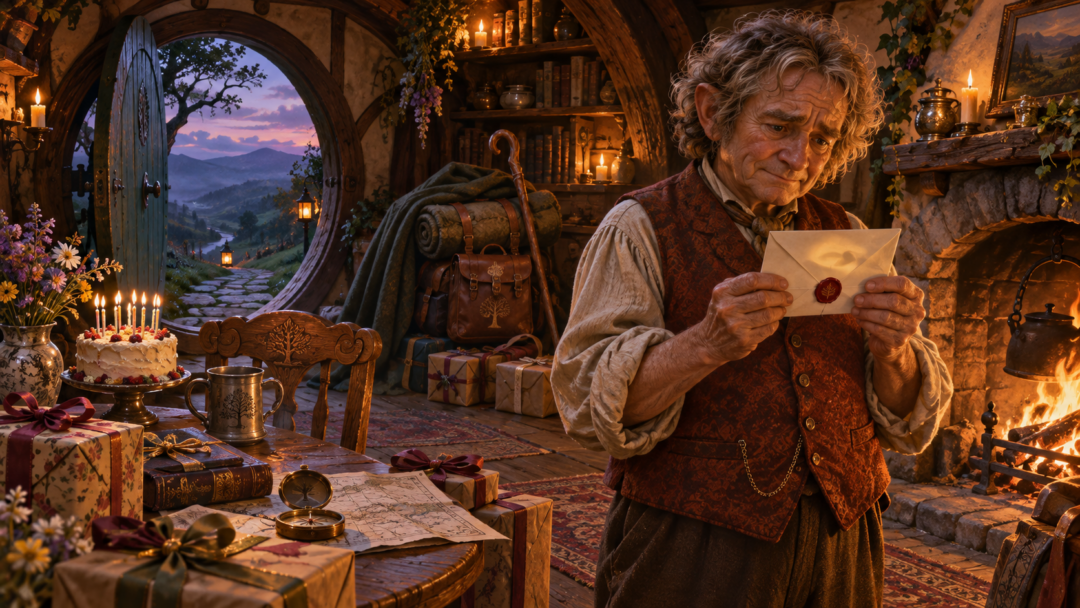
In The Fellowship of the Ring, Bilbo’s eleventy-first birthday is an elaborate farewell. He has arranged gifts, organized his departure, and prepared to leave his belongings to Frodo.
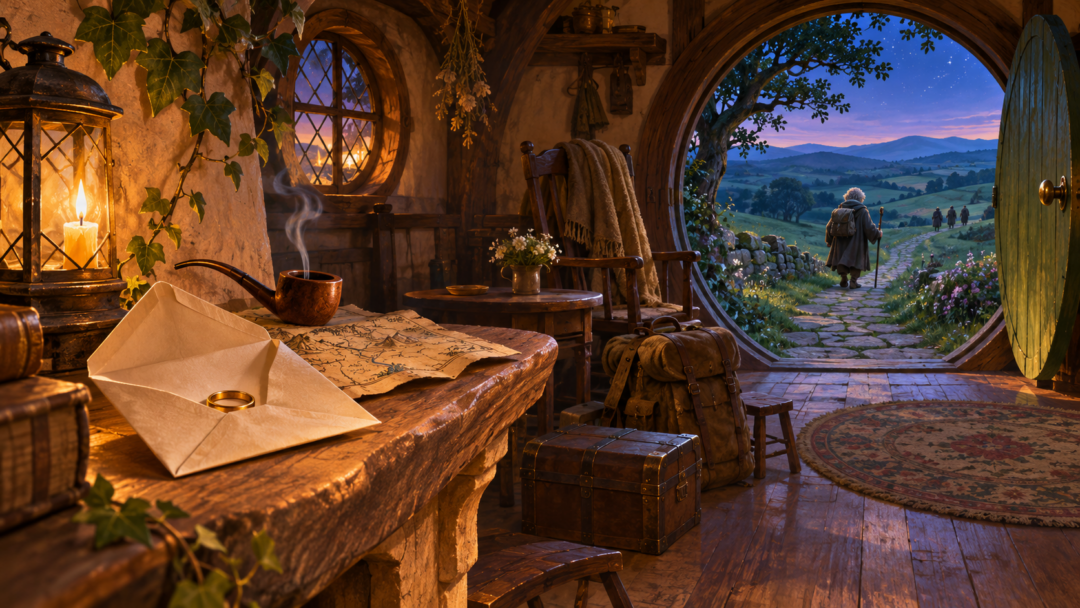
He has even placed the Ring inside an envelope addressed to his heir.
This should be straightforward. The decision has already been made, and the practical arrangements are complete.
Yet after placing the envelope on the mantelpiece, Bilbo takes it back and puts it in his pocket.
It is an astonishingly small action. No thunder sounds. No monstrous transformation announces the presence of evil. A respectable old hobbit simply changes his mind about a piece of jewelry.
The detail becomes more troubling because Bilbo is otherwise so determined to leave. He does not appear to be inventing excuses to remain in Bag End. His longing for another journey is genuine.
He wants to relinquish his familiar life, but cannot easily relinquish the object that has quietly become central to it.
The Ring has turned an apparently simple inheritance into a struggle over ownership, control, and identity.
Tolkien makes the reader notice the contradiction before explaining the full danger. That is why the moment is so convincing.
Gandalf Discovers How Far the Attachment Has Gone
The conversation that follows exposes the psychology behind Bilbo’s behavior.
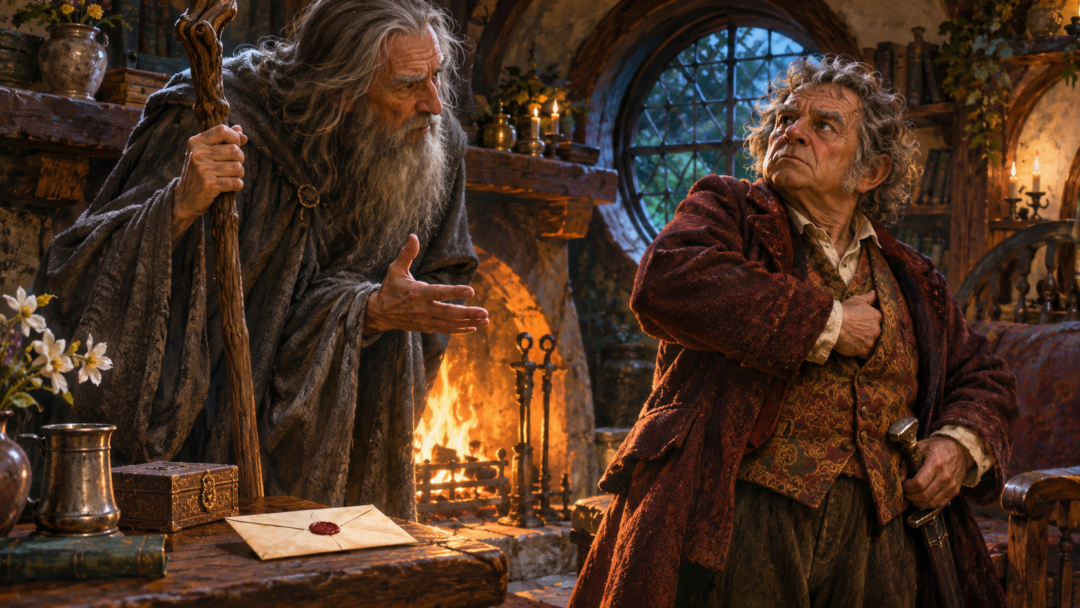
When Gandalf insists that the Ring should remain with Frodo, Bilbo becomes defensive. He questions Gandalf’s interest and begins treating his old friend’s advice as interference.
The confrontation grows serious enough that Bilbo’s hand moves toward his sword. Gandalf must assert himself forcefully before the hobbit recovers his perspective.
Consider what has happened. The same Bilbo who has spent decades regarding Gandalf as a trusted companion now approaches him as someone who might steal his property.
The Ring has not given Bilbo a new political ambition or turned him into a servant of Sauron. It has distorted an existing attachment until an act of friendship feels like a threat.
Tolkien also allows the emotional transition to happen in stages. Bilbo becomes angry, frightened, apologetic, and eventually willing to trust Gandalf.
His resistance is not evidence that he has ceased to be good. It reveals how difficult a genuinely good choice can become when a possessive instinct has been repeatedly reinforced.
This is the books’ greatest advantage: they show temptation operating through recognizable human behavior rather than replacing it.
Jackson Finds a Brilliant Visual Equivalent
Peter Jackson’s The Fellowship of the Ring handles the departure differently, but preserves its essential conflict.
Ian Holm initially plays Bilbo with warmth and eccentricity. His apparent freedom after deciding to leave the Shire makes the prospect of another adventure feel joyful.
Then Gandalf raises the Ring.
Bilbo’s mood changes. His defensiveness emerges almost before he seems aware of it. Holm lets the conversation become uncomfortable without immediately turning Bilbo into a villain.
The film also gives the Ring itself a striking role when it falls to the floor. The camera holds on the small golden object, making its apparent weight feel unnatural.
This is an excellent cinematic choice. The Ring looks simple, yet everything about the scene suggests that abandoning it requires enormous effort.
The film ultimately shows Bilbo leaving it behind, and his departure carries a renewed sense of freedom.
Jackson communicates the essential struggle in remarkably little screen time. The scene is visually memorable, emotionally clear, and grounded in Holm’s performance.
Still, the film necessarily compresses the progression. Tolkien can dwell on the private revisions and evasions through which Bilbo nearly defeats his own decision.
The camera captures the crisis. The prose makes its development easier to understand.
Rivendell Gives the Films Their Strongest Argument
The films’ most unforgettable portrayal of Bilbo’s obsession comes later, in Rivendell.
Frodo has reached the safety of Elrond’s house, where he reunites with his uncle. Their meeting initially offers relief after the danger of the journey.
Then Bilbo notices the Ring around Frodo’s neck.
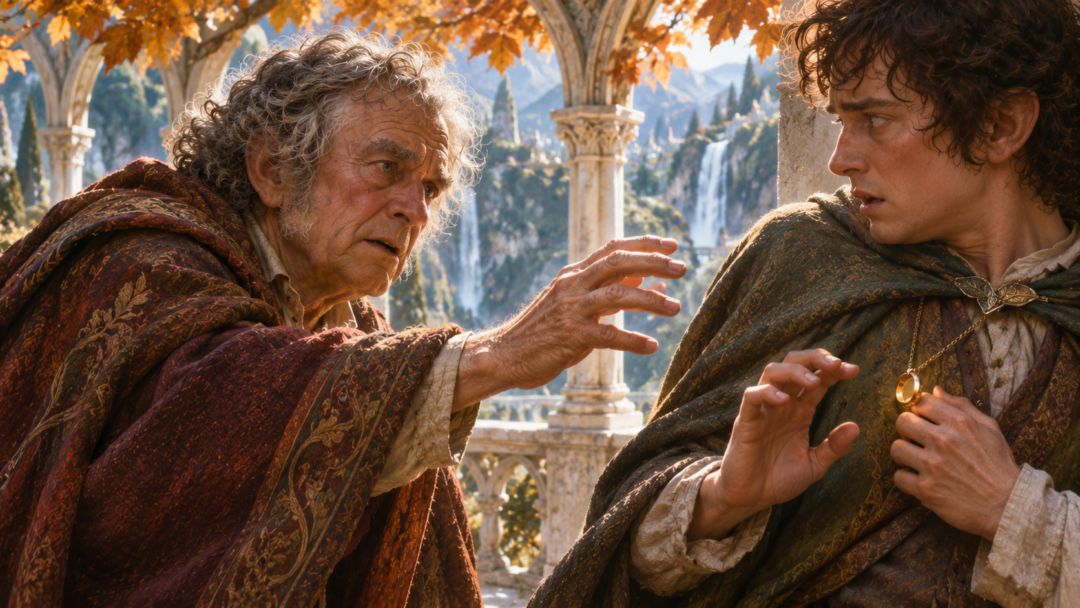
He asks to see it, reaches toward it, and briefly undergoes a horrifying facial transformation. The gentle old hobbit suddenly resembles a creature driven by hunger and possessiveness.
The shock is effective precisely because Bilbo has already surrendered the Ring. The audience might reasonably expect his struggle to have ended at Bag End.
Instead, the desire returns as soon as the object is placed before him.
Holm’s reaction afterward gives the scene its emotional force. Bilbo recognizes what has happened and is distressed by his own behavior. The horror is not simply that the Ring can make someone frightening. It is that Bilbo remains capable of recognizing the person he nearly became.
This moment is Jackson’s strongest evidence for the power of cinematic storytelling. A few seconds of performance and visual effects make the Ring’s continued hold immediately understandable.
But the book’s corresponding scene is more complicated.
Tolkien’s Rivendell Scene Is Quieter and Stranger
In the chapter Many Meetings, Bilbo also asks to see the Ring again. Frodo’s perception of him changes dramatically as Bilbo reaches for it, making his beloved uncle seem grasping and repulsive.
The difference is partly one of perspective.
The novel presents the disturbing transformation through Frodo’s experience. It is not simply an objective announcement that Bilbo has physically become monstrous.
That distinction matters because Frodo is now carrying the Ring. His own possessiveness has begun influencing how he responds to anyone who approaches it, including someone he loves.
The scene therefore exposes two related vulnerabilities at once. Bilbo still desires the Ring, while Frodo increasingly experiences another person’s interest as threatening.
Jackson’s version concentrates the horror on Bilbo’s sudden appearance. Tolkien leaves more room for the reader to consider how the Ring changes the perceptions of its current bearer.
The film makes the moment terrifying. The book makes it psychologically unstable.
And that instability is particularly appropriate for an object whose power repeatedly operates through desire, suspicion, and distorted judgment.
Bilbo’s Mercy Makes His Obsession More Interesting
There is another reason the books’ treatment works so well: Tolkien never reduces Bilbo to the Ring’s influence.
In The Hobbit, Bilbo has an opportunity to kill Gollum while escaping the tunnels. Instead, he chooses to spare him. That decision later becomes enormously important to the fate of the Ring.
Bilbo can possess a deeply dangerous object and still make a compassionate choice.
His capacity for mercy does not mean that the Ring is harmless. Likewise, his possessiveness does not erase the decency that defines much of his behavior.
Tolkien maintains both truths at once.
This also explains why Bilbo’s eventual surrender matters so much. In The Shadow of the Past, Gandalf emphasizes the significance of Bilbo giving up the Ring voluntarily, even though he needed assistance and encouragement.
Bilbo’s achievement is not that he was immune to temptation. It is that he finally acted against it.
The distinction is central to Tolkien’s moral argument. Courage is not always displayed through battle, and resistance to evil does not require a person to be untouched by it.
Sometimes it means leaving an envelope on a mantelpiece and walking away.
The Verdict: The Book Understands the Obsession Better
Peter Jackson deserves substantial credit for making Bilbo’s struggle unforgettable on screen. Ian Holm’s sudden defensiveness at Bag End, the Ring’s heavy fall, and the frightening moment in Rivendell are among the adaptation’s most effective demonstrations of its influence.
Those scenes show the danger with an immediacy that prose cannot reproduce in exactly the same way.
But Tolkien’s books offer a more complete portrait.
Bilbo’s attachment begins with a useful discovery, develops into a questionable claim of ownership, survives decades of comfortable secrecy, and eventually threatens his ability to trust someone he loves. Even after he gives the Ring away, its attraction has not entirely disappeared.
Most importantly, the books distinguish between possessing the Ring, wanting it, and choosing whether to obey that desire.
Jackson gives us the startling sight of a beloved hobbit momentarily becoming frightening.
Tolkien gives us the more uncomfortable possibility that a beloved hobbit can remain recognizably himself while repeatedly finding reasons not to surrender something he should have left behind.
That is why the books win this comparison. Their Bilbo does not need to look monstrous to reveal the Ring’s influence. He only needs to insist that the little gold object belongs to him.
Sources & Notes
This article is based on close reading and interpretation of Tolkien's published works and related source material where relevant.