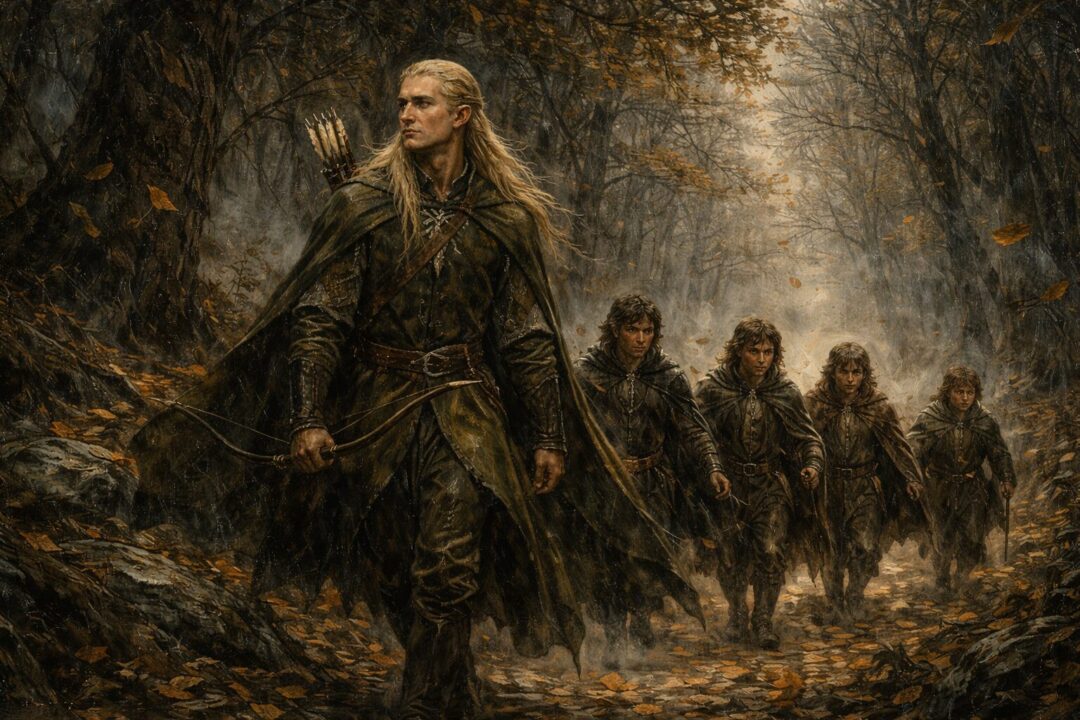
Among the many relationships implied but rarely explored in The Lord of the Rings, few are as quietly absent as that between Legolas and his father, Thranduil.
Legolas is present at nearly every major turning point of the War of the Ring. He walks from Rivendell to Mordor, fights at Helm’s Deep, witnesses the fall of Isengard, stands beneath the walls of Minas Tirith, and marches to the Black Gate itself. He speaks often—of forests and stones, of ancient griefs, of the fading of beauty from the world.
Yet throughout the entire narrative, he almost never speaks of his father.
This absence feels especially noticeable because Legolas does speak of other things that matter deeply to him. He mourns the destruction of Fangorn’s outer woods. He laments the coming of an age where Elves will no longer dwell in Middle-earth. He speaks with reverence of Galadriel and Lothlórien, and he openly compares the cultures of Men, Dwarves, and Elves.
But the king he serves—the ruler of the Woodland Realm, the lord whose halls once imprisoned Thorin Oakenshield, and whose realm stands closest to Dol Guldur—is nearly unmentioned.
This silence is not accidental.
It is a direct result of how the War of the Ring is framed, whose voices shape the story, and what Tolkien chooses to leave outside the Fellowship’s immediate experience.
Thranduil Is Not a Minor Figure
To understand why Legolas’s silence stands out, it is important to recognize who Thranduil actually is within the legendarium.
In The Hobbit, Thranduil is a central political power in the north. He commands armies, controls vital forest territory, negotiates—sometimes tensely—with Dwarves and Men, and plays a decisive role in the aftermath of the Battle of Five Armies. His realm is wealthy, strategically positioned, and constantly threatened by the shadow from Dol Guldur.
By the time of The Lord of the Rings, that threat has not diminished.
Dol Guldur is once again openly occupied by Sauron’s servants. The Woodland Realm stands directly in the path of forces moving west and north. In geopolitical terms, Thranduil is one of the most exposed rulers in Middle-earth during the war.
And yet, within the main narrative of The Lord of the Rings, he is almost invisible.
The reason is not that he is irrelevant.
It is that the story is not being told from where he stands.
Legolas Is Not a Courtly Voice
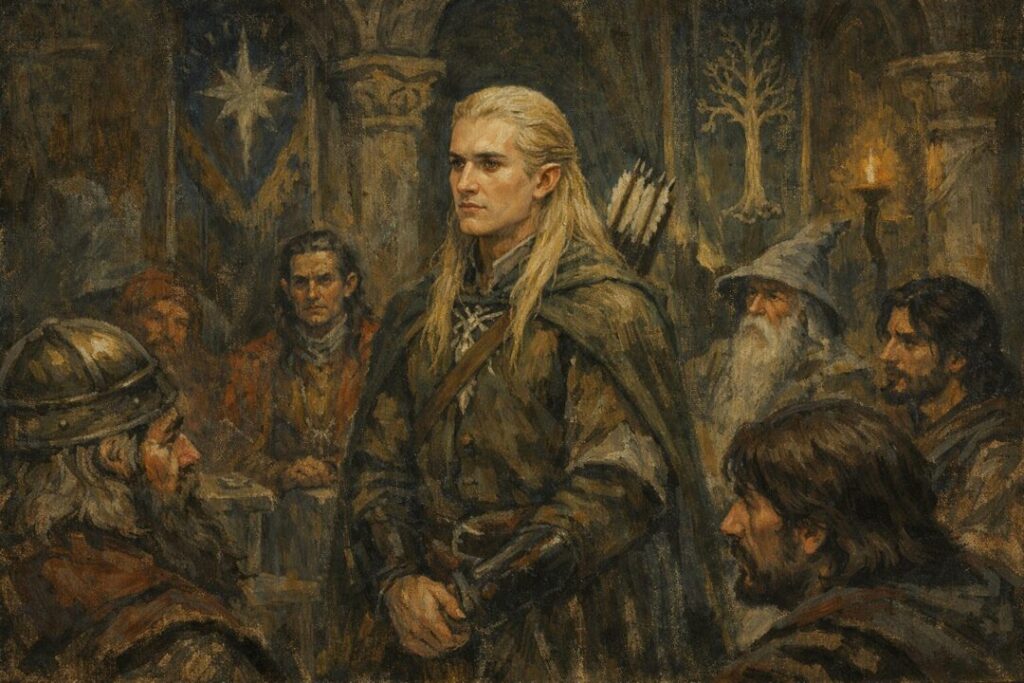
At the Council of Elrond, Legolas appears in what might be called a formal capacity. He brings news from the Woodland Realm and represents his people among the gathered Free Peoples. In that moment, he is clearly connected to his father’s rule and to the political realities of the north.
But once the Fellowship leaves Rivendell, that role ends.
From that point forward, Legolas is no longer functioning as a messenger or diplomat. He is a companion in a mission defined by secrecy, endurance, and moral restraint. The quest of the Ring is not a campaign led by kings, but a burden carried quietly by those least likely to draw attention.
Tolkien is careful not to turn Legolas into a political commentator once the journey begins. Unlike Boromir—who constantly frames events through Gondor’s needs, his father’s expectations, and the survival of his city—Legolas rarely interprets events in terms of royal duty or territorial defense.
This contrast is deliberate.
Men in The Lord of the Rings often define themselves through lineage, inheritance, and visible authority. Elves, particularly in the Third Age, are portrayed differently. Their loyalties are older, less performative, and less frequently verbalized.
Legolas’s silence reflects this cultural distinction rather than any personal distance from his father.
The Story Is Told Through Hobbits
One of the most important structural facts about The Lord of the Rings is that it is not written as a comprehensive chronicle of the war.
It is written, largely, from the perspective of Hobbits.
Frodo, Sam, Merry, and Pippin are not scholars of Elvish history. They do not understand the full political map of Middle-earth, nor do they ask detailed questions about realms they never visit. Their attention—and therefore the narrative’s attention—is focused on what directly touches their path.
This narrative framing has consequences.
Rivendell and Lothlórien appear prominently because the Fellowship passes through them. Elrond and Galadriel speak because the Hobbits hear them speak. Thranduil’s halls, deep in northern Greenwood, lie far outside the Hobbits’ lived experience of the war.
Legolas may carry thoughts of his homeland with him—but the story does not pause to record thoughts the Hobbits never hear.
The absence of Thranduil is not a gap in the world. It is a limit of perspective.
Parallel Wars, Unequal Visibility
The War of the Ring is not a single front moving eastward toward Mordor. It is a series of simultaneous conflicts spread across Middle-earth.
Canon sources outside the main narrative make this explicit.
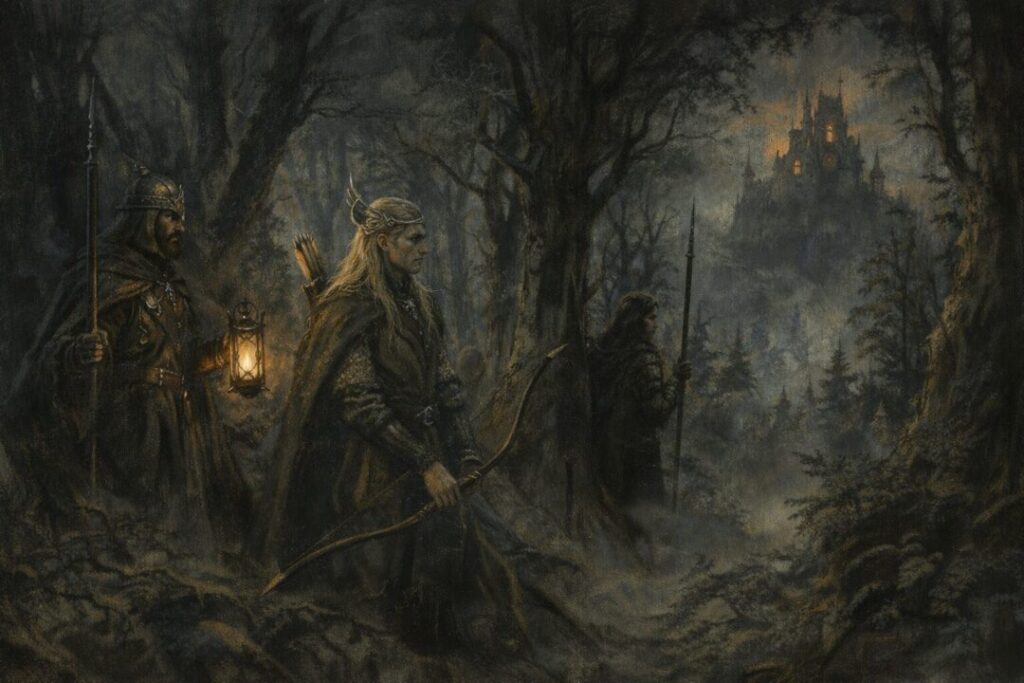
In the appendices to The Lord of the Rings, Tolkien records that the Woodland Realm was attacked by forces from Dol Guldur. Thranduil fought multiple battles to defend his borders. These were not minor skirmishes, but sustained conflicts that drained strength and cost lives.
The Elves of Lórien fought similar battles under Galadriel and Celeborn. Only after the fall of Sauron were these threats finally removed, and Dol Guldur itself destroyed.
Legolas does not narrate these events because he is not present for them.
More importantly, Tolkien deliberately avoids shifting the main narrative away from the Ring-bearer’s journey to give equal weight to every battlefield. Doing so would fracture the story’s focus and undermine its central theme.
The silence around Thranduil preserves narrative cohesion.
Elvish Reserve, Not Estrangement
It is tempting—especially for modern readers—to interpret silence as emotional distance or strained relationships. But Tolkien gives us no textual basis for such a conclusion.
Legolas never criticizes his father. He never expresses resentment or dissatisfaction with his rule. He never implies a desire to escape his homeland or its authority.
If anything, his actions suggest the opposite.
Legolas leaves his father’s realm not to abandon it, but to serve a cause that transcends any single kingdom. In Tolkien’s moral framework, such service is not rebellion—it is fidelity to a higher good.
Elves in Tolkien’s world do not frequently articulate their deepest bonds. Love, loyalty, and grief are often shown through endurance, patience, and sacrifice rather than through speech.
Silence, for Elves, is not absence.
It is containment.
Kings at the Margins of the Story
Ultimately, Legolas’s silence is not about Thranduil as a character.
It is about what kind of story The Lord of the Rings chooses to be.
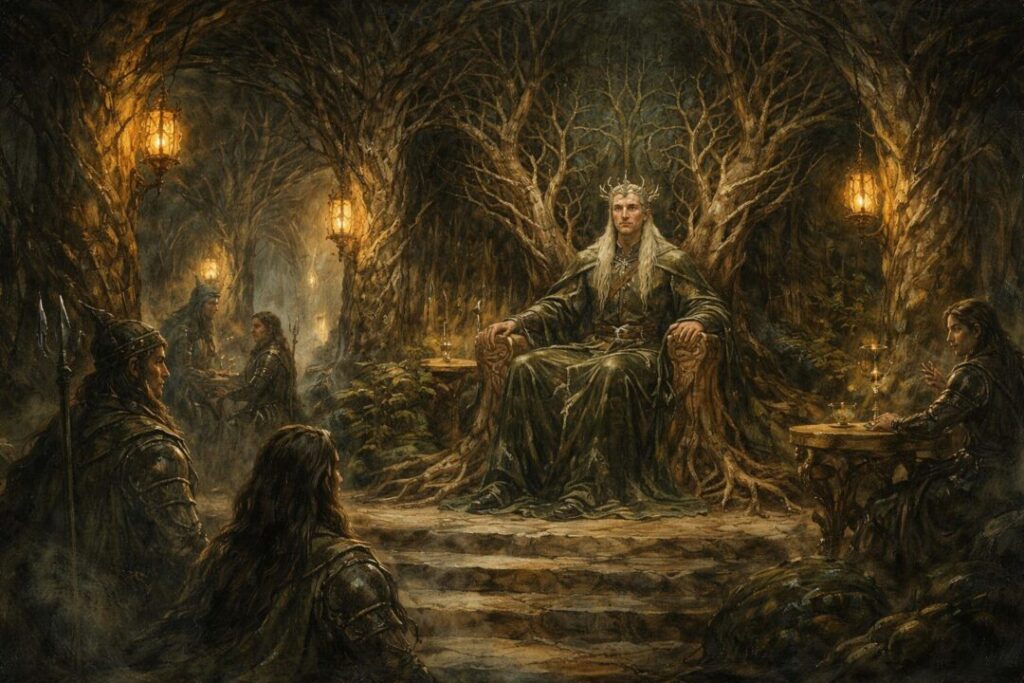
This is not a tale of dynasties asserting themselves through conquest or royal figures dominating the field. Kings and rulers exist, and they matter—but they operate largely at the edges of the narrative.
They hold ground. They resist. They endure.
But the fate of the world is decided elsewhere.
Legolas belongs to the fading world of ancient kingship and long memory. By keeping his father largely unspoken, the narrative reinforces a broader truth of the Third Age: that the age of Elves and their rulers is passing—not through defeat, but through withdrawal.
They do not vanish because they fail.
They fade because the story no longer belongs to them.
The Meaning of the Silence
Legolas’s silence is not emptiness.
It is restraint.
It reflects the narrative perspective of the Hobbits, the cultural reserve of the Elves, and the thematic choice to center the story on humility rather than authority.
In Middle-earth, the loudest claims are rarely the most important ones.
Sometimes, the deepest loyalties are the ones that never need to be spoken at all.
And that, perhaps, is why Legolas says so little—while meaning so much.