It sounds like a simple comparison.
Beleriand on one side.
Middle-earth on the other.
Which was bigger?
But the moment you look closely, the question begins to slip.
Because Beleriand was never the whole world of the First Age. And the “Middle-earth” most readers picture in the Second or Third Age is usually not the whole world of those Ages either.
That is the first thing that has to be untangled.
When people imagine later Middle-earth, they usually imagine the lands most visible in The Lord of the Rings: the Shire, Bree, Rivendell, Moria, Rohan, Gondor, Mordor, and the northern and southern ranges around them. It feels like a complete map because it is the map the story teaches us to hold in our minds.
But it is not all of Middle-earth.
Not even close.
So when someone asks whether Beleriand was bigger than Second or Third Age Middle-earth, they are often comparing one major First Age region to one familiar later portion of a much larger continent.
And that is why the answer depends on what “Middle-earth” means.
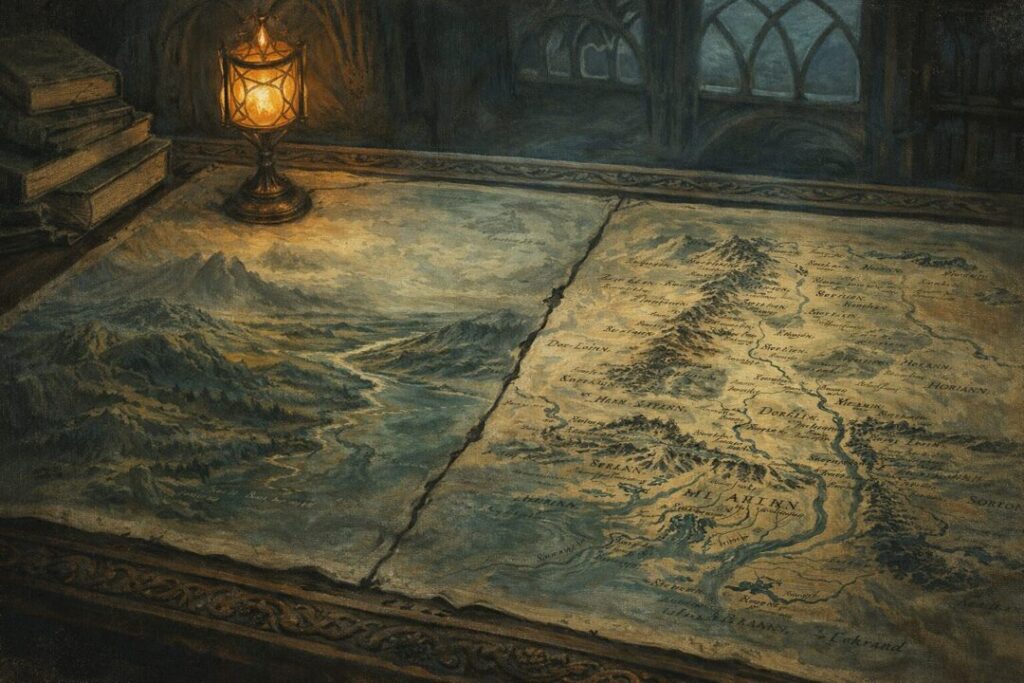
Beleriand Was a Region, Not the Whole Continent
Beleriand was the great western land of the First Age, lying west of the Blue Mountains. Within it stood many of the most important realms of the Elder Days: Doriath in the guarded forest, Nargothrond beside Narog, the hidden city of Gondolin, the havens of the Falas, the March of Maedhros in the east, and Ossiriand by the Seven Rivers.
This is one reason Beleriand feels so large in memory.
So much happens there that it seems to contain the whole struggle of the Age.
In narrative terms, it almost does.
But geographically, it does not.
Even in the First Age, Beleriand was only one part of Middle-earth. East of the Blue Mountains lay lands that did not vanish from the world after the Elder Days ended. The Blue Mountains were not the edge of the continent. They were the eastern border of Beleriand.
That distinction matters.
Because if Beleriand is placed against the entire continent of Middle-earth, then the answer is no. It was not bigger than Middle-earth in the Second or Third Age, because Middle-earth was still a far larger landmass extending far to the east and south beyond the regions central to the stories.
Why the Question Feels Like It Should Be Yes
And yet the question persists for a reason.
Beleriand does look enormous.
The texts present it as the stage of long wars, multiple hidden kingdoms, great marches, ruinous battles, and journeys that feel epic in distance and consequence. It was broad enough that east and west Beleriand were meaningful distinctions, and one traditional measure places Beleriand at roughly 550 miles across from Eglarest to the Blue Mountains. East Beleriand alone is described as stretching a hundred leagues across at its widest.
Those are not small dimensions.
They help explain why Beleriand feels heavier and grander than the later world.
The First Age is dense with realms packed into a relatively coherent western theater of war. Readers move from Hithlum to Doriath, from Dorthonion to Nargothrond, from the Falas to the marches below Thangorodrim, and the whole region gains an emotional scale larger than many later maps.
So the instinct is understandable.
If Beleriand contains all that, how could the later world not be smaller?
The answer is that the later world is often only partially shown.
The Third Age Map Is Not All of Middle-earth
This is where the comparison usually breaks.
The map most readers know from The Lord of the Rings is a map of the Westlands, or northwestern Middle-earth, during the War of the Ring. It is not a map of the entire continent.
That is easy to forget because the story itself is so complete within those bounds.
But beyond those familiar lands lie Rhûn to the east, Harad to the south, and still wider regions only lightly described in the narrative. Even within the northwest, there are large stretches that matter little to the immediate plot and so remain vague in many readers’ minds.
In other words, the later Ages did not inherit a smaller world.
They inherited a differently narrated one.
The First Age gives intense attention to Beleriand because that is where the struggle against Morgoth is concentrated for much of the surviving tradition. The Third Age gives intense attention to the northwestern lands of the War of the Ring because that is where the fate of the Ring is decided.
Those are not equal cartographic categories.
One is a major historical region.
The other is the currently relevant portion of a larger continent.
So Was Beleriand Bigger than the Familiar Third Age World?
If the comparison is narrowed, the answer becomes more interesting.
If by “Third Age Middle-earth” someone really means the familiar story-map from the Shire to Mordor, then Beleriand can begin to feel comparable in scale, and in some directions surprisingly expansive for a single region.
That does not make the two identical in size.
And the texts do not give a clean single statement that settles the comparison mathematically.
But they do support the more careful conclusion that Beleriand was much larger than many readers first assume, while the commonly pictured Third Age map is much smaller than “all of Middle-earth.”
That is why debates about this question often turn confusing so quickly.
Both sides are usually seeing a real thing.
One side sees the sheer breadth and density of Beleriand.
The other sees that Middle-earth, taken properly, is a whole continent and therefore not something Beleriand could exceed.
Both are right within different frames.
The War of Wrath Changed the Shape of the Question
There is another reason the comparison feels distorted.
Beleriand is not simply absent in later Ages because the story moved elsewhere.
It was broken and largely drowned in the War of Wrath.
That loss gives it a mythic disproportion in memory.
Readers are not just comparing two maps. They are comparing a lost land of the Elder Days to the surviving lands of later history.
And loss magnifies scale.
When Beleriand perished, not everything west of the Blue Mountains vanished entirely. A remnant survived and became Lindon, while the breaking of the mountains helped form the Gulf of Lhûn. That means the western edge of the later map still carries the memory of the First Age, but only as a fragment.
This matters because it shows that the later west is not a replacement map equal to Beleriand in kind.
It is a surviving edge.
A remainder.
A coastline left behind after catastrophe.
So when readers look at Lindon on a Third Age map, they are not looking at a new western land comparable to the old. They are looking at what was left.
That can make the whole later world feel reduced even when the broader continent remains vast.
Why Beleriand Feels Larger Than It Was
There is also a narrative illusion at work.
Beleriand is one of the most storied lands in the legendarium. Every name in it seems burdened with doom, memory, oath, loss, or hidden glory. Dorthonion is not just a highland. Gondolin is not just a city. Doriath is not just a forest. The map is saturated with fate.
That saturation creates a sense of enormousness.
By contrast, later Middle-earth often feels more open, emptier, and more broken. Arnor is gone. Eregion is gone. Much of Eriador lies quiet. Great stretches are wild, thinly settled, or no longer central to the fate of the world in the way the realms of Beleriand once were.
So even where the geography is broad, the emotional density is lower.
Beleriand feels bigger not only because it was large, but because so much of the Elder Days is concentrated within it.
The map is full of pressure.
The later world is fuller of distance.
The Most Accurate Answer
So was Beleriand bigger than Second or Third Age Middle-earth?
If “Middle-earth” means the whole continent, then no.
Beleriand was one great western region of Middle-earth, not a land larger than the entire continent that endured into later Ages.
But if “Middle-earth” means the familiar northwestern map most readers carry from The Lord of the Rings and The Hobbit, then the question becomes far less foolish than it sounds. In that narrower sense, Beleriand may feel comparable, and in narrative weight it can even seem greater.
That is the real answer.
Not a flat yes.
Not a flat no.
The comparison is usually being made between unlike things.
A lost First Age region that held the weight of the Elder Days is being set against only the best-known corner of the later world. Once that is corrected, the apparent contradiction disappears.
Beleriand was vast.
Later Middle-earth was not smaller in itself.
We are simply shown a different portion of it.
And perhaps that is why Beleriand still looms so large.
It is not just that it was real within the history of Arda.
It is that almost everything about the Elder Days makes it feel larger than memory should be able to hold.
Sources & Notes
- J.R.R. Tolkien, The Silmarillion, “Of Beleriand and Its Realms” — identifies Beleriand as the western lands bounded by Ered Luin and describes its chief realms and regions.
- J.R.R. Tolkien, The Silmarillion, “Of the Ruin of Beleriand and the Fall of Fingolfin” — supports Beleriand’s role as the dense First Age theatre of wars, marches, and ruined kingdoms.
- J.R.R. Tolkien, The Silmarillion, “Of the Voyage of Eärendil and the War of Wrath” — recounts the breaking and drowning of Beleriand after Morgoth’s defeat.
- J.R.R. Tolkien, The Lord of the Rings, “Prologue” and Appendix B — keeps the late Third Age story focused on the north-western lands rather than the full continent of Middle-earth.