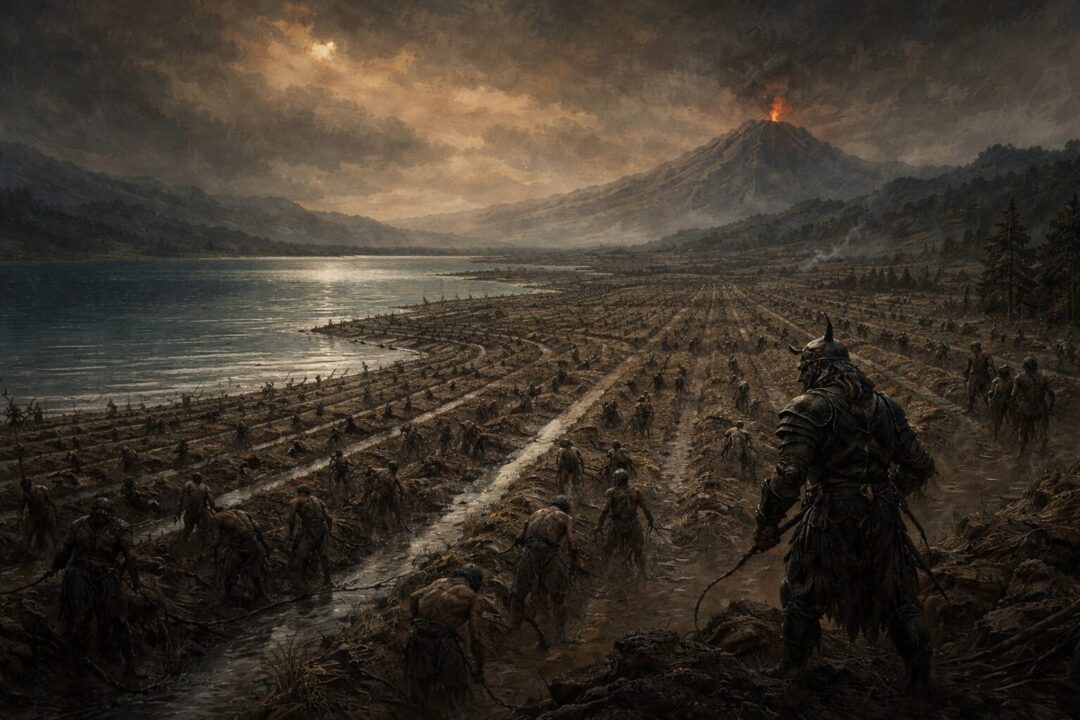
Most people imagine Mordor as a place where nothing could grow.
That impression is understandable. When the story takes us inside the Black Land, we see ash, choking dust, stone, slag-heaps, marching roads, pits, cliffs, and the long shadow of the Dark Tower. It looks like a realm built only for destruction.
And yet that picture is incomplete.
Because the texts quietly reveal something crucial: Mordor was not only a wasteland. It was also a system capable of sustaining war on a massive scale.
That matters, because one of the oldest practical questions about the War of the Ring is also one of the simplest:
How did Sauron feed his armies?
The answer, as far as the canon allows us to say, is not mysterious at all. It is simply easy to miss.
The Part of Mordor Frodo and Sam Did Not See
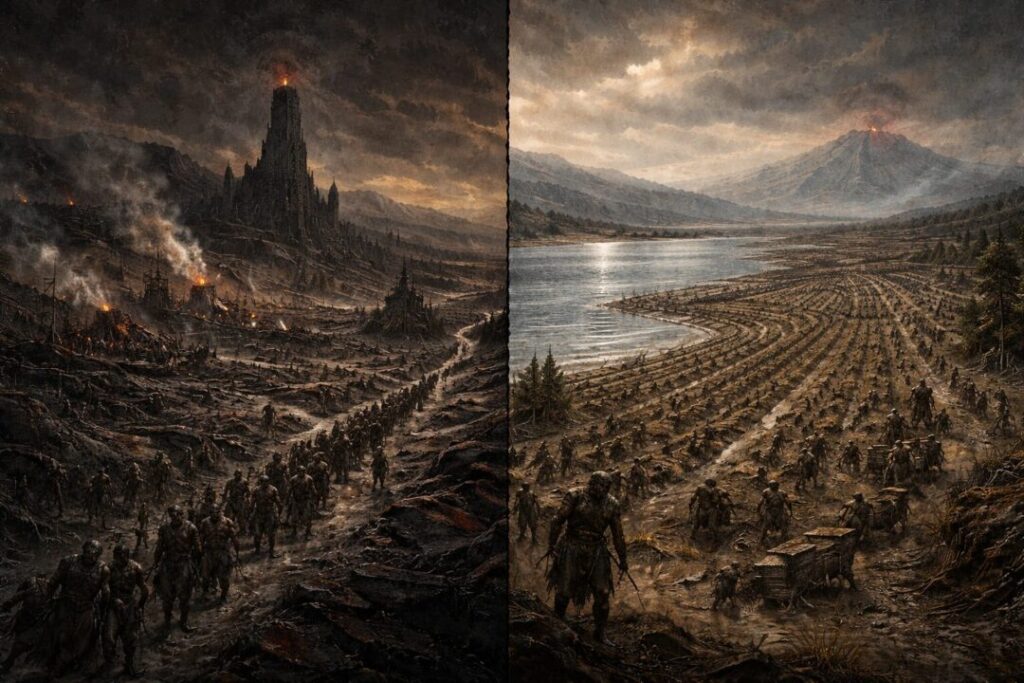
The landscape followed by Frodo and Sam is the northern part of Mordor, the grim region associated with Udûn, Gorgoroth, the forges, and the mustering of war. The narrative itself contrasts this northern zone with another part of the land that the hobbits never reach.
In one of the most revealing passages in the entire story, we are told that they knew nothing of the “great slave-worked fields” far to the south, beyond the fumes of Orodruin, by the dark waters of Lake Núrnen. The same passage also mentions great roads running east and south to tributary lands, from which soldiers of the Tower brought long wagon-trains of goods, booty, and fresh slaves.
That is the key.
The books do not leave us guessing whether food existed in Mordor. They tell us directly that the south contained large agricultural lands worked by slaves, and that Mordor’s road network linked the realm to outside sources of supply and extraction.
So the first answer is plain:
Sauron fed his armies through slave agriculture in southern Mordor.
Lake Núrnen Changes the Entire Picture
Lake Núrnen is easy to overlook because it is not the center of the narrative. But in logistical terms, it may be one of the most important places in all Mordor. Tolkien Gateway’s summary, drawing on The Lord of the Rings map and later references, notes that Nurn was the more fertile southern region of Mordor and that the Sea of Núrnen was fed by rivers, making cultivation there possible in a way that the northern wasteland was not.
This means Mordor was geographically divided.
The north was the face of terror: military concentration, industry, command, and surveillance. The south was part of the structure that kept that northern machine alive.
That division makes immediate sense of what otherwise seems impossible. A realm like Gorgoroth could not comfortably feed vast hosts. But a wider Mordor that included Nurn is something else entirely. It becomes not merely a cursed battlefield, but an empire with an agricultural base.
And the language of the text matters here.
These are not peasant farms belonging to ordinary households. They are slave-worked fields. The economy implied is one of coercion, centralized domination, and production for power.
Mordor Was a War Machine, Not Just a Fortress
This is the deeper significance of the question.
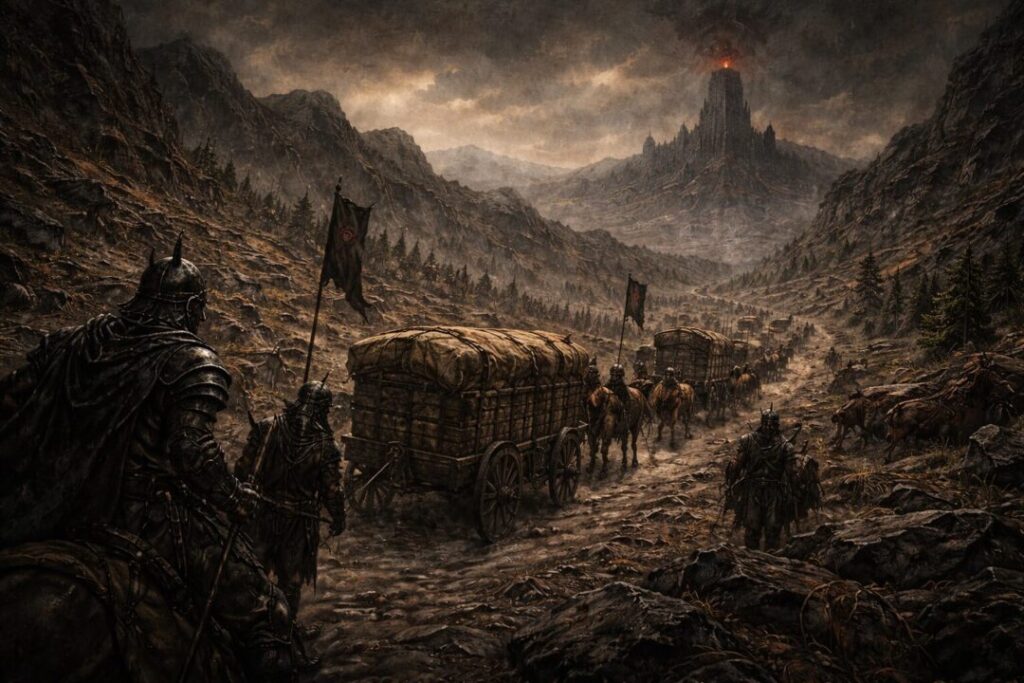
People often speak of Mordor as though it were only a dark citadel surrounded by dead land. But the text suggests something harsher and more organized. Mordor is a war machine supported by labor, roads, transport, and tributary relationships.
The same passage that mentions the fields of Nurn also mentions the great roads running east and south, and the wagon-trains returning with goods. The text does not specify every category included under “goods,” so we should be careful not to claim more than it says. Still, in context, the implication is hard to miss: Mordor was supplied not only from its internal fields, but also through extraction from lands under Sauron’s domination.
That is as far as the canon lets us go with certainty.
We are not given inventories.
We are not told the exact crops.
We are not told how granaries were organized, or how rations were distributed among Orcs, trolls, and Men.
But we are shown the structure.
And once that structure is visible, the problem of feeding Mordor’s armies becomes far less puzzling.
What the Text Explicitly Says — and What It Does Not
This distinction is important, because the subject invites exaggeration.
The texts explicitly support these points:
Southern Mordor, especially Nurn around Lake Núrnen, was fertile enough for major agriculture.
Those lands were worked by slaves and were tied to the feeding of Sauron’s armies.
Mordor had great roads linking it to tributary lands east and south, and these roads carried wagon-trains of goods, booty, and fresh slaves.
After the war, Aragorn released the slaves of Mordor and gave them the lands about Lake Núrnen, confirming both the existence and importance of that agricultural region.
But the texts do not explicitly tell us:
Exactly what those fields grew.
Whether allied Mannish armies from Harad and Rhûn were fully provisioned by Mordor or partly by their own supply arrangements.
Whether Mordor stored food in vast depots in the north or moved it forward only as needed.
What a standard Orc ration looked like in book-canon terms.
Those are the places where responsible interpretation must stop short of pretending certainty.
The Role of Tributary Lands
The mention of roads to tributary lands is one of the most suggestive details in the entire passage. It implies that Mordor did not exist in isolation. Sauron’s strength depended on a wider network of subject peoples, coerced labor, and movement of wealth toward the center.
That fits the larger picture of the war. Sauron’s forces were not only Orcs bred or gathered in Mordor. They also included armies from the East and South: Easterlings, Haradrim, and other peoples serving his cause.
We should be careful here. The books do not say, in a line-by-line logistical sense, that these allied or subject forces solved Mordor’s provisioning problem by feeding themselves. But their very presence means that Sauron’s military strength was not something produced by Mordor alone. The war effort was imperial in scale.
So when readers imagine Mordor as one closed box somehow producing endless soldiers and supplies out of bare ash, they are imagining too small a system.
The canon points instead to something broader:
an extractive realm drawing in both food and people.
Why the Ending Matters So Much
One of the strongest confirmations comes only after Sauron falls.
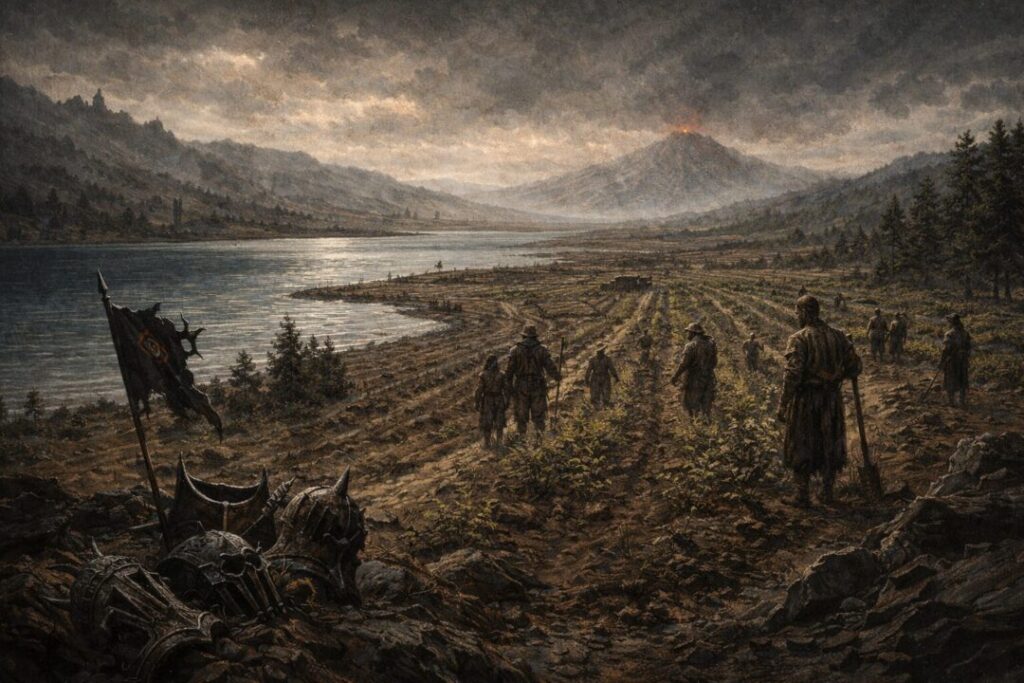
When Aragorn becomes king, we are told that he released the slaves of Mordor and gave them all the lands about Lake Núrnen to be their own.
That is not a random act of mercy attached to a vague location. It reveals that the agricultural population of Nurn was substantial enough to be recognized, liberated, and settled in the very lands they had been forced to work.
In other words, the story does not merely hint that there may have been food somewhere in Mordor.
It circles back at the end and shows that this hidden region was real enough to survive the war as a human landscape.
That is a powerful detail.
It means the productive heart of Mordor was not Barad-dûr.
It was the enslaved labor that sustained Barad-dûr.
The Darker Meaning of the Answer
So how did Sauron feed the armies of Mordor?
Mainly, so far as the texts directly indicate, by enslaving people to work the fields of Nurn and by drawing goods inward along the roads from tributary lands.
That answer is practical.
But it is also moral.
The frightening thing about Mordor is not only that it destroys. It is that it organizes. It turns land into production, roads into channels of extraction, and living people into tools for sustaining war.
The north of Mordor is where terror is seen.
The south is where terror is made durable.
And that may be the most unsettling part of all.
Because once you notice the fields of Núrnen, Mordor stops being a fantasy wasteland that somehow runs by dark magic alone.
It becomes something colder, more plausible, and more disturbing:
a kingdom of conquest fed by forced labor, transport, and the quiet machinery behind visible evil.
Sources & Notes
- J.R.R. Tolkien, The Lord of the Rings, Book VI, Chapter 2, “The Land of Shadow” — directly describes the slave-worked fields south of Orodruin by Lake Núrnen, and roads bringing goods, booty, and slaves from tributary lands.
- J.R.R. Tolkien, The Lord of the Rings, Book VI, Chapter 5, “The Steward and the King” — Aragorn frees the slaves of Mordor and gives them the lands about Lake Núrnen, confirming the region’s settled importance after the war.
- J.R.R. Tolkien, The Lord of the Rings, Book V, Chapter 10, “The Black Gate Opens” — shows Mordor’s war effort as part of a wider military system, drawing strength from peoples and lands beyond Mordor itself.
- J.R.R. Tolkien, Letter 131 — describes Sauron’s governing impulse as domination and ordering of wills and things to his own purposes, a useful frame for Mordor’s coercive logistics.