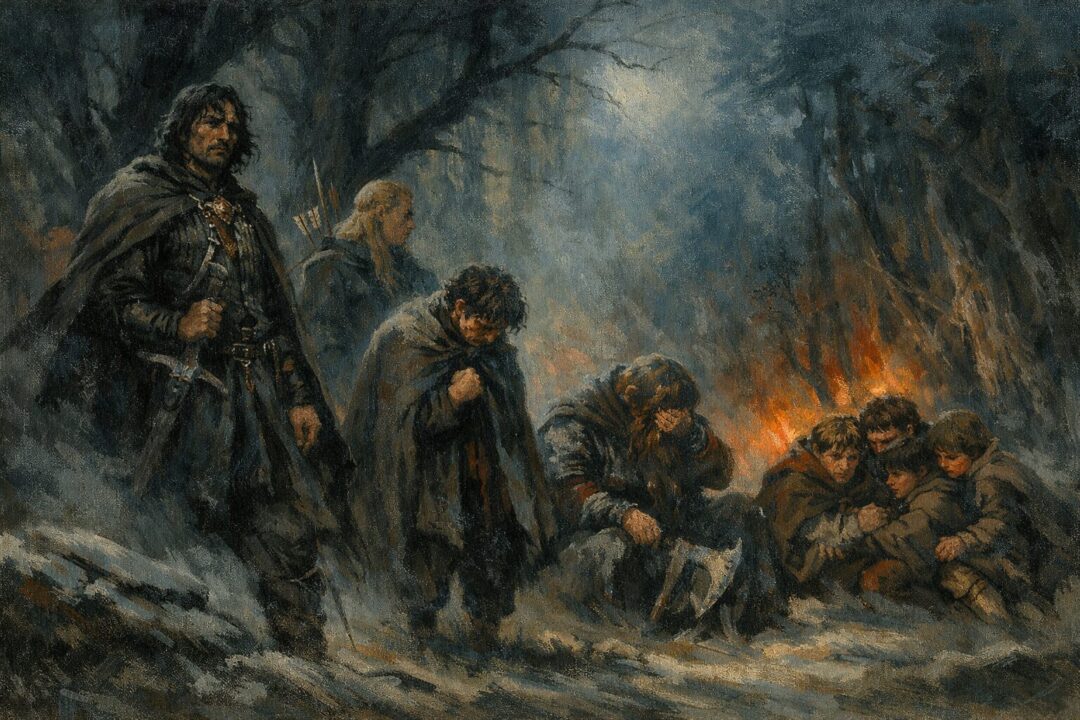
When Gandalf falls in Moria, the Fellowship loses more than a companion.
It loses its guide.
That loss is easy to underestimate because the Company keeps moving. Aragorn takes command. Legolas and Gimli remain. Frodo still bears the Ring. The quest does not end on the Bridge of Khazad-dûm. But something central has been torn out of it. Gandalf was not simply one member among nine. He was the leader appointed for the road ahead.
That is why a tempting question opens almost immediately:
If Gandalf had truly been gone for good, could Radagast have stepped in?
At first glance, it feels plausible. Radagast is one of the Istari. He is not corrupted like Saruman. Gandalf himself calls him a worthy wizard, and the story already shows that his connections with birds and beasts matter. Radagast warns Gandalf that the Nazgûl are abroad, passes on Saruman’s summons without understanding the trap, and through his message to the birds helps set in motion Gandalf’s rescue from Orthanc by Gwaihir.
So the idea has real footing.
But once the texts are followed more carefully, the answer becomes far less simple.
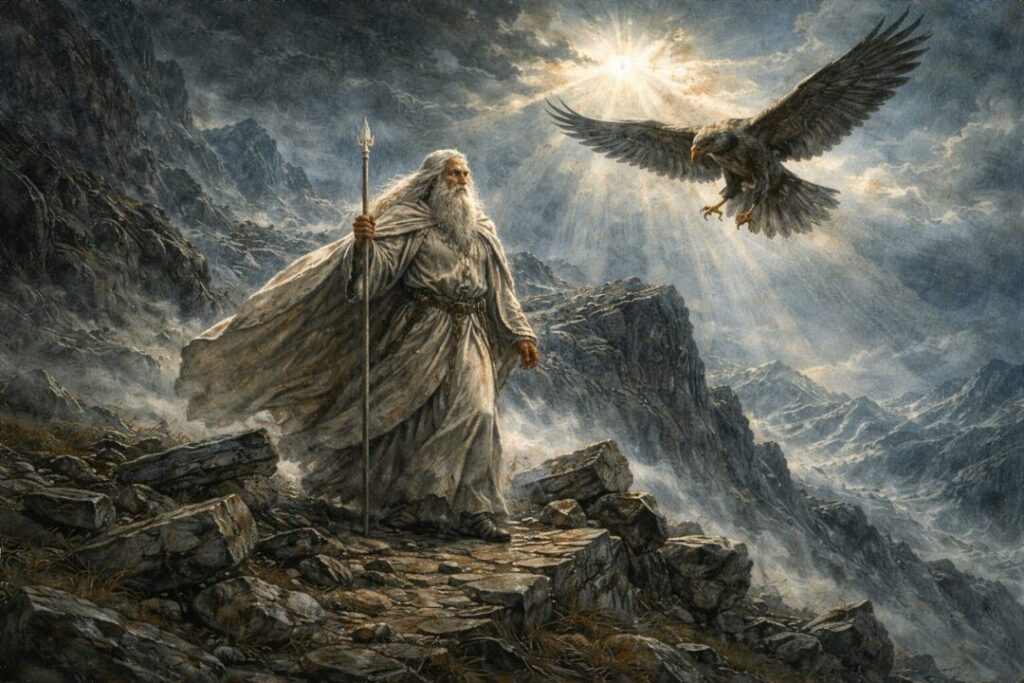
Radagast Was Useful, But He Was Never Framed as Gandalf’s Equal in the War
The crucial thing about Radagast is that the legendarium treats him with a kind of restrained sadness.
He is not presented as false.
He is not presented as treacherous.
He is not even mocked by Gandalf.
But later writings do say that Gandalf differed from both Saruman and Radagast because he never turned aside from his appointed mission. Radagast, by contrast, was fond of beasts and birds, found them easier to deal with, and had very little to do with Elves or Men, even though resistance to Sauron had to be sought chiefly through their cooperation.
That line matters more than it first appears to.
Because it means Radagast’s limitation is not lack of kindness or lack of power in some vague sense. His limitation is that he is not shown carrying the kind of burden Gandalf carries: moving among peoples, strengthening hearts, joining scattered powers, and helping Elves and Men act together against Sauron. Gandalf is consistently described as the one who wandered widely, knew the peoples of Middle-earth, and helped lead the resistance.
Radagast belongs to the same order.
But he does not fill the same role.
The Fellowship Did Not Wait for Another Wizard
The story itself quietly confirms this.
After Gandalf’s fall, no one speaks as though the Company should seek out Radagast and replace its leader. Aragorn takes command of the Company after the loss of Gandalf, and their next movement is toward Lórien. The Fellowship, as constituted at the Council, was never built around the assumption that a second wizard would step in if the first were lost.
That is not an accident.
At the Council of Elrond, Gandalf is the leader of the Nine Walkers, and the Company is formed without Radagast present among its members or its planners. The quest depends on secrecy, endurance, judgment, and moral strength, not on assembling every available wise person. Radagast is simply not part of that design.
This becomes even clearer in one small but revealing detail: after the Council, scouts are sent in many directions, and some go beyond the Misty Mountains to Rhosgobel, but Radagast is not there. The text does not even give us a scene of consultation. He remains peripheral at precisely the moment when the central struggle narrows toward open war.
So if we ask whether Radagast could have stepped up, the first honest answer is this:
The story never positions him close enough to the center for that to happen naturally.
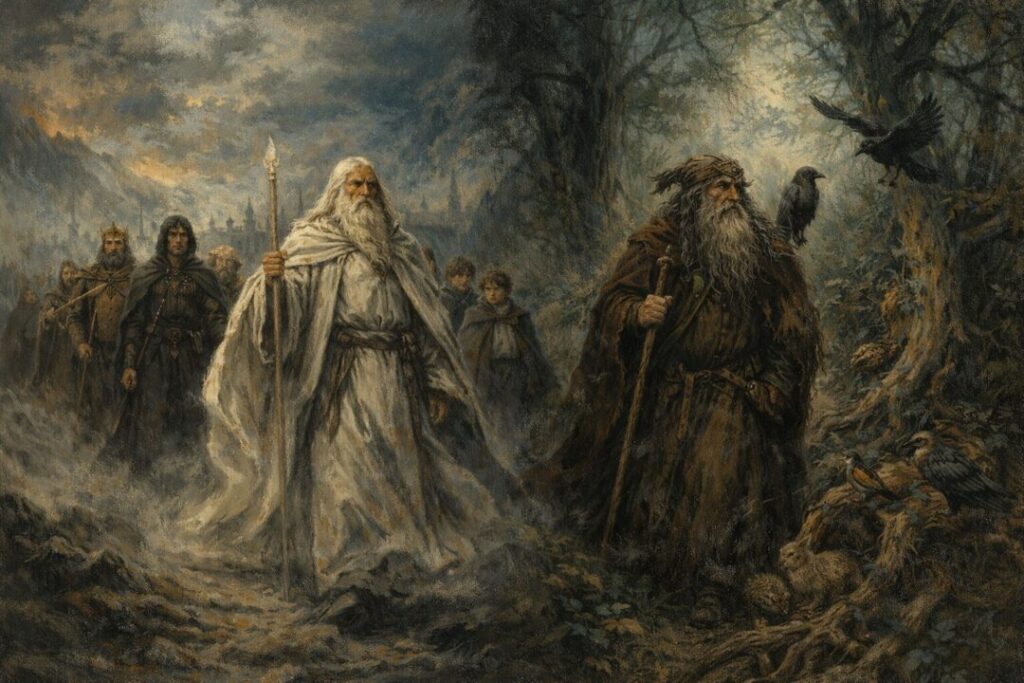
What Radagast Might Actually Have Helped With
That does not mean he would have been useless.
In fact, the strongest version of this hypothetical is not Radagast as replacement-Fellowship leader, but Radagast as indirect aid.
His connection with birds and beasts is real, and already matters once in Gandalf’s escape from Orthanc. Gandalf also describes him as having much lore of herbs and beasts and birds being especially his friends. So it is reasonable to say that if Radagast had become more active, he might have been valuable in gathering news, passing warnings, or strengthening the flow of intelligence across the wild.
That is conservative and text-based.
What goes beyond the texts is claiming that he would have rallied great hosts, taken command of the Ring-quest, or become the strategic counterpart to Saruman. The canon does not show him doing anything like that. It does not show him guiding councils of the Wise, leading Men into battle, correcting rulers, or carrying the authority Gandalf later bears in Rohan and Gondor.
So the most defensible possibility is narrow but meaningful:
Radagast might have helped the war from the margins.
He is much harder to imagine at its center.
The Real Problem Is Not Power, But Kind of Power
This is where the question turns into something deeper.
People often imagine Gandalf primarily as a powerful being. That is true as far as it goes, but it misses the specific shape of his task. Gandalf is not just someone who can do great things. He is someone who can move between worlds: Shire and court, hobbit and king, ranger and steward, Elf-lord and common soldier. He persuades, counsels, rebukes, heartens, and unites. At the Council of Elrond he helps drive the central conclusion that the Ring must be destroyed, and the Fellowship is formed under that judgment.
Radagast, as described in the later tradition, is almost the opposite sort of figure.
He is close to living things.
He is rooted in the natural world.
He is not proud or tyrannical.
But he is also easygoing, neglectful, and detached from the political and moral cooperation by which Sauron must actually be resisted.
That means the gap between Gandalf and Radagast is not just a gap in rank.
It is a gap in vocation.
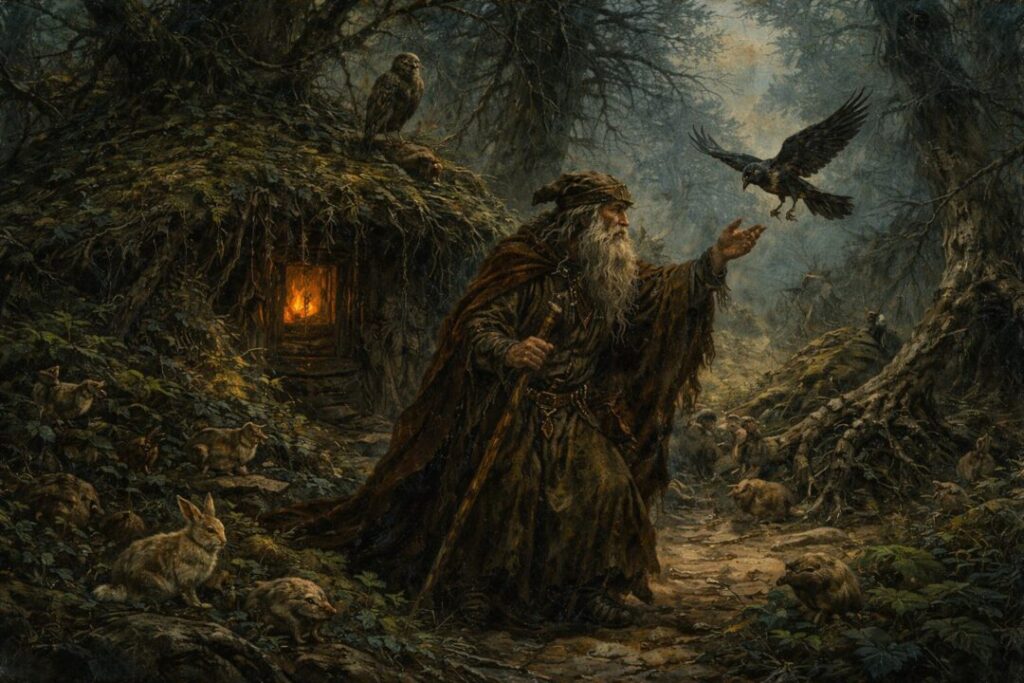
Why Gandalf’s Return Matters So Much
The strongest proof that Radagast could not simply replace Gandalf is the story that follows.
Gandalf is not merely mourned and left behind. He returns as Gandalf the White, and the narrative frames this as the continuation of an unfinished task. Tolkien Gateway’s summary of The White Rider notes that Gandalf is found again after his transformation, and that after his battle with the Balrog he is taken by Gwaihir to Lórien, where he is healed and clad in white before returning to action. The larger Gandalf entry likewise states that he was sent back to Middle-earth as Gandalf the White.
That does not read like a mere replacement of a fallen member.
It reads like the restoration of the one figure the war still requires.
And what does Gandalf do once he returns? He reenters the story exactly where Radagast has never been shown to stand: among kings, armies, and turning points. He goes to Rohan, helps break the paralysis around Théoden, opposes Saruman openly, and later becomes central in Gondor as the last movements toward the Black Gate and Mount Doom unfold.
The implication is hard to miss.
Middle-earth did not merely need a wizard.
It needed Gandalf.
Would Radagast Have Tried?
This is the one place where careful speculation can still say something worthwhile.
Nothing in the canon suggests that Radagast would have sided against the Free Peoples, and nothing suggests he wished the quest to fail. On the contrary, the evidence we do have presents him as innocent of Saruman’s trap and still capable of being useful to Gandalf’s cause.
So it is fair to imagine that, had he fully understood the scale of the crisis after Moria, he might have tried to help in whatever way lay nearest to his nature.
But that last phrase is the key.
Nearest to his nature.
The texts support help in the form of warning, watching, conveying tidings, and perhaps using his bond with wild creatures in defense of the lands he loved. They do not support the idea that he would suddenly become the architect of the anti-Sauron resistance or the shepherd of the Ring-bearer.
That difference keeps the speculation honest.
Radagast’s Tragedy Is That He Is Good, Yet Not Central
In the end, this question reveals something unexpectedly sad about Radagast.
He is one of the clearest examples in Middle-earth of a good being who is not false, not corrupted, and yet still not equal to the age’s deepest need. Gandalf respects him. The story never turns him into a villain. But the wider tradition also does not let us pretend that he was another Gandalf waiting in reserve.
That is why the idea is so haunting.
Because there is a version of the story in which another wizard rises, the Fellowship regains its guide, and the loss in Moria becomes survivable in a simpler way.
But the canon resists that comfort.
Aragorn leads after Moria.
Radagast remains elsewhere.
And Gandalf alone returns, changed, to finish what the war still demands of him.
So if Radagast had stepped up after Gandalf’s fall, he might have mattered.
He might have carried news.
He might have helped the struggle at the edges.
He might even have relieved some small part of the darkness spreading through the wild.
But the deeper answer is that he could not truly have taken Gandalf’s place.
Not because he was evil.
Not because he was weak in any crude sense.
But because Middle-earth had only one wizard who never turned aside from that central road, and when the age reached its breaking point, the story itself tells us exactly who had to walk back onto it.
Sources & Notes
- J.R.R. Tolkien, The Lord of the Rings, Book II, Chapter 2, “The Council of Elrond” — Gandalf’s account of Radagast, Rhosgobel, the Nazgûl warning, and the birds sent to Orthanc.
- J.R.R. Tolkien, The Lord of the Rings, Book II, Chapter 7, “The Mirror of Galadriel” — the Company is told that some scouts went to Rhosgobel and found it empty.
- J.R.R. Tolkien, The Lord of the Rings, Book II, Chapter 5, “The Bridge of Khazad-dûm,” and Book II, Chapter 6, “Lothlórien” — Gandalf’s fall and Aragorn’s immediate assumption of leadership.
- J.R.R. Tolkien, Unfinished Tales, “The Istari” — Radagast’s love of birds and beasts, his lesser involvement with Elves and Men, and Gandalf’s distinctive faithfulness to the Wizards’ mission.
- J.R.R. Tolkien, The Lord of the Rings, Book III, Chapter 5, “The White Rider” — Gandalf’s return, healing in Lórien, and renewed role after his battle with the Balrog.
- J.R.R. Tolkien, The Lord of the Rings, Book III, Chapter 6, “The King of the Golden Hall,” and Book III, Chapter 10, “The Voice of Saruman” — Gandalf acting at the political and military center of the war in Rohan.