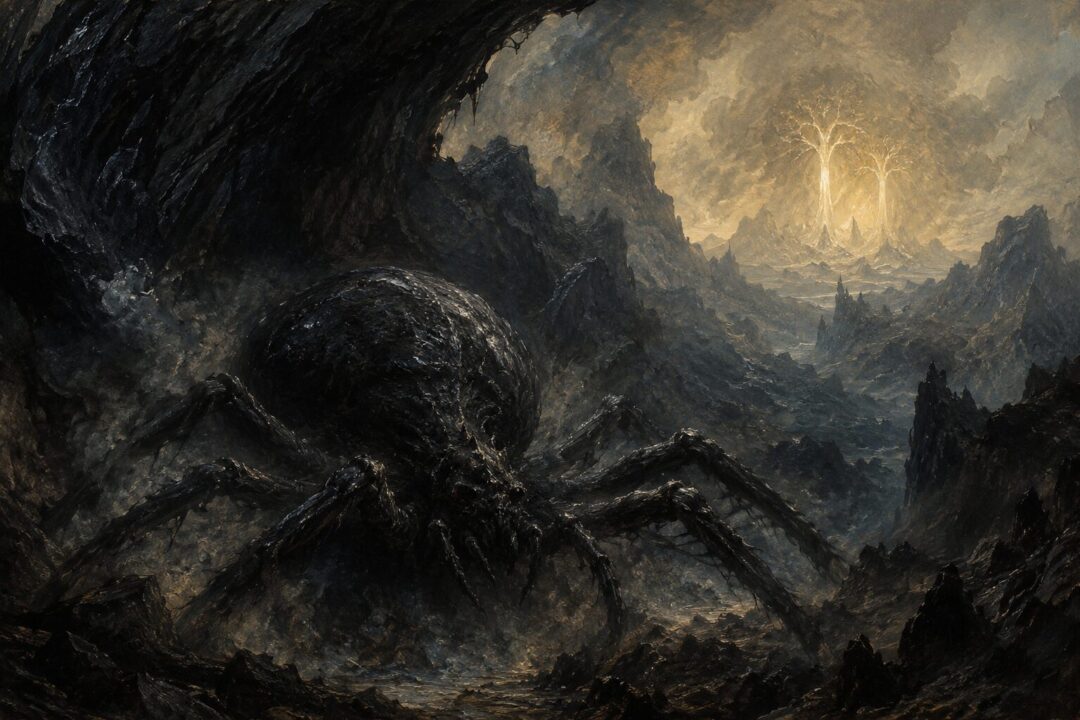
Long before Frodo and Sam climbed the stairs of Cirith Ungol, another darkness had already taught Middle-earth what endless hunger could become. Shelob is often remembered simply as the monstrous spider lurking outside Mordor, but the story surrounding her is far older than Sauron's realm. The texts present her as the last great child of Ungoliant to trouble the world, linking one of the most terrifying encounters in The Lord of the Rings to one of the oldest evils in the legendarium.
That connection explains something deeper than ancestry. It explains why Shelob is never merely hungry. Her appetite feels bottomless, detached from ordinary survival, and wrapped in darkness itself. The closer one compares her with Ungoliant, the clearer it becomes that Shelob inherits more than a monstrous shape. She reflects an ancient pattern of desire that consumes without satisfaction, takes without gratitude, and ultimately turns even upon itself.
Hunger That Was Never Meant to Be Filled
Ungoliant enters the history of Arda as a mystery. The Eldar speculate about her origins, but the texts never provide a definitive explanation. She appears as a being associated with darkness beyond the ordinary evils of Middle-earth, taking the form of a monstrous spider and dwelling in the shadowed land of Avathar before Melkor sought her aid.
What defines her above all else is hunger.
She drinks light itself. She devours the radiance of the Two Trees after Melkor wounds them. Even after consuming treasures that no other creature could possess, she immediately demands more. Her appetite only grows with every feast.
This is the first key to understanding Shelob.
Ungoliant does not simply enjoy eating. The narrative repeatedly portrays her as feeding an inner emptiness that can never be satisfied. Her desire expands alongside her consumption rather than shrinking. The more she receives, the greater her need becomes.
The tradition preserved in The Silmarillion even suggests that, in her final and uttermost famine, she may have devoured herself. The wording is deliberately cautious—presented as what was said rather than certain history—but the possibility perfectly matches the pattern established throughout her story. Endless appetite eventually has nothing left except itself.
Shelob Lives by the Same Rule
When readers finally meet Shelob in The Two Towers, centuries have passed since Ungoliant vanished from history.
Yet the family resemblance is unmistakable.
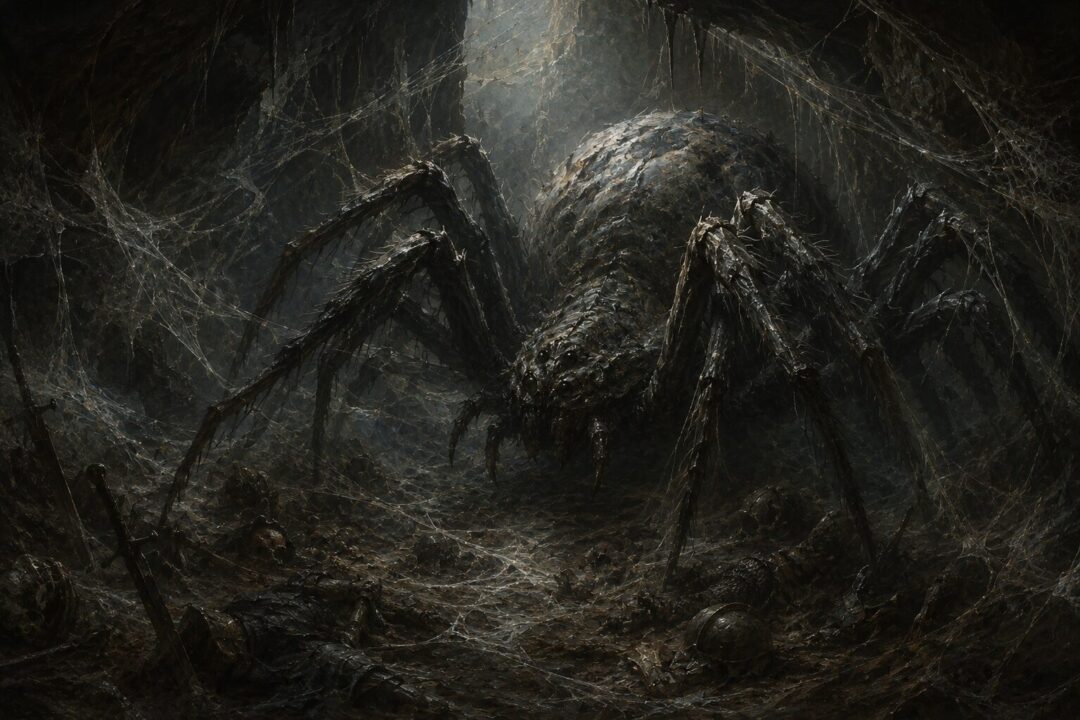
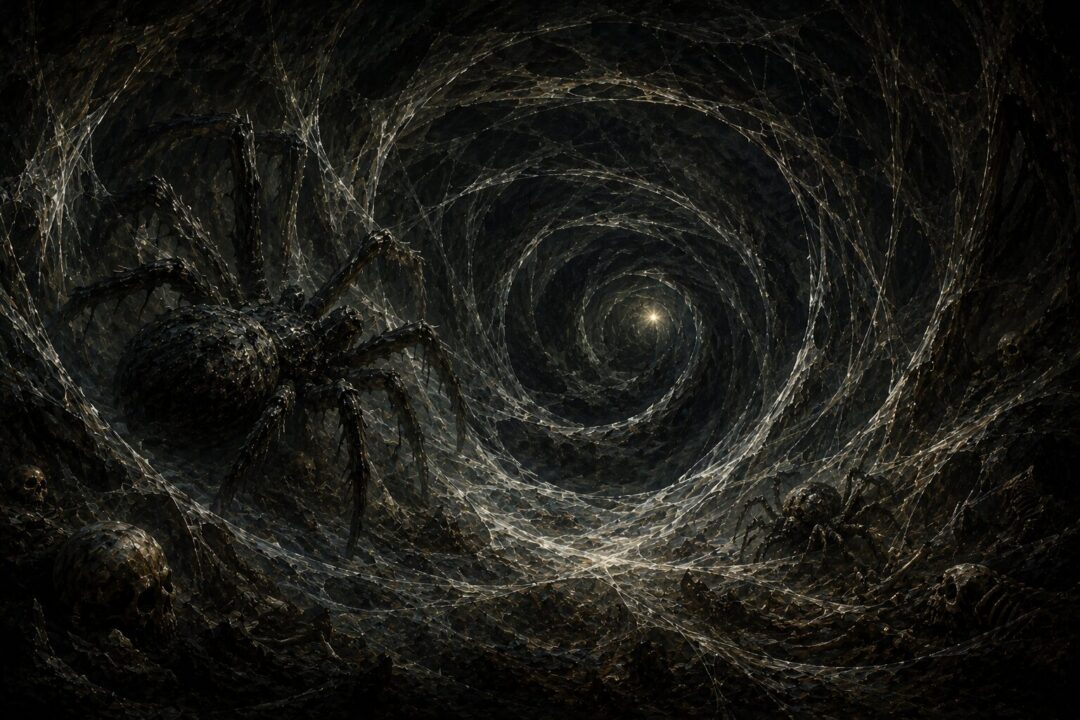
Shelob is described as ancient, bloated by countless feasts, endlessly weaving webs of darkness while making every living creature her prey. She has survived empires, kingdoms, and wars. Unlike Sauron, she seeks no dominion over Middle-earth. Unlike Morgoth, she desires no throne.
She wants food.
That simplicity is deceptive.
The text emphasizes that "all living things were her food." This is not the measured appetite of a predator occupying an ecological niche. Shelob exists almost as an embodiment of consumption itself.
Importantly, Tolkien never states that Shelob literally possesses the supernatural powers of Ungoliant. Ungoliant's ability to consume light and produce Unlight belongs uniquely to her story. Shelob's darkness comes through her webs, her lair, and her overwhelming presence rather than the same explicitly described cosmic power.
Even so, the literary connection is impossible to miss. Shelob's existence echoes the same principle: appetite divorced from natural limits.
Darkness and Appetite Become One
One of the most striking similarities between mother and daughter is that darkness is never merely the absence of light.
Ungoliant actively gathers light into herself before spinning it out again as suffocating blackness. Her darkness is something produced through consumption.
Shelob's tunnels reflect this imagery on a smaller scale.
Her lair is a place where vision fails, hope contracts, and prey becomes trapped before ever being eaten. The darkness functions as an extension of her feeding rather than simple concealment. Victims lose orientation long before they lose their lives.
This recurring association between darkness and appetite suggests that the physical gloom surrounding both creatures expresses something spiritual as well. They do not merely hide within darkness.
Their hunger creates environments where life steadily disappears.
Shelob Is Not Sauron's Servant
A common misconception is that Shelob faithfully serves Sauron.
The text points in another direction.
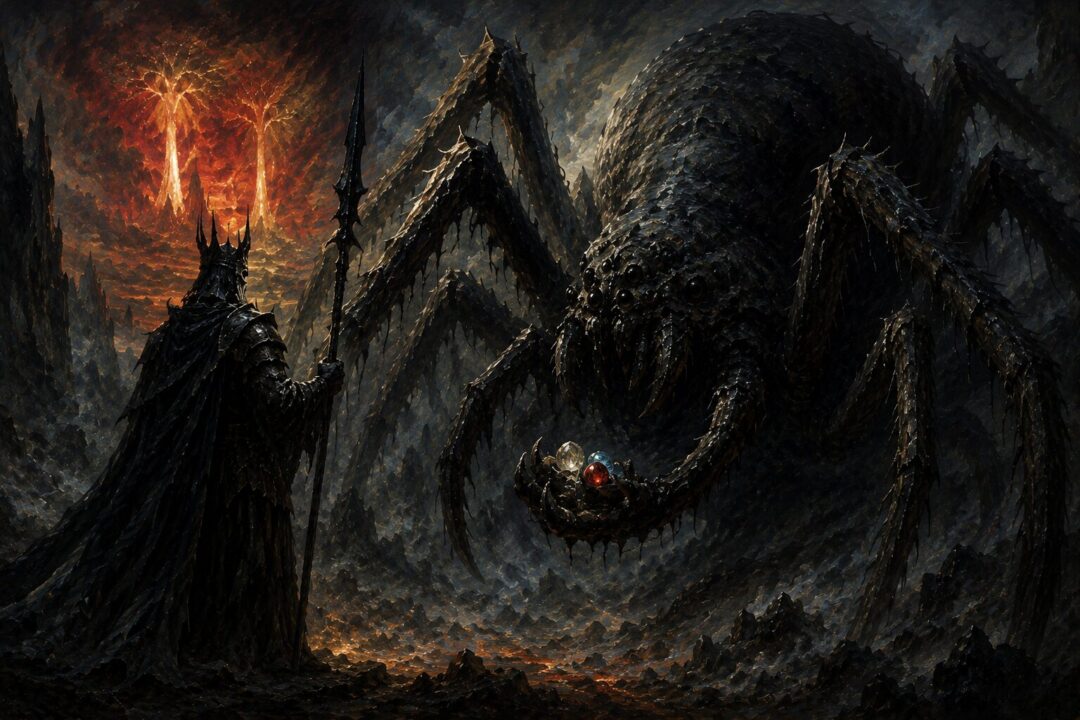
Sauron tolerates her presence because she guards an important pass into Mordor, but Shelob is repeatedly portrayed as serving herself alone. She existed before Sauron established his kingdom there and continues according to her own instincts.
The narrator even compares her relationship to Sauron with that of a cat tolerated by a household rather than an obedient servant.
This comparison matters.
Cats hunt because they desire to hunt, not because their owners command them. Likewise, Shelob attacks because feeding is her defining impulse.
Her independence also recalls Ungoliant's relationship with Melkor.
Ungoliant cooperates with Melkor only after extracting promises of reward. Once the Two Trees have been destroyed, she immediately turns upon her ally, demanding the Silmarils as payment. Her loyalty lasts only as long as her hunger believes it profitable.
Neither spider is truly ruled.
Both ultimately recognize only appetite.
The Horrifying Family Legacy
The texts reveal another disturbing inheritance.
Ungoliant mates with other spider-like creatures, bears offspring, and then devours both mates and, eventually, many of her own young. Shelob likewise produces lesser broods that spread into various lands.
The emphasis is not simply on reproduction but on consumption overwhelming every natural bond.
Ordinary creatures preserve offspring.
Ungoliant's appetite consumes even family.
This reinforces an important theme. Hunger has become so absolute that it dissolves relationships themselves. Kinship offers no protection when desire has no limits.
Shelob inherits at least part of this legacy. Her descendants spread throughout Middle-earth, but the texts consistently frame these broods as extensions of monstrous corruption rather than the flourishing of a living family.
Why Light Defeats Her
Shelob's defeat is not achieved through superior strength alone.
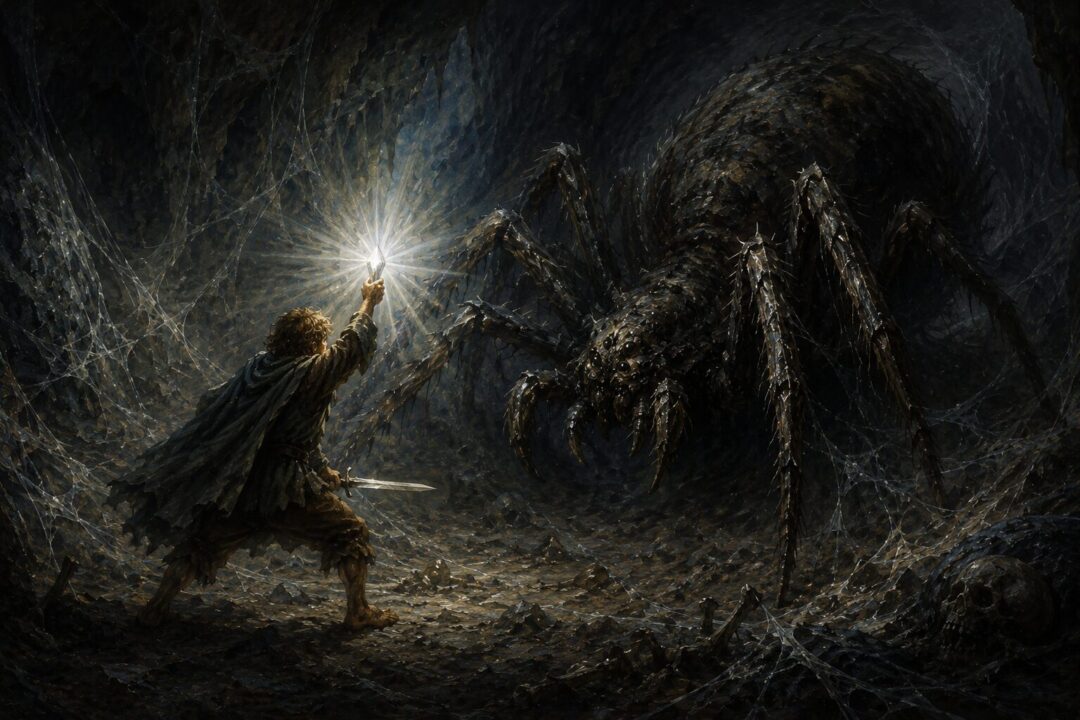
The Phial of Galadriel becomes decisive because it carries the light of Eärendil's star, itself ultimately preserving the last unmarred light derived from the Two Trees.
That symbolic chain stretches all the way back to Ungoliant.
Ungoliant helped extinguish the Two Trees.
Shelob recoils before their surviving light.
The connection enriches the scene enormously.
Sam is not simply frightening a giant spider with a bright object. The narrative places the surviving light of the Elder Days directly against the descendant of the being that sought to erase it forever.
The victory is temporary—Shelob survives—but the confrontation dramatizes an ancient conflict between preservation and consumption.
The light nourishes.
The spider devours.
Hunger Versus Possession
Shelob also provides an illuminating contrast with the One Ring.
The Ring corrupts through possession. It persuades people to desire power, status, domination, or preservation of self.
Shelob's hunger is different.
She has no interest in ruling anyone.
She scarcely cares who governs Mordor.
Food alone matters.
This distinction shows that evil in Tolkien's legendarium is not always identical. Morgoth seeks domination. Sauron seeks order through tyranny. The Ring exploits ambition.
Shelob simply consumes.
Yet this simplicity does not make her less dangerous. In some respects it makes her more frightening because negotiation becomes impossible. A tyrant may calculate. Shelob merely waits until something edible enters her web.
Gollum Understands Her Better Than Anyone
No one appreciates Shelob's nature more clearly than Gollum.
His plan depends upon understanding that she cannot resist prey.
He expects Frodo to carry the Ring into her tunnel, not because she desires the Ring, but because she desires flesh.
This reveals another contrast between different forms of corruption.
Gollum is enslaved by possession.
Shelob is enslaved by appetite.
Each represents a different way desire can imprison a soul.
Gollum cannot abandon the Ring.
Shelob cannot abandon the hunt.
Neither can imagine genuine contentment.
The Final Lesson Hidden in Shelob
Shelob's hunger is terrifying because it reflects a much older truth already demonstrated by Ungoliant.
The more these creatures consume, the less capable they become of satisfaction.
This pattern appears repeatedly throughout Tolkien's world. Morgoth pours so much of his native power into domination that he diminishes himself. Sauron invests himself in the One Ring and becomes dependent upon it. Ungoliant devours light until even unimaginable feasts fail to satisfy her.
Shelob inherits this tragic logic on a smaller but still dreadful scale.
She has survived for ages by feeding upon countless victims, yet when Frodo and Sam enter her tunnels she is still driven by the same desperate craving. Centuries of successful hunting have not brought peace. They have merely prolonged the cycle.
That may be the deepest connection between mother and daughter.
Ungoliant's shadow is not simply a bloodline.
It is a pattern in which desire becomes identity.
Shelob therefore stands as more than a giant spider blocking the road to Mordor. She is living evidence that appetite, once severed from any natural end, can become its own prison. Every meal promises completion. None delivers it.
The result is not abundance but endless famine.
In that sense, Shelob remains the truest surviving echo of Ungoliant—not because she matches her mother's cosmic power, but because she preserves her mother's curse. The shadow passed from one generation to the next is not merely darkness.
It is hunger that can never say, "Enough."
Sources & Notes
- Tolkien Gateway, “Ungoliant” — summarizes Ungoliant’s mysterious origin, alliance with Melkor, devouring of the Two Trees’ light, production of Unlight, insatiable hunger, and possible self-devouring end. https://tolkiengateway.net/wiki/Ungoliant
- Tolkien Gateway, “Shelob” — covers Shelob as a descendant of Ungoliant, her lair near Cirith Ungol, her predatory independence from Sauron, and her attack on Frodo and Sam. https://tolkiengateway.net/wiki/Shelob
- Tolkien Gateway, “Two Trees of Valinor” — provides context for the Trees whose light Ungoliant consumes after Melkor’s attack, grounding the article’s comparison between hunger, darkness, and stolen light. https://tolkiengateway.net/wiki/Two_Trees_of_Valinor
- Tolkien Gateway, “Cirith Ungol” — explains the pass and tower associated with Shelob’s lair on the border of Mordor, supporting the article’s setting-based reading of darkness, webs, and predation. https://tolkiengateway.net/wiki/Cirith_Ungol
Sources selected for Ungoliant’s endless hunger and darkness, Shelob’s ancestry and independence, the Two Trees episode, and the Cirith Ungol setting of Shelob’s lair.