A wizard’s staff is easy to mistake for a weapon. In Middle-earth, it can blaze with light, break stone, command attention, and mark its bearer as something more than an ordinary old man on the road. Yet the strangest thing about the Istari is not how much power they possess. It is how often that power does not solve the problem.
Radagast the Brown is one of the clearest examples. He is named, respected by Gandalf, mocked by Saruman, linked with beasts and birds, and briefly placed near the machinery of the War of the Ring. Then he disappears from the story. Rivendell’s scouts later reach Rhosgobel and find that he is not there. No great farewell follows. No final stand. No clear account of his end. The silence around Radagast is not merely a loose thread. It reveals something important about the Wizards themselves: they were not sent as conquering angels, and even a being sent from the West could turn aside, grow limited, or fail to bring his gifts to the place where they were most needed.
The Wizard Who Is Present by Being Missing
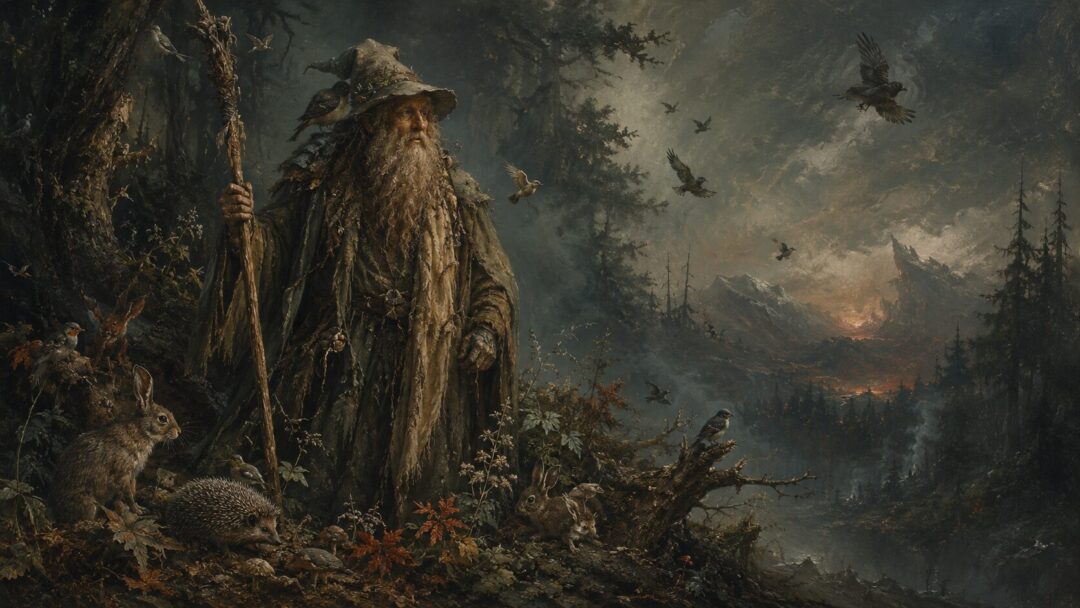
Radagast’s absence matters because he is not presented as wicked. In The Lord of the Rings, Gandalf describes him as a “worthy” wizard, with lore of herbs, beasts, and birds, and as someone honest enough that Gandalf trusts the message he brings. That message, however, has been shaped by Saruman. Radagast tells Gandalf that the Nazgûl are abroad and that Saruman wants him to come to Isengard. Gandalf goes, and Saruman imprisons him.
This is not Radagast betraying Gandalf. The texts make him more innocent than malicious. The darker irony is that innocence can still become useful to evil. Saruman understands Radagast well enough to use his honesty as bait. Radagast becomes dangerous not because he desires power, but because he does not see clearly enough into the designs of one who does.
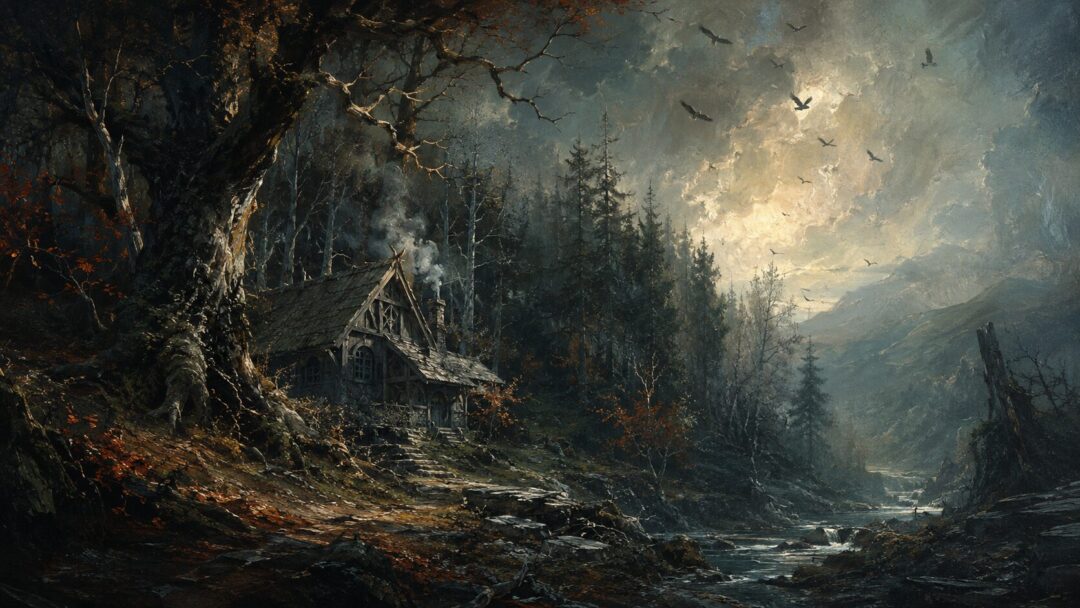
His later absence deepens the problem. After the Council of Elrond, scouts search widely, including toward Rhosgobel, Radagast’s dwelling near the western eaves of Mirkwood, but he is not found there. The text does not tell us where he has gone or whether he ever learns how Saruman used him. Reputable lore summaries rightly note this as one of the last direct references to him in the main narrative.
That absence creates a quiet question: what is the value of a wizard who knows the tongues and habits of birds and beasts, if he is missing when the Free Peoples gather for their most desperate hour?
The Istari Were Powerful, But Not Unrestricted
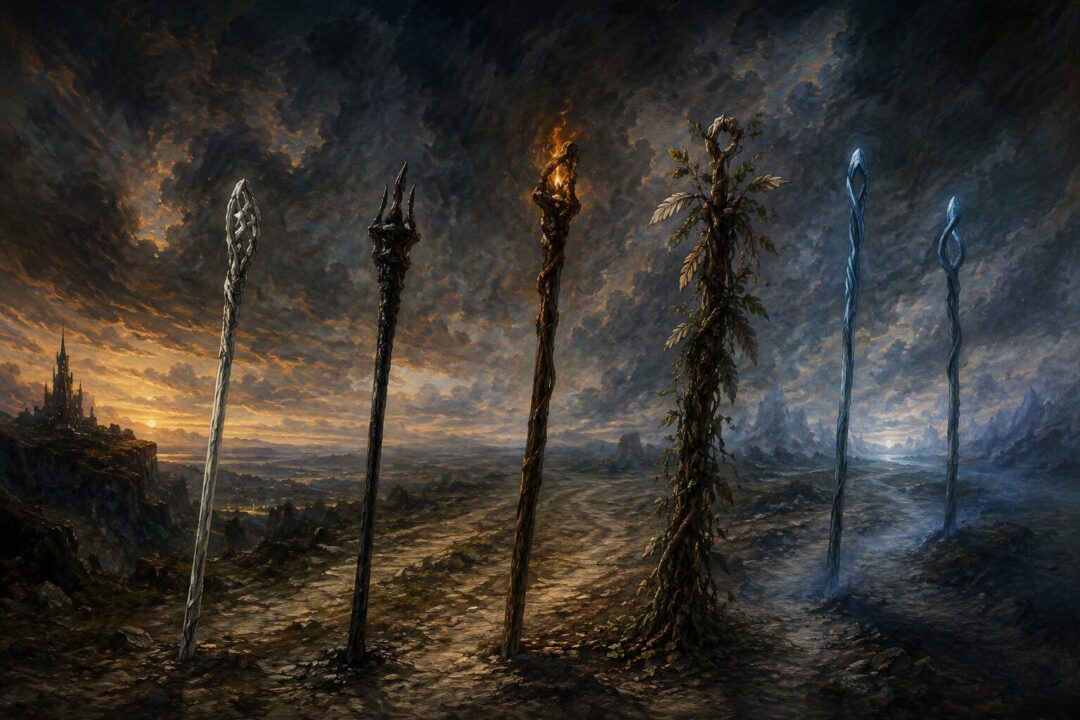
The answer begins with the nature of the Istari. They were not sent to Middle-earth to overthrow Sauron by naked force. In the later account of the Wizards, preserved in Unfinished Tales, the five are presented as emissaries from the West, sent to contest Sauron and aid resistance among the Free Peoples. The same tradition emphasizes that their mission was not domination but guidance, counsel, encouragement, and opposition to Sauron’s will.
This limitation is essential. Gandalf is not simply “less powerful” than Sauron in a numerical sense. His task is different. He must awaken courage rather than replace it. He must help Elves, Men, Dwarves, and Hobbits act freely, not reduce them to pieces on a divine chessboard. A letter discussing Gandalf’s role describes the Istari as messengers sent to guide and inspire resistance, not to dominate by overwhelming display of power.
Radagast’s absence shows the danger built into that arrangement. If the Wizards must work through persuasion, relationship, and chosen faithfulness, then their mission depends on attention. They can miss things. They can misjudge people. They can become absorbed in lesser goods. They can be present in Middle-earth and still absent from the central struggle.

Radagast’s Gift Was Real
It is important not to flatten Radagast into a joke. The books do not support that. Saruman despises him, but Saruman’s judgment is morally diseased long before his final ruin is revealed. Gandalf’s judgment is more generous. Radagast has real lore, especially concerning plants, beasts, and birds. His connection with the non-speaking and half-hidden life of Middle-earth is not treated as worthless.
In fact, his gift briefly helps Gandalf escape disaster. Radagast, having been asked by Gandalf to send news through beasts and birds, apparently helps set in motion the arrival of Gwaihir at Orthanc. Gwaihir comes not to rescue Gandalf by prior plan, but because he has been sent to bring tidings. Once there, he discovers Gandalf imprisoned and bears him away. Radagast’s network of living messengers becomes a crack in Saruman’s trap.
That matters. Radagast is not useless. His love of birds and beasts is not evil. The problem is not that he cares for the wrong things in themselves. Middle-earth is full of creatures wounded by Sauron’s shadow, and concern for them is not trivial. The problem is proportion. A good gift becomes limited when it is severed from the larger need.
The Difference Between Failure and Corruption
Saruman and Radagast reveal two very different ways an Istar can go wrong.
Saruman’s fall is active and proud. He seeks mastery. He studies the devices of the Enemy until imitation becomes desire. He turns Isengard into a place of engines, axes, pits, and domination. His failure is rebellion.
Radagast’s failure, if we call it that, is quieter. Later commentary on the Istari says that, among them, only Gandalf remained fully faithful, and that Radagast became enamoured of the beasts and birds of Middle-earth, forsaking Elves and Men. Another later assessment is more precise: Radagast did not become proud and domineering like Saruman, but was neglectful and easygoing, preferring beasts and birds and having little to do with Elves or Men, though resistance to Sauron had to be sought chiefly through their cooperation.
This distinction is crucial. Radagast does not become a servant of Sauron. There is no canon account of him joining evil, building armies, seeking Rings, or desiring rule. His danger is not tyranny. It is withdrawal.
That makes him more unsettling, not less. Saruman is a warning about corrupted power. Radagast is a warning about harmlessness that becomes neglect. He suggests that a person may avoid evil ambition and still fail to answer the central call of his age.
Why Gandalf Succeeds Where Radagast Fades
Gandalf also loves small things. He befriends Hobbits, speaks with Eagles, respects trees, and notices the overlooked. But Gandalf does not let affection become retreat. His love for the small draws him deeper into danger rather than away from it.
This is why the contrast with Radagast is so revealing. Gandalf’s humility is active. He moves from the Shire to Rivendell, from Moria to Lórien, from Rohan to Gondor, from counsel to sacrifice. He does not seize command in the manner of Sauron or Saruman, but neither does he hide among safe affections. He spends himself.
Radagast, by contrast, appears to have settled into a narrower circle. The texts imply that birds and beasts were easier for him to deal with than Elves and Men. That is psychologically believable. The Free Peoples are quarrelsome, proud, afraid, divided, and slow to trust. Animals may be wounded or wild, but they do not debate policy in councils or lust after Rings. Radagast’s preference may therefore reveal one of the deepest limits of the Istari: their mission required them to work with free beings who could refuse, misunderstand, and fall.
The Wizards could not simply love the world in the abstract. They had to enter its conflicts.
The Brown Wizard and the Shadow of Mirkwood
Radagast’s home near Mirkwood also matters. Rhosgobel lies close to one of the great zones of shadow in the Third Age. Mirkwood is not just a forest; it is a living sign of corruption spreading through the natural world. In The Hobbit, the forest is oppressive, dark, bewildering, and dangerous. The Necromancer’s presence in Dol Guldur is part of the larger pressure that makes the region fearful.
A lore-grounded reading can see Radagast as a figure placed near wounded nature. His concern for birds, beasts, and herbs may have had a fitting place there. But the War of the Ring shows that Sauron’s power cannot be resisted by care for nature alone. The Shadow is political, spiritual, military, and moral. It moves through kings, councils, roads, messengers, fear, greed, and despair.
Radagast’s knowledge may have been valuable near the forest edge, but the crisis demanded coordinated resistance. Elrond’s council needed news, wisdom, and allies. Rohan needed awakening. Gondor needed endurance. Frodo needed help to reach Mordor. The Eagles could bear tidings and sometimes rescue, but they could not replace the burden of the Ring-bearer. Radagast’s world of birds and beasts touched the great story, but did not carry it.
The Limits of Specialization
Radagast may be Middle-earth’s most tragic specialist. He is deeply attuned to one part of creation, yet the Enemy threatens the whole. His gift is real, but it is not enough when isolated.
That makes his absence feel surprisingly modern. He is not condemned for loving living things. He is diminished because he appears to let one field of love excuse him from the harder fellowship of persons. In Middle-earth, the great victories usually come through unlikely cooperation: Elf and Dwarf, Man and Hobbit, wizard and king, gardener and Ring-bearer. Sauron isolates. The Wise gather.
Radagast’s disappearance from the center of the tale therefore dramatizes a hidden rule of the Istari: wisdom that does not join itself to the common struggle becomes marginal. It may remain gentle. It may remain knowledgeable. It may even do occasional good. But it will not be enough to overthrow the Shadow.
Mercy for Radagast
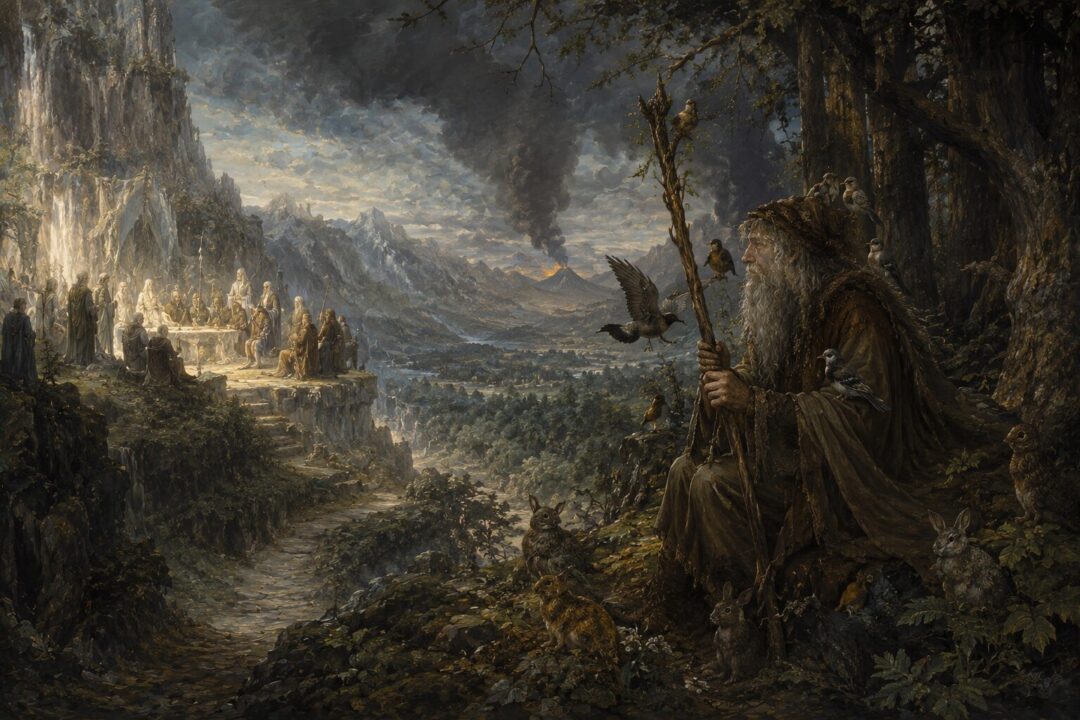
Still, the texts leave room for caution. Radagast’s final fate is not clearly told. It is possible to speak of his neglect, but not to invent a full doom for him. We are not shown his repentance, death, return to the West, or permanent exile. The silence remains silence.
That silence should make judgment careful. Radagast is not Saruman. He is not a villain. He is a being whose appointed purpose seems to have narrowed. If Gandalf shows what the Istari were meant to be at their highest, Radagast shows how even good loves can become too small for the hour.
His absence says that the Wizards were limited not only by rules imposed from the West, but by the vulnerability of incarnation: attention, weariness, preference, fear, habit, and the temptation to choose the easier company. The Istari came clothed in bodies, walking roads, speaking with people, making choices over long years. Their greatness did not remove the possibility of drifting.
Radagast’s empty house at Rhosgobel is therefore one of the quietest warnings in the War of the Ring. The door is not barred by evil. The ground is not blackened by treachery. The wizard is simply not there.
And in Middle-earth, sometimes absence is enough to reveal the wound.
Sources & Notes
- https://tolkiengateway.net/wiki/Radagast — overview of Radagast’s role, his message to Gandalf, his association with birds and beasts, and his later unexplained absence from Rhosgobel.
- https://tolkiengateway.net/wiki/Istari — explains the Wizards’ origin, mission, and limits as emissaries sent to counsel and encourage resistance rather than rule by force.
- https://tolkiengateway.net/wiki/Rhosgobel — background on Radagast’s dwelling near Mirkwood and the narrative detail that scouts later found he was not there.
- https://tolkiengateway.net/wiki/Gwaihir — supports the article’s point that Radagast’s bird-network indirectly helped Gandalf when Gwaihir came to Orthanc with tidings.
Sources cover Radagast, the Istari mission, Rhosgobel, and Gwaihir’s role in the Orthanc episode.