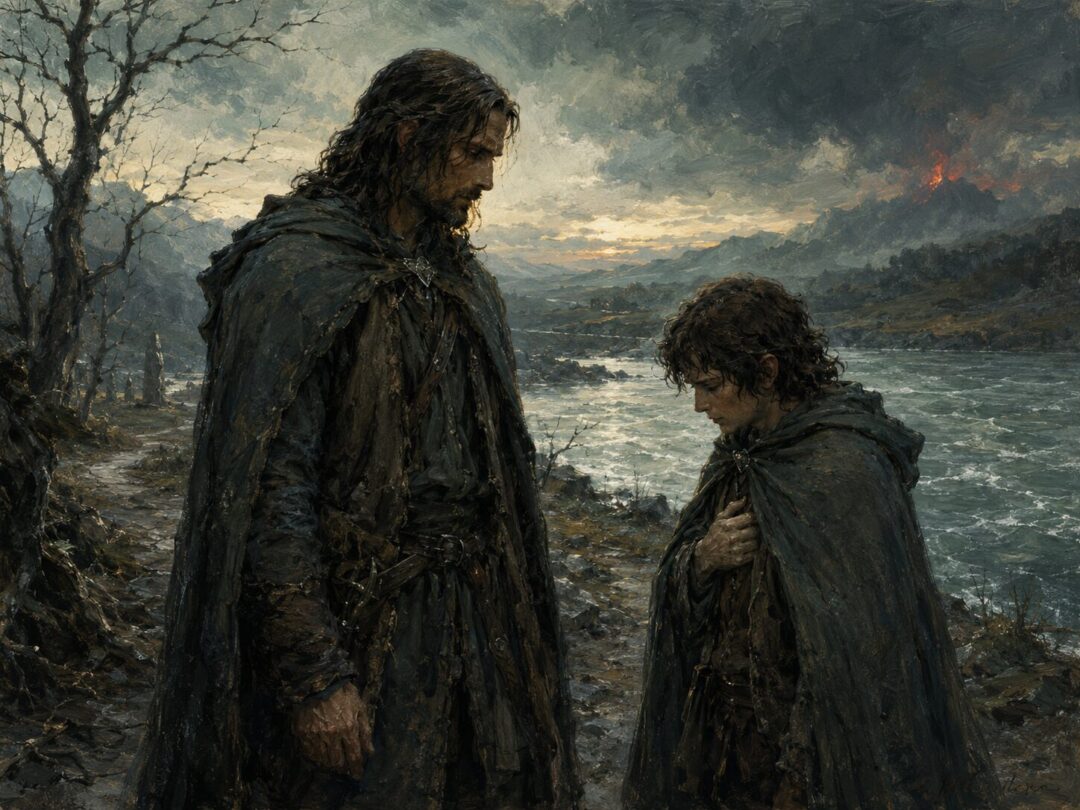
The strangest thing about the Ring is not that kings desire it. It is that the fate of kingdoms finally rests in the hands of someone no king can command.
Aragorn is the hidden heir of Isildur, the man whose house once cut the Ring from Sauron’s hand and then failed to destroy it. By blood, history, and need, he seems like the person who should seize control of the quest. He is wiser than Frodo in war, stronger in body, trained for hardship, and burdened with the future of Gondor. Yet at the most important turn of the story, he does not drag Frodo back, order him onward, or claim the right to decide the Ring’s road.
That restraint is easy to miss, especially because different versions of the story frame the moment differently. In the book, Aragorn does not stage a dramatic farewell with Frodo at Amon Hen. Frodo chooses to leave while the Company is breaking, Boromir has fallen into temptation, and Aragorn is forced into another urgent crisis. But the deeper truth remains: Aragorn accepts that the fate of the Ring-bearer is not something he can rule by command.
That is not weakness. It is one of his strongest acts of kingship.
The Quest Was Never Built Like a Military Mission
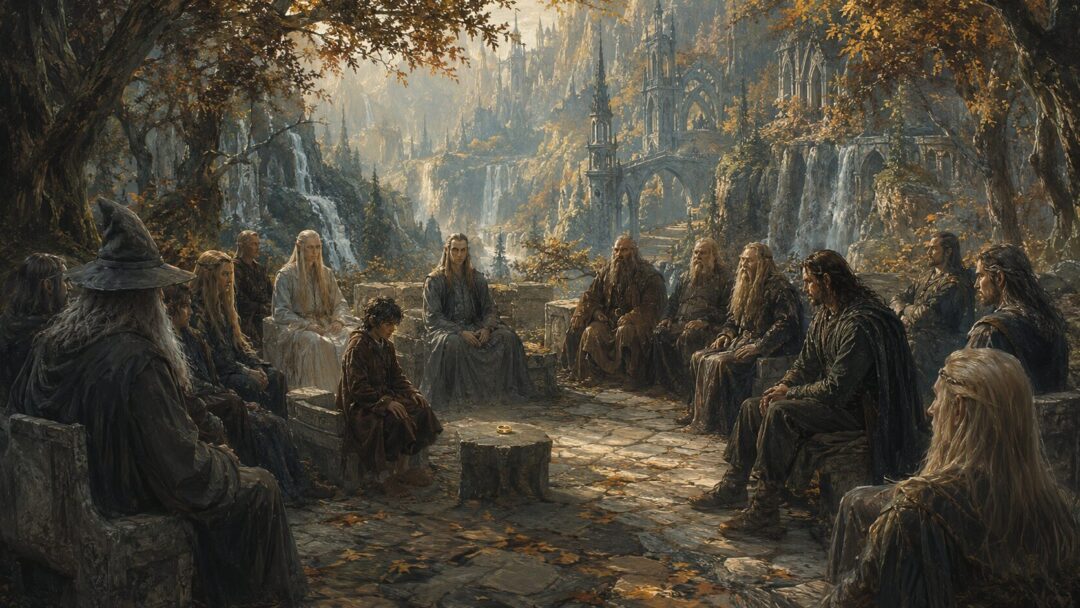
At the Council of Elrond, the Ring is not treated as a weapon to be assigned to the greatest captain. That is the crucial first rule. The Wise do not decide to march openly against Mordor with the Ring at the center of an army. They decide the opposite: the Ring must be destroyed, and the way to its destruction must be secrecy, endurance, and renunciation.
This matters because Aragorn’s authority, great as it is, is the authority of a leader in a world where power itself is under suspicion. The Ring cannot be handled like a sword, a fortress, or a throne. It works precisely by turning rightful desire into domination. It offers the strong a reason to become stronger. It offers the fearful a reason to control the future before the future can wound them.
Frodo’s role begins in freedom, not command. He volunteers at the Council, though he does not know the way. Elrond then recognizes that the task appears appointed for him, but the pattern is not coercion. Frodo is not conscripted like a soldier into an errand chosen by kings. He becomes the Ring-bearer because the Ring has already come to him, because he has shown pity and endurance, and because no obvious power in Middle-earth can safely master the burden.
Aragorn understands this. He joins the Company not as the owner of the quest but as its protector. His strength is real, but it is secondary to the moral shape of the mission.
Aragorn’s Blood Made Restraint Necessary
Aragorn is not just any warrior standing beside Frodo. He is Isildur’s heir. That makes his relationship to the Ring painfully charged.
Isildur took the Ring after Sauron’s defeat and did not cast it into the fire. The full moral weight of that failure hangs over the later story. Aragorn is not personally guilty for Isildur’s choice, but he inherits its shadow. His kingship must be proven by doing what Isildur did not: refusing to let the Ring become the instrument of his claim.
This is why Aragorn’s restraint matters more than ordinary humility. He has the very lineage that could make possession of the Ring seem like destiny. He could argue that the Ring came from the hand of his ancestor, that the war against Sauron is the burden of his house, that Gondor’s need is desperate, and that a halfling should not carry what kings and warriors are better equipped to guard.
Yet that argument is exactly the kind the Ring would love.
Aragorn’s greatness lies partly in recognizing that his true inheritance is not the Ring, but the responsibility to resist it. He cannot heal Isildur’s failure by controlling Frodo. He can only answer it by refusing the old pattern of possession.
Frodo Sees What the Strong Cannot Safely Ignore
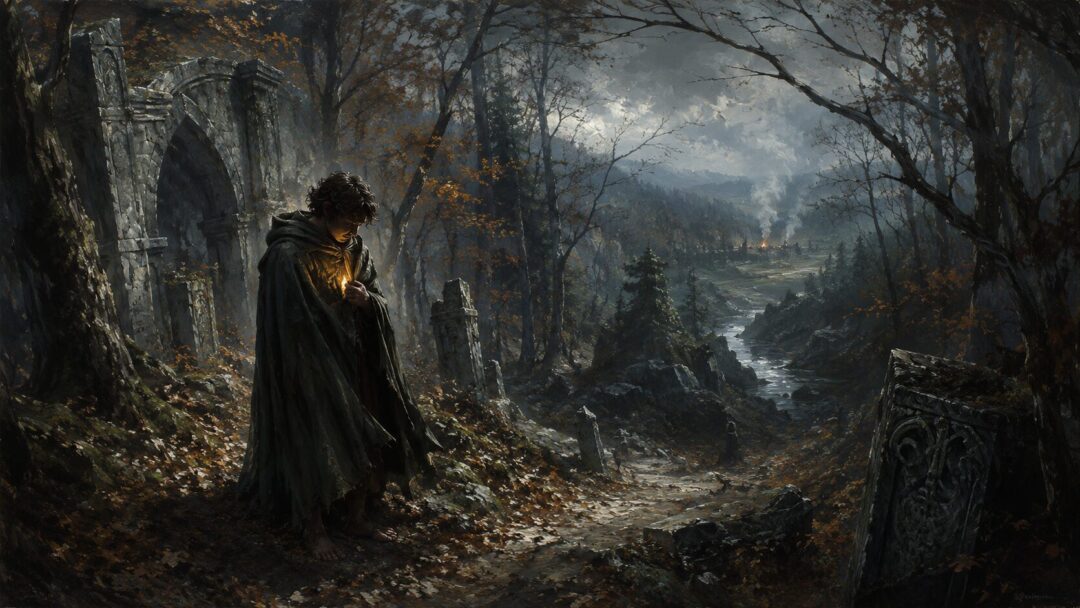
By the time the Company reaches Parth Galen and Amon Hen, the quest has become unbearable. Gandalf has fallen in Moria. Boromir is tormented by the need of Minas Tirith. The road splits between Mordor and the war in the West. Aragorn himself longs for Minas Tirith, the city of his fathers, yet he has also promised himself to the Ring-bearer’s protection.
Frodo’s decision comes after Boromir tries to take the Ring. This is not merely a private betrayal. It proves that the Ring is already dividing the Company from within. Frodo understands that the danger is no longer only outside them in Orcs, spies, and the Eye of Sauron. The Ring is working among friends.
His conclusion is severe: he must go alone. Some companions he cannot trust; others he trusts too much to expose them further. Even Aragorn is not dismissed as unworthy. Rather, Frodo recognizes that Aragorn has another need and another road. His heart is drawn toward Minas Tirith, and in the larger war he will be needed there.
This is one of Frodo’s clearest moments of agency. He is not simply fleeing. He is judging the moral danger of the Ring more accurately than a military council could do in that instant. He sees that love itself can become a reason to endanger others. He sees that companionship, though precious, can become another path for the Ring’s corruption.
Aragorn does not make that decision for him. And once it is made, Aragorn does not undo it.
The Book’s Aragorn Does Not Choose Easily
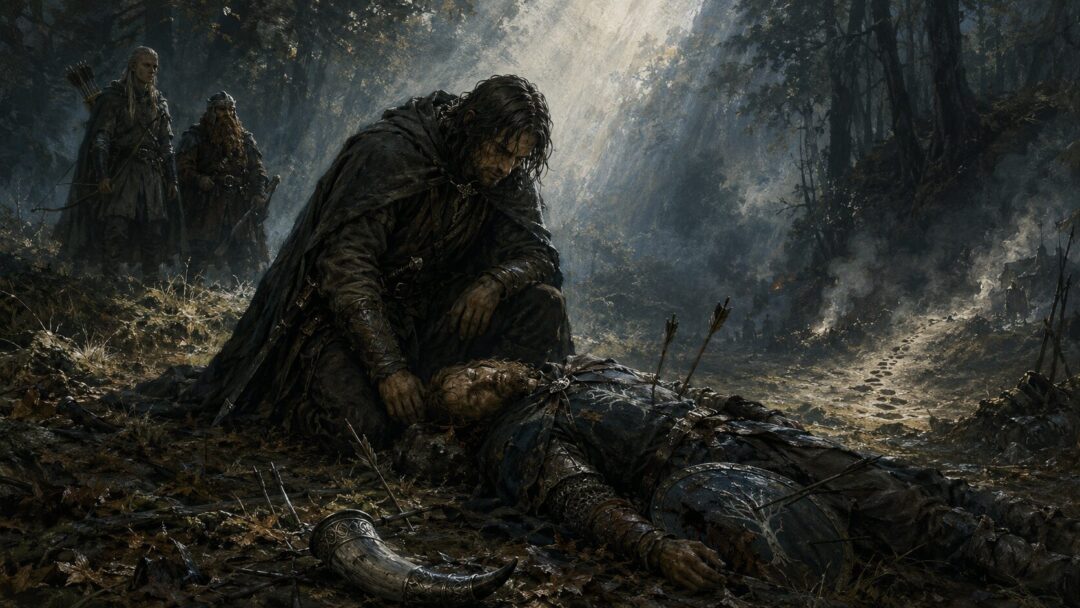
It is important to be precise: in the book, Aragorn is not calmly watching Frodo cross the river from a distance after a private farewell. He is caught in the ruin of the Company. Boromir is dying after defending Merry and Pippin. The younger hobbits have been captured by Orcs. Frodo has vanished. Sam has gone after him.
Aragorn’s choice is therefore not a simple “let Frodo go” moment. It is a bitter triage. If he searches for Frodo, he must abandon Merry and Pippin to torment and likely death. If he follows the Orcs, he must accept that the Ring-bearer’s path has passed beyond his control.
His heart finally speaks clearly: the fate of the Bearer is no longer in his hands. The Company has played its part.
That statement is not fatalism in the lazy sense. Aragorn does not shrug and do nothing. He chooses the task still given to him. He follows the captives. He begins the chase across Rohan. That pursuit will lead to Fangorn, to the return of Gandalf, to the defense of Rohan, and eventually to the road that brings Aragorn toward kingship and war.
So Aragorn’s surrender of control over Frodo is not an escape from responsibility. It is the acceptance of the right responsibility.
A King Who Refuses to Possess
The Ring corrupts by turning care into control. Boromir’s fall shows this most tragically. He does not begin as a servant of Sauron. He loves Gondor. He fears for his people. His desire to use the Ring grows from a real wound: the city of Minas Tirith has long stood against the Shadow. But the Ring twists that love until he tries to take by force what Frodo will not give.
Aragorn faces a quieter version of the same temptation. He too loves Gondor. He too has a claim bound to the fate of the West. He too knows that Frodo is small, exhausted, and walking toward a land where strength seems necessary.
But Aragorn does not turn protection into possession. He does not confuse leadership with ownership of another person’s burden. He does not decide that because he can command men, he can command the Ring-bearer’s soul.
This is why his kingship is morally different from mere domination. The future king must be able to lead armies, but he must also know where command ends. In the matter of the Ring, the highest authority is not the one who can compel. It is the one who can refuse to compel when compulsion would betray the mission.
Why Frodo Had to Remain Free
The Ring can be destroyed only through a strange chain of free acts, failures, mercies, and unintended consequences. Bilbo spares Gollum. Frodo carries the Ring. Sam follows out of love. Gollum survives because pity has restrained judgment more than once. At the end, even Frodo’s strength is not enough in a simple heroic sense; the Ring is destroyed through a convergence of mercy, obsession, and providence.
That pattern would be broken if Frodo were treated merely as cargo guarded by stronger people. His burden has to remain his, even when he is too weak to bear it perfectly. The story does not pretend that Frodo is invincible. It shows the opposite: he is wounded, worn down, and finally unable to surrender the Ring by his own unaided will at the Crack of Doom.
But his freedom still matters. Without it, the quest becomes another exercise in domination, merely aimed at a good outcome. The Ring cannot be defeated by adopting its logic. It cannot be destroyed by turning the Ring-bearer into a tool.
Aragorn’s restraint keeps the quest aligned with its deepest rule: evil is not overcome by a stronger will simply crushing a weaker one.
The Hidden Cost of Letting Go
There is also grief in Aragorn’s choice. He would have guided Frodo to Mordor if that had remained his appointed road. He does not abandon Frodo because he does not care. He lets the matter pass from his hands because he has reached the limit of rightful action.
That limit is painful. Leaders often want the comfort of control, especially when the stakes are unbearable. Aragorn could imagine that if he only found Frodo, guarded him, planned the route, and held the Company together by force of will, the disaster might be repaired. But the Company has already broken. Boromir is dead. Merry and Pippin are gone. Frodo has chosen. Sam has followed.
To keep chasing control at that point would not heal the Fellowship. It would betray the living duties still before him.
So Aragorn turns to the road he can still take. In doing so, he helps save more than Frodo. The pursuit of Merry and Pippin sets in motion events that matter enormously to the War of the Ring. His path and Frodo’s path separate because both are needed.
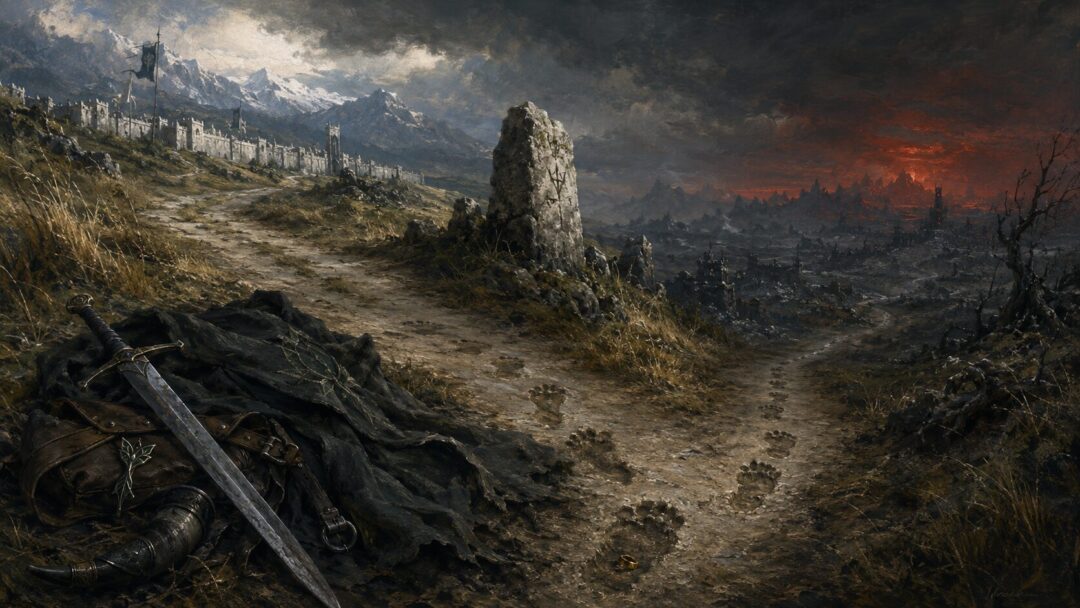
The Fate of the Ring Was Never Aragorn’s Alone
The answer to why Aragorn let Frodo decide the fate of the Ring is that he understood, more deeply than many kings would have, that the Ring’s fate could not be decided by kingship.
He could protect Frodo. He could guide him. He could fight beside him. He could mourn the breaking of the Company and choose the next right deed. But he could not possess Frodo’s burden without changing the nature of the quest.
The Ring was made by a will that wanted to rule all other wills. Its defeat required a fellowship strong enough to help and humble enough to let go. Aragorn’s restraint is therefore not a missing act of heroism. It is heroism purified of possession.
He lets Frodo go because Frodo is not his instrument. He lets the Ring-bearer’s fate pass beyond his hands because command, at that moment, would be another form of temptation. And in that refusal, Aragorn becomes more worthy of the crown than any victory with the Ring could ever have made him.
Sources & Notes
- Wikipedia overview of Aragorn and his role in the Fellowship — https://en.wikipedia.org/wiki/Aragorn
- Wikipedia overview of Frodo Baggins and the Ring-bearer role — https://en.wikipedia.org/wiki/Frodo_Baggins
- Wikipedia overview of the One Ring and its corrupting power — https://en.wikipedia.org/wiki/One_Ring
Sources selected for Tolkien-lore context and reader verification.