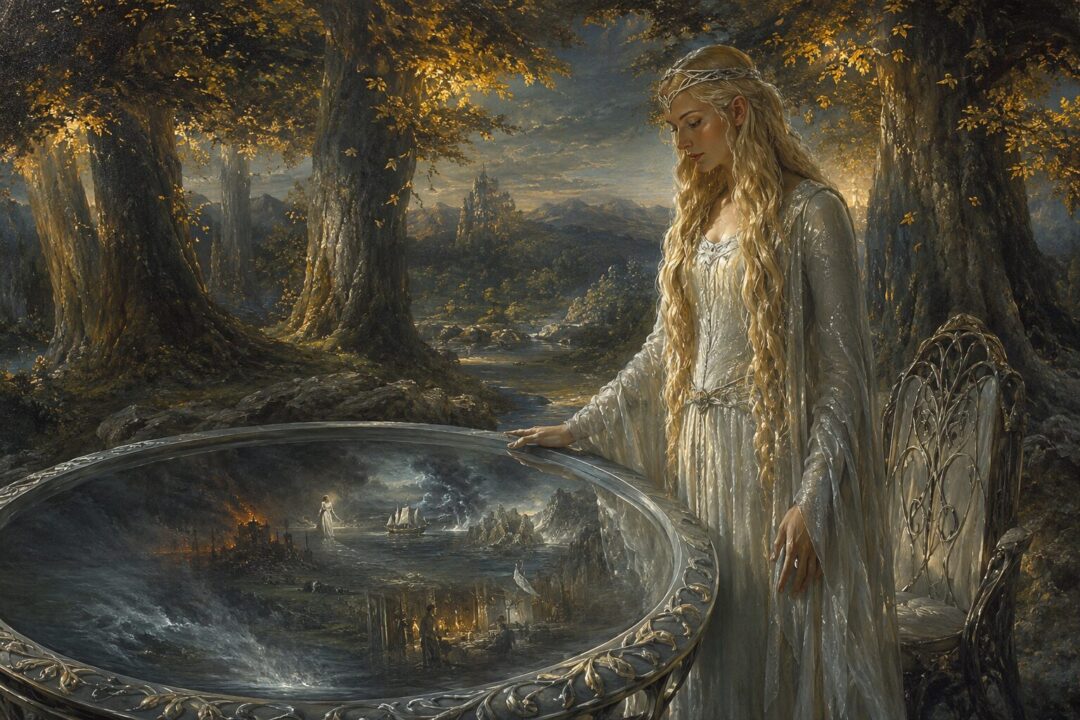
Many objects in Middle-earth promise knowledge. The Seeing-stones reveal distant places. Ancient songs preserve forgotten history. Even the One Ring whispers a vision of what power might accomplish. Yet few things are as quietly unsettling as the Mirror of Galadriel.
When Frodo and Sam enter the Lady's garden in Lothlórien, they are not handed a prophecy or a promise. Instead, they are invited to look into a basin filled with water beneath the open sky. What they receive is something far more dangerous than certainty.
The Mirror does not simply tell the future. It confronts the viewer with possibility. It forces difficult choices without removing freedom. In a world where so many long for certainty, the Mirror becomes one of the most subtle tests in all of The Lord of the Rings.
The Mirror Never Claims to Predict a Fixed Future
One of the most important details is also one readers often overlook. Galadriel herself carefully limits what the Mirror can do.
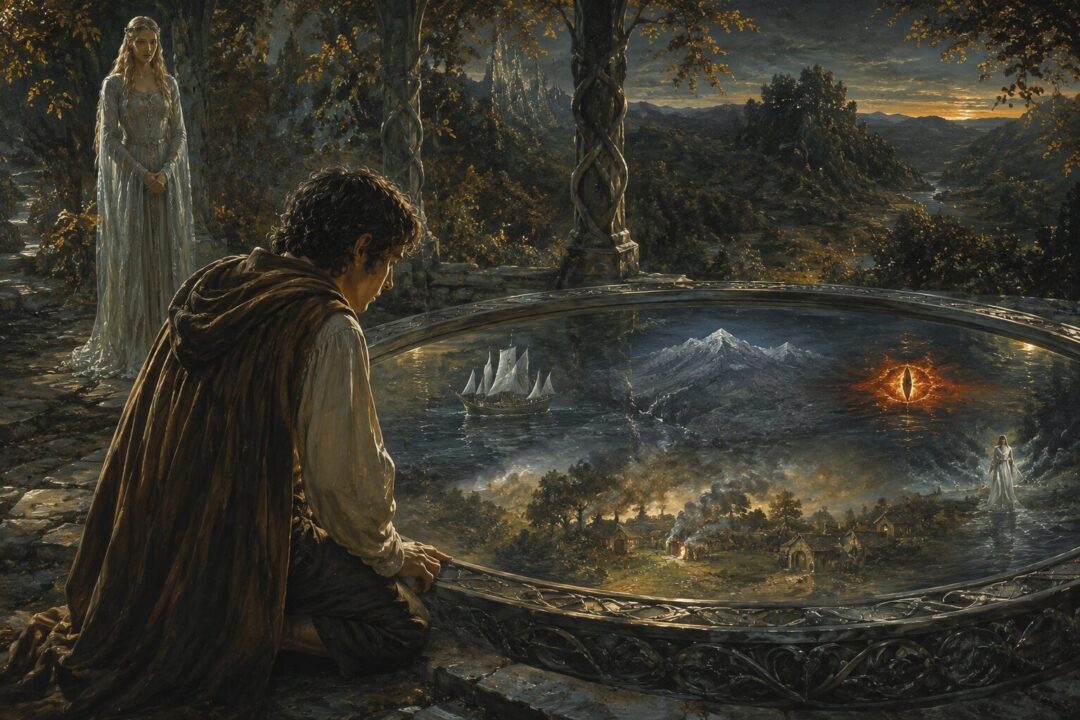
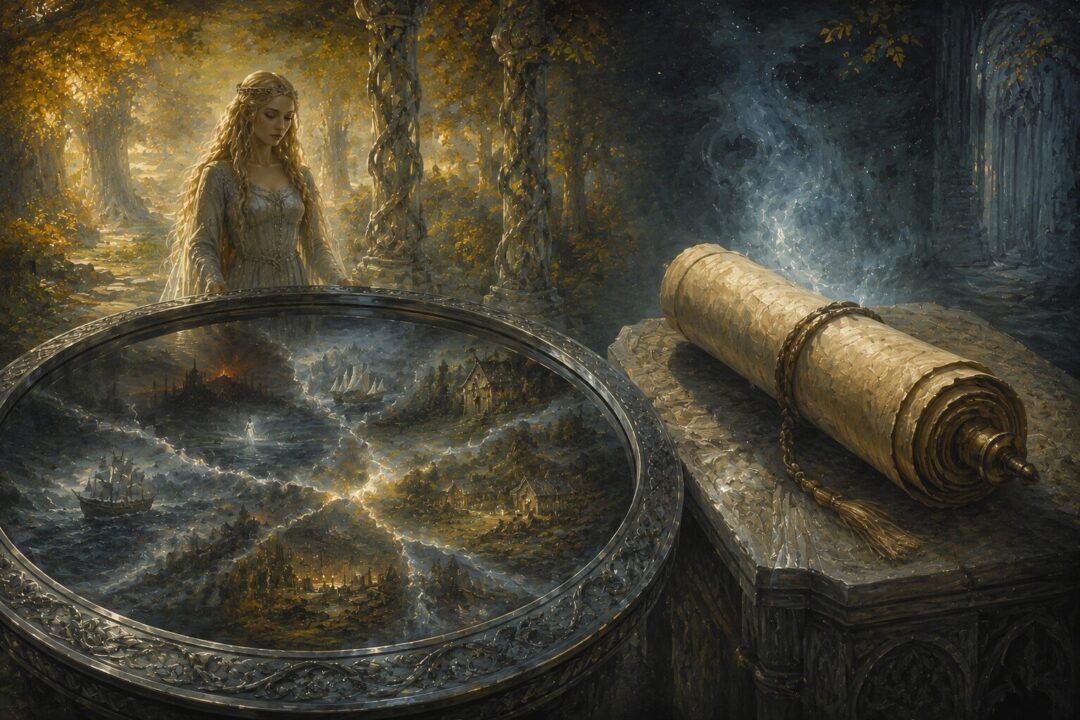
She explains that the Mirror shows many things. Some belong to the past. Some belong to the present. Some have not yet happened.
Most importantly, she warns that many things shown have not yet come to pass—and some never will unless those who behold the visions turn aside from their path to prevent them.
This distinction matters enormously.
Unlike a traditional prophecy, the Mirror does not announce an unavoidable destiny. It presents possibilities that exist within the unfolding history of Middle-earth. The future remains open because the choices of free peoples still matter.
The danger therefore lies not in believing the visions are false, but in assuming they are absolute.
Knowledge Without Interpretation Can Become a Trap
Throughout Tolkien's legendarium, possessing knowledge is rarely enough. Wisdom depends upon understanding what knowledge means—and equally important, understanding what it does not mean.
The Mirror offers images without explanation.
Frodo sees the Shire, smoke rising, trees cut down, and familiar places seemingly destroyed. He also witnesses ships, mountains, a white figure, and eventually the Eye searching for him.
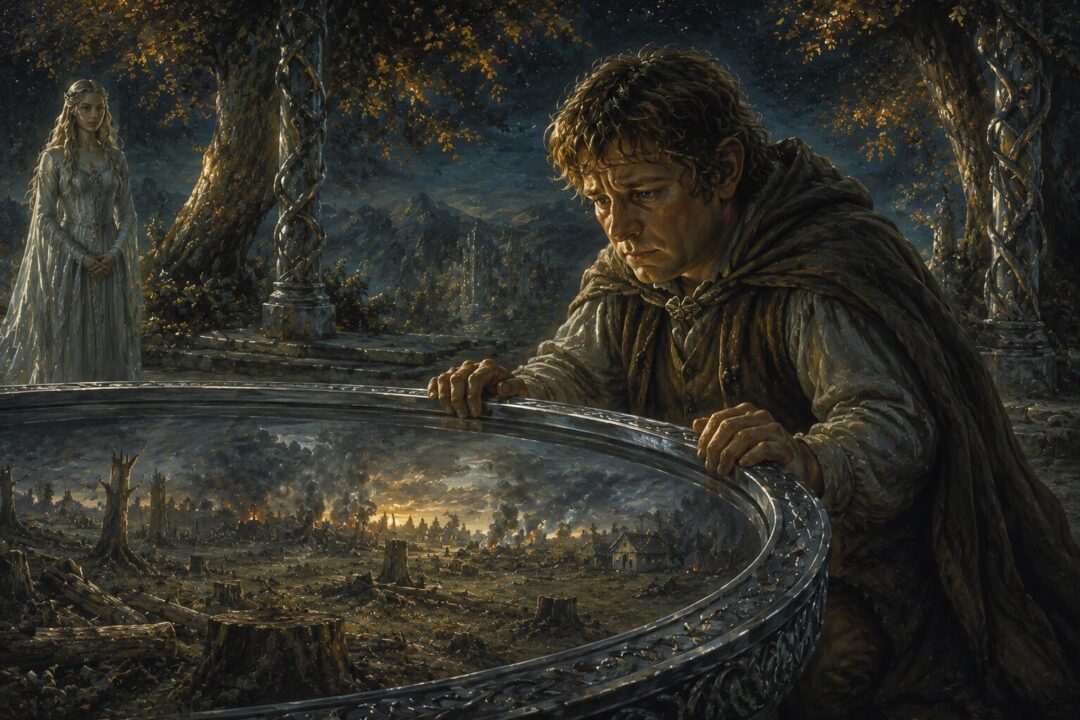
Sam sees the Shire as well, believing it to be under immediate threat.
Neither receives commentary. Neither is told which scenes belong to the present, which belong to the future, or whether any are inevitable.
The viewers must interpret for themselves.
That uncertainty creates the true danger.
Human beings naturally seek patterns and certainty. The Mirror offers enough information to provoke fear while withholding enough context to prevent confident conclusions.
It is therefore less like an oracle delivering answers and more like a profound moral examination.
Sam's Greatest Temptation Comes From Love
Sam's experience reveals perhaps the clearest example of the Mirror's danger.
He sees what appears to be devastation in the Shire. His immediate instinct is simple: abandon the Quest and return home.
His desire is neither selfish nor cowardly.
It springs from loyalty.
Everything Sam values appears to be in danger. If the vision represents reality, continuing toward Mordor could mean sacrificing everyone he loves.
This creates one of the most painful dilemmas in the story.
Should a person abandon a world-saving mission to protect family and home?
Galadriel never answers the question for him.
Instead, she leaves Sam to decide whether what he has seen should govern his actions.
Ultimately, Sam continues the Quest, trusting the larger responsibility entrusted to Frodo.
Later events suggest remarkable complexity. The Shire is indeed eventually despoiled during the Scouring of the Shire, meaning Sam's vision may well have reflected a genuine possibility—or even a future event. Yet leaving Frodo would almost certainly have doomed the Quest, allowing Sauron to triumph and making the Shire's fate immeasurably worse.
The Mirror therefore reveals something true without revealing the whole truth.
Frodo Learns That Fear Can Be Weaponized
Frodo's visions are broader and even more unsettling.
He witnesses scenes from many lands, glimpses figures whose significance is not immediately apparent, and eventually perceives the searching Eye.
Whether the Eye literally sees him through the Mirror or whether the experience reflects the growing spiritual connection between Ring-bearer and Ring is not explicitly explained in the text.
The scene remains intentionally mysterious.
What matters is Frodo's response.
The Mirror reminds him that carrying the Ring means living under constant uncertainty. Every new piece of knowledge carries emotional weight without offering security.
He cannot use what he sees to devise a perfect strategy.
Instead, he must continue forward despite incomplete understanding.
This becomes one of the central themes of the Quest itself.
Galadriel Refuses to Become an Oracle
An overlooked aspect of the episode is Galadriel's own restraint.
She possesses immense wisdom acquired over thousands of years. She understands the limitations of foresight better than almost anyone remaining in Middle-earth.
She refuses to explain every vision.
She refuses to tell Frodo exactly what will happen.
She refuses to remove uncertainty.
This restraint reflects a consistent pattern throughout the legendarium.
Those who seek to dominate the future often become destructive. Those who acknowledge the limits of knowledge are more likely to act wisely.
Galadriel guides without controlling.
Even when Frodo asks questions, she offers careful qualifications rather than absolute declarations.
Her wisdom lies partly in knowing where certainty ends.
The Mirror Echoes a Larger Pattern Throughout Middle-earth
The Mirror belongs to a recurring theme found across Tolkien's world.
Attempts to master the future frequently lead to tragedy.
Denethor's use of the Palantír illustrates this dramatically.
The Seeing-stone provides genuine information, but Sauron manipulates what Denethor sees. The Steward reaches disastrously false conclusions because accurate facts are presented without complete context.
Likewise, Saruman gathers vast knowledge yet increasingly mistakes partial understanding for complete mastery.
Even the Rings of Power themselves represent attempts to preserve or control what naturally changes over time.
Again and again, the desire for certainty becomes spiritually dangerous.
The Mirror differs because Galadriel openly warns against that mistake before anyone looks into it.
Its danger comes not from deception but from the viewer's assumptions.
Free Will Remains Stronger Than Foreknowledge
One of the most remarkable features of the Mirror is what it refuses to eliminate.
Choice.
If the future were completely fixed, moral responsibility would lose much of its meaning.
Instead, Galadriel explicitly states that many things shown may never occur.
This preserves one of the deepest principles operating throughout The Lord of the Rings.
Providence exists.
Yet free peoples remain genuinely free.
Characters repeatedly face situations where they possess incomplete knowledge.
Aragorn marches toward the Black Gate without certainty of success.
Faramir rejects the Ring despite not knowing whether Gondor can survive.
Frodo continues toward Mount Doom despite believing death highly probable.
The Mirror reinforces this same pattern.
Knowledge does not replace moral decision.
Why the Mirror Is Closely Connected to Mercy
At first glance, mercy seems unrelated to visions of the future.
Yet the connection becomes clearer when considering what certainty often produces.
If someone believes they know exactly what another person will become, mercy becomes difficult.
Judgment feels justified.
But throughout the story, characters repeatedly act without complete knowledge.
Gandalf insists that Bilbo's pity toward Gollum may shape events beyond anyone's understanding.
Frodo himself repeatedly shows restraint despite uncertainty.
The Mirror encourages similar humility.
Its visions remind viewers that reality is larger than their immediate interpretation.
This uncertainty creates space for patience, compassion, and hope.
The Mirror Tests the Desire to Control Events
The greatest temptation is not simply to know the future.
It is to control it.
Many figures in Middle-earth attempt precisely that.
Sauron seeks domination through overwhelming power.
Saruman pursues knowledge to reshape history according to his own designs.
Denethor desperately searches for information that will allow him to preserve Gondor.
Each becomes trapped by an overwhelming need to master events.
The Mirror quietly exposes the same temptation in gentler hearts.
If Sam abandons Frodo because of his vision, he attempts to seize control of one possible future.
If Frodo mistakes every image for unavoidable fate, despair may overwhelm him before the true struggle even begins.
The Mirror therefore examines motives rather than intelligence.
Can the viewer accept uncertainty?
Can they continue doing what is right without possessing every answer?
Those questions prove harder than solving any riddle.
Even Galadriel Faces Her Own Test
The chapter containing the Mirror also includes Galadriel's greatest personal trial.
Shortly afterward, Frodo freely offers her the One Ring.
She imagines the immense ruler she might become before rejecting the temptation.
Although the text does not directly connect this decision to the Mirror itself, the sequence is revealing.
The Lady who has just warned Frodo about incomplete knowledge must herself choose between trust and control.
The Ring promises the power to impose order upon the world.
Instead, Galadriel accepts diminishing, the fading of Lothlórien, and the passing of the Elves.
Her famous declaration that she will diminish and remain herself reflects acceptance rather than domination.
In this sense, she embodies the very lesson the Mirror teaches.
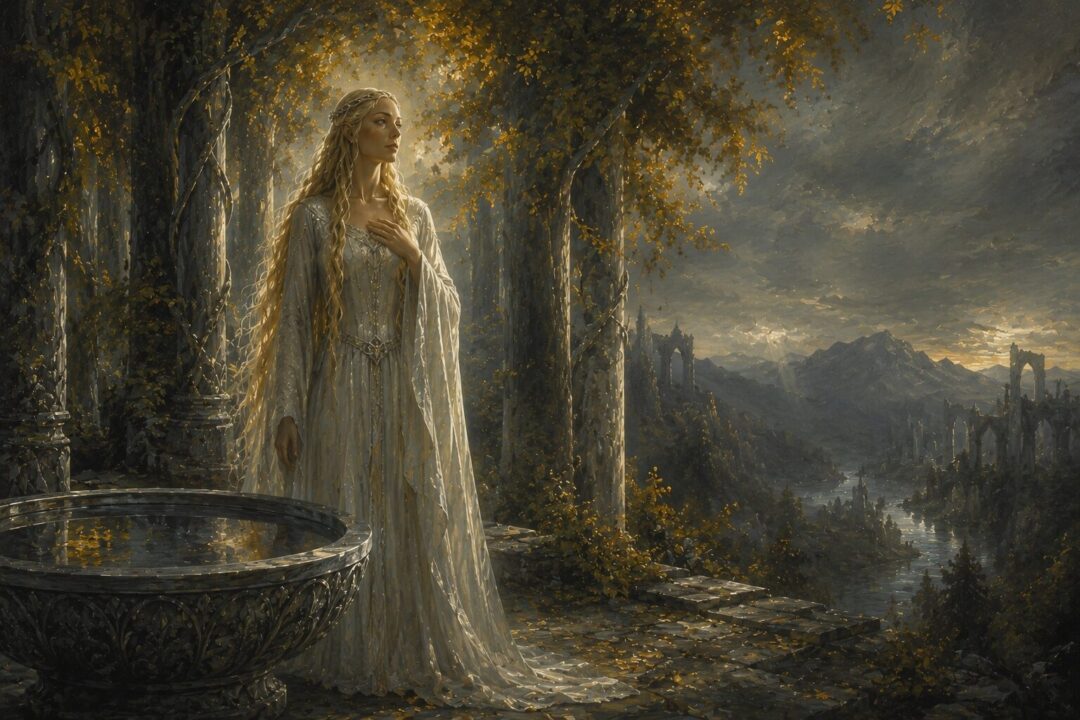
Why the Mirror Is More Dangerous Than a Prophecy
A prophecy often comforts because it seems to settle uncertainty.
Even terrible prophecies imply that events follow a known path.
The Mirror offers no such reassurance.
It presents fragments.
Possibilities.
Warnings.
Truths whose full meaning remains hidden.
The viewer leaves with greater responsibility, not less.
That is why Galadriel prepares Frodo and Sam before allowing them to look.
The greatest danger is not seeing frightening things.
It is believing that incomplete knowledge grants complete understanding.
The Mirror asks every viewer the same question: what will you do when you know enough to fear, but not enough to be certain?
That question reaches beyond Middle-earth itself. The greatest acts of courage rarely occur when every outcome is known. They occur when uncertainty remains, hope seems fragile, and duty still demands a choice.
The Mirror of Galadriel is therefore not dangerous because it predicts the future.
It is dangerous because it reveals how easily even the wisest heart can mistake possibility for destiny—and how much depends upon choosing faithfully anyway.
Sources & Notes
- Wikipedia overview of Galadriel and her role in Lothlórien — https://en.wikipedia.org/wiki/Galadriel
- Wikipedia overview of The Fellowship of the Ring and the Lothlórien episode context — https://en.wikipedia.org/wiki/The_Fellowship_of_the_Ring
- Wikipedia overview of the One Ring and temptation theme connected to Galadriel’s test — https://en.wikipedia.org/wiki/One_Ring
Sources selected for Tolkien-lore context and reader verification.