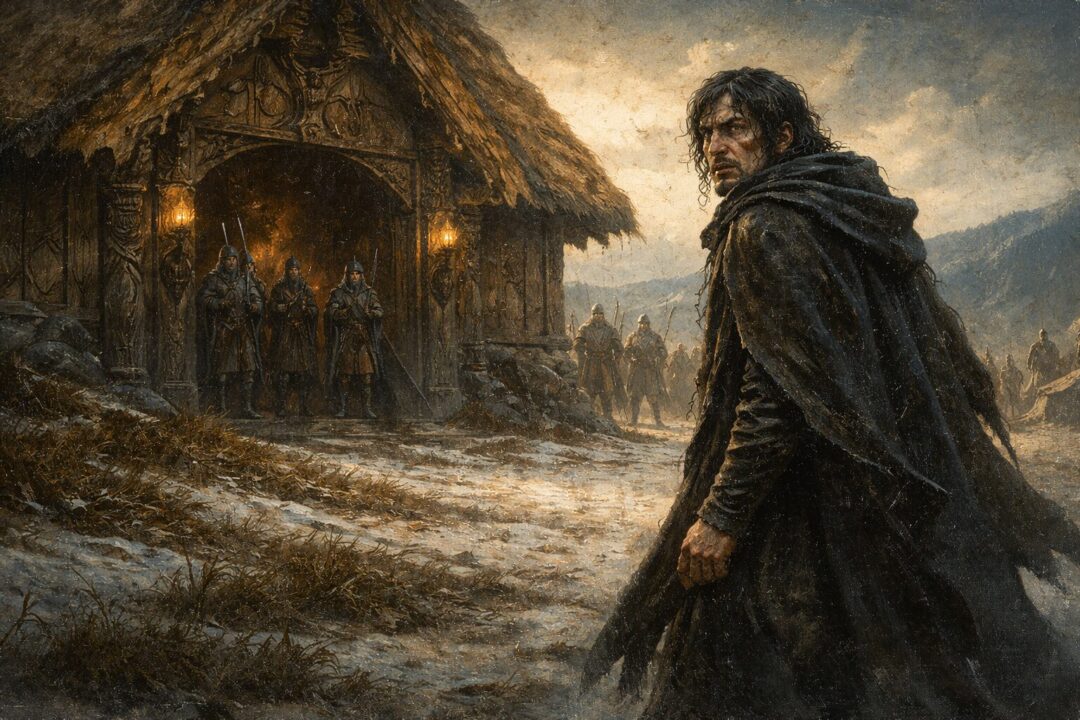
Few characters in The Lord of the Rings provoke such immediate and enduring disgust as Gríma Wormtongue.
He is not introduced as a tragic hero, nor as a figure trapped by unavoidable fate. Tolkien presents him plainly and deliberately: a man who knowingly betrays his lord, weakens his people from within, and serves an enemy of Middle-earth for his own advantage. Long before Saruman’s armies ride, Rohan is already failing—and it is Gríma’s voice that hastens that decline.
His weapon is not the sword, but speech. He lies, delays, poisons counsel, and feeds Théoden despair until the king can no longer act. Tolkien leaves little room for ambiguity. When Gandalf finally breaks Saruman’s hold over Rohan, Gríma’s guilt stands exposed beyond question.
And yet—he is not executed.
At the moment when justice, anger, and retribution all seem aligned, Aragorn intervenes.
The Moment at Meduseld
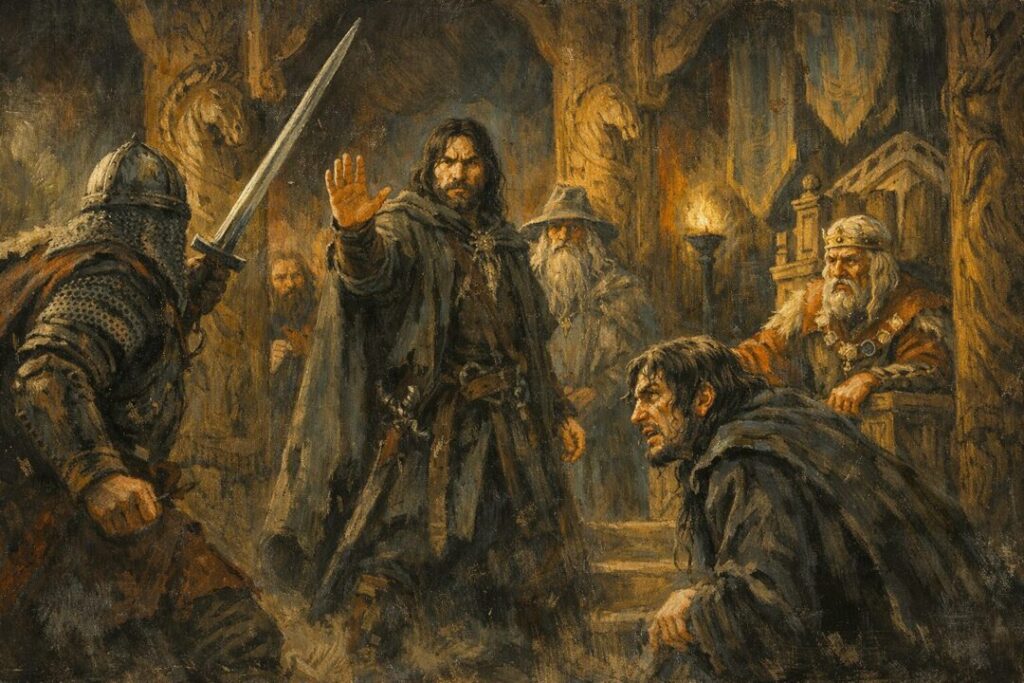
This moment occurs in The Two Towers, during the confrontation in Meduseld between Théoden, Gandalf, Éomer, and Wormtongue. When Gríma’s treachery is laid bare, Éomer moves to strike him down. From a Rohirrim perspective, the impulse is entirely understandable. Gríma has effectively committed treason against both king and country.
But Aragorn stops him.
“Do not slay him,” Aragorn says.
The command is brief. Tolkien does not linger on it. There is no extended explanation, no philosophical justification spoken aloud. The narrative simply records that Aragorn forbids the killing—and that his word is obeyed.
For some readers, this can feel strange. Why intervene on behalf of someone so clearly corrupt? Why spare a man who has done nothing to earn mercy?
Tolkien does not answer these questions directly. But when this moment is placed within the broader moral structure of Middle-earth, Aragorn’s choice is anything but arbitrary.
Aragorn’s Authority at Edoras
At this point in the story, Aragorn is not yet king. He holds no crown, issues no formal judgments, and possesses no legal authority within Rohan. And yet, when he speaks, others listen.
This is significant.
Aragorn does not speak as a mere ranger, nor simply as Gandalf’s companion. He speaks as the future bearer of Númenórean kingship—a kingship shaped not by domination, but by restraint. Tolkien consistently portrays true authority as moral rather than coercive. Aragorn commands not because he can enforce his will, but because his judgment is trusted.
Just as importantly, Aragorn does not deny Gríma’s guilt.
He does not argue that Wormtongue has been misunderstood.
He does not claim that Saruman magically compelled him.
He does not attempt to excuse his actions.
Instead, Aragorn makes a much narrower—and much more demanding—moral claim: that Gríma should not be slain now.
This distinction matters. Aragorn’s command is not forgiveness. It is mercy.
Mercy Is Not the Absence of Judgment
Tolkien is careful throughout The Lord of the Rings to distinguish mercy from moral blindness. Mercy does not erase wrongdoing. It does not deny guilt. It does not pretend that evil is harmless.
Rather, mercy is the refusal to claim absolute judgment while choice still exists.
This principle is articulated most clearly earlier in the story by Gandalf, in one of the most quoted passages in the entire legendarium:
“Many that live deserve death. And some that die deserve life. Can you give it to them?”
Aragorn’s decision at Meduseld reflects this same moral framework. He does not give Gríma life as a reward. He refrains from taking it because the authority to decide life and death does not belong to him—or to Éomer—in that moment.
Tolkien never states that Aragorn consciously echoes Gandalf’s words. But the alignment is unmistakable. Both act on the same underlying principle: that the war against evil is not won by becoming its mirror.
Was Gríma Under Compulsion?
This question is crucial—and Tolkien handles it with unusual precision.
Gríma is clearly influenced by Saruman. Saruman uses his voice, his presence, and his power of persuasion to dominate others. But the texts never describe Gríma as magically enslaved in the way Théoden is weakened.
In fact, Gandalf explicitly distinguishes between them.
Théoden is diminished, clouded, and oppressed. Gríma, by contrast, is repeatedly described as a willing servant. He enjoys his position. He resents Éomer. He benefits from Théoden’s weakness. His actions are self-chosen.
This distinction matters deeply in Tolkien’s moral universe.
Because mercy, in Middle-earth, is not reserved only for the innocent or the coerced. It is offered precisely when guilt is real—but repentance remains possible.
Gríma is spared not because he is blameless, but because he is still capable of choosing otherwise.
The Second Offer of Mercy at Orthanc
This is not the last time mercy is extended to Wormtongue.
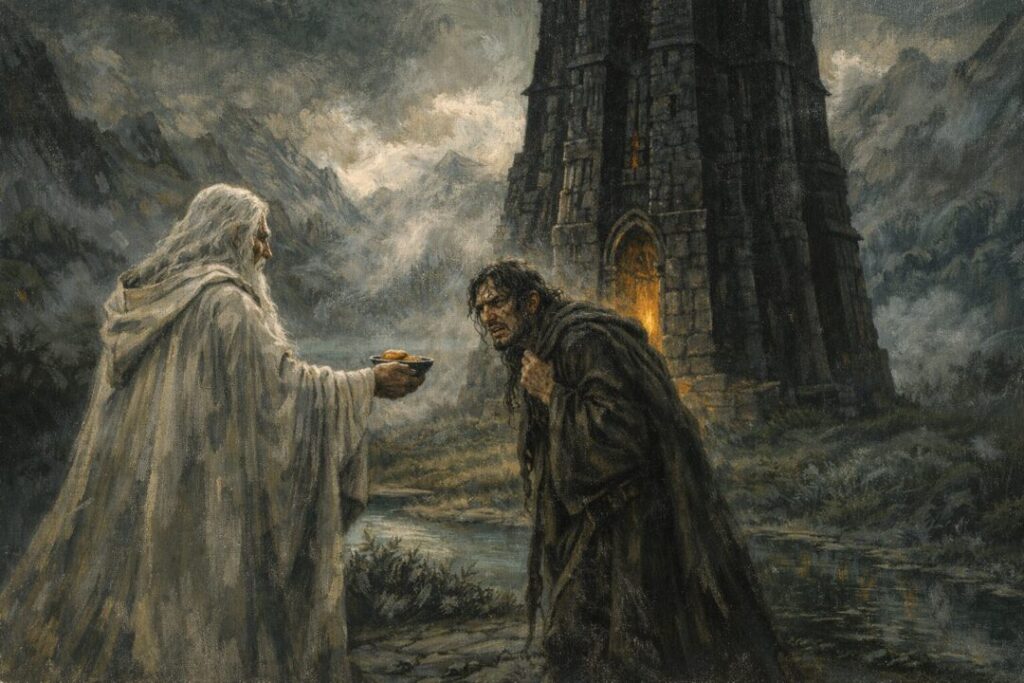
After Saruman’s defeat, Gríma stands once more at a crossroads. At Orthanc, Gandalf offers him freedom, food, and protection if he will abandon Saruman and come away.
This is not a symbolic gesture. It is a genuine offer of release.
Even after years of corruption, manipulation, and betrayal, the door remains open.
Gríma refuses.
Tolkien is unambiguous here. Gríma chooses to stay with Saruman. He chooses bitterness over freedom, resentment over release. No force compels him. No illusion deceives him. He rejects mercy with full knowledge of what he is doing.
Only after that refusal does violence finally occur—and not by Aragorn, Gandalf, or Théoden.
Gríma kills Saruman.
Gríma is slain in turn.
Tolkien never frames this as delayed justice or cosmic irony. He frames it as the natural end of a road repeatedly chosen.
Judgment comes—but only after mercy has been unmistakably offered and rejected.
Aragorn’s Kingship Defined by Restraint
This moment at Meduseld is not isolated. It fits a clear pattern in Aragorn’s character and future rule.
Later in the story, Aragorn spares the Men of the Mountains after they fulfill their oath. He grants mercy to former enemies of Gondor. He rules as a healer and restorer, not as a tyrant consolidating power through fear.
Throughout the legendarium, rightful kings are not marked by severity, but by self-control.
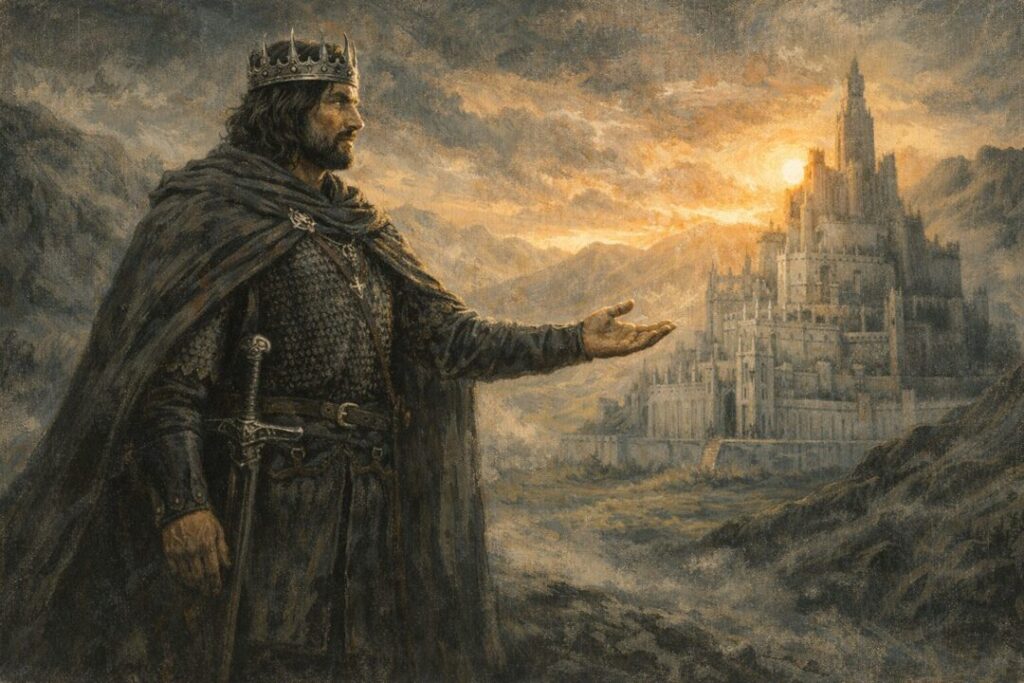
Sparing Gríma Wormtongue is one of the earliest expressions of this kingship.
Not sentimental mercy.
Not naïve optimism.
But disciplined refusal to let evil dictate one’s actions.
Aragorn does not allow Wormtongue’s corruption to corrupt him.
Did Aragorn Know What Would Happen?
Some readers have suggested that Aragorn spared Gríma because he foresaw Saruman’s eventual downfall at Wormtongue’s hands.
There is no textual support for this.
Tolkien gives Aragorn no prophetic insight into Gríma’s future actions. Any claim that Aragorn “knew” how events would unfold must be labeled as speculation—and should not be presented as fact.
What Tolkien does show is simpler and more demanding:
Mercy must be offered whether or not it is accepted.
The moral responsibility ends with the offer itself, not with the outcome.
Why This Moment Matters
Gríma Wormtongue is spared because Tolkien’s world does not operate on execution-by-desert.
It operates on choice.
Aragorn’s restraint does not save Gríma. Gríma ultimately destroys himself. But Aragorn’s restraint preserves Aragorn—and preserves the moral shape of the world Tolkien is depicting.
Middle-earth is not saved by flawless people.
It is saved by those who refuse to surrender their moral limits, even when faced with someone who seems to deserve none.
That is why this small, easily overlooked moment matters.
Because in stopping the blade at Meduseld, Aragorn proves that he is already the king Middle-earth will one day need.