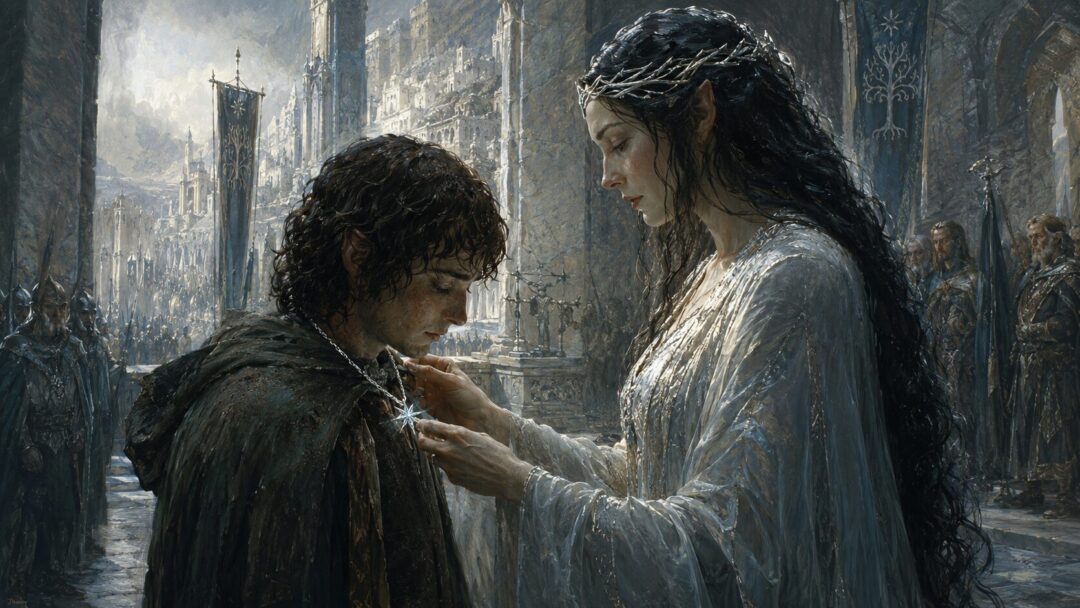
The white gem Arwen placed around Frodo’s neck is easy to miss beside greater things: the One Ring, the shards of Narsil reforged, the Palantíri, the Silmarils remembered only in song. It is a small object, given quietly after the victory is won, when kings are crowned and farewells begin. Yet its meaning is far larger than its size.
Arwen’s gift to Frodo is not merely a jewel. It is a promise of healing, a sign of gratitude, and a strange exchange of destinies. She tells Frodo that he may pass into the West “in my stead” when the time comes, if his wounds still grieve him. In that moment, the Queen of Gondor gives comfort to the Ring-bearer, but she also speaks aloud the cost of her own choice.
She has chosen the fate of Lúthien. Frodo may sail because Arwen will not.

The Gift Given After Victory
Arwen gives Frodo the white gem in “Many Partings,” after the fall of Sauron and after her marriage to Aragorn. The great public triumph has already happened: Aragorn has become king, the Shadow has passed, and the long hope of the Dúnedain has been fulfilled. But Tolkien does not end the story with coronation alone. He turns instead to those who cannot be wholly restored by victory.
Frodo is one of them.
The Ring has been destroyed, but Frodo’s suffering remains. He has been wounded by the Morgul-knife on Weathertop, stung by Shelob, burdened by the Ring, and spiritually scarred by the long approach to Mount Doom. The Shire may be saved, but Frodo himself is not simply “better.” The later chapters make this painfully clear: his old wounds return on anniversaries, and he finds no lasting peace in the land he helped preserve.
Arwen seems to understand this before many others do. Her words are not casual courtesy. She gives Frodo both a visible token and a future hope: if his hurts remain and the memory of his burden is heavy, he may pass into the West until his wounds and weariness are healed.
The gem is immediate aid. The passage West is deeper mercy.
“In My Stead”: The Strange Weight of Those Words
Arwen’s most important phrase is “in my stead.” She does not merely say that Frodo may sail. She frames the privilege as connected to her own refusal of it.
As the daughter of Elrond, Arwen belongs to the Half-elven line, and her fate is bound to a choice. Elrond’s children are not ordinary Elves in this respect. They inherit the ancient doom of the Half-elven: to be counted among Elves or Men. Arwen chooses mortality for love of Aragorn, repeating in a later age the pattern of Lúthien, who chose Beren and accepted the mortal fate.
That choice has sweetness and bitterness. Arwen says as much. The sweetness is Aragorn: love, kingship, children, and the restoration of a realm long in exile. The bitterness is separation. She will not depart with Elrond when he sails from the Grey Havens. She will not remain with the Elves beyond the circles of the world. Her road now leads toward the fate of Men.
So when Arwen gives Frodo her “place,” the gesture carries more than kindness. It is a farewell to the Elven future she has surrendered.
Arwen’s Gift Is Not a Mechanical Ticket
A careful reading should avoid making the gift too literal in a simplistic way. Tolkien does not present the passage into the West as a normal travel arrangement, nor does he spell out exactly how Arwen’s surrendered place functions in practical terms. Frodo’s later sailing is also connected with his unique role as a Ring-bearer, and Bilbo and eventually Sam are associated with that same mercy.
So Arwen’s words should not be reduced to bureaucracy: one seat exchanged, one passenger removed, another added. The deeper point is symbolic, spiritual, and relational. Arwen has the right to depart with her people, but she will not use it. Frodo, who has saved the world in which her mortal happiness can exist, may receive healing in the West instead.
Her gift acknowledges a hidden debt. Without Frodo’s endurance, Aragorn’s kingship and Arwen’s marriage would have no future. The destruction of the Ring does not merely save kingdoms in the abstract. It makes possible the life Arwen has chosen.
Frodo loses the peace of the Shire so others may dwell in peace. Arwen sees that cost.

The White Gem as a Counter-Ring
The white gem is especially powerful because Frodo has spent so long carrying another object on a chain. The Ring hung close to him, pressed upon him, tempted him, and marked him. It was beautiful in appearance but corrupting in essence. Arwen’s jewel reverses that image.
It is a white gem like a star, set on a silver chain. It does not dominate. It does not command. It is not a tool of power. It is given freely, and its purpose is aid when memory darkens.
This makes the jewel one of the quietest counter-images to the Ring in the entire story. The Ring isolates; the gem remembers relationship. The Ring magnifies desire; the gem offers consolation. The Ring binds its bearer to Sauron’s will; the gem links Frodo to Elfstone and Evenstar, to Aragorn and Arwen, whose lives have been woven with his.
The jewel does not erase Frodo’s pain. Tolkien is too honest for that. But it gives him something to hold when fear and darkness return. In that sense, it is not a cure but a mercy.
Why Arwen Understands Wounded Victory
Arwen is not a Ring-bearer, and the text never suggests that she knows Frodo’s suffering from direct experience. But she does understand something essential: triumph can demand a wound that history does not fully see.
Her own victory is shadowed. She gains Aragorn, but loses Elrond. She becomes Queen of the Reunited Kingdom, but accepts mortality. Her joy belongs to the beginning of the Fourth Age; her grief belongs to the same choice. The Elves are fading from Middle-earth, and she, who was called the Evenstar of her people, remains behind as their evening deepens.
This is why her gift to Frodo feels so fitting. Both Arwen and Frodo stand at the edge of an age that cannot continue. Frodo cannot return unchanged to the Shire. Arwen cannot return unchanged to the immortality of her kin. Each has made possible a future that costs them the world they once belonged to.
Their fates are not identical. Frodo is mortal by nature, while Arwen chooses mortality. Frodo is wounded by evil, while Arwen is wounded by love and parting. Yet the story brings them together in a moment of recognition. She can name his need because she knows that some sacrifices are not healed by applause.
The Farewell Hidden Inside the Gift
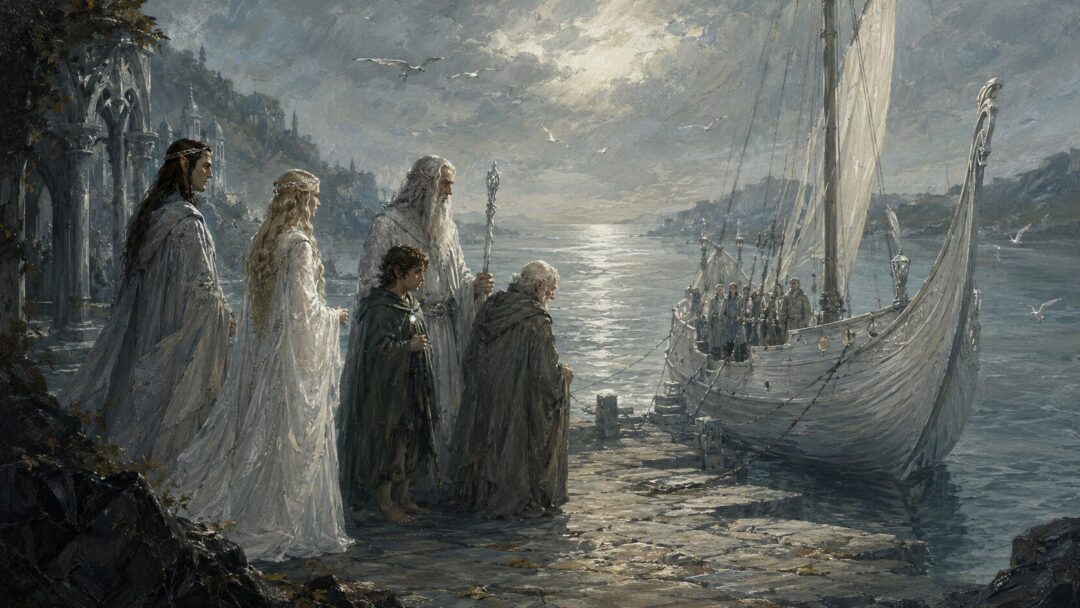
When Arwen gives Frodo the gem, she is also saying farewell before the Havens ever appear.
She will not sail with Elrond. That parting is still ahead in the narrative, but her decision has already made it inevitable. The ship that will carry Elrond, Galadriel, Gandalf, Bilbo, and Frodo will not carry her. Her road bends south and east, toward Gondor, kingship, motherhood, widowhood, and finally the quiet death described in Appendix A.
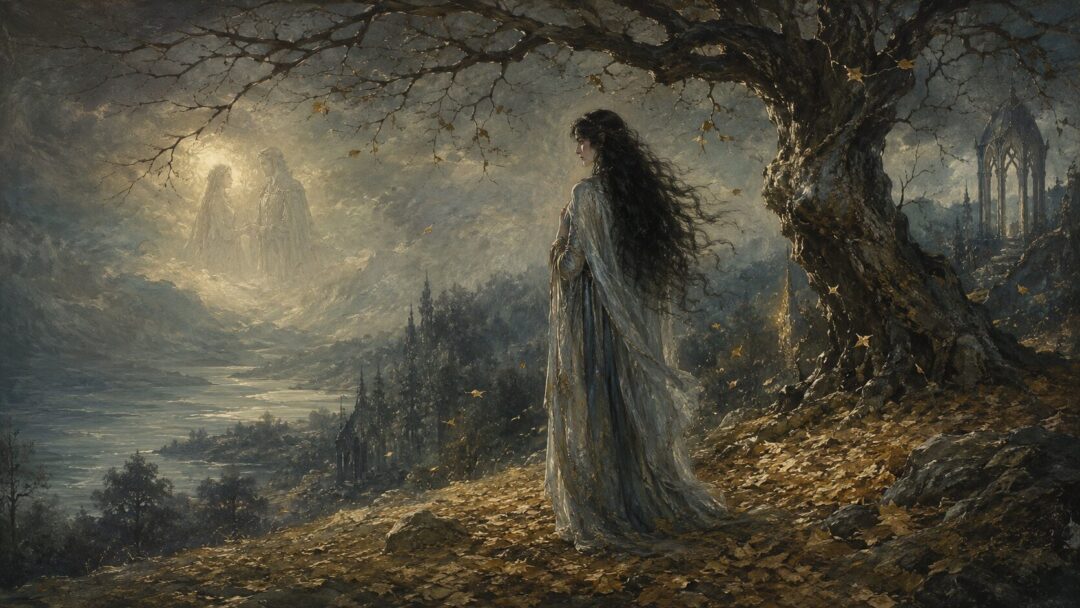
The later account of Aragorn and Arwen gives the full sorrow of this choice. After Aragorn’s death, Arwen goes to Lórien, but it is emptying and changed. She dies on Cerin Amroth, the hill where she and Aragorn had once pledged themselves. The place of beginning becomes the place of ending.
That later grief is already foreshadowed in the gift to Frodo. Her “in my stead” is not only generosity. It is the sound of a door closing. Frodo may seek healing where she will never go.
The Gift Connects Three Great Stories
Arwen’s gesture gathers together three great patterns of Middle-earth.
The first is the story of Lúthien. Arwen explicitly names that path. Like Lúthien, she chooses love with a mortal man, accepting both joy and death. The comparison is not decorative; it is the moral frame of her life.
The second is the story of the Ring-bearers. Frodo’s burden does not end at the Cracks of Doom. The West becomes a place of healing for wounds that Middle-earth cannot mend. His departure is not a rejection of the Shire but the final consequence of saving it.
The third is the passing of the Elves. Arwen’s name, Evenstar, already suggests an ending radiance. She is not the morning of her people but their evening beauty in Middle-earth. Her gift shines with that twilight: lovely, merciful, and touched by loss.
This is why the scene matters so much. It is small, but it contains the shape of the whole ending.
Mercy, Not Escape
The West is sometimes misunderstood as simple immortality or paradise granted as a reward. For Frodo, the text frames it more carefully as healing. He remains mortal. His sailing does not make him an Elf, nor does it cancel the nature of hobbits. It offers rest from wounds and weariness that Middle-earth can no longer soothe.
That distinction matters. Arwen is not giving Frodo a way to become something else. She is helping him endure what he has become.
Nor is Frodo’s departure a failure. He saved the Shire, but not for himself in the ordinary sense. This is one of the great bittersweet truths of The Lord of the Rings: some acts of mercy and courage preserve a home to which the savior cannot fully return. Frodo’s peace lies beyond the circles of his familiar world.
Arwen’s gift recognizes that before Frodo himself can accept it.
The Queen, the Ring-bearer, and the Cost of the New Age
The Fourth Age begins with renewal: Aragorn crowned, the White Tree flowering, Gondor restored, the Shadow defeated. But renewal in Tolkien almost always comes with passing. The Elves depart. The Ring-bearer sails. The old wonders diminish. Even Arwen’s happiness is measured within time.
Her gift to Frodo stands at the crossing of those losses. She gives away a jewel from her breast, a promise from her own surrendered road, and a place in the healing West that she herself will not take. It is an act of compassion, but also an act of self-knowledge.
Arwen knows what she has chosen. Frodo does not yet know that he will need what she offers.
That is the quiet tragedy of the scene. The white gem shines like a star, but stars are often seen most clearly in darkness. Arwen’s gift comforts Frodo because it comes from someone who understands that victory does not remove all grief. Sometimes the highest mercy is not to pretend the wound will vanish, but to prepare a road for the wounded when the world they saved is no longer enough.
In giving Frodo her place, Arwen does not merely honor the Ring-bearer.
She says farewell to the fate she might have had.
Sources & Notes
- J.R.R. Tolkien, The Lord of the Rings, Book VI, Chapter 6, “Many Partings” — Arwen gives Frodo the white gem and says he may pass into the West “in my stead” if his wounds and memories trouble him.
- J.R.R. Tolkien, The Lord of the Rings, Book VI, Chapter 9, “The Grey Havens” — Frodo’s recurring wounds and final sailing frame the gift as healing rather than ordinary reward.
- J.R.R. Tolkien, The Lord of the Rings, Appendix A, “The Tale of Aragorn and Arwen” — Arwen’s choice of mortality, her parting from Elrond, and her death on Cerin Amroth show the cost behind “in my stead.”
- J.R.R. Tolkien, The Silmarillion, “Of Beren and Lúthien” — Lúthien’s choice of a mortal fate provides the older pattern explicitly echoed by Arwen.
- J.R.R. Tolkien, The Lord of the Rings, Book II, Chapter 1, “Many Meetings” — Bilbo’s presence in Rivendell and the Half-elven lineage context help connect Elrond’s house, Aragorn, and Arwen before the ending.