By the time we reach The Lord of the Rings, Gondor feels like a kingdom built around an absence.
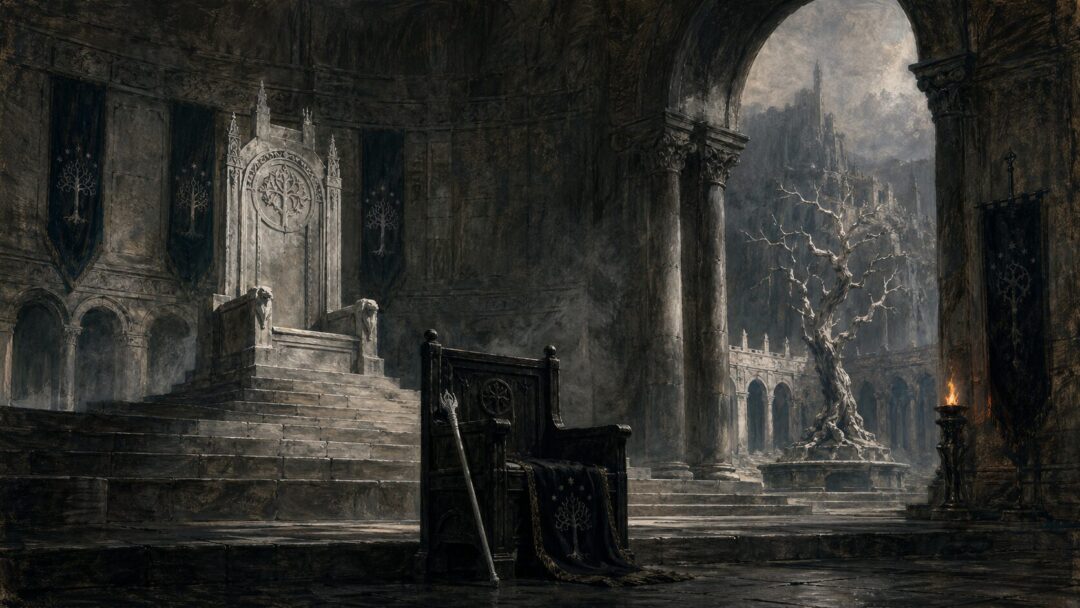
The White Tree is dead.
The throne is empty.
The Stewards rule from the lower chair, while the high seat of the kings remains unused.
Everyone in Minas Tirith seems to know that Gondor was once ruled by kings. The memory has not vanished. The symbols are still there. The city still carries the weight of its ancient lineage.
And yet there is no king.
For many readers, the simple answer is Aragorn. Gondor has no king because the heir is far away, hidden in the North, waiting for the time of his return.
That is true—but it is not the whole answer.
The deeper question is not only why Aragorn had not yet come.
It is why Gondor’s own kings disappeared in the first place.
And the answer is not a single event. It is a long unraveling.
Gondor Did Not Abandon Its Kings
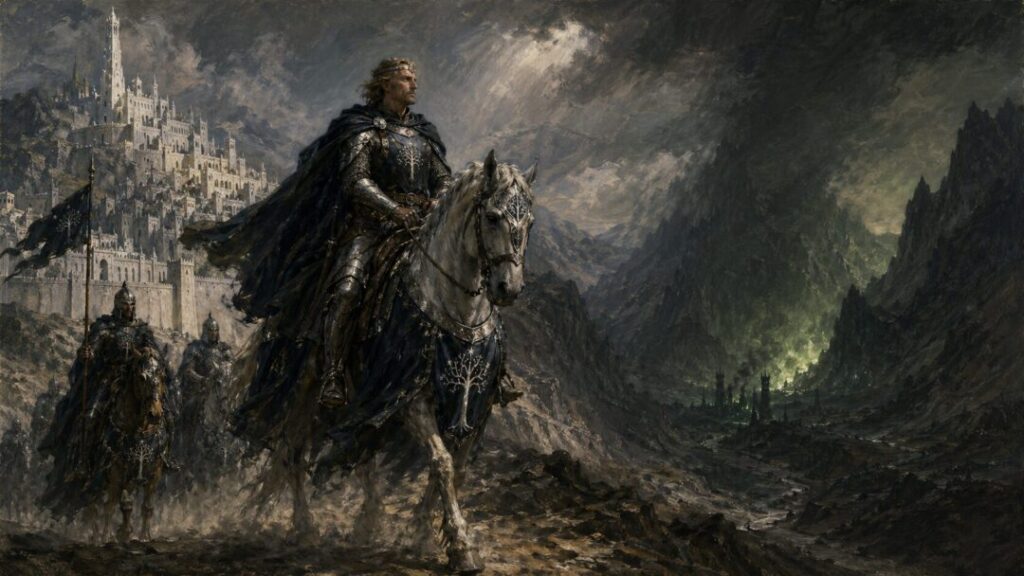
The first thing to understand is that Gondor did not simply decide it no longer wanted kings.
This was not a revolution. The Stewards did not overthrow the royal house. The people of Gondor did not replace monarchy with some new system of rule.
In fact, the opposite is true.
Gondor preserved the idea of kingship with almost painful loyalty.
The Stewards ruled in the name of the king. They did not sit on the throne. They did not wear the crown. Their authority was great, but it was still framed as guardianship, not replacement.
That distinction matters.
Gondor’s empty throne was not a sign that the kingdom had moved on.
It was a sign that the kingdom was waiting.
But waiting for whom had become the terrible question.
The Line of Anárion
Gondor’s kings came from the line of Anárion, son of Elendil.
After the fall of Númenor, Elendil and his sons founded the Realms in Exile: Arnor in the North and Gondor in the South. Isildur and Anárion ruled together in Gondor at first, but after the War of the Last Alliance and the deaths of Elendil and Anárion, the southern kingship passed through Anárion’s descendants.
For many generations, that line endured.
Gondor grew powerful. Its armies marched far. Its cities shone. Its kings ruled over a realm that was, for a time, the greatest power of Men in the West of Middle-earth.
But Middle-earth is rarely kind to greatness.
Gondor’s decline did not begin with one foolish king riding into darkness.
It began centuries earlier, when the kingdom started wounding itself from within.
The Kin-strife Broke More Than Trust
One of the deepest wounds in Gondor’s history was the Kin-strife.
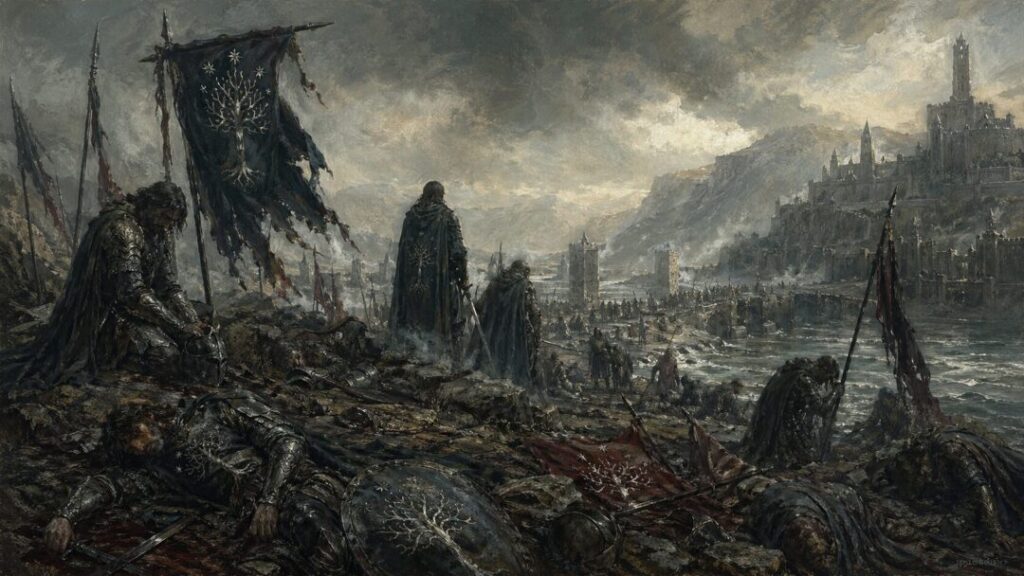
This was not a war against Mordor. It was not a war against Easterlings or Haradrim. It was civil war—Gondorian against Gondorian, king against claimant, noble house against noble house.
The conflict began over the kingship of Eldacar, whose mother was of the Northmen. Some in Gondor rejected him, and Castamir seized the throne. Eldacar later returned, Castamir was slain, and the rebellion was defeated.
But victory did not undo the damage.
The Kin-strife killed many of Gondor’s noble and royal kindred. It weakened the realm from the inside. Castamir’s sons and supporters escaped to Umbar, turning that southern haven into a long-lasting enemy of Gondor.
This is crucial to the story of the missing kings.
Because when the final crisis came centuries later, Gondor’s royal house was not broad, healthy, and secure. It had already been narrowed by civil war, exile, suspicion, and death.
The kingdom survived the Kin-strife.
But it never fully escaped its consequences.
Plague, War, and a Thinning Crown
After the Kin-strife came more disasters.
The Great Plague struck Gondor and carried off many of its people. Later, wars with the Wainriders brought another succession crisis when King Ondoher and both his sons were slain.
This left Gondor with a dangerous problem: who had the right to rule?
Arvedui, king of Arthedain in the North, claimed the crown. His argument was not absurd. He was descended from Isildur, and his wife Fíriel was the daughter of King Ondoher.
But Gondor rejected his claim.
Instead, the crown passed to Eärnil, a victorious captain of the royal house of Anárion. Gondor’s choice was not simply about blood. It was also about custom, politics, military strength, and what the southern kingdom was willing to accept.
This moment is easy to overlook, but it matters deeply.
Gondor had already faced a disputed throne before the last king vanished. It had already seen how dangerous uncertainty could be. And behind all of this stood the memory of the Kin-strife.
The kingdom knew what rival claims could do.
It had bled for that lesson.
Eärnur: The Last King
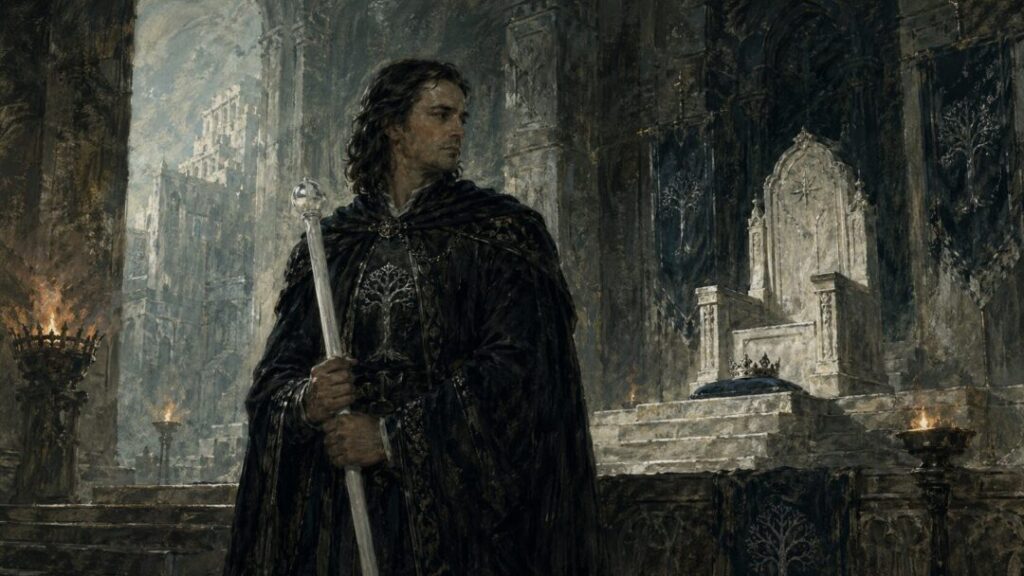
Eärnil II was succeeded by his son Eärnur.
Eärnur was brave. No one questions that. He had fought in the North against the realm of Angmar, and he had seen the Witch-king flee after the Battle of Fornost.
But Eärnur was not described as a king of deep wisdom.
The texts present him as proud, strong, warlike, and quick to anger. He loved combat. He never married. He had no heir. And he carried an old shame connected to the Witch-king.
At Fornost, when the Witch-king fled, Eärnur had wanted to pursue him. His horse had panicked before the terror of the Nazgûl, and Glorfindel restrained him, speaking the famous prophecy that the Witch-king would not fall by the hand of man.
The Witch-king remembered.
Years later, after Minas Ithil had fallen and become Minas Morgul, he challenged Eärnur to single combat.
The first time, Eärnur’s Steward, Mardil, restrained him.
That restraint may have saved Gondor for a while.
But the challenge came again.
And this time, Eärnur answered.
The Trap at Minas Morgul
Eärnur rode to Minas Morgul with only a small escort.
That is one of the most chilling details in the history of Gondor.
He did not lead an army to reclaim the city. He did not march as a king defending his realm. He went as a warrior answering a personal challenge.
And he never returned.
The texts do not give us a detailed account of what happened inside Minas Morgul. We are not shown his death. We are not told whether he was slain, imprisoned, tormented, or destroyed in some other way.
The silence is part of the horror.
What can be said safely is this: Eärnur disappeared after entering the city of the Ringwraiths, and Gondor never saw him again.
The last king did not leave in glory.
He vanished into the shadow.
Why Was There No New King?
This is where the story becomes more than a tragedy about one reckless ruler.
Eärnur had no heir.
That alone would have created a crisis. But Gondor’s problem was even worse. The royal line had been weakened for generations. Other claimants either lacked clear enough standing or were politically dangerous to accept.
The kingdom had already rejected the northern claim of Arvedui generations earlier. The memory of civil war still mattered. The fear of another Kin-strife was not irrational; it was based on Gondor’s own history.
So Gondor chose stability.
Mardil the Steward took up rule, not as king, but as guardian of the realm “until the King should return.”
That phrase is haunting because it is both loyal and uncertain.
It preserves hope.
It avoids civil war.
It keeps the throne sacred.
But it also admits that no acceptable king is present.
The Stewards Did Not Steal the Throne
It is tempting to imagine the Stewards as usurpers, especially because Denethor in the War of the Ring is so fiercely resistant to Aragorn.
But historically, the Stewardship began as an act of preservation.
Mardil did not crown himself. The Stewards ruled Gondor, but they maintained the old distinction. Their seat was not the king’s throne. Their symbol was the white rod, not the crown.
This does not mean every Steward was humble in heart. By the time of Denethor, the office had been hereditary for many generations, and the Stewards had exercised kingly power for nearly a thousand years.
But the form still mattered.
In Gondor, tradition had enormous weight. A Steward could rule. A Steward could command armies. A Steward could govern the realm.
But a Steward could not simply become king by waiting long enough.
That is why the empty throne remained so powerful.
It was a wound Gondor refused to cover over.
So Why Did the Kings “Leave”?
Strictly speaking, the kings did not all leave Gondor.
That phrase is more poetic than literal.
Most of Gondor’s kings died as kings do: in age, war, plague, or succession. The kingship itself gradually became fragile because the royal house had been weakened by centuries of disaster.
Then the last king, Eärnur, rode away from Minas Tirith and entered Minas Morgul.
He never returned.
So the better answer is this:
The kings did not abandon Gondor. Gondor’s royal line was broken by history, narrowed by bloodshed, and finally ended when its last king was lured into the darkness by the Witch-king.
After that, the realm was too proud, too lawful, and too afraid of civil war to place a doubtful claimant on the throne.
So it waited.
The Empty Throne Was a Test
By the end of the Third Age, Gondor’s empty throne is not just a political fact.
It is a spiritual condition.
The kingdom is still noble, but diminished. Still faithful, but weary. Still proud, but afraid. Its rulers preserve the forms of ancient greatness, while the living heart of that greatness seems harder and harder to find.
That is why Aragorn’s return matters so much.
He is not merely a man claiming a chair.
He represents the healing of a broken story: the reunion of the northern and southern lines, the return of the king after centuries of waiting, and the restoration of hope where Gondor had preserved only memory.
But that return only has meaning because the throne had remained empty.
If the Stewards had seized it, the old promise would have ended.
If Gondor had accepted any convenient claimant, the kingship might have survived in name but lost its sacred weight.
If Eärnur had lived, the story would have been different.
Instead, Gondor endured a thousand years of absence.
And in that absence, the kingdom became one of the most tragic images in Middle-earth:
A realm still guarding a throne for a king it could no longer find.
The Real Tragedy of Gondor’s Kings
The fall of Gondor’s kings is not simply about weakness.
It is about pride, memory, law, and fear.
Eärnur’s pride led him to Minas Morgul.
Gondor’s memory of civil war made it fear uncertain succession.
Its reverence for lawful kingship kept the Stewards from claiming the crown.
Its endurance kept the realm alive long enough for the true return.
That is what makes the story so powerful.
Gondor did not forget its kings.
It remembered them so fiercely that it left the throne empty rather than fill it falsely.
And for nearly a thousand years, that empty throne asked the same silent question:
Was the king truly gone forever?
Or was Gondor still waiting for the one return that could heal everything?
Sources & Notes
- J.R.R. Tolkien, The Lord of the Rings, Appendix A, “Gondor and the Heirs of Anárion” — gives the line of Anárion, the Kin-strife under Eldacar and Castamir, and the later weakening of Gondor’s royal house.
- J.R.R. Tolkien, The Lord of the Rings, Appendix A, “Gondor and the Heirs of Anárion” — describes the Great Plague, the Wainrider wars, Ondoher’s death, Arvedui’s rejected claim, and Eärnil II’s accession.
- J.R.R. Tolkien, The Lord of the Rings, Appendix A, “Eriador, Arnor, and the Heirs of Isildur” — records Arvedui’s claim through Isildur and Fíriel, and Gondor’s refusal to accept the northern king as heir.
- J.R.R. Tolkien, The Lord of the Rings, Appendix A, “Gondor and the Heirs of Anárion” — tells how Eärnur, childless and proud, answered the Witch-king’s challenge at Minas Morgul and never returned.
- J.R.R. Tolkien, The Lord of the Rings, Appendix A, “The Stewards” — explains that Mardil and his heirs ruled in the king’s name, using the white rod and preserving the empty throne “until the King returns.”