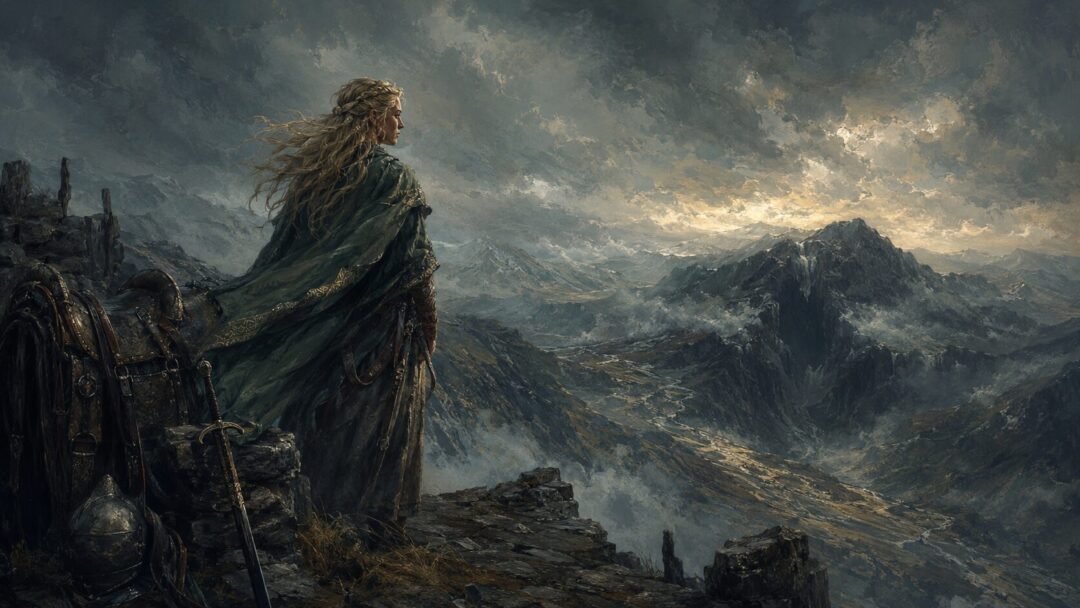
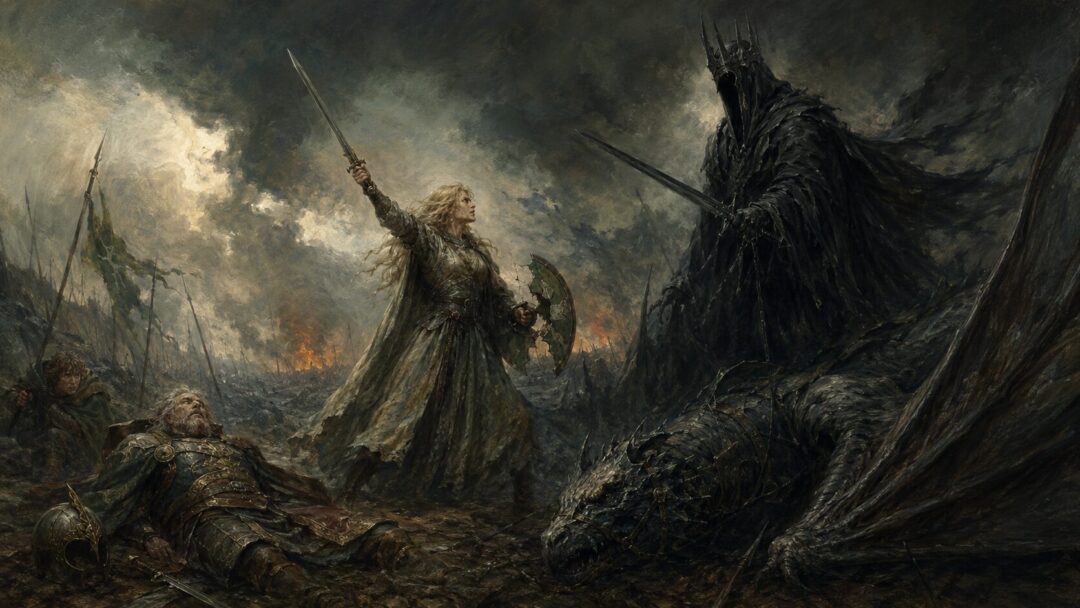
The Witch-king falls because Éowyn stands where almost anyone else would have fled. That is the moment everyone remembers: the black captain before the broken body of Théoden, the Nazgûl’s terror over the Pelennor, the hidden rider named Dernhelm revealing herself as Éowyn of Rohan. With Merry’s aid, she does what prophecy had long made seem impossible. No living man would slay the Lord of the Nazgûl; yet Éowyn was no man.
But the victory is darker than it first appears.
Éowyn did not ride to the Pelennor simply because she expected glory. She rode because, by her own later confession, she had looked for death in battle. Her greatest triumph came from a place dangerously close to despair. That is why her story is not merely about courage, nor only about a woman denied a warrior’s place. It is about a soul so starved of hope that death begins to look like freedom — and how Middle-earth turns that death-wish into an unexpected road back to life.
The Cage Before the Battlefield
Éowyn’s despair begins long before she puts on the disguise of Dernhelm.
When she appears in Rohan, she is not merely a noble lady waiting in a golden hall. She is the niece of Théoden, sister of Éomer, daughter of Éomund and Théodwyn, and a woman of the House of Eorl. Her bloodline belongs to riders, battles, duty, and songs of renown. Yet her actual life has narrowed around sickness, waiting, and restraint.
Her most revealing answer comes when Aragorn asks what she fears. She does not say pain. She does not say death. She says a cage: to remain behind bars until age and habit accept them, and until the chance of great deeds has vanished beyond recall or desire. That line matters because it shows that Éowyn’s terror is not merely being kept indoors. It is the slow death of the will.
She fears becoming someone who no longer even wants freedom.
This is why her argument with Aragorn cuts so deeply. When he tells her that her duty is with her people, she hears the old command beneath noble language: men may ride to honour, while she must remain in the house. She even gives the bitterest form of that thought — when the men have died in battle and honour, she will have leave to be burned in the house, because the men will need it no more.
That is not calm political complaint. It is a cry from someone who believes every path left to her ends in erasure.
Wormtongue’s Poison Was Not Only for Théoden
Éowyn’s suffering is made worse by the corruption inside Meduseld. Gríma Wormtongue is remembered mainly as the counsellor who helped bend Théoden’s mind under Saruman’s influence. But the text also implies that his poison reached Éowyn.
Gandalf’s words after Théoden’s restoration are crucial. He asks whether Wormtongue had poison only for Théoden’s ears, then imagines the kind of contempt Gríma may have wrapped in “more cunning” terms at home. Gandalf then says that Éowyn’s love for Éomer and her duty restrained her lips, but wonders what she spoke to the darkness alone when her life seemed shrinking and the walls of her bower closed around her like a hutch for a trapped wild thing.
That image is one of the bleakest descriptions of Éowyn in the book. She is not weak. She is caged strength. She is a wild thing made to wait while her house decays, her uncle withers, her brother is endangered, and a servant of Saruman whispers rot into the halls.
The texts do not give us every private word Wormtongue spoke to her, and they do not fully open Éowyn’s inner thoughts in those nights. But they do strongly imply that her despair was not sudden. It was cultivated by isolation, political decay, gendered restriction, and proximity to a hidden enemy.
Her longing for battle grows in that soil.
Why Aragorn Looked Like Escape
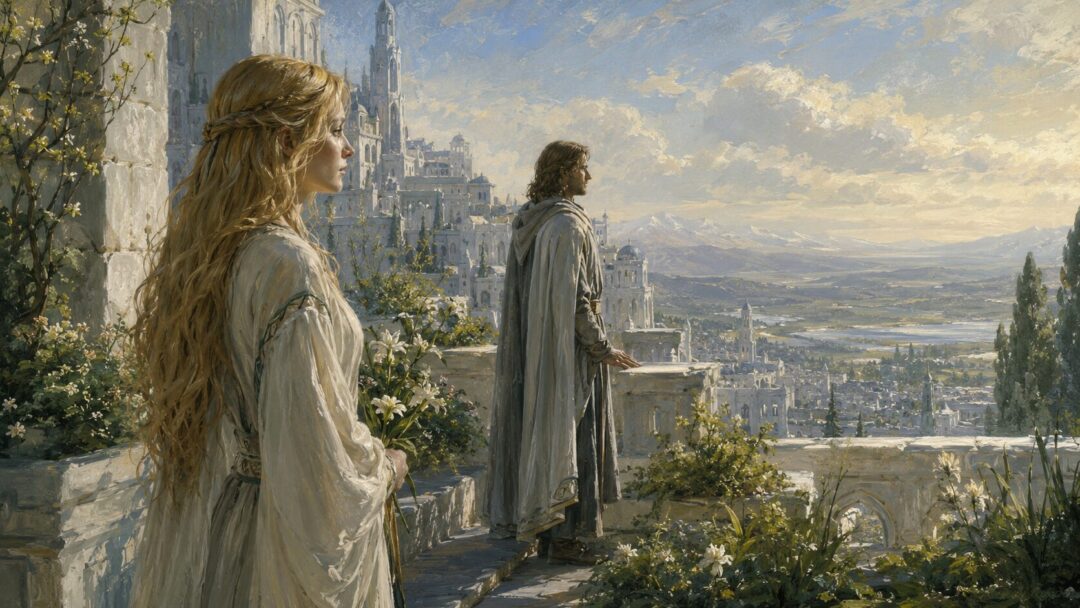
Éowyn’s feelings for Aragorn are often reduced to romance, but that is too small. Aragorn appears to her at a moment when Rohan’s honour seems nearly lost. He comes as a healer of the king, a companion of Gandalf, a lordly figure out of legend, and later as the heir moving toward a perilous destiny.
To Éowyn, Aragorn seems to represent everything denied to her: freedom, command, high purpose, motion, and a life spent in deeds that songs might remember.
That does not mean her feelings are false. But the text itself frames them carefully. In the Houses of Healing, Aragorn says that in him she loves “only a shadow and a thought.” This is not contempt. It is diagnosis. Éowyn does not truly know Aragorn’s long burden, his love for Arwen, or the full nature of his road. She sees in him an image of the life she cannot reach.
When he refuses to take her with him on the Paths of the Dead, her hope is struck again. She has already watched others ride away to danger and renown. Now the one figure who seemed to embody escape tells her that she has no errand to the South.
Aragorn’s refusal is not cruelty; he is bound by duty and by Théoden’s command. But emotionally, for Éowyn, it confirms the cage. Every door opens for others. Every road closes for her.
Dernhelm Was Courage — and Despair
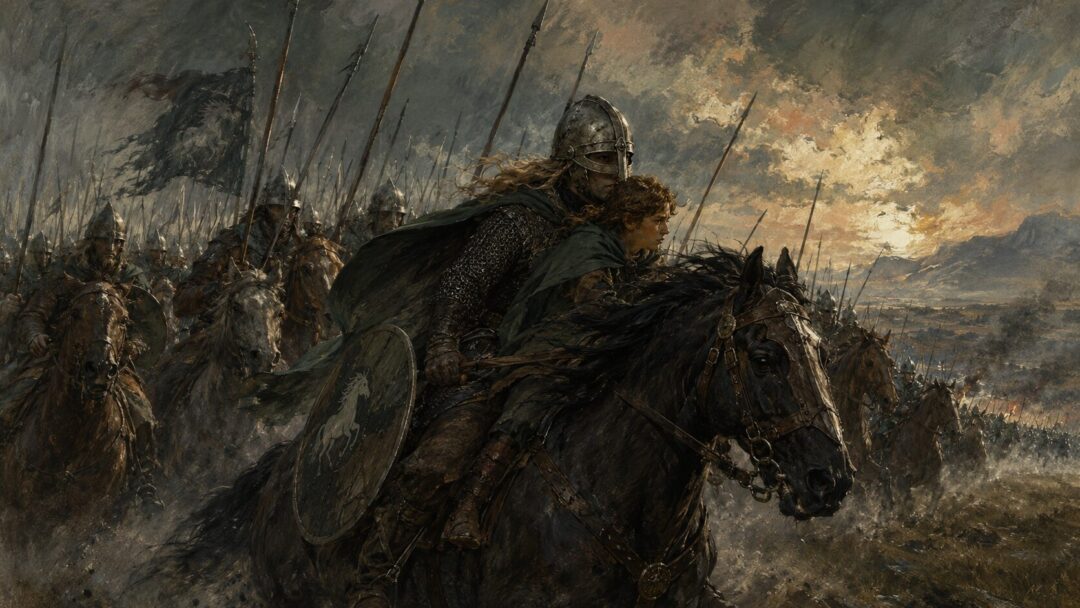
Éowyn’s disguise as Dernhelm is one of the boldest acts in The Lord of the Rings. It is also morally complicated. Théoden had entrusted her with the leadership of the people left behind. By riding secretly to war, she disobeys that charge. Yet the story does not treat her simply as rebellious or selfish. It allows the reader to see both truths at once.
She is brave. She is desperate.
She takes Merry with her, another person told to remain behind because he is considered too small for the great deeds ahead. Their pairing matters. Neither belongs, according to the visible rules of heroic warfare. Both are overlooked. Both become essential.
When Éowyn finally stands before the Witch-king, her courage is real. She does not merely stumble into destiny. She places herself between the Lord of the Nazgûl and Théoden, her lord and kin. She reveals herself not to win applause, but to declare that the enemy may not touch the fallen king while she still lives.
Yet the shadow behind the act remains. She has already been seeking death. This makes her stand more tragic, not less heroic. In that moment, she is willing to spend her life because she has almost ceased to value it for herself. The wonder of the scene is that this broken willingness becomes the means by which a great evil is overthrown.
Middle-earth often turns small, rejected, or wounded people into instruments of providence. Merry’s blade, taken from the Barrow-downs, helps undo the Witch-king’s protection. Éowyn’s defiance completes the fall. Neither alone would have done it. Together, the overlooked pierce the invincible.
Victory Did Not Heal Her
The deepest proof that Éowyn wanted death before victory comes after the battle.
If slaying the Witch-king were enough to heal her, her story would end in triumph. Instead, she is brought to the Houses of Healing, cold and wounded by the Black Breath. Her body has survived, but her spirit remains turned toward death.
When she wakes, she is not content. She tells Faramir that she cannot lie idle and caged. She says plainly that she looked for death in battle, but has not died, and battle still goes on. Later she says she does not desire healing. She wants to ride to war like Éomer, or better like Théoden, because Théoden died with honour and peace.
That is the terrible phrase: honour and peace.
For Éowyn, death has become not only a way to prove herself, but a way to rest. She does not envy Théoden merely because he has glory. She envies him because the struggle is over for him. Her victory over the Witch-king has not yet answered the wound that drove her to battle.
This is why the Houses of Healing are more than an infirmary. They are the place where the story separates physical survival from true healing. Aragorn can call her back from the edge of death with the kingly hands of healing, but he cannot simply command her to want life. That change must come more slowly.
Faramir Sees the Wound Beneath the Steel
Faramir’s role is often misunderstood if read as a simple romantic reward. His importance is not that he domesticates Éowyn or proves that marriage was her “proper” ending. His importance is that he sees her clearly.
He does not mock her desire for war. He does not treat her as childish. He recognizes someone who, like himself, has passed under the Shadow and been drawn back. Faramir is a soldier and a leader, but he is not intoxicated by battle. He has seen enough war to know its cost. That gives him the authority to answer Éowyn without belittling her.
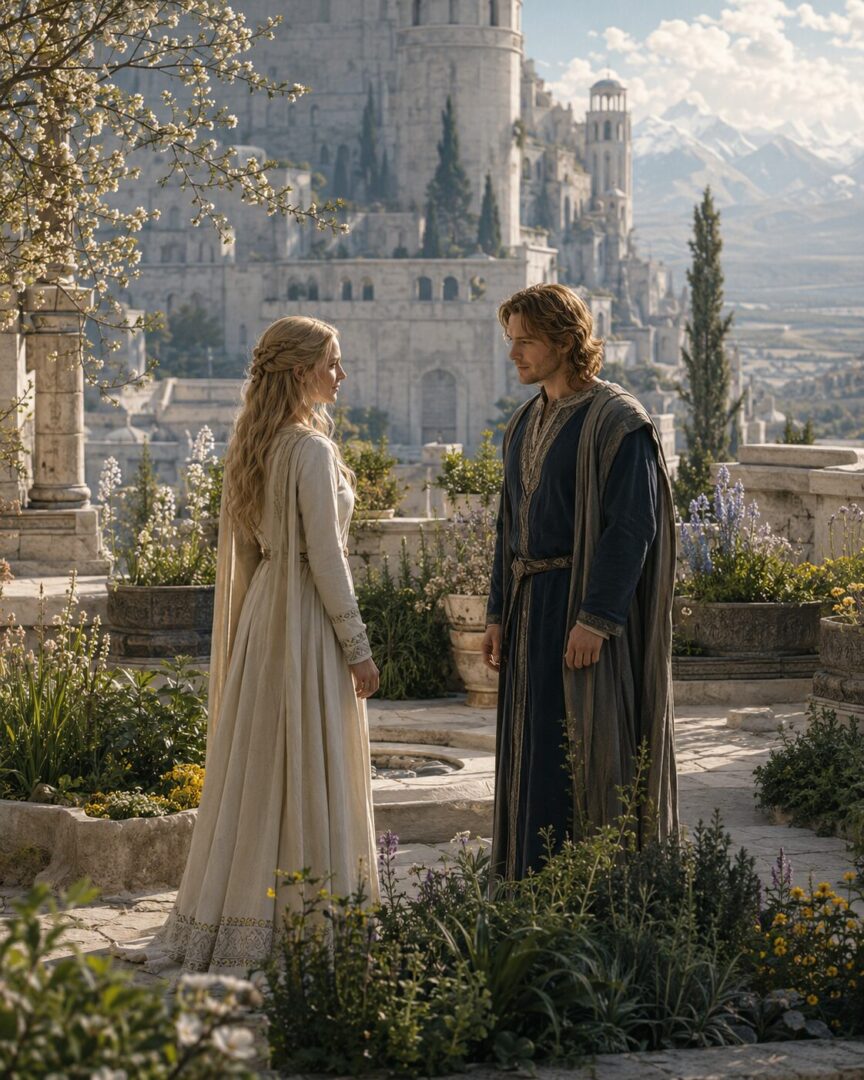
Their conversations shift the meaning of courage. Until then, Éowyn has imagined honour mainly through the songs of riders and the deaths of kings. Faramir offers another kind of nobility: endurance, mercy, rebuilding, stewardship, and choosing life after grief.
This is not an instant cure. Éowyn’s heart changes gradually, as the Shadow passes, as the wind turns, and as hope returns to the world. When she finally says that she will be a shieldmaiden no longer, nor take joy only in songs of slaying, and that she will be a healer and love growing things, the change is not surrender. It is release.
She is not accepting the cage. She is refusing the lie that only death in battle can make her life meaningful.
The Victory She Did Not Expect
Éowyn’s greatest victory is not only the fall of the Witch-king. It is that she survives the part of herself that wanted to die.
That does not diminish her battlefield deed. If anything, it makes it more powerful. She stands against the Lord of the Nazgûl while carrying her own inner darkness. She is not fearless because she is untouched by despair. She is brave because despair has already wounded her, and still she acts for love of Théoden, loyalty to her house, and defiance of evil.
Her story also complicates the heroic ideal of Rohan. The songs of slaying are not condemned outright; Théoden’s ride is noble, Éomer’s fury is terrible and great, and Éowyn’s stand is worthy of remembrance. But the story refuses to let battle be the only form of glory. Death may bring honour in some moments, but seeking death is not the same as finding purpose.
Éowyn wanted death because life had become a cage. She found victory because, at the edge of that darkness, she still loved enough to defend another. And she found healing when she discovered that freedom did not have to mean dying gloriously on a field of spears.
It could mean living beyond the battle.
It could mean growing things in a land wounded by war.
It could mean becoming not less than a warrior, but more than one.
Sources & Notes
- Tolkien Gateway overview of Eowyn and her despair, disguise as Dernhelm, and later healing. https://tolkiengateway.net/wiki/%C3%89owyn
- Tolkien Gateway entry for Dernhelm, Eowyn’s battle identity at the Pelennor Fields. https://tolkiengateway.net/wiki/Dernhelm
- Tolkien Gateway summary of The Houses of Healing, where Eowyn’s desire for death is named and turned toward life. https://tolkiengateway.net/wiki/The_Houses_of_Healing
Sources selected to support the Tolkien textual/lore context discussed in this article.