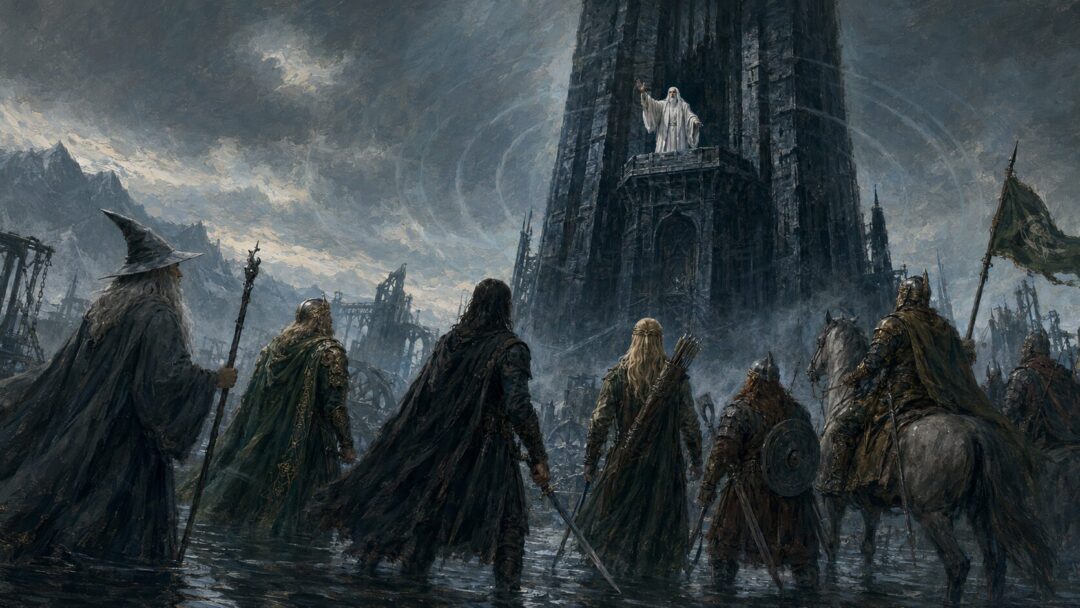
Orthanc is already beaten when Saruman becomes most frightening.
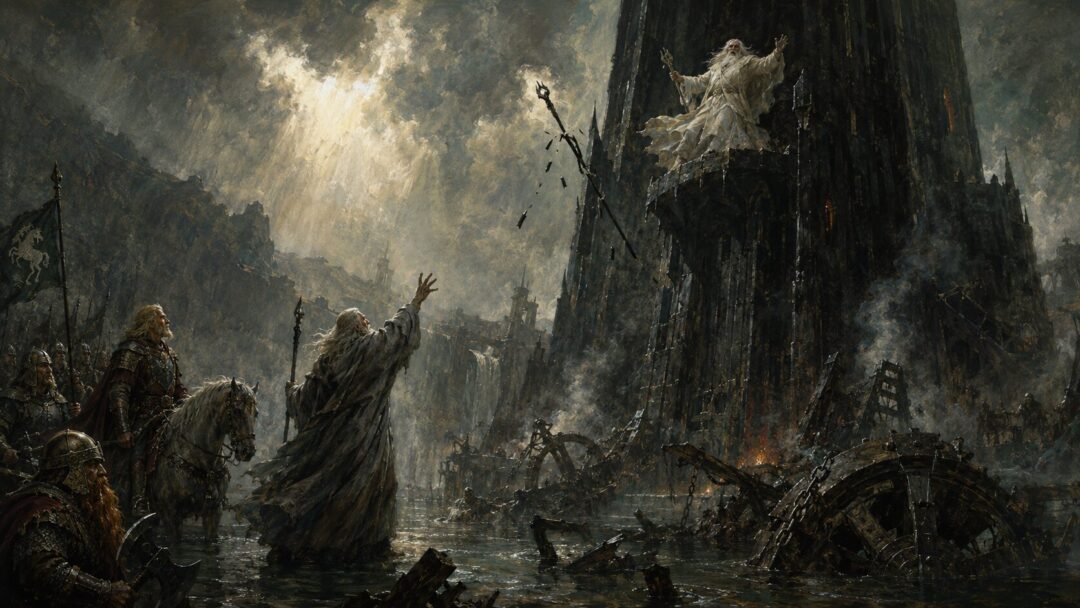
His armies have been broken. Isengard has been drowned by the Ents. The pits, forges, wheels, and engines that fed his war against Rohan lie ruined. The Orcs and Men he sent against Helm’s Deep are gone. By ordinary military logic, Saruman should be finished.
And yet Gandalf does not treat the meeting at Orthanc as a simple victory parade. He warns Théoden, Aragorn, Legolas, Gimli, and the riders that Saruman still possesses a power they should not underestimate: his voice. The chapter itself is named for that danger. Saruman’s most lethal weapon is not a sword, a siege engine, or an Orc-host. It is the ability to make surrender sound like wisdom.
That is why his voice is more dangerous than his Orcs. Orcs can kill men. Saruman’s voice can persuade men to betray themselves.
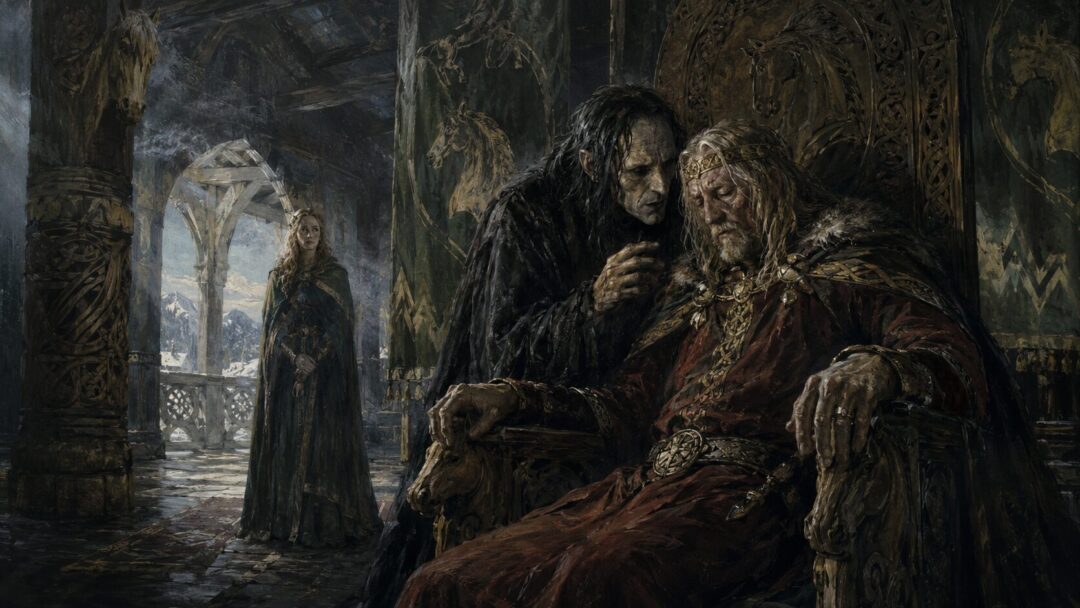
The Power That Survived Isengard
The destruction of Isengard removes Saruman’s outer strength, but not his inner corruption. His armies are visible. His voice is intimate. It enters through judgment, pride, pity, fear, and the desire to seem reasonable.
At Orthanc, Gandalf warns the company before Saruman speaks. Tolkien Gateway’s summary of the chapter notes that Gandalf warns them of Saruman’s voice, and that when Saruman appears, his speech sounds extraordinarily sweet and persuasive. The scene is not presented as ordinary conversation; everyone approaches it as a spiritual and moral danger.
The Encyclopedia of Arda describes Saruman’s voice as his most notable power, one that could make him seem wise and rational, especially to a single listener, though it was not limitless. encyclopedia-of-arda.com That last point matters. Saruman is not simply hypnotizing crowds. His voice works by appealing to things already inside the hearer: fear, resentment, weariness, ambition, and the longing for an easier path.
That makes it more insidious than brute force. A soldier can recognize an Orc rushing at him with a blade. A king listening to Saruman may believe he is being offered peace, dignity, and practical sense.
He Does Not Command First — He Reframes
Saruman’s method is not to begin with obvious threats. He begins by changing the moral shape of the situation.
To Théoden, he does not speak as a defeated traitor begging mercy. He presents himself as a wronged neighbor, a potential ally, almost a wounded friend. He tries to make the war seem like a misunderstanding that reasonable men might put behind them. The purpose is not merely to escape punishment. The purpose is to make Théoden doubt the justice of his own awakening.
That is the true danger of the voice. It does not only say, “Do this.” It says, “You have misread everything.” Saruman wants Théoden to reinterpret his own suffering, the wasting of Rohan, the counsel of Gríma, the death and peril of his people, and the war against Isengard as something that can be smoothed over by Saruman’s superior wisdom.
This is why the voice attacks memory. Théoden’s resistance matters because he remembers what Saruman’s “friendship” has cost. He does not answer as a strategist calculating advantage; he answers as a king who has finally seen through the language of decay.
Saruman’s Orcs assaulted the Hornburg. His voice tries to assault Théoden’s recovered sanity.
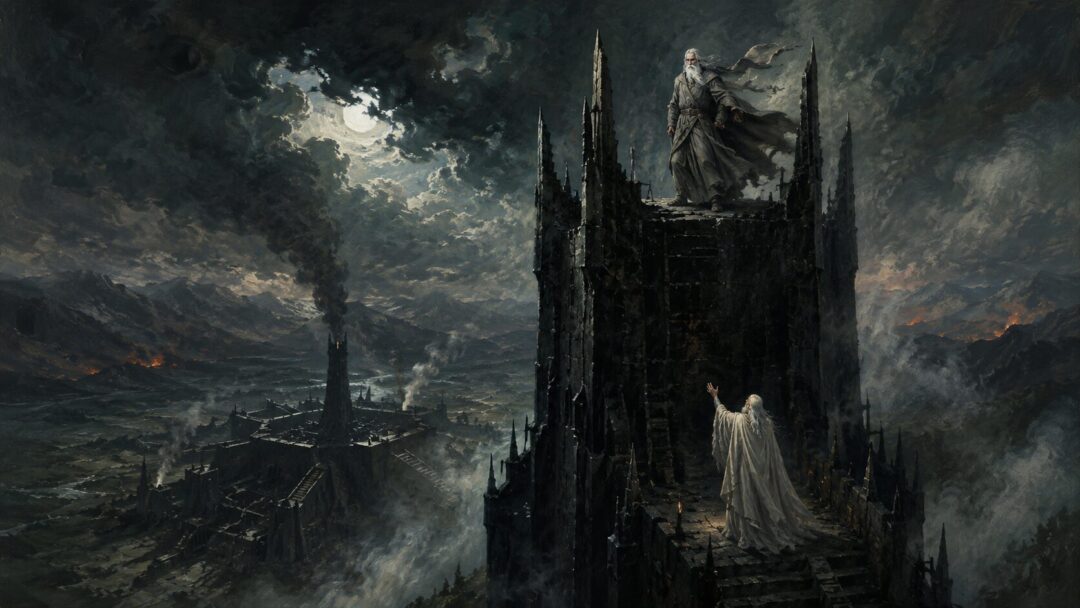
Wormtongue Was the Voice in a Smaller Room
Saruman’s power over Rohan did not begin at Orthanc. It had already been working in Meduseld through Gríma Wormtongue.
Gríma is not Saruman, but he is Saruman’s method made domestic. He does not conquer Edoras with soldiers. He whispers, advises, delays, discourages, and interprets the world for Théoden. The king is surrounded not by chains but by counsel.
The texts are careful here. In The Two Towers, Théoden’s decline is bound up with Gríma’s words and influence. Unfinished Tales adds the possibility that Théoden’s weakened state was induced or increased by subtle poisons administered by Gríma, so the corruption is not purely verbal. But the emotional pattern remains clear: Saruman’s rule over Rohan is achieved by making action feel hopeless and trust feel foolish.
That is more dangerous than an army because it prevents resistance before battle begins. A king who rides to war may win or lose. A king convinced that nothing can be done has already surrendered.
Gríma’s name, Wormtongue, captures the horror perfectly. The weapon is not strength. It is speech turned parasitic.
Saruman’s Voice Is the Corruption of Wisdom
Saruman is especially dangerous because he was not ignorant. He was one of the Wise. He understood lore, craft, politics, and the devices of power. His fall is not the fall of a fool into crude evil; it is the fall of wisdom into domination.
That is why his arguments are so poisonous. He rarely sounds like a monster to himself. At the Council of Elrond, Gandalf recounts Saruman’s earlier temptation: the idea that the Wise might use power, wait, manage events, and perhaps rule “for good” until good becomes indistinguishable from control. Saruman’s rhetoric turns patience into compromise, prudence into cowardice, and wisdom into a claim of ownership over others.
His voice is therefore the audible form of his fall. He does not simply want obedience. He wants agreement. He wants the listener to feel clever for yielding.
This is where Saruman differs from the simpler terror of Orcs. Orcs can terrify the body. Saruman flatters the mind. He makes domination sound mature. He makes mercy sound naïve. He makes loyalty sound provincial. He makes treachery sound like realism.
That is why his voice is so dangerous to leaders. A common soldier may need courage to face Orcs. A king, steward, captain, or wizard needs humility to resist Saruman.
Why Gimli and Éomer Matter
The Orthanc scene is also important because Saruman’s voice does not work equally on everyone.
Gimli is not taken in. Éomer is not taken in. Théoden is tempted, or at least tested, but he overcomes the appeal. Gandalf allows the encounter to unfold because Théoden must answer for himself. Tolkien Gateway’s summary preserves that structure: Saruman speaks to Théoden, Gandalf lets Théoden make his own choice, and Théoden eventually rejects him.
This is not a magical duel in which Gandalf simply blocks a spell. It is a moral trial. Saruman’s voice can bend perception, but it cannot erase character entirely. Gimli’s bluntness, Éomer’s loyalty, and Théoden’s recovered kingship all become defenses.
That detail keeps the scene from becoming mere enchantment. Saruman is not irresistible. He is persuasive. The difference is crucial. If he were irresistible, his victims would bear no moral burden. But because his voice works through consent, even weakened consent, the scene becomes more frightening. He offers people a version of evil they can accept while still believing themselves reasonable.
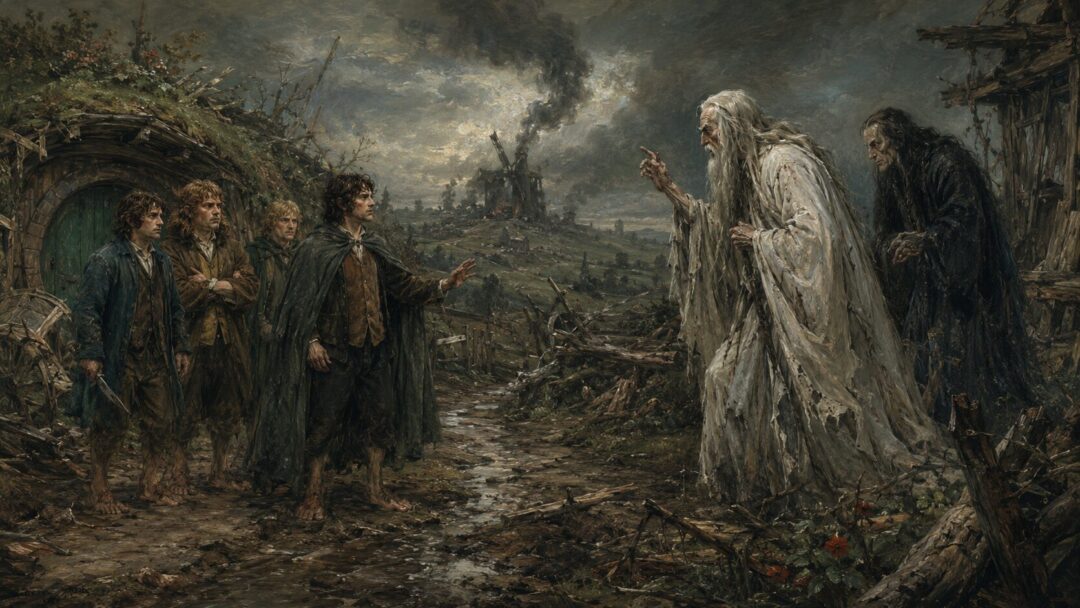
Gandalf Breaks More Than a Staff
When Gandalf finally speaks with authority, the confrontation changes. He does not merely debate Saruman. He summons him, gives him a chance to come down, and when Saruman refuses, Gandalf casts him from the order and breaks his staff.
This is the true end of Saruman the White. His military defeat has already happened, but his spiritual demotion happens here. The staff is a visible sign, but the deeper loss is authority. Saruman has used wisdom as a mask for possession; Gandalf answers with judgment.
Immediately afterward, Wormtongue throws down the palantír from Orthanc. Gandalf recognizes it as a great treasure, and the next chapter turns toward its danger. Tolkien Gateway notes that the stone thrown from Orthanc was one of the seven palantíri and that it had allowed Saruman to communicate with Sauron.
This matters because Saruman’s voice and the palantír belong to the same pattern. Both involve vision twisted by pride. Both promise knowledge while narrowing freedom. Both make the user believe he is mastering events, even as he becomes trapped by them.
The Voice After Power Is Gone
Saruman’s later appearance in the Shire proves the point again. By then he has lost Isengard, his staff, his rank, and his former grandeur. Yet he still causes harm.
In the Scouring of the Shire, he does not return as a great warlord. He returns as “Sharkey,” working through ruffians, rules, fear, spite, and petty domination. The scale is smaller, but the pattern is recognizable. Saruman’s evil has always been administrative as much as military. He loves systems that make others smaller.
This is why the Shire episode is not an anticlimax in moral terms. It shows what remains of Saruman when the grand machinery is stripped away: not greatness, but malice; not power for a noble purpose, but the pleasure of spoiling what others love.
His voice is no longer majestic in the same way, but he still tries to curse, shame, and wound. Frodo’s mercy reveals how diminished he has become. Saruman can still speak poison, but he can no longer command the future.
The Most Dangerous Lie in Middle-earth
Saruman’s Orcs were deadly because they were violent. His voice was deadly because it made violence seem reasonable before it arrived.
It persuaded kings to delay. It used servants to weaken households. It offered alliances that were really submissions. It clothed cowardice in prudence and ambition in wisdom. It did not always force people to obey; often it tempted them to agree.
That is the deeper horror of Saruman. He is not merely a maker of armies. He is a maker of excuses.
Against Orcs, Middle-earth needs courage, walls, swords, and riders. Against Saruman’s voice, it needs memory, humility, clear judgment, and the willingness to call evil by its name even when it speaks beautifully.
At Orthanc, the ruined wizard stands above his enemies with no army left to save him. Yet for a moment, the danger is still real. Not because he can storm another fortress, but because he can still make free people wonder whether freedom is worth defending.
That is why Saruman’s voice was more dangerous than his Orcs. His Orcs could break a gate. His voice could open one from the inside.
Sources & Notes
- Tolkien Gateway overview of Saruman, whose chief danger after military defeat remains persuasion and domination. https://tolkiengateway.net/wiki/Saruman
- Tolkien Gateway summary of The Voice of Saruman, the chapter focused on the power of his speech. https://tolkiengateway.net/wiki/The_Voice_of_Saruman
- Tolkien Gateway overview of Orthanc, the setting of Saruman’s failed attempt to master his listeners by voice. https://tolkiengateway.net/wiki/Orthanc
Sources selected to support the Tolkien textual/lore context discussed in this article.