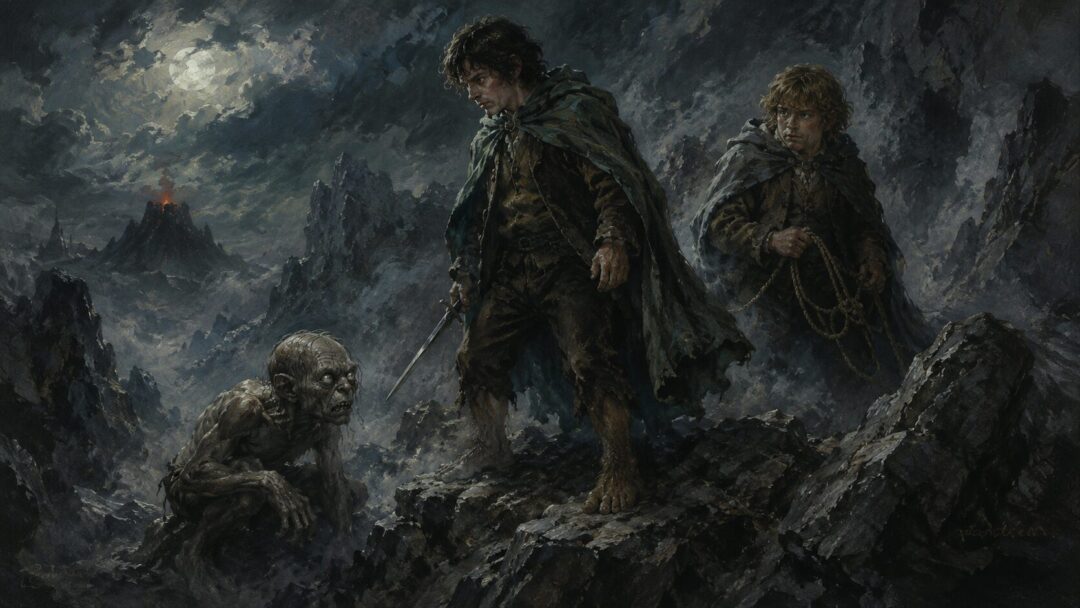
In the dark of the Shire, before Frodo ever saw Mordor, the Ring’s story already carried one uncomfortable question: why was Gollum still alive?
Bilbo had once stood over a miserable creature in the tunnels beneath the Misty Mountains, sword in hand, and chose not to strike. Years later, Frodo hears that choice explained not as weakness, but as pity and mercy. At first, Frodo does not welcome the lesson. Gollum seems vile, treacherous, and dangerous. He murdered Déagol for the Ring. He haunted the margins of the Quest. He would later betray Frodo and Sam to Shelob. No simple reading can turn him into an innocent victim.
And yet The Lord of the Rings places Frodo’s mercy toward Gollum at the moral center of the Quest. Not because Frodo is naïve. Not because he mistakes evil for harmlessness. Not because he refuses to see danger. Frodo’s mercy matters precisely because he sees more clearly than most what Gollum is—and still refuses to make killing him easy.
That is not softness. It is one of the hardest acts of judgment in the story.
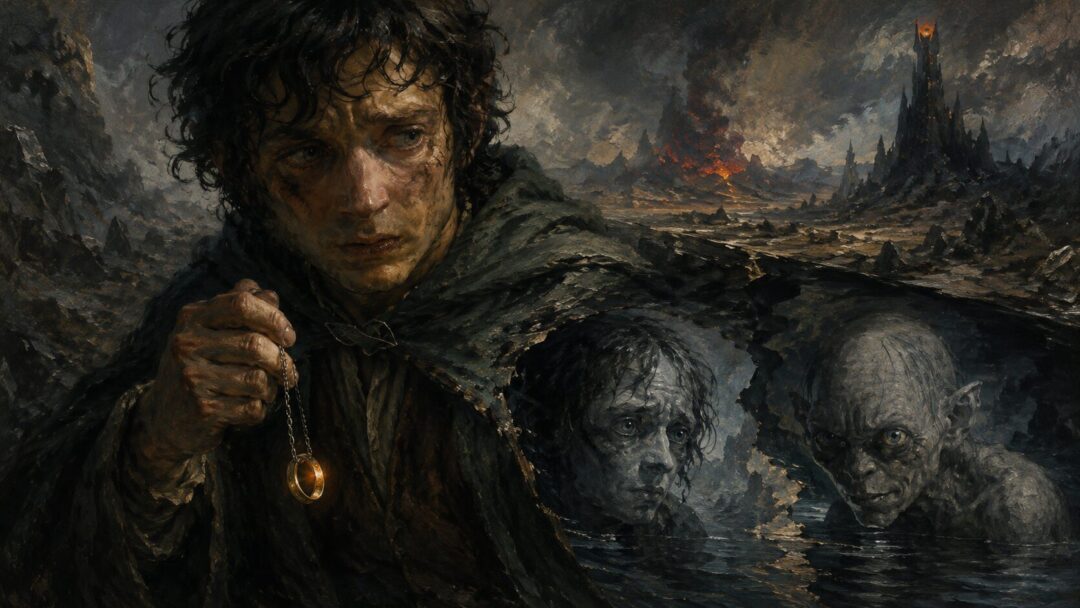
Mercy Begins Where Hatred Would Be Easier
Frodo’s first instinct toward Gollum is not tenderness. In “The Shadow of the Past,” he reacts with revulsion and anger when he learns how the Ring came from Sméagol to Bilbo. Gandalf’s warning is not that Gollum is secretly good, or that Frodo should ignore evil. The warning is deeper: many deserve death, but even the wise cannot see all ends.
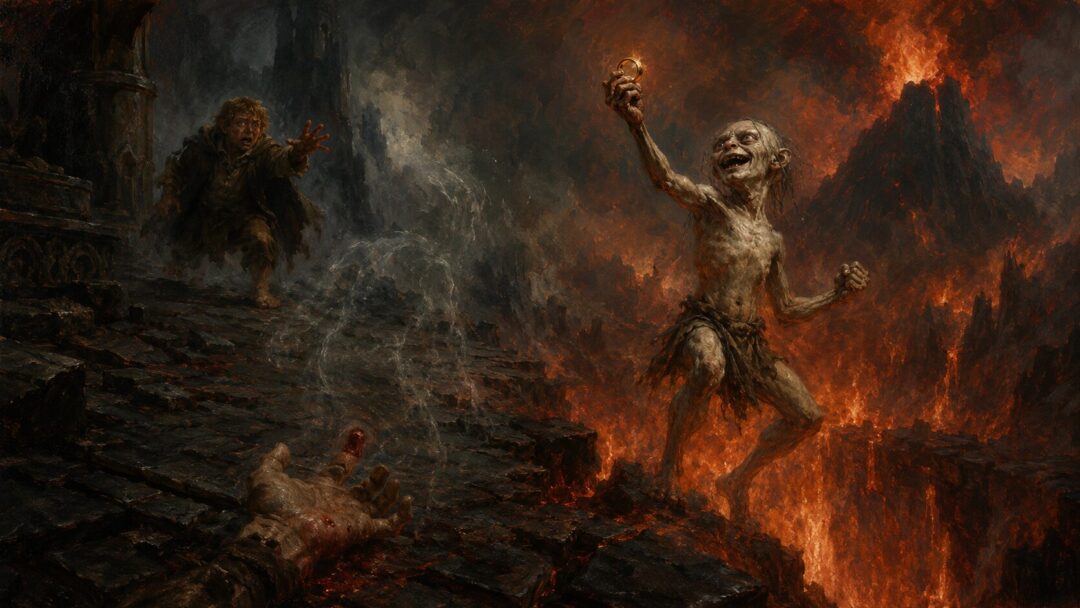
That distinction matters. Gandalf does not deny guilt. He does not ask Frodo to pretend Gollum is safe. He asks Frodo to resist the intoxicating certainty that death is the only meaningful answer. The tale later proves that this restraint is not sentimental. Gollum’s survival becomes one of the hidden conditions by which the Ring is destroyed at the Cracks of Doom, where Frodo claims the Ring and Gollum bites it from his hand before falling with it into the fire.
Mercy in this story is not the refusal to judge. It is the refusal to assume that judgment belongs wholly to oneself.
Frodo Does Not Trust Gollum Blindly
One of the strongest arguments against calling Frodo “soft” is that he never treats Gollum as harmless. When Gollum attacks Frodo and Sam in the Emyn Muil, Frodo helps subdue him. He questions him. He compels him to swear by the Precious, but he also warns him against swearing on it. Tolkien’s text presents Frodo as suddenly stern in that moment, and Sam is startled by the authority in his master’s voice.
This is not a gentle rescuer being fooled by a lost creature. It is a Ring-bearer recognizing a creature enslaved to the same power that is now working on him.
Frodo’s mercy is therefore disciplined. He releases Gollum from immediate harm, but he does not release him into complete freedom. Gollum becomes their guide because Frodo sees both the danger and the necessity. The route to Mordor is deadly, and the hobbits do not know the way. Reputable summaries of “The Taming of Sméagol” preserve this essential pattern: Gollum is captured, constrained, made to swear, and then used as a guide toward Mordor.
That is the opposite of foolish softness. Frodo chooses a narrow path between cruelty and gullibility.
Mercy Is Harder Because Frodo Understands Corruption
Frodo’s pity for Gollum grows as the Quest darkens because Frodo begins to understand him from the inside. This is one of the great tragic ironies of the Ring. At Bag End, Gollum can seem like a distant monster. By the time Frodo reaches the Dead Marshes and the road to Mordor, Gollum is no longer merely “other.” He is a warning.
Frodo knows that Gollum was once Sméagol. He knows that the Ring did not create evil out of nothing, but it found weakness, desire, secrecy, possessiveness, and fear—and magnified them. Frodo never becomes Gollum, but he comes close enough to recognize the shared abyss. That recognition does not erase moral responsibility. Gollum still chooses treachery. But Frodo’s mercy rests on a terrible humility: under the Ring’s pressure, no bearer remains untouched.
This is why Frodo’s mercy cannot be reduced to kindness. It is knowledge. It is the mercy of someone who has stopped imagining himself safely above the fallen.
The Ring Makes Power Look Like Justice
The Ring is not merely a weapon. It tempts its bearers through the desire to control outcomes. For Boromir, it appears as a means to save Gondor. For Galadriel, if she accepted it, it would offer rule in a beautiful and terrible form. For Gandalf, he fears that the way of the Ring to his heart would be pity for weakness and the desire of strength to do good.
That last point is crucial. Even mercy can be corrupted if it becomes domination. Frodo’s treatment of Gollum sits close to this danger. When Gollum swears by the Precious, Frodo’s authority over him is bound up with the Ring itself. Later, near Mount Doom, Frodo speaks with a severity that seems more than ordinary anger. The text implies that oaths made by the Ring are perilous, and Gollum’s final fall can be read in light of his broken oath, though the story does not reduce the ending to a simple magical rule.
So Frodo’s mercy is not pure sweetness untouched by peril. It is morally dangerous because everything near the Ring becomes dangerous. Yet Frodo’s better choice remains clear: he refuses unnecessary killing. He refuses to become the kind of person who treats a ruined life as worthless simply because it is inconvenient.
Sam’s Suspicion Is Not Villainy
To understand Frodo’s mercy, we also have to be fair to Sam. Sam does not trust Gollum, and he has reason. Gollum is treacherous. He has stalked them. He eventually leads them toward Shelob. Sam’s harshness is not stupidity; it is protective love.
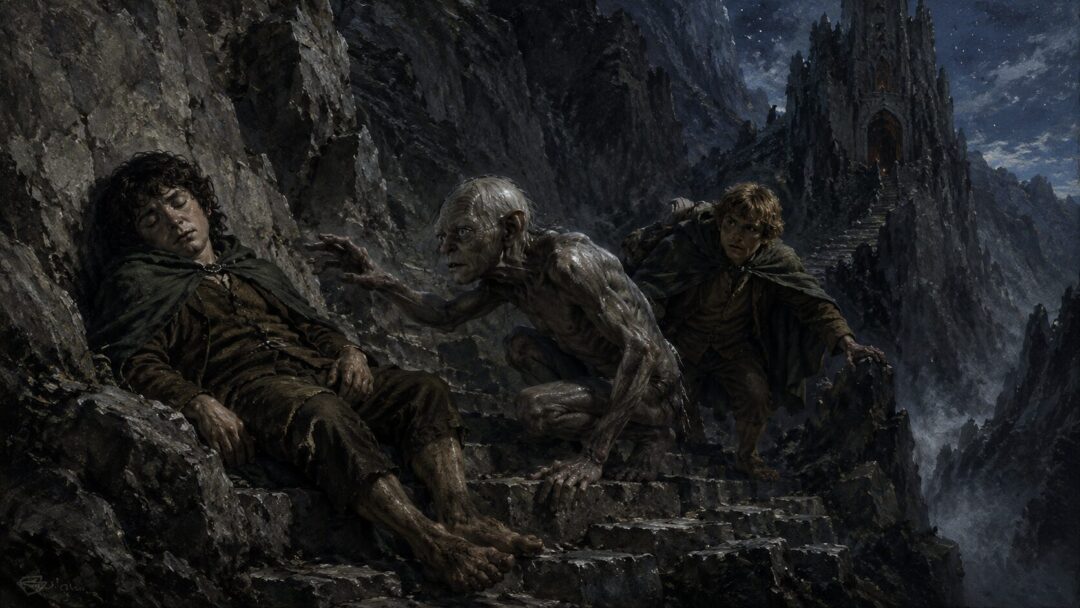
The tragedy is that Sam sees Gollum clearly in one way and not clearly in another. He sees the danger, but he struggles to see the remaining possibility of Sméagol. Frodo, burdened by the Ring, can perceive that possibility more painfully. The famous near-turning point on the stairs of Cirith Ungol—where Gollum finds Frodo asleep and has a brief moment of strange tenderness before Sam wakes and rebukes him—is one of the saddest scenes in the book. The text does not say Gollum would certainly have repented if Sam had spoken differently. It only shows that something fragile existed for a moment, and was lost.
That is where Frodo’s mercy becomes so costly. It does not guarantee redemption. It leaves room for it.
Mercy Does Not Save Frodo from Failure
The deepest reason Frodo’s mercy is not softness is that the story does not reward him with an easy victory. At the Cracks of Doom, Frodo fails to cast the Ring away. He claims it. This is essential. The destruction of the Ring does not happen because Frodo is morally flawless. It happens because a long chain of pity, restraint, endurance, and providential-seeming consequence has brought Gollum to that place at that hour.
Gollum’s survival is not a decorative moral lesson. It is structurally necessary. Had Bilbo killed him, had Frodo killed him, had Sam killed him at the last moment on the slopes of Orodruin, the final scene would be different. The Quest succeeds through a mercy that did not look practical when it was given.
This does not mean Frodo “used” mercy as a strategy. He could not foresee the end. That is the point. Mercy is not valuable because it gives the merciful person control. It is valuable because it refuses total control.
The Scouring Shows Mercy After the Ring
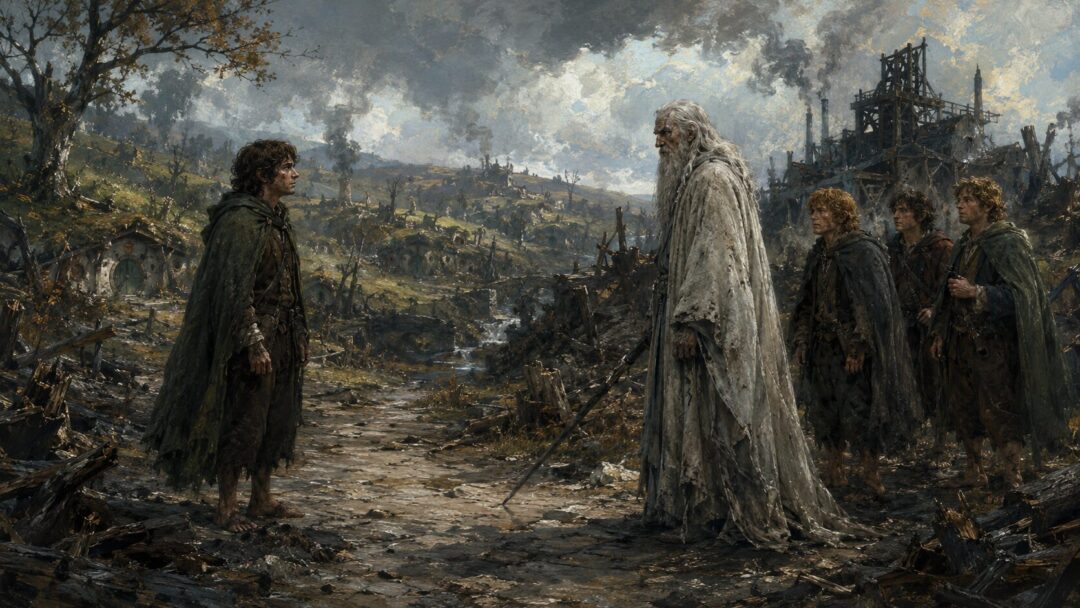
Frodo’s mercy does not end with Gollum. When the hobbits return to the Shire and face Saruman, Frodo again resists vengeance. The Shire has been damaged. Trees have been cut. Homes and habits have been violated. Saruman is diminished, spiteful, and still venomous. Yet Frodo does not want him killed. In summaries of “The Scouring of the Shire,” Frodo’s clemency toward Saruman stands out as one of his final moral acts before Saruman’s death at Wormtongue’s hand.
This scene proves that Frodo’s mercy is not only a response to Gollum’s usefulness. Saruman is not needed as a guide. He offers no path into Mordor. Frodo’s restraint comes from what he has become through suffering. He has seen too much domination, too much revenge, too much will imposed by force. He will not bring that spirit home if he can help it.
Yet this mercy is not passivity. The Shire is still freed. The ruffians are confronted. The damage is named. Frodo’s mercy does not mean evil is allowed to rule. It means that even after victory, he refuses to let hatred decide what justice must look like.
The Strength to Leave Room
Frodo’s mercy is often misunderstood because modern readers can mistake hardness for strength. In Middle-earth, the harder thing is often restraint: Faramir refusing the Ring, Gandalf refusing to take it, Galadriel refusing domination, Bilbo sparing Gollum, Frodo sparing Gollum, and Frodo sparing Saruman.
These choices do not deny evil. They resist becoming its mirror.
Frodo’s mercy is not soft because it costs him certainty. It costs him safety. It costs him the comfort of despising Gollum as a thing rather than a person. It does not spare Frodo from wounds, failure, or exile from the ordinary happiness of the Shire. But it preserves something the Ring cannot understand: the belief that a ruined creature is still not merely an object to be used or erased.
At the end, Frodo does not conquer the Ring by superior force. He endures as far as he can, and the mercy he and Bilbo once gave becomes part of the world’s deliverance. That is why his mercy matters. It is not softness. It is the last strength left when power has become too dangerous to trust.
Sources & Notes
- J.R.R. Tolkien, The Hobbit, Chapter 5, “Riddles in the Dark” — Bilbo spares Gollum when killing him would be easy.
- J.R.R. Tolkien, The Fellowship of the Ring, Book I, Chapter 2, “The Shadow of the Past” — Gandalf explains pity, mercy, and the limits of judging who deserves death.
- J.R.R. Tolkien, The Two Towers, Book IV, Chapter 1, “The Taming of Sméagol” — Frodo subdues, questions, and binds Gollum without treating him as harmless.
- J.R.R. Tolkien, The Two Towers, Book IV, Chapter 8, “The Stairs of Cirith Ungol” — Gollum’s fleeting tenderness and Sam’s interruption frame the tragedy of lost repentance.
- J.R.R. Tolkien, The Return of the King, Book VI, Chapter 3, “Mount Doom” — Frodo claims the Ring, and Gollum’s survival becomes decisive in its destruction.
- J.R.R. Tolkien, The Return of the King, Book VI, Chapter 8, “The Scouring of the Shire” — Frodo’s clemency toward Saruman shows mercy after victory, not passivity.
- J.R.R. Tolkien, The Letters of J.R.R. Tolkien, Letter 246 — Tolkien reflects on Frodo’s failure, Gollum, and the providential effect of earlier pity.