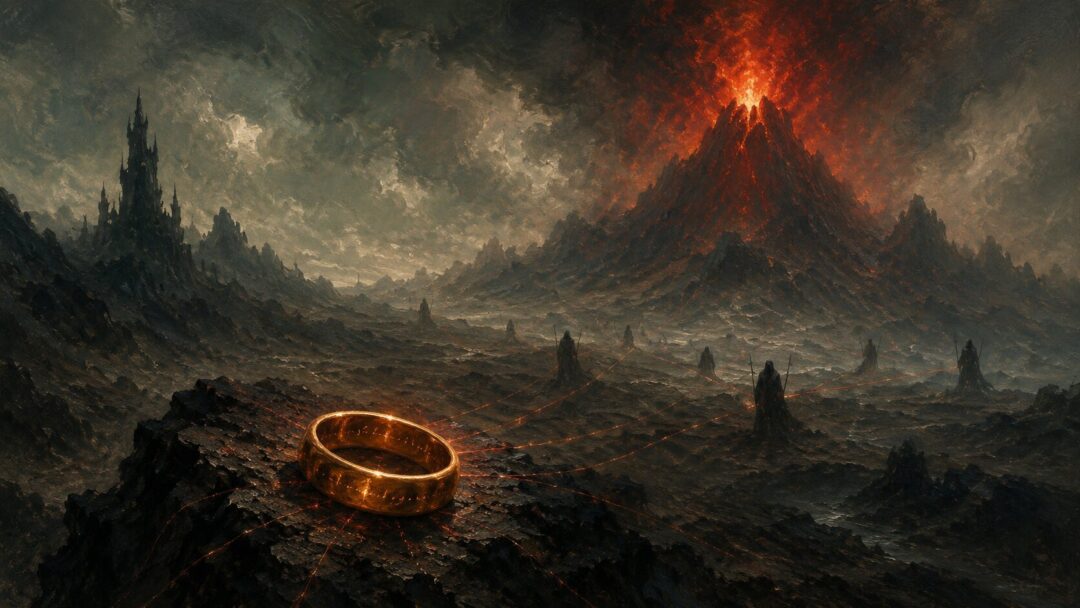
The One Ring is easy to mistake for a simple weapon: a golden answer to a dark lord’s hunger for strength. But its true terror is quieter. It is not a sword, a dragon, or a mountain-crushing spell. It is a system. It binds lesser rings, bends wills, links distant rulers to one master, and turns desire itself into a chain.
That is the key to understanding why Sauron’s evil feels different from Morgoth’s.
Morgoth, the first Dark Lord, was the greater being by origin. He began as Melkor, mightiest of the Ainur, and his rebellion wounded the world at a depth Sauron never matched. But by the later ages of Middle-earth, Sauron did not need to become a second Morgoth in raw cosmic power. He copied Morgoth’s role, symbols, and ambition, then adapted them to his own nature: order, craft, hierarchy, deception, and domination.
Sauron’s imitation was not an escalation of strength. It was a refinement of control.
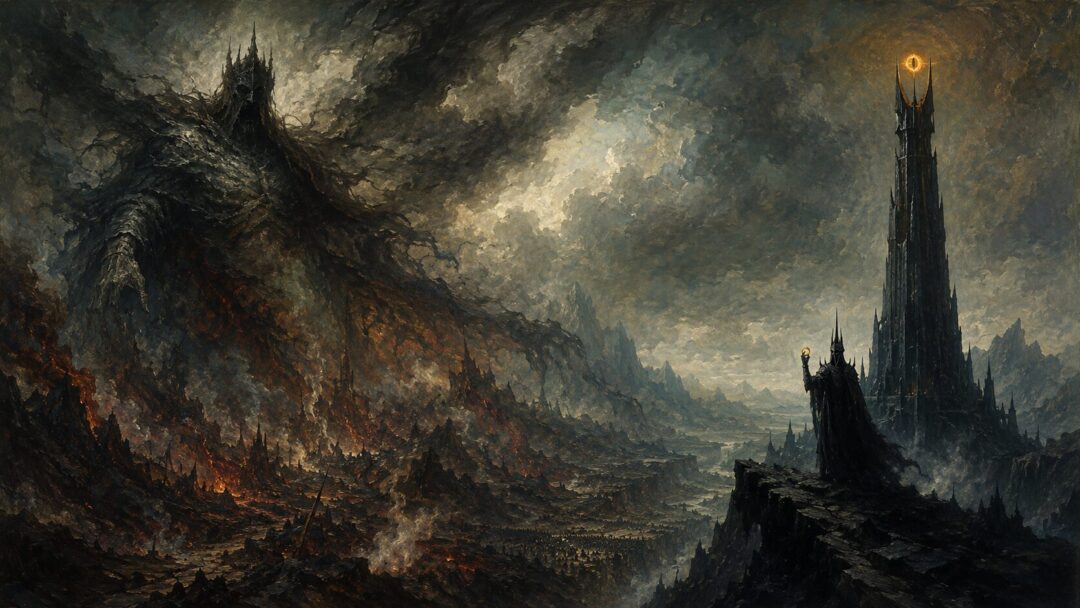
Morgoth Wanted to Mar the World Itself
Morgoth’s evil is vast because it begins before kingdoms, before Númenor, before the Rings, before even the familiar geography of Middle-earth. His rebellion is not merely political. It is metaphysical. He wants his own will to enter the Music, the world, matter, creatures, and history.
This matters because Morgoth’s power works by diffusion. He pours himself outward. He corrupts, twists, breeds fear, and stains the very substance of Arda. Later Tolkienian writings describe this idea through the famous concept that the whole of Middle-earth had become, in a sense, “Morgoth’s Ring”: not a literal ring, but a world infused with the residue of his rebellion.
That is why Morgoth’s power is both greater and more tragic than Sauron’s. He is more primal, more elemental, more destructive. Yet the very act of spreading his will into the world diminishes him. By investing himself into domination over matter and creatures, he becomes less able to act with the unspent might he once possessed.
Morgoth is the ruin beneath things. Sauron is the ruler who studies the ruin and asks how it can be administered.
Sauron Was Never Morgoth’s Equal
The texts do not present Sauron as Morgoth’s equal in origin. Sauron is a Maia, not one of the Valar. He is mighty among the servants of the Powers, but he begins on a lower order than Melkor. His greatness lies not in being the strongest spirit in existence, but in how efficiently he uses what he has.
That distinction is essential. Sauron does not become terrifying because he surpasses Morgoth’s original magnitude. He becomes terrifying because, after Morgoth is removed from the world, Sauron remains: concentrated, purposeful, and practical.
There is a narrow sense in which Sauron at his height can be described as more “effective” than Morgoth near the end of the First Age, because Morgoth had spent and dispersed so much of himself. But that does not mean Sauron rose above Melkor as he was in the beginning. It means Sauron’s power was less cosmic but more focused.
Morgoth was a fallen godlike rebel bleeding himself into the world. Sauron was the surviving lieutenant who learned that domination works best when every part of the machine answers to one will.
The Dark Lord as Administrator
One overlooked detail about Sauron is that his evil is not chaotic in the ordinary sense. Before his fall, he was associated with order, planning, and craft. His corruption does not erase that nature; it perverts it. The result is not Morgoth’s vast rage against creation, but a cold desire to arrange creation under command.
Sauron wants Middle-earth organized.
That sounds less dramatic than burning mountains or breaking kingdoms, but it is exactly why he is so dangerous. Morgoth often destroys because he hates what he cannot originate. Sauron prefers to possess, categorize, command, and use. He does not need every forest cut down if the forest can be taxed, watched, feared, or strategically ignored. He does not need every enemy slain if some can be deceived, corrupted, or made useful.
This is why Sauron’s great achievements are systems of control: Mordor as a fortified realm, Barad-dûr as a center of command, the Nazgûl as enslaved captains, Orc-hosts as instruments of war, human kingdoms turned into vassals or worshippers, and above all the Rings of Power as a spiritual network of domination.
He copies Morgoth’s crown, but replaces Morgoth’s vast wastefulness with structure.
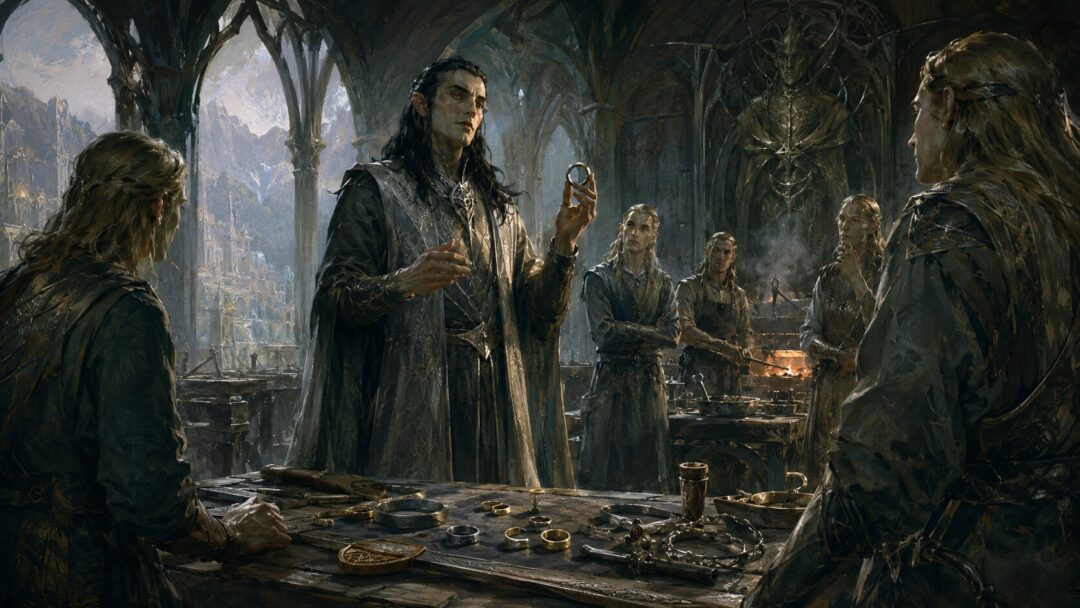
The One Ring Was Organization Made Visible
The One Ring is Sauron’s most revealing creation because it shows how different he is from his master. Morgoth dispersed his power broadly into Arda. Sauron concentrates much of his own native power into a single object, not to create random destruction, but to rule other powers through it.
The Ring is not merely “more power.” It is power arranged into command.
Its purpose is domination: especially over the bearers of the other Rings. Sauron’s plan in the Second Age is not simply to defeat the Elves by force. He comes in fair form, offers knowledge, encourages craft, and helps create a situation in which the rulers and preservers of Middle-earth might unknowingly become reachable by his will. When he forges the One, the scheme is exposed, and the Elves perceive him. But the design itself is astonishingly Sauronic: indirect, technical, patient, and centralized.
This is not Morgoth’s way of pouring hatred into the whole world until everything is marred. It is the building of a hierarchy. Many rings, one Ring. Many wills, one ruler. Many realms, one hidden master.
Even Sauron’s vulnerability follows from this. Because he concentrates so much of himself into the Ring, he becomes bound to it. His method is more efficient than Morgoth’s, but also more brittle. Destroy the Ring, and the system collapses.
Mordor Was Not Just a Fortress
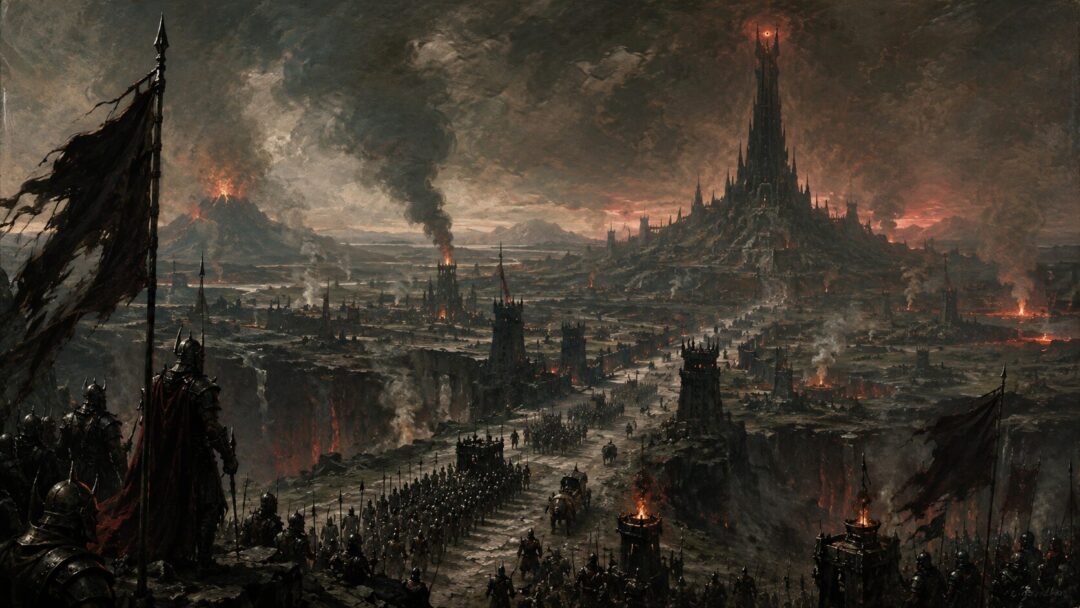
Mordor is often imagined as a wasteland of fire and ash, but in the story it functions as something more specific: a military and administrative heartland. It has borders, gates, roads of war, mustering fields, slave-worked lands around the Sea of Núrnen, and a central tower from which Sauron’s will is projected.
That does not make Mordor “modern” in a literal sense, and the texts do not give us a complete bureaucracy with offices and documents. But they do show a realm built around organization. Armies are gathered from multiple peoples. Signals are coordinated. Captains command. The Nazgûl operate as extensions of Sauron’s will. Even fear becomes a form of communication.
Morgoth’s Angband was also a fortress of terror, and Sauron clearly inherits that model: a dark stronghold, enslaved creatures, breeding of war, hatred of the free peoples. But Mordor in the Third Age feels narrower and sharper. It is not the whole world groaning under the first rebellion. It is a command-state aimed at making the whole world answer to one mind.
Sauron does not need to be everywhere if his orders are.
Why Sauron’s Imitation Was Smarter Than It Looked
Calling Sauron a copy of Morgoth can make him sound lesser in an uninteresting way, as though he merely repeated an old evil. But his imitation is more intelligent than that. He takes Morgoth’s basic claims—fear, lordship, spiritual rebellion, hatred of the West, use of Orcs, desire to dominate Elves and Men—and reshapes them into something suited to a changed world.
After the First Age, Beleriand is gone. Morgoth is thrust out. The Valar are no longer openly marching against a northern Dark Lord in the same way. Elves are fewer. Men are rising. Númenor becomes powerful. The world is more political, more divided, and more vulnerable to persuasion.
Sauron adapts.
To the Elves, he comes as a giver of knowledge. To Númenor, after being taken there as a prisoner, he becomes a counselor and corrupter, turning fear of death into rebellion and worship of darkness. To Men in Middle-earth, he becomes god-king, overlord, and master of tribute. In the Third Age, after losing fair form and later the Ring itself, he still rebuilds through secrecy, fortification, servants, and long patience.
This is why his evil is so difficult to resist. Morgoth often announces himself through overwhelming ruin. Sauron can arrive as advice.
The Tragic Irony of Sauron’s Order
Sauron’s deepest contradiction is that he wants order without goodness. He wants peace without freedom. He wants unity without love. In one reading, this is what makes him more frighteningly recognizable than Morgoth. Morgoth’s hatred of existence is almost mythic in scale. Sauron’s tyranny can look, from a distance, like efficiency.
But Middle-earth repeatedly shows that order severed from mercy becomes slavery. Sauron’s “organization” is not healing. It is compression. He reduces living wills into tools. The Nazgûl are the clearest example: kings or great lords of Men, preserved not in glory but in bondage, their identities thinned into extensions of the master who ensnared them.
The Ring tempts others along similar lines. It offers the fantasy that one could use dominating power for good: command the enemy, impose justice, repair disorder, force the world into shape. That is why Gandalf refuses it, and why Galadriel’s rejection matters. The problem is not only Sauron personally. The problem is the method. To rule by the Ring is to accept Sauron’s logic.
Organization becomes evil when it treats persons as material.
Why He Failed Where Morgoth Failed Differently
Morgoth fails because he cannot truly create, and because his vast rebellion spends itself against the deeper reality of the world’s making. Sauron fails because his system depends on a single point of control. The One Ring is brilliant, but it is also the fatal center of his empire.
His servants cannot imagine that anyone would seek to destroy it rather than use it. That blindness is not accidental. It reveals Sauron’s own mind. He understands ambition, fear, hierarchy, and desire for command. He does not understand renunciation. He can calculate armies and borders, but not pity. He can organize vast strength, but not comprehend the small mercy that spared Gollum and eventually broke his design.
Here the contrast with Morgoth becomes sharpest. Morgoth poured himself into the world and left a wound too deep to be fully escaped within history. Sauron concentrated himself into a device of rule, and that concentration allowed a small, almost impossible mission to undo him.
He became more organized, not more powerful—and because of that, he became more defeatable.
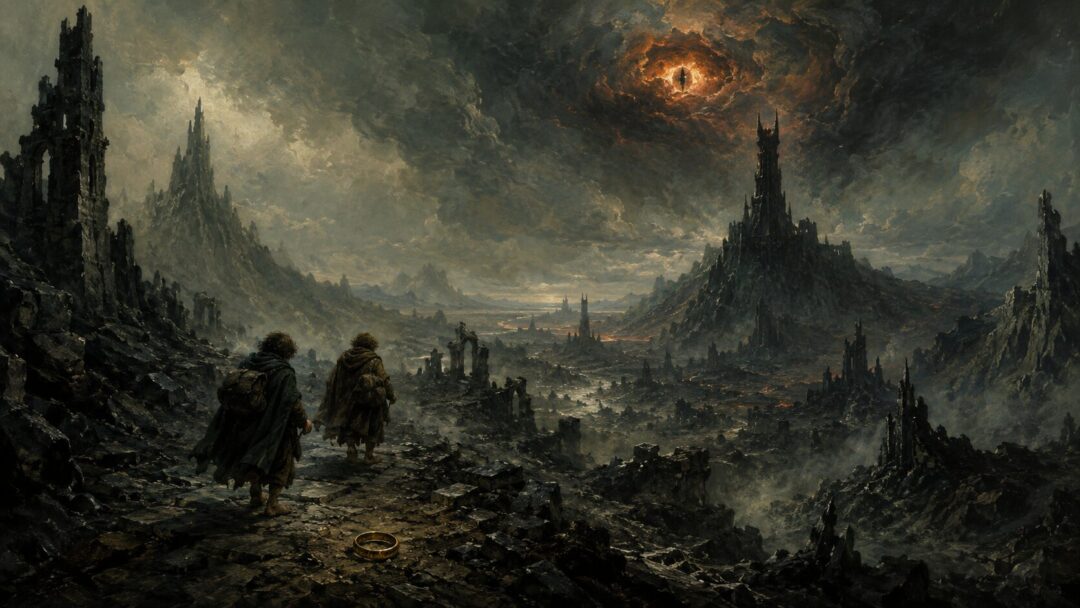
The Successor Who Revealed His Own Limit
Sauron copied Morgoth because Morgoth had defined what a Dark Lord was: a rebel power enthroned in fear, gathering monsters and corrupted peoples against the free. But Sauron’s nature made him a different kind of darkness. He did not merely want to smash Middle-earth. He wanted it arranged around himself.
That made him terrifyingly effective. It also made him spiritually narrow.
Morgoth’s shadow is the marring of the world. Sauron’s shadow is the dream of perfect control. One is the ancient wound in creation; the other is the tower, the ring, the chain of command, the eye that searches for every moving piece on the board.
Sauron did not need to become stronger than Morgoth to become the great enemy of the later ages. He only needed to learn from Morgoth’s ruin and build a more focused tyranny.
In the end, his imitation of Morgoth was also his confession. Sauron could not create a world. He could only organize one into slavery.
Sources & Notes
- J.R.R. Tolkien, The Silmarillion, “Valaquenta: Of the Enemies” — identifies Sauron as Morgoth’s chief servant, originally a Maia of Aulë, with a mind drawn to craft, order, and command.
- J.R.R. Tolkien, The Silmarillion, “Of the Rings of Power and the Third Age” — gives Sauron’s fair-seeming deception of the Elven-smiths, the forging of the One Ring, and its purpose of ruling the other Rings.
- J.R.R. Tolkien, The Lord of the Rings, Book II, Chapter 2, “The Council of Elrond” — explains the Ring’s binding power, Sauron’s dependence on it, and why its destruction would overthrow his power.
- J.R.R. Tolkien, The Lord of the Rings, Book VI, Chapter 2, “The Land of Shadow” — shows Mordor as an organized war-realm, including roads, mustering, command structures, and slave-worked lands around Núrnen.
- J.R.R. Tolkien, Morgoth’s Ring, “Myths Transformed” — develops the idea that Morgoth dispersed his power into the matter of Arda, contrasting with Sauron’s more concentrated investment in the Ring.
- J.R.R. Tolkien, The Letters of J.R.R. Tolkien, Letter 131 — describes Sauron’s special drive toward domination, “order,” and the coordination of all things under his own will.