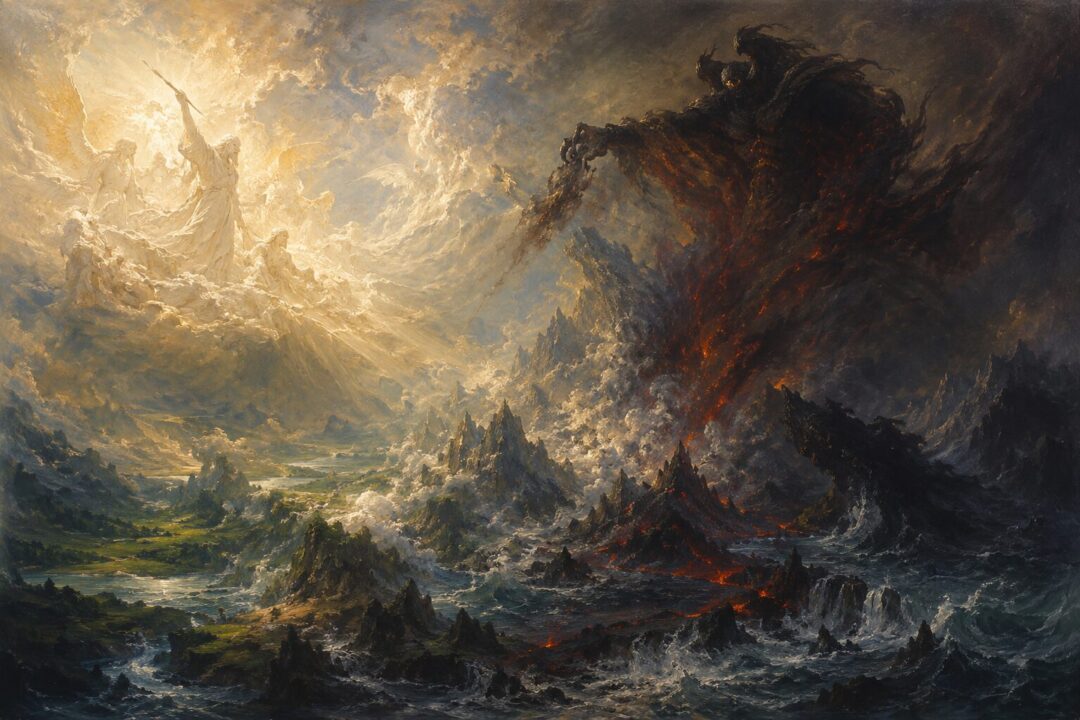
The One Ring is easy to fear because it is visible. It is gold, circular, secretive, and terrible. It can be held in the hand, hidden in a pocket, lost in a river, or carried toward fire. Sauron’s evil has a shape.
Morgoth’s greatest evil is harder to see because it does not always look like evil at all.
It looks like fear. It looks like decay. It looks like pride answering injury with more injury. It looks like the strong assuming that domination is simply how the world works. It looks like Elves growing weary, Men fearing death, Dwarves guarding treasure, kings mistaking possession for safety, and whole peoples accepting that grief is the normal weather of existence.
That is why Morgoth’s worst victory was not merely killing the Trees, stealing the Silmarils, breeding monsters, or ruining kingdoms. Those were catastrophes. But deeper than all of them was this: he helped make evil appear woven into the nature of the world.
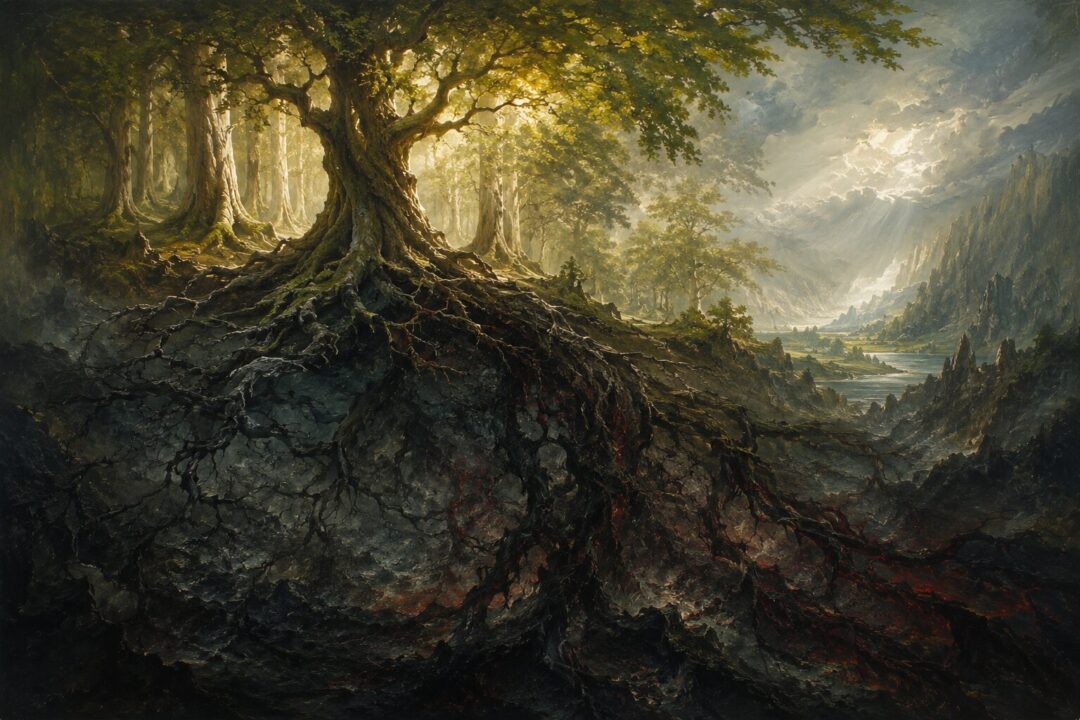
The First Enemy Did Not Create Evil Things From Nothing
In Tolkien’s legendarium, Morgoth begins as Melkor, the mightiest of the Ainur who enters into rebellion during the Music before the world is made. His first sin is not battlefield violence but discord: the desire to impose his own theme against the design of Ilúvatar.
That distinction matters. Morgoth is not a creator equal to the Creator. He cannot make true independent life from nothing. Again and again, evil in Middle-earth works by distortion, mockery, captivity, and corruption. It bends what already exists.
Orcs are associated with corruption and enslavement in the older traditions of the Elder Days, though the exact metaphysical origin of Orcs is one of the more difficult and debated matters in the legendarium. Trolls are made in mockery of Ents. Dragons are terrible works of malice, cunning, and domination. Even Morgoth’s greatest visible victories depend on ruining, twisting, or possessing what he did not truly originate.
This is the first hidden rule: evil is parasitic. It needs goodness to wound.
Morgoth’s genius, if that dark word can be used, was to make the wound feel like the body itself.
Arda Marred: The World As Wounded Reality
The concept often called Arda Marred is central here. The world was not merely attacked from outside by Morgoth. It was damaged from within history itself. The Valar labored to shape Arda as a dwelling for the Children of Ilúvatar, but Melkor repeatedly entered their works, broke them, polluted them, and turned their making into struggle.
This does not mean every stone, tree, beast, or person is evil. That would be too simple, and not Tolkien’s moral world. It means the world as experienced by Elves, Men, Dwarves, and Hobbits is not Arda as it should have been. It is a wounded creation.
That wound explains why evil often arrives wearing the mask of inevitability. Death, possessiveness, domination, weariness, suspicion, and the desire to control are not presented as Morgoth personally whispering into every ear. Rather, the histories of Middle-earth show peoples living inside a world where the Shadow has already left its pressure on matter, memory, and fear.
The result is terrifyingly subtle. Morgoth does not need everyone to worship him. It is enough if they accept his assumptions.
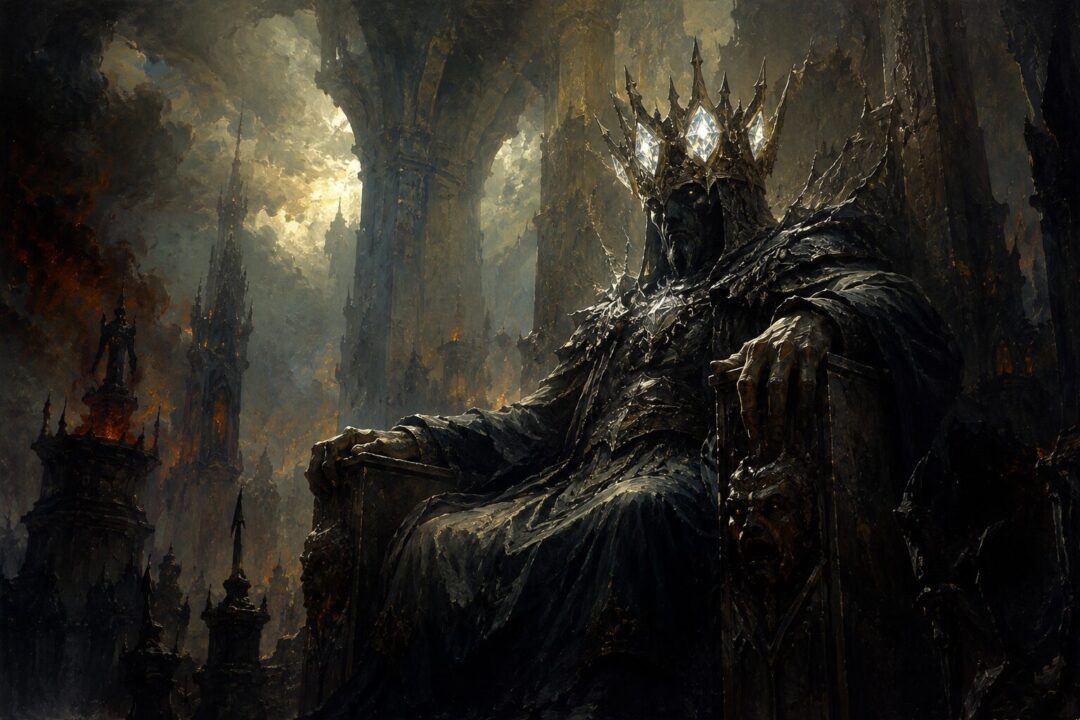
When Domination Starts To Look Like Order
Morgoth’s desire is not merely to destroy. Destruction is often what follows when he cannot possess. His deeper hunger is domination: to make all things extensions of his will.
This is why his evil has a cosmic weight that differs from Sauron’s. Sauron also seeks domination, but in the Third Age his strategy is more concentrated: Rings, towers, armies, fear, surveillance, and political control. Morgoth’s rebellion is older and more elemental. He wants the world itself.
One careful way to phrase it is this: Sauron tries to rule the board; Morgoth tried to poison the board.
That poisoning makes tyranny look practical. In a marred world, rulers can convince themselves that mercy is weakness, trust is childish, and power must be answered only by greater power. The great tragedies of the First Age are full of this logic. Oaths become chains. Vengeance becomes duty. Possession becomes identity.
The Oath of Fëanor is not caused by Morgoth alone; the sons of Fëanor remain morally responsible for what they swear and do. Yet Morgoth’s theft of the Silmarils creates the conditions in which their pride, grief, and possessiveness harden into disaster. Evil triumphs not only when monsters attack, but when wounded people begin to sound like the Enemy while believing they are resisting him.
The Silmarils Show The Pattern
The Silmarils are holy jewels, preserving the light of the Two Trees. Morgoth cannot make such beauty. He can only desire it, steal it, and defile everything around it through possession.
That is one of the great ironies of the First Age. Morgoth’s theft does not make the Silmarils evil. The jewels remain hallowed. But the struggle over them becomes a furnace for pride, slaughter, betrayal, and ruin. Something beautiful becomes the center of a history soaked in blood.
This is one of the clearest examples of evil making itself appear natural. The logic seems almost reasonable: if something precious has been stolen, should it not be recovered? If a wrong has been done, should it not be avenged? If enemies stand in the way, should they not be overcome?
But in Tolkien’s moral imagination, a true claim can still become corrupt when it is made absolute. The sons of Fëanor do have a grievance against Morgoth. Yet their oath drives them into crimes against other Elves. Justice, when severed from humility and mercy, becomes another instrument of ruin.
Morgoth’s victory is not that everyone loves darkness. It is that even those who hate him may begin moving according to his rhythm.
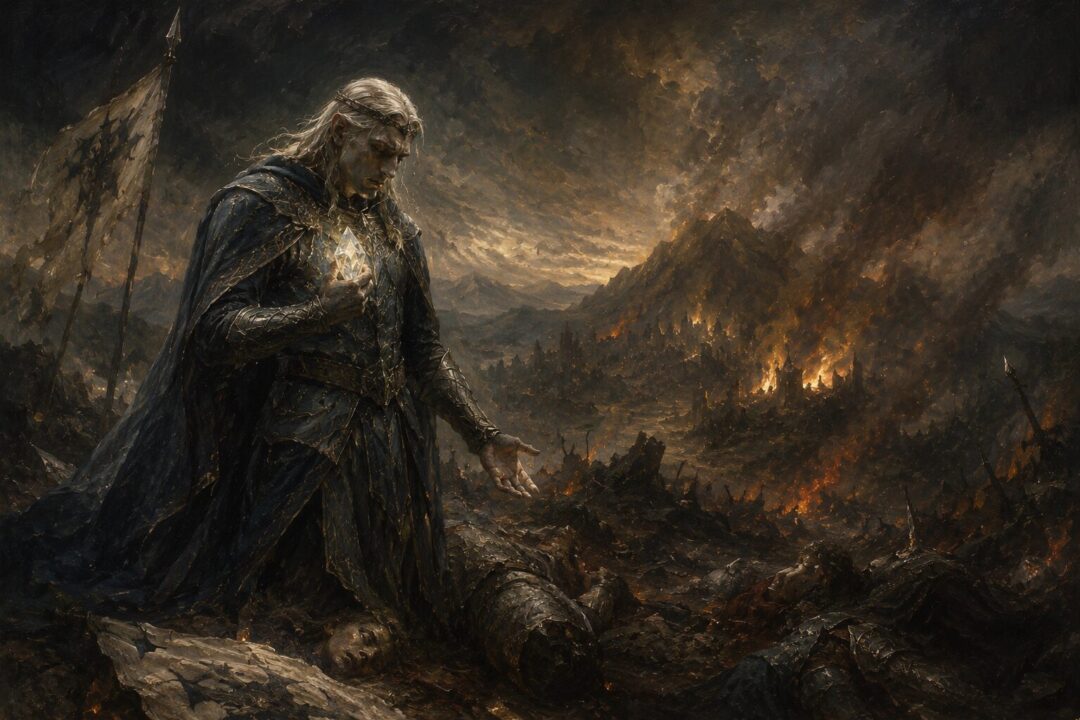
Fear Of Death And The Shadow Over Men
The tragedy deepens with Men. In the legendarium, mortality is originally described as the Gift of Ilúvatar, though its meaning becomes darkened by fear and by the lies of the Enemy. The texts do not reduce every human fear of death to Morgoth alone, but they do present the Shadow as corrupting how Men understand their fate.
This is one of Morgoth’s most profound successes. He cannot revoke the Gift. But he can help make it seem like a punishment, a deprivation, or an insult. Once death is seen only as loss, the desire to escape it can become spiritually dangerous.
Later, Sauron exploits this same wound in Númenor. The Númenóreans become great, wise, and powerful, yet many grow resentful of mortality. Their fear becomes a door through which domination enters. Sauron’s lies work because Morgoth’s older shadow has already made the world feel unjust.
Again, evil appears natural. Why should Men accept death? Why should the world be arranged this way? Why should the immortal Elves have what Men do not? The questions are not foolish. But under the Shadow, they can be bent toward envy, rebellion, and worship of power.
The Enemy’s Strongest Lie Is “This Is Just How Things Are”
Morgoth’s worst victory is psychological as much as physical. He teaches Middle-earth to confuse brokenness with reality.
This is why hope in Tolkien’s world is never shallow optimism. Hope is resistance against the claim that the marred world is the only truth. Elves preserve memory of beauty. Hobbits practice small acts of loyalty. Dwarves cherish craft and kinship even amid loss. Men are called to courage without guarantees. Again and again, the story honors those who act as if goodness is older and deeper than the Shadow.
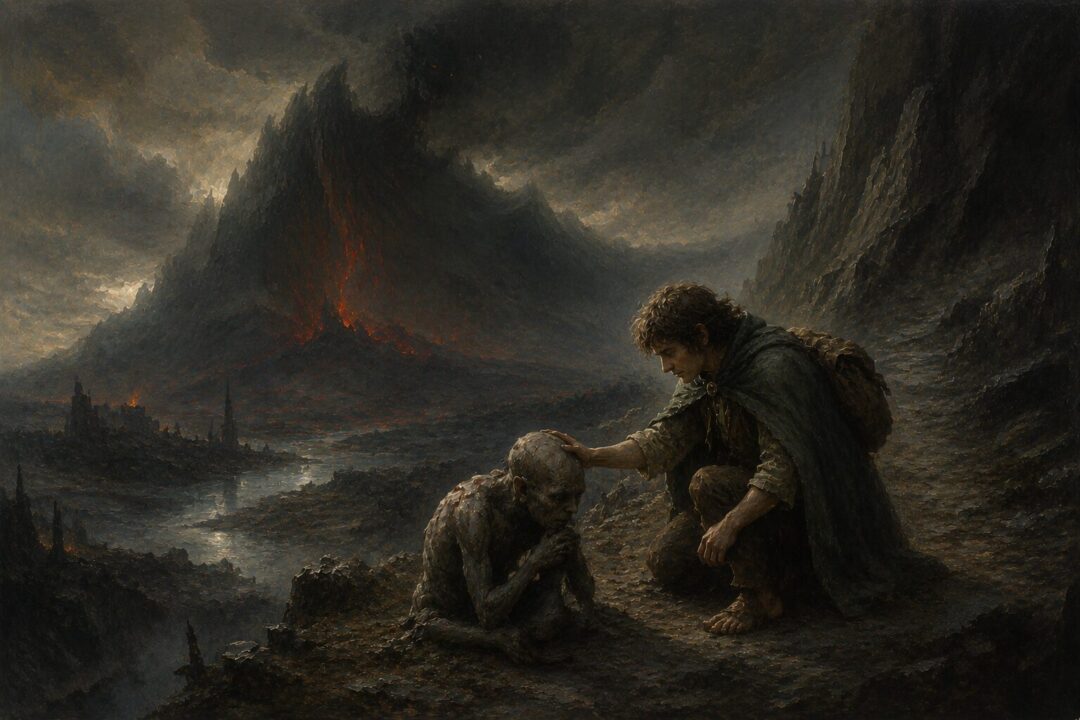
That is why pity matters so much in The Lord of the Rings. Bilbo’s pity for Gollum, Frodo’s mercy, and Sam’s final endurance are not sentimental exceptions to the hard laws of the world. They are signs that the hard laws are not ultimate.
Sauron cannot imagine this properly. He understands power, fear, possession, and calculation. He does not understand mercy as strength. That blindness is part of his inheritance from the older darkness. Evil has taught itself that domination is reality, and so it cannot fully comprehend acts that come from beyond domination.
Morgoth Lost, But His Damage Remained
Morgoth is defeated at the end of the First Age and thrust beyond the world, but the histories do not present his removal as an instant healing of Arda. The world remains marred. The Second and Third Ages unfold under consequences older than Sauron’s Ring.
This is why Middle-earth feels so anciently sad. Its beauty is real, but almost always touched by loss. Lothlórien is golden, yet fading. Rivendell is wise, yet temporary. Gondor is noble, yet diminished. The Shire is beloved, yet vulnerable. Even victory often means preservation for a time, not permanent restoration.
That sadness is not despair. It is the texture of a world where evil has been beaten many times but not yet wholly unmade.
Morgoth’s deepest defeat will not be accomplished merely by removing a tyrant. It would require the healing of the world he marred. Until then, his old lie continues to whisper through history: cruelty is realistic, possession is safety, death is meaningless, power is truth, and mercy is folly.
The great answer of Middle-earth is quieter but stronger.
The world is wounded, not evil. Power is not the deepest law. Mercy is not weakness. Beauty is not an illusion because it fades. And evil, however ancient, is not natural in the final sense. It is an intruder that has made itself look native.
That is why Morgoth’s worst victory was so terrible. He did not merely darken the world. He made darkness seem like the world’s own face.
Sources & Notes
- J.R.R. Tolkien, The Silmarillion, “Ainulindalë” — Melkor’s first rebellion appears as discord in the Music, not as a rival creation equal to Ilúvatar’s.
- J.R.R. Tolkien, The Silmarillion, “Of the Beginning of Days” and “Of Fëanor and the Unchaining of Melkor” — Melkor repeatedly mars the Valar’s works and turns beauty, trust, and freedom toward ruin.
- J.R.R. Tolkien, The Silmarillion, “Of the Silmarils and the Unrest of the Noldor” and “Of the Flight of the Noldor” — the hallowed jewels, Morgoth’s theft, Fëanor’s oath, and the way possessive grief becomes catastrophe.
- J.R.R. Tolkien, Morgoth’s Ring, “Myths Transformed” — Tolkien’s later reflections on Morgoth’s dispersal of power into Arda and the idea of Arda as a marred world.
- J.R.R. Tolkien, The Silmarillion, “Akallabêth” — the Gift of Men is darkened by fear of death, a wound later exploited by Sauron in Númenor.
- J.R.R. Tolkien, The Letters of J.R.R. Tolkien, Letter 131 — Tolkien distinguishes Morgoth’s nihilistic rebellion and corruption from Sauron’s more ordered will to domination.