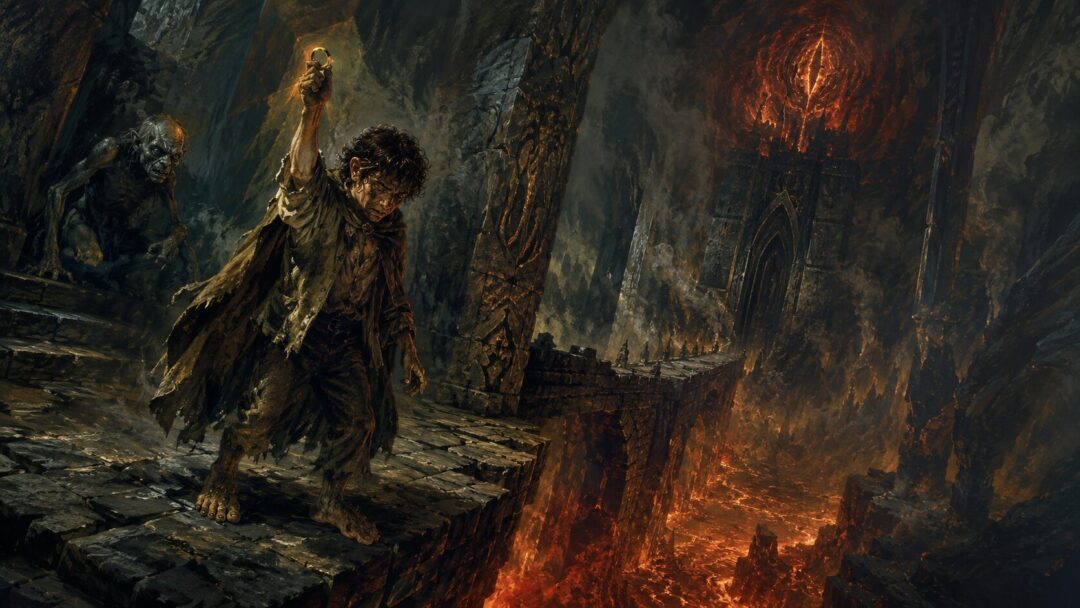
Everyone asks why Sauron did not guard Mount Doom better.
But that may be the wrong question.
The more disturbing answer is not that Sauron was careless. It is that he was brilliant in a way that made one kind of thought almost impossible for him.
Sauron understood power.
He understood fear. He understood ambition. He understood the desire to rule, to command, to preserve oneself, to bend others to a single will. Across the Second and Third Ages, he built his strength around that understanding.
And for most of the story, he is right.
The Ring corrupts.
The proud are tempted.
The wise fear to use it.
The strong imagine what they could accomplish with it.
Sauron’s mistake was not that he misunderstood the Ring.
His mistake was that he understood it too well from within his own nature.
He knew what power did to people. He knew what the Ring promised. He knew that anyone strong enough to wield it would be drawn toward mastery.
What he did not truly expect was someone carrying the Ring into the heart of his own land, not to claim it, not to bargain with it, not to challenge him with it, but to destroy it.
That was the thought outside his imagination.
And by the time he saw it, the Ring was already at the Fire.
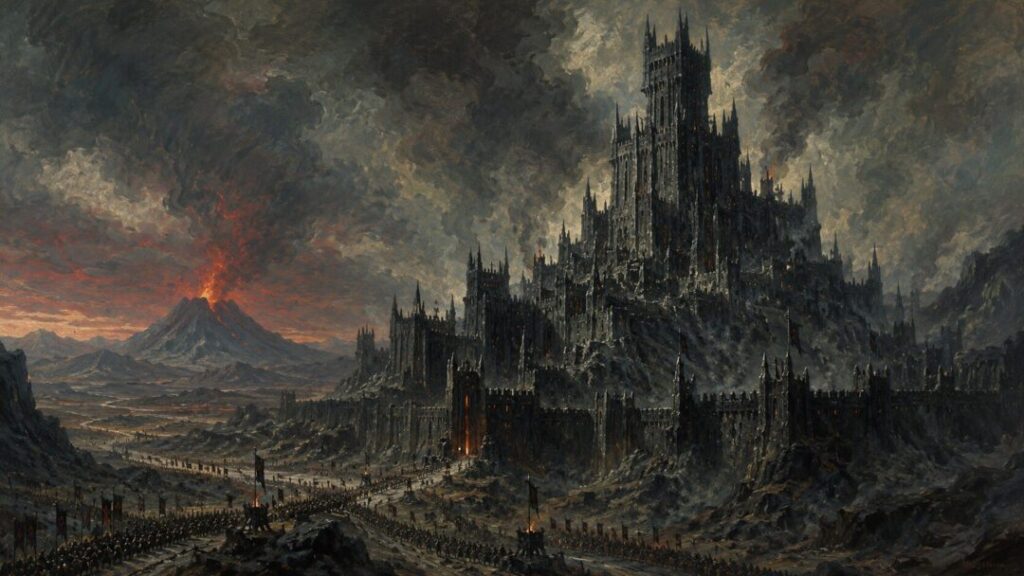
Sauron’s Strength Was the Reading of Desire
Sauron’s greatness as an enemy is not merely military.
He is not dangerous only because he has armies, fortresses, servants, and Nazgûl. Those things matter, but they are expressions of something deeper.
Sauron knows how wills bend.
The Ring itself is the clearest sign of this. It is not simply a weapon in the ordinary sense. It is a device of domination. Its purpose is bound to mastery over the other Rings and, through them, over the wills of others.
That matters because Sauron’s power is not random destruction. He is not Morgoth in another shape. Morgoth’s rebellion sinks toward ruin, hatred, and the marring of the world itself. Sauron’s evil is more ordered. His desire is control.
He wants rule.
He wants obedience.
He wants the world shaped beneath one commanding will.
This makes him terrifyingly perceptive. He can predict pride because pride is close to his own heart. He can predict ambition because ambition is the road he himself has taken. He can predict the seduction of power because the Ring was made out of that very logic.
That is why the Wise fear the Ring so deeply.
Not because it is useless.
Because it is useful in exactly the wrong way.
The Ring Does Not Tempt Everyone the Same Way
The Ring’s danger is not identical in every hand.
A humble bearer may be worn down slowly. A powerful bearer may be tempted toward great designs. A warrior may imagine victory. A ruler may imagine order. A wizard may imagine doing good by force.
That is why the Council of Elrond rejects the simple answer of using the Ring against Sauron.
On the surface, Boromir’s question sounds practical. If the Enemy made a weapon, why not turn it against him?
But the answer is not merely that the Ring is dangerous. The deeper answer is that the Ring wins by making domination look necessary.
This is the trap Sauron understands.
A person does not need to begin by wanting evil. It is enough to want victory. It is enough to want safety. It is enough to say, “Only this once. Only until the Enemy is defeated. Only for the good of my people.”
The Ring does not need to invent desire from nothing.
It enlarges what is already there.
Sauron knows this because it is the pattern of his own fall. Power becomes the means. Then power becomes the habit. Then power becomes the end.
So when he thinks about the Ring, he thinks like its maker.
He expects possession to lead to use.
And almost all the evidence supports him.
Why Aragorn’s Challenge Worked
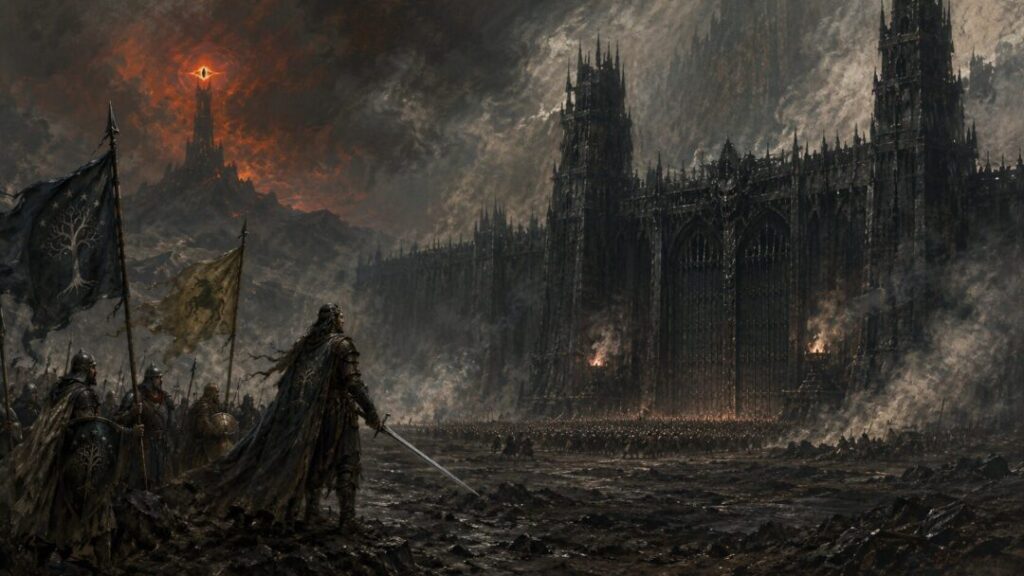
The march to the Black Gate is often remembered as an act of courage.
It is that, but it is also an act of deception.
Aragorn does not march on Mordor because his army can defeat Sauron by force. The Captains of the West are terribly outmatched. Their hope is not military victory.
Their hope is to draw Sauron’s eye away from the two small figures moving through Mordor.
But the deception only works because it fits Sauron’s expectations.
From Sauron’s point of view, Aragorn has revealed himself. He has looked into the palantír and declared himself as Isildur’s heir. He now advances openly to the Black Gate with a force too small for conquest but large enough for a challenge.
To Sauron, this can look like arrogance.
A new claimant has arisen.
A hidden king has come forward.
Perhaps he has the Ring.
Perhaps he is trying to master it before he is ready.
This is exactly the kind of mistake Sauron expects the proud to make.
And that is why the trap holds him.
Aragorn does not defeat Sauron by pretending to be weak. He defeats Sauron’s attention by letting Sauron believe he understands the shape of the danger.
A lord with a Ring.
A rival will.
A contest for mastery.
That is the story Sauron knows how to read.
The Thought Sauron Did Not Follow
The plan of the Wise is almost absurd when seen through Sauron’s mind.
Send the Ring into Mordor.
Carry it across the Enemy’s own land.
Bring it to the place where it was made.
Destroy it.
This is not how power thinks.
Power preserves itself. Power seeks advantage. Power calculates use. The Ring is the greatest weapon in Middle-earth, and the entire hope of the West depends on refusing to use it.
That refusal is the part Sauron cannot properly imagine.
This does not mean he is stupid. It does not mean he does not know, in some abstract way, that the Ring could be destroyed in the Fire where it was made. The Council understands that this is the path. Sauron, who made the Ring, is not presented as ignorant of its nature.
The point is subtler.
He does not believe his enemies will actually choose that path.
Why would they?
If they have the Ring, they have hope of power. If they have power, they can challenge him. If they can challenge him, they will be tempted to do so.
That chain of reasoning is nearly unbreakable.
Nearly.
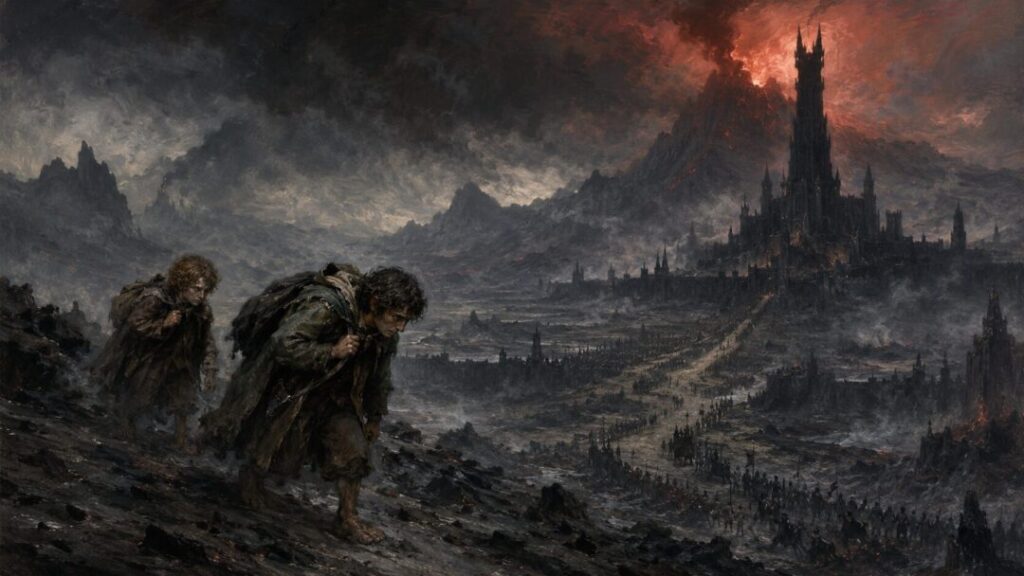
Frodo Proves Sauron Right — and Still Sauron Loses
The most important part of the ending is that Frodo does not simply destroy the Ring by heroic will.
At the Cracks of Doom, after the long torment of the journey, Frodo claims the Ring for himself.
This must not be softened.
It is not a small hesitation. It is not merely a moment of confusion. At the very place where the Ring’s power is greatest, Frodo can no longer give it up. The burden has become too much.
In one sense, this proves Sauron’s view of the Ring.
No one willingly destroys it at the end.
Not even Frodo.
That is what makes the ending so powerful. Sauron’s mistake was not believing that the Ring could corrupt. It could. It did.
His mistake was failing to account for a mercy and a pity that lay outside the Ring’s logic.
Gollum is there because Bilbo once spared him.
Gollum is there because Frodo later showed him pity.
Gollum is there because the story’s moral pattern has been moving toward this moment long before Sauron understands it.
Sauron can calculate force.
He can calculate ambition.
He can calculate fear.
But pity is not a weapon he knows how to measure.
And in the end, the Ring is destroyed through a chain of events Sauron did not design and could not master.
The Moment of Recognition
When Frodo claims the Ring in the Sammath Naur, Sauron finally sees the truth.
The danger was never at the Black Gate.
It was inside his own land.
Inside the mountain.
At the very place where the Ring could be unmade.
The text presents this as a moment of terrible recognition. Sauron’s attention turns suddenly toward Mount Doom, and the full shape of his enemies’ plan is revealed to him.
But revelation comes too late.
This is the tragedy of Sauron’s intelligence. He sees with dreadful clarity once the missing piece appears. His mind is not slow. It is not dull. When Frodo claims the Ring, Sauron understands.
But he understands only when the plan has already reached the one place where understanding can no longer save him.
The Nazgûl fly toward the mountain.
They cannot arrive in time.
His Blind Spot Was Moral, Not Strategic
It is tempting to reduce Sauron’s defeat to a tactical error.
Why was the entrance not guarded more heavily?
Why were there not soldiers in the Sammath Naur?
Why did he focus so much on Aragorn?
But those questions only reach the surface.
The deeper blind spot is moral.
Sauron’s imagination is shaped by domination. He assumes that power, when offered, will be used. He assumes that the Ring’s possessor will eventually claim it. He assumes that the real contest is between rival rulers.
And because those assumptions are usually correct, they become nearly invisible to him.
That is what makes the blind spot fatal.
A foolish enemy might overlook the truth because he cannot think clearly.
Sauron overlooks it because he thinks clearly along the wrong lines.
He sees ambition everywhere because ambition is everywhere.
He sees the desire for mastery because the Ring awakens it.
He sees the danger of a powerful Ring-bearer because that danger is real.
But he does not understand the full strength of renunciation.
He does not understand the strange power of the small, the humble, the merciful, and the exhausted who keep going without any dream of ruling afterward.
Why the Smallness of Hobbits Matters
Hobbits are not immune to the Ring.
That is important.
Bilbo is changed by it. Frodo is wounded by it. Sam is tempted by it, even if briefly. Gollum is devoured by it over long years.
The point is not that Hobbits are magically safe.
The point is that they are unlikely instruments for the kind of war Sauron expects.
They do not naturally appear in his mind as rivals. They do not command armies. They do not rule kingdoms. They are not great lore-masters or warriors or princes of the Eldar.
Their smallness helps conceal them from the logic of great power.
But smallness alone is not enough. The Quest succeeds through endurance, loyalty, mercy, secrecy, and providence. None of these can be reduced to strength in Sauron’s sense.
That is why the Ring comes so close to victory and still fails.
Not because the Ring is weak.
Because there are forces in the story that do not operate by the Ring’s rules.
The Final Irony of Sauron’s Defeat
Sauron made the Ring to secure his dominion.
By placing so much of his own power into it, he made his rule more terrible while the Ring endured. But he also bound his fate to something outside himself.
That is the central irony.
His greatest instrument became his greatest vulnerability.
Yet even that vulnerability remained hidden behind his confidence in desire. The Ring was safe, he believed, because no one who truly possessed it would choose its destruction. It would betray the weak, inflame the strong, and return at last to him or to someone he could confront.
And for almost the entire story, that belief seems justified.
Isildur keeps it.
Gollum clings to it.
Bilbo struggles to surrender it.
Boromir is tempted by it.
Frodo claims it at the end.
Sauron is wrong only in the one place where being wrong matters most.
He does not foresee that the Ring could be carried to the Fire by those who do not seek to become lords. He does not foresee that pity toward Gollum could become decisive. He does not foresee that victory might come, not through mastering the Ring, but through refusing its entire promise as long as anyone possibly can.
That is why his defeat is not simply the fall of a villain.
It is the collapse of a worldview.
Sauron believes that power is the deepest truth of the world.
The Ring proves him right about much.
But not about everything.
And in Middle-earth, that small remaining space the space for mercy, humility, endurance, and surrender is enough to bring down the Dark Tower.
Sources & Notes
- J.R.R. Tolkien, The Lord of the Rings, Book II, Chapter 2, ‘The Council of Elrond’ — the Wise reject using the Ring because it would master its bearer and turn victory into another form of domination.
- J.R.R. Tolkien, The Lord of the Rings, Book V, Chapter 10, ‘The Black Gate Opens’ — Aragorn’s hopeless challenge draws Sauron’s attention by fitting the pattern of a proud rival claimant.
- J.R.R. Tolkien, The Lord of the Rings, Book VI, Chapter 3, ‘Mount Doom’ — Frodo claims the Ring at the Sammath Naur, and Sauron only then perceives the real danger and sends the Nazgûl too late.
- J.R.R. Tolkien, The Lord of the Rings, Book I, Chapter 2, ‘The Shadow of the Past’ — Gandalf’s teaching on Bilbo’s pity for Gollum supplies the mercy-chain that Sauron cannot calculate.
- J.R.R. Tolkien, The Silmarillion, ‘Of the Rings of Power and the Third Age’ — Sauron’s making of the One Ring and his bid to rule the bearers of the other Rings ground the article’s focus on control and mastery.
- J.R.R. Tolkien, The Letters of J.R.R. Tolkien, Letter 131 — Tolkien describes Sauron’s evil as ordered domination, clarifying why Sauron’s imagination runs toward command rather than renunciation.