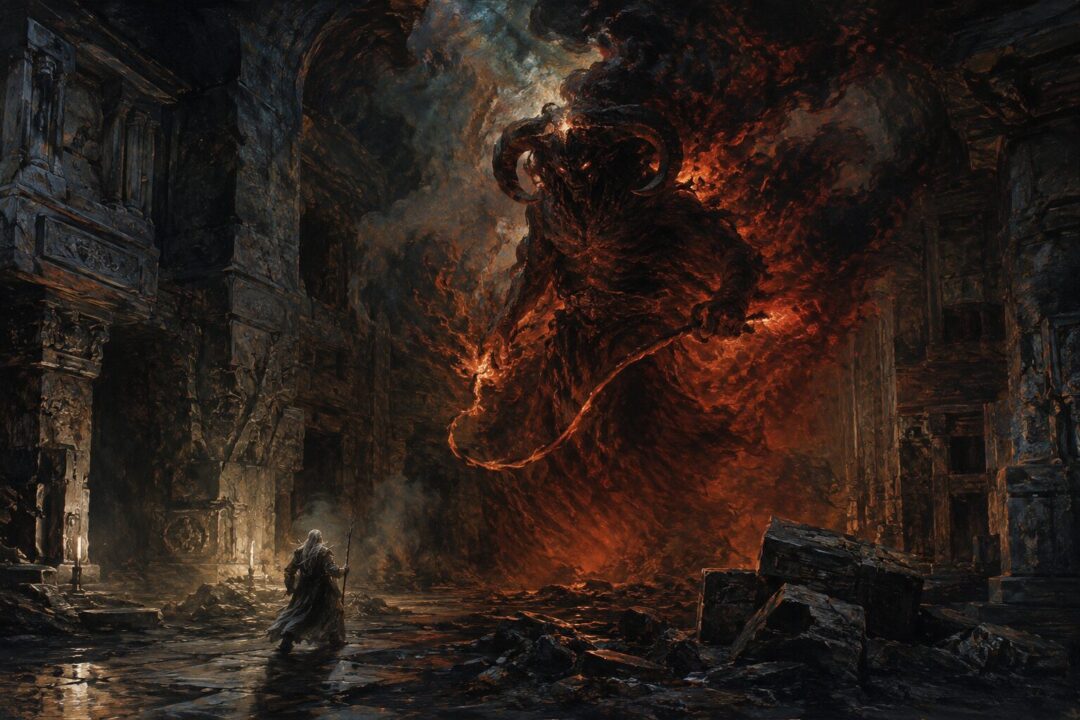
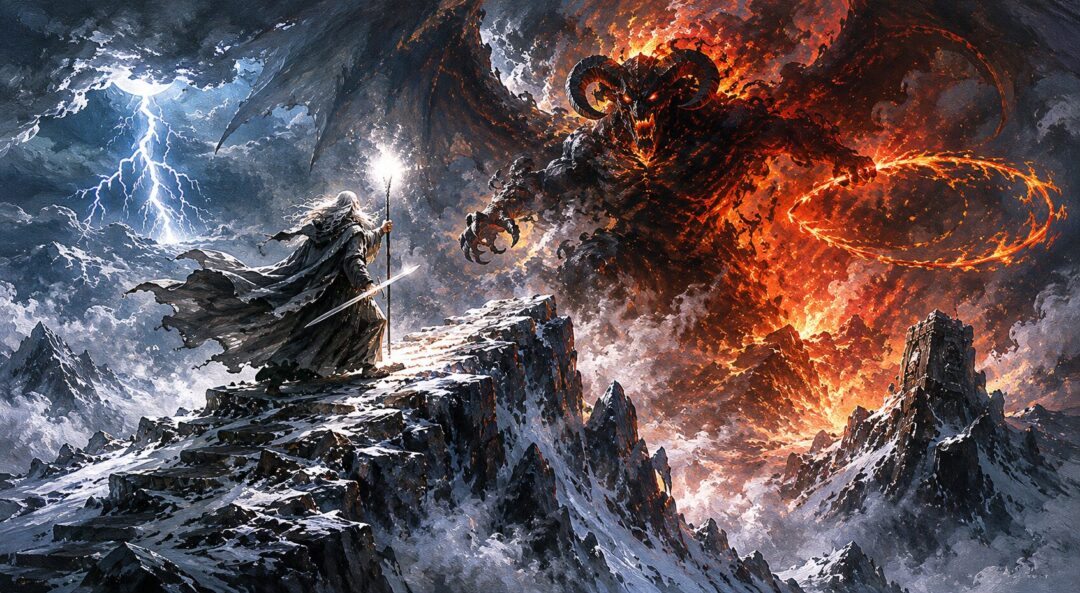
The Balrog in Moria is easy to remember as a huge creature of fire. That image is dramatic, but it also hides why Durin’s Bane was so frightening in Tolkien’s world. The danger was not simply that it was large, burning, armed with a whip, or difficult to kill. The Balrog was terrifying because it belonged to a far older category of evil. It was not just a monster in a dungeon. It was a surviving servant of Morgoth, a fallen spirit from the first wars of the world, buried inside the mountain like a catastrophe that had never truly ended.
That difference matters. Many fantasy creatures threaten bodies. The Balrog threatened history, kingdoms, courage, memory, and the hidden foundations of Middle-earth itself.
It Was Not an Animal
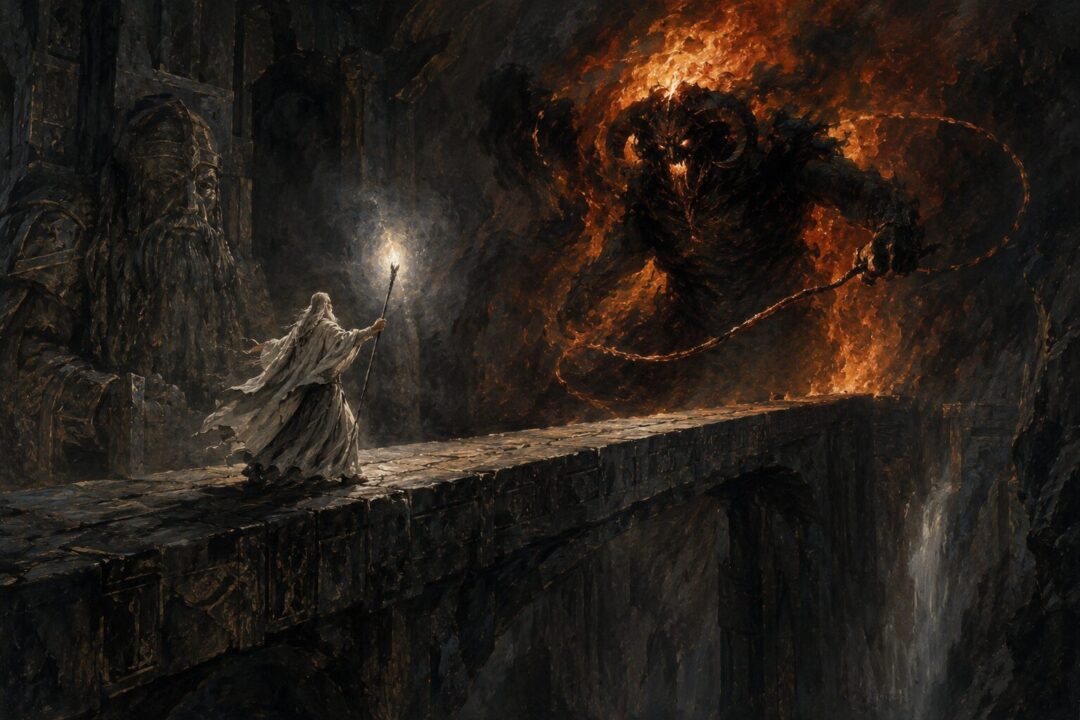
The first mistake is treating the Balrog as if it were a powerful beast. Tolkien’s Balrogs were Maiar: angelic or spiritual beings of the same broad order as Gandalf, Saruman, Sauron, and other servants or messengers of the Valar. They were not born as ordinary flesh. They were spirits who took shape, chose allegiance, and were corrupted in the service of Morgoth.
That means Durin’s Bane was not scary because it had fire around it. The fire was a sign of something deeper. It was the visible expression of an ancient will.
A cave troll can be strong. A dragon can be devastating. But a Balrog is something stranger: a mind and power from before the later ages, still carrying the terror of Morgoth’s world. When the Fellowship sees it in Moria, they are not just facing a creature. They are encountering a relic of the First Age, when the greatest powers in Middle-earth fought wars that reshaped continents.
This is why Gandalf reacts so seriously. He understands what the others cannot fully measure. The enemy in front of them is not merely dangerous. It is kin, in a dark sense, to the kind of being Gandalf himself is. The fight is not warrior against monster. It is spirit against spirit, old power against old power.
It Carried the Shadow of Morgoth
The Balrog’s presence in Moria also matters because of what it represents. Morgoth was not just another villain before Sauron. He was the original Dark Lord, the first source of organized evil in Arda, and the one who corrupted many of the powers and creatures that later haunted the world.
A Balrog is therefore a living remnant of Morgoth’s rebellion. Durin’s Bane is not simply an enemy that survived a battle. It is a fragment of a much older disaster, still moving beneath the earth long after Morgoth himself was cast out of the world.
That makes the scene in Moria feel larger than the Fellowship’s immediate escape. The Balrog proves that the past has not stayed buried. Ancient evil can sleep under stone for thousands of years and still wake with enough force to destroy a kingdom.
This is one of Tolkien’s most powerful ideas: evil does not always vanish when its master falls. It leaves ruins, servants, habits, fears, and hidden wounds. Durin’s Bane is one of those wounds with a body.
It Destroyed More Than Lives
A giant fire monster might kill people. The Balrog did something worse. It ended an age of dwarven greatness in Khazad-dûm.
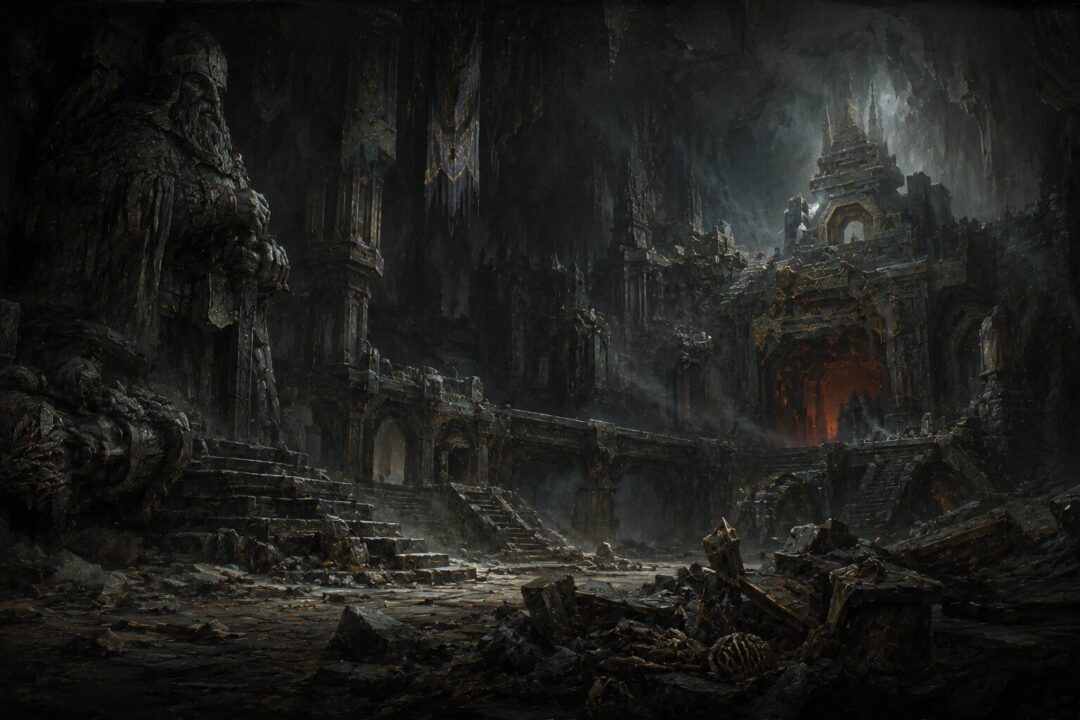
Moria was not a random mine. It was one of the greatest realms of the Dwarves, a place of craft, memory, wealth, and identity. The Dwarves did not merely occupy it; they belonged to it. Khazad-dûm was tied to their history and pride in a way few places in Middle-earth could match.
When Durin’s Bane awoke, it did not just kill King Durin VI and then his son Náin I. It broke the confidence of an entire civilization. The Dwarves abandoned their most famous home. A living kingdom became a haunted name. The halls that once held song, labor, trade, and light became dark passages where Orcs and fear could settle.
That is why the Balrog is worse than a combat threat. Its victory was cultural. It turned a homeland into a tomb.
For the Dwarves, Moria remained both a memory and a wound. They wanted it back because it was theirs, but the thing underneath it had changed what return meant. The Balrog made home itself dangerous.
It Was Hidden Under Desire
Durin’s Bane also connects to one of the recurring patterns in Tolkien: the danger of digging too deep, reaching too far, or desiring what should be approached with humility.
The Dwarves of Khazad-dûm mined mithril, the extraordinary metal that made Moria famous and wealthy. Mithril was beautiful, useful, and precious. It was not evil in itself. But the deeper the Dwarves went, the closer they came to something ancient and terrible sleeping below.
That is what makes the Balrog such a strong symbol. It is not a simple punishment for greed. Tolkien is usually more subtle than that. The Dwarves were not villains for mining. Yet the story still carries a warning: even noble craft and legitimate desire can uncover powers no one is prepared to master.
The horror of Moria is that greatness and ruin were physically layered on top of each other. The same depths that held treasure also held the disaster.
It Fought Gandalf on His Own Level
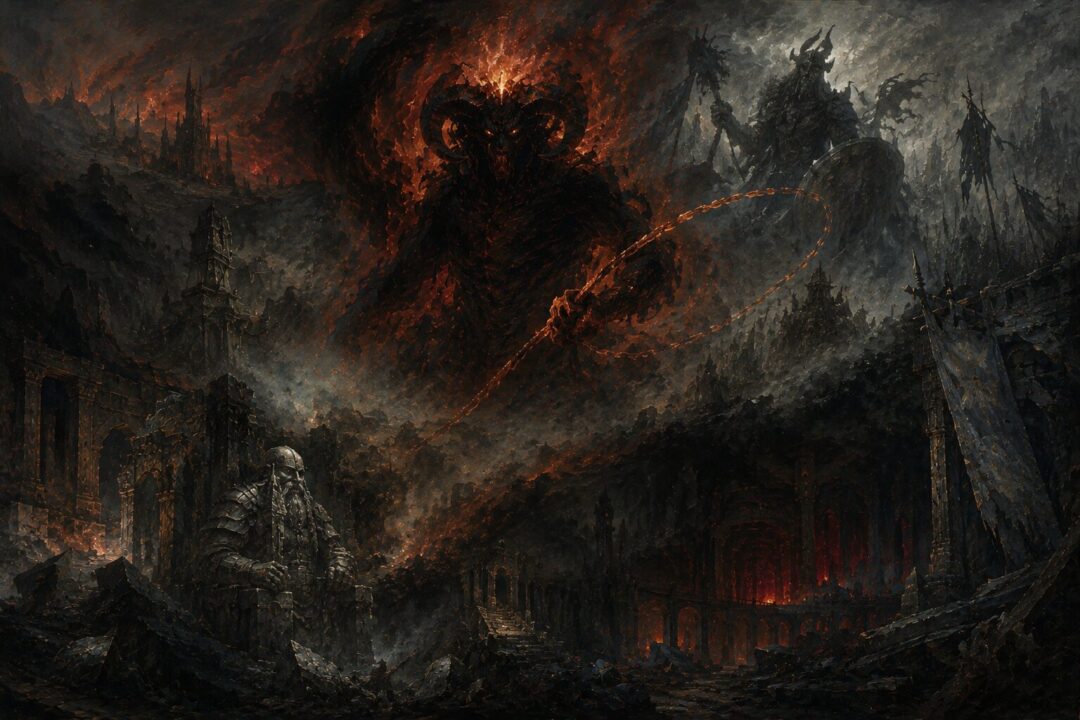
The Bridge of Khazad-dûm is one of the clearest signs that the Balrog is not an ordinary monster. The Fellowship cannot simply fight it together. Aragorn and Boromir are brave, but Gandalf knows that courage alone is not enough. He stands against the Balrog because he is the one member of the company who can meet that kind of power.
His words on the bridge are not just dramatic defiance. They are a declaration of authority. Gandalf names himself as a servant of the Secret Fire and a wielder of the flame of Anor. He is not boasting. He is identifying the spiritual ground on which the confrontation is happening.
The Balrog answers with shadow and flame. Gandalf answers with command, light, and endurance. Their battle continues far beyond what the Fellowship sees, from the depths under the mountain to the peak of Zirakzigil. That scale tells us everything. This is not a sword fight with a dangerous creature. It is a mythic struggle between beings whose conflict belongs to the deep structure of the world.
The cost also proves the point. Gandalf does not merely get injured. He dies and is sent back changed. A giant fire monster could have been defeated by enough heroes. Durin’s Bane required a sacrifice that moved Gandalf from the Grey to the White.
Its Terror Was Spiritual
The Balrog’s most frightening weapon may not be its whip or sword. It is dread.
Tolkien often treats fear as a real force. Some enemies do not only attack the body; they press on the will. The Balrog arrives with darkness, heat, and a sense of ancient doom. The Fellowship feels that something far beyond an Orc-chieftain or cave beast has entered the story.
This matters because Middle-earth is a moral and spiritual landscape, not just a physical one. Evil can have weight. Memory can linger. Places can be wounded. The Balrog brings the First Age into the Third like a shadow crossing time.
That is why the phrase “Durin’s Bane” is so effective. It is not just a name. It means this being became the doom of a king and the terror behind an abandoned realm. The Balrog is remembered by consequence.
The Real Horror of Durin’s Bane
So why was the Balrog worse than a giant fire monster?
Because it was not merely giant. It was ancient.
Because it was not merely fiery. It was fallen.
Because it did not only kill. It emptied a kingdom.
Because it was not just found in the dark. It was a piece of the oldest darkness left waiting there.
The Balrog works so well because Tolkien gives it depth without overexplaining it in the moment. The reader sees enough to fear it, and later learns enough to understand why Gandalf could not treat it like another enemy. Durin’s Bane was the past refusing to stay dead. It was Morgoth’s war echoing under the mountains. It was proof that some evils survive not because they are loud, but because they sleep until the world forgets to be afraid.
That is much worse than a giant made of fire.
Sources & Notes
- J.R.R. Tolkien, The Silmarillion, “Valaquenta: Of the Enemies” — Balrogs are presented as Maiar spirits corrupted by Melkor, not as ordinary beasts of fire.
- J.R.R. Tolkien, The Lord of the Rings, Book II, Chapter 5, “The Bridge of Khazad-dûm” — Durin’s Bane appears as shadow and flame, and Gandalf’s stand frames the encounter as more than a physical fight.
- J.R.R. Tolkien, The Lord of the Rings, Appendix A, “Durin’s Folk” — the Dwarves’ deep mining for mithril awakens Durin’s Bane, which slays Durin VI and Náin I and drives the Longbeards from Khazad-dûm.
- J.R.R. Tolkien, The Lord of the Rings, Book III, Chapter 5, “The White Rider” — Gandalf describes the battle from the depths beneath Moria to Zirakzigil, ending in the Balrog’s fall and Gandalf’s death.
- J.R.R. Tolkien, Unfinished Tales, “The Istari” — Gandalf’s nature as one of the Maiar helps explain why the confrontation with a Balrog belongs to the same spiritual order of power.