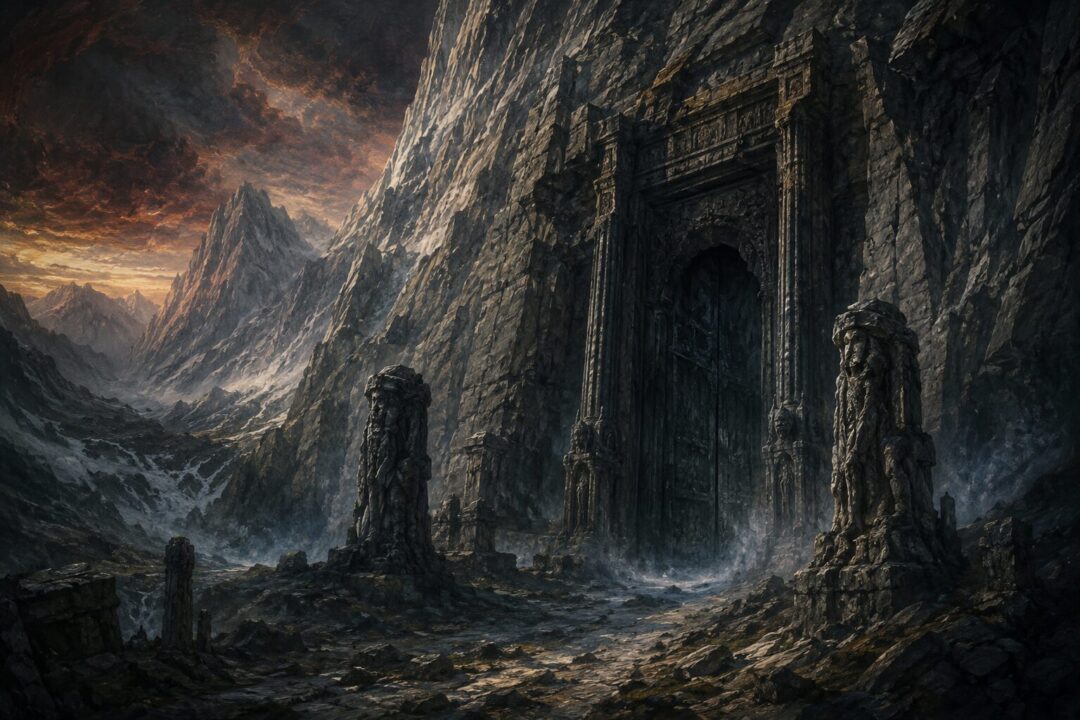
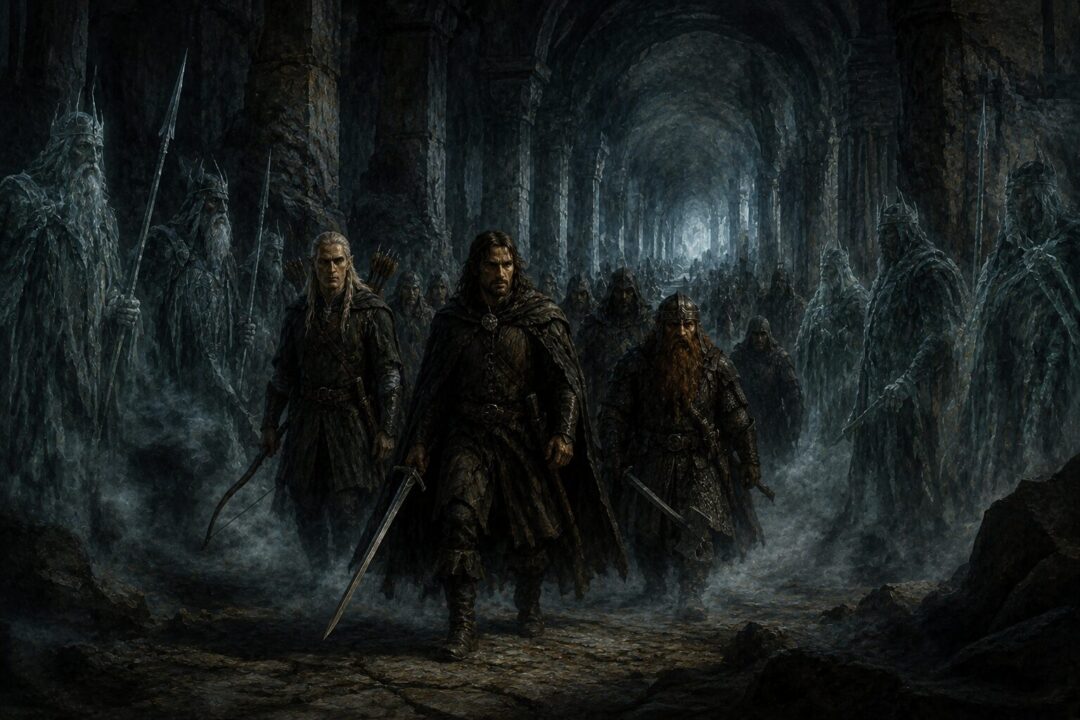
The Paths of the Dead are among the most haunting places in Middle-earth. A hidden road beneath the White Mountains, avoided for centuries, they carry the memory of broken promises rather than simple horror. When Aragorn walks those tunnels with the Grey Company, Legolas, and Gimli, many readers remember the scene because of the army of the dead that follows him. Yet the deeper story is not about unstoppable ghost warriors. It is about the enduring weight of an oath, the limits of power over death, and the long shadow cast by a single act of betrayal.
The Dead Men of Dunharrow are often remembered as a supernatural army that helped win the War of the Ring. The texts present something more complex. They were neither ordinary spirits nor mindless undead soldiers. Their existence reveals one of Middle-earth's most important moral truths: words spoken freely can bind people far beyond their own lifetime.
The Oath That Changed an Age
The story begins thousands of years before the War of the Ring.
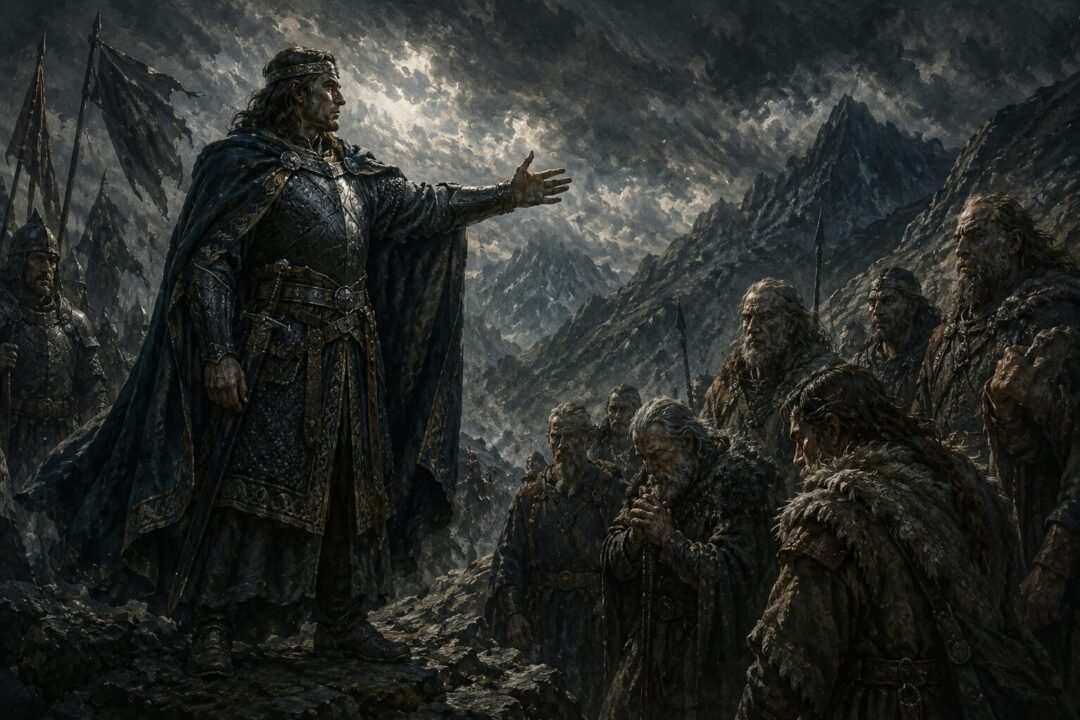
During the early years of the kingdoms in exile, Isildur sought the loyalty of the Men who lived in the White Mountains. These people, later called the Men of the Mountains, swore an oath to aid him in the struggle against Sauron.
That promise carried enormous weight.
In Middle-earth, oaths are never treated as casual agreements. Throughout the legendarium, solemn vows repeatedly shape history, sometimes bringing honor and sometimes terrible ruin. The Men of the Mountains freely pledged themselves to Isildur. Nothing suggests they were forced into the oath.
When Sauron returned to power after the forging of the Rings, however, they refused to fulfill their promise. Instead of joining Isildur's war, they hid in the mountains and abandoned the alliance they had sworn to uphold.
Their failure was not merely political. It was moral.
Isildur's Curse Was Rooted in Justice, Not Revenge
After their betrayal, Isildur pronounced a terrible judgment upon them.
He declared that they would never find rest until they had fulfilled the oath they had broken. The exact wording in The Return of the King emphasizes that they would remain unfulfilled "for this war will last through years uncounted."
The curse is often misunderstood as magical punishment created by a powerful king. The text, however, never explains precisely how such a judgment operated.
One careful reading is that Isildur, acting as the lawful king to whom the oath had been sworn, pronounced a doom that reflected the moral order already woven into Middle-earth rather than inventing a new supernatural law. Tolkien never explicitly explains the mechanics.
What matters is the result.
The Men of the Mountains died, yet they were denied peace. Their broken word became the defining fact of their existence.
They Were Not Simply Ghosts
The Dead are consistently described with language that emphasizes dread rather than physical violence.
When Aragorn enters the Paths of the Dead, fear itself becomes the overwhelming force. Even hardened warriors hesitate. Horses refuse to continue. The atmosphere is oppressive long before the Oathbreakers appear.
The Dead themselves inspire terror by their presence. Their arrival empties courage from those who oppose them.
The text never depicts them as ordinary soldiers engaging in prolonged physical combat.
Instead, their greatest weapon is fear.
This distinction matters because it changes how their role in the War of the Ring should be understood.
Many adaptations have encouraged the idea that they won battles through overwhelming supernatural force. The book presents a more restrained picture.
What the Dead Actually Did in the War of the Ring
After passing beneath the mountain, Aragorn summons the Dead because he is Isildur's heir and therefore possesses the authority connected to the original oath.
The Dead acknowledge him immediately.
Their obedience is not based on military conquest or magical domination. It is based on legitimacy. Aragorn stands where Isildur once stood. The ancient obligation still exists.
Their mission is specific.
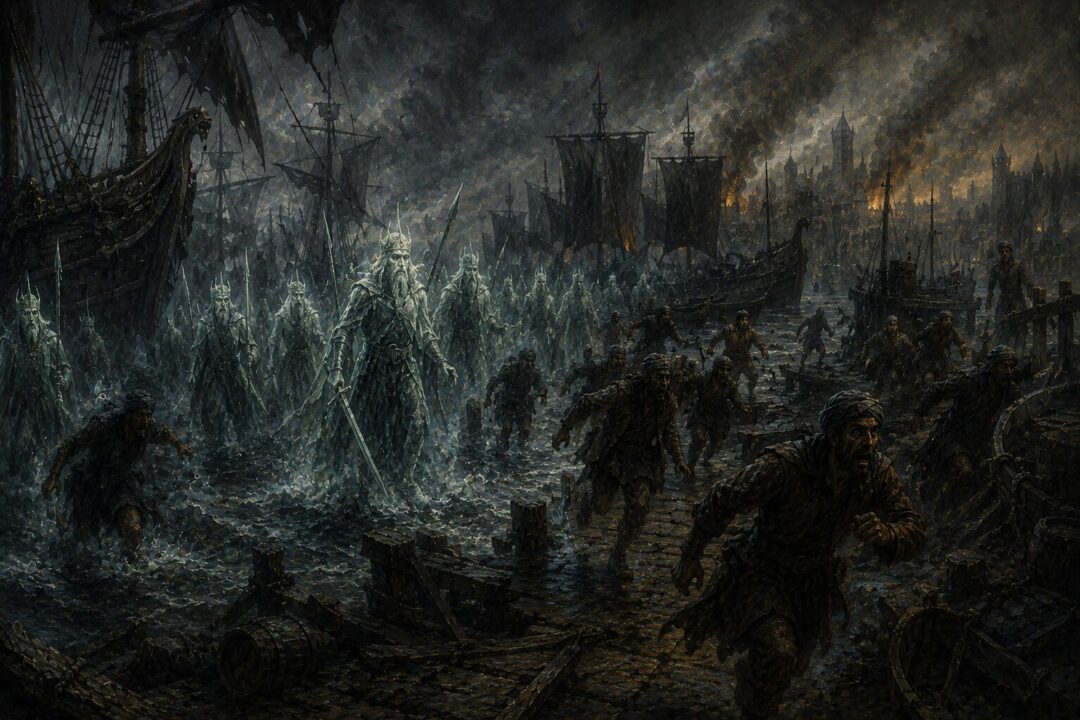
They accompany Aragorn south through Gondor, where many regions are threatened not only by Corsairs from Umbar but also by allies of Sauron. As Aragorn advances, the Dead spread overwhelming fear.
The text repeatedly stresses that enemies flee.
Many abandon ships.
Others scatter without offering meaningful resistance.
Aragorn himself later explains that the Dead "put fear" into the hearts of their enemies.
The narrative does not linger on scenes of ghostly slaughter. Instead, psychological collapse becomes their decisive contribution.
This distinction is easy to overlook, yet it is central to understanding their purpose.
The Corsairs Were Not Defeated by Ghost Warriors Alone
One of the most common misconceptions is that the Dead fought all the way to the Battle of the Pelennor Fields.
That is not what happens in the book.
After the Corsair threat has been broken, Aragorn declares that the oath has finally been fulfilled.
At the Stone of Erech, he releases the Dead from their burden.
Only then do they disappear forever.
The soldiers who later sail the captured fleet toward Minas Tirith are living men.
Aragorn gathers reinforcements from southern Gondor, including men from the coastal regions who had been freed from fear once the Corsairs were defeated. These living warriors accompany him to the Pelennor.
This moment is important because it restores the proper place of mortal courage.
The victory before Minas Tirith ultimately belongs to living people making costly choices, not to an unstoppable supernatural army.
Why Aragorn Could Release Them
Aragorn's authority rests on more than royal blood.
Throughout The Lord of the Rings, legitimacy matters as much as power.
He repeatedly acts as the rightful heir long before he is crowned. His healing, his leadership, and his willingness to bear difficult burdens all reinforce that legitimacy.
The Dead recognize this immediately.
Their ancient obligation was never owed to any king in general.
It was owed to the House of Isildur.
Once Aragorn judges that they have completed the task required by their oath, he dismisses them.
Remarkably, they obey without resistance.
Their long imprisonment ends not through conquest but through fulfilled obligation.
The Dead Reveal One of Middle-earth's Deepest Moral Laws
The Dead Men of Dunharrow belong to a broader pattern that appears throughout the legendarium.
Words matter.
Promises matter.
Oaths shape destiny.
This principle appears in very different forms across the ages.
The Oath of Fëanor unleashes generations of tragedy.
The oath between Cirion and Eorl establishes an alliance that ultimately saves Gondor.
Sam's promises repeatedly sustain Frodo through impossible hardship.
Even Gollum's oath upon the Ring becomes unexpectedly significant near the end of the quest.
These examples differ dramatically in character and consequence, but together they reveal a consistent pattern.
Speech creates responsibility.
Breaking that responsibility carries consequences beyond immediate political failure.
The Men of the Mountains become perhaps the clearest illustration of this principle because the consequence extends beyond death itself.
Fear Is Their True Weapon
Readers sometimes focus on the supernatural appearance of the Dead while overlooking the emotional reality they represent.
Fear has always been one of Sauron's greatest instruments.
Ironically, the Oathbreakers become an opposing force that uses fear against his own servants.
Yet there is an important difference.
Sauron spreads fear through domination and despair.
The Dead spread fear because their very existence reminds others that betrayal carries consequences.
Their appearance is not simply frightening.
It is morally unsettling.
Enemies face something that should not exist: warriors who cannot rest because of promises abandoned centuries earlier.
The terror comes from confronting justice that has waited across generations.
Mercy Finally Enters Their Story
Although the Dead live under a curse, their story does not end in endless punishment.
Aragorn does not prolong their suffering.
He does not exploit them after their task is complete.
He does not seek additional victories simply because he commands an unmatched supernatural force.
Instead, he keeps faith with them.
Once the oath has been fulfilled, he grants them release exactly as justice requires.
This restraint reflects one of Aragorn's defining qualities as a ruler.
Power exists to restore order, not to extend domination.
The Dead are not tools to be used indefinitely.
They are people whose long sentence has finally reached its rightful conclusion.
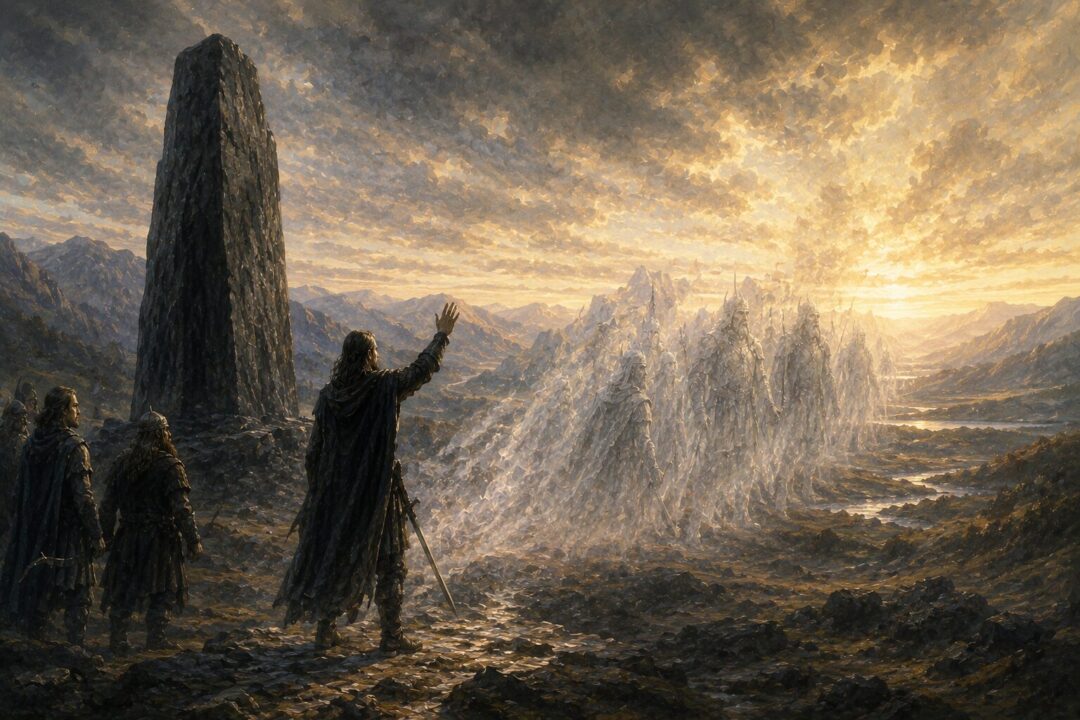
Why Their Story Still Matters
The Dead Men of Dunharrow endure in readers' imaginations because they represent more than a frightening episode beneath a mountain.
They embody memory.
They remind Middle-earth that history never fully disappears.
Promises echo across centuries.
Leadership carries moral authority rather than mere military strength.
Perhaps most importantly, they show that justice and mercy need not oppose one another.
Justice required that the oath be fulfilled.
Mercy allowed the burden to end once it was.
Seen this way, the Dead were never simply ghost soldiers waiting to win a battle. They were living proof that in Middle-earth, the deepest conflicts are rarely decided by strength alone. They are decided by fidelity, responsibility, and the willingness to keep one's word even when every easier path lies open. The Men of the Mountains failed that test in life, endured ages because of it, and finally found peace only when the promise they abandoned was at last fulfilled.
Sources & Notes
- Wikipedia overview of the Paths of the Dead and the Oathbreakers — https://en.wikipedia.org/wiki/Paths_of_the_Dead
- Wikipedia overview of Aragorn and his claim to the kingship — https://en.wikipedia.org/wiki/Aragorn
- Wikipedia overview of The Return of the King for the Pelargir and Gondor context — https://en.wikipedia.org/wiki/The_Return_of_the_King
Sources selected for Tolkien-lore context and reader verification.