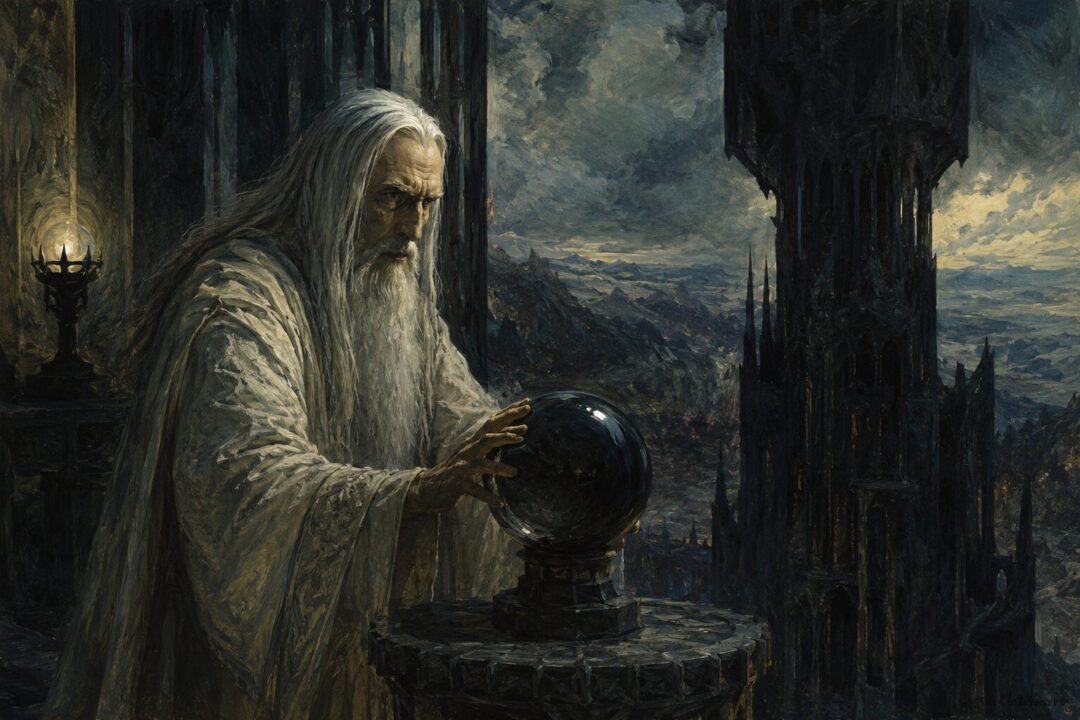
Few objects in Middle-earth promise greater knowledge than the palantíri. These ancient Seeing Stones could reveal distant places, bridge enormous distances, and preserve communication across kingdoms. To a mind devoted to wisdom, they seemed like the perfect instrument.
Yet one of the greatest minds in Middle-earth became noticeably smaller after claiming one.
When readers first meet Saruman in The Lord of the Rings, he is still immensely powerful. He is the head of the White Council, the chief of the Istari, and a figure whom Gandalf once respected above all others. But by the time the War of the Ring unfolds, Saruman no longer seems expansive in thought. Instead, he has become increasingly narrow—obsessed with control, suspicious of rivals, and convinced that only power can overcome power.
The irony is striking. The palantír did not simply deceive Saruman through false visions. The greater tragedy is that it encouraged him to see less, not more. The Stone became a lens through which an already dangerous ambition gradually crowded out wisdom, humility, and hope.
A Tool Built for Truth, Not Deception
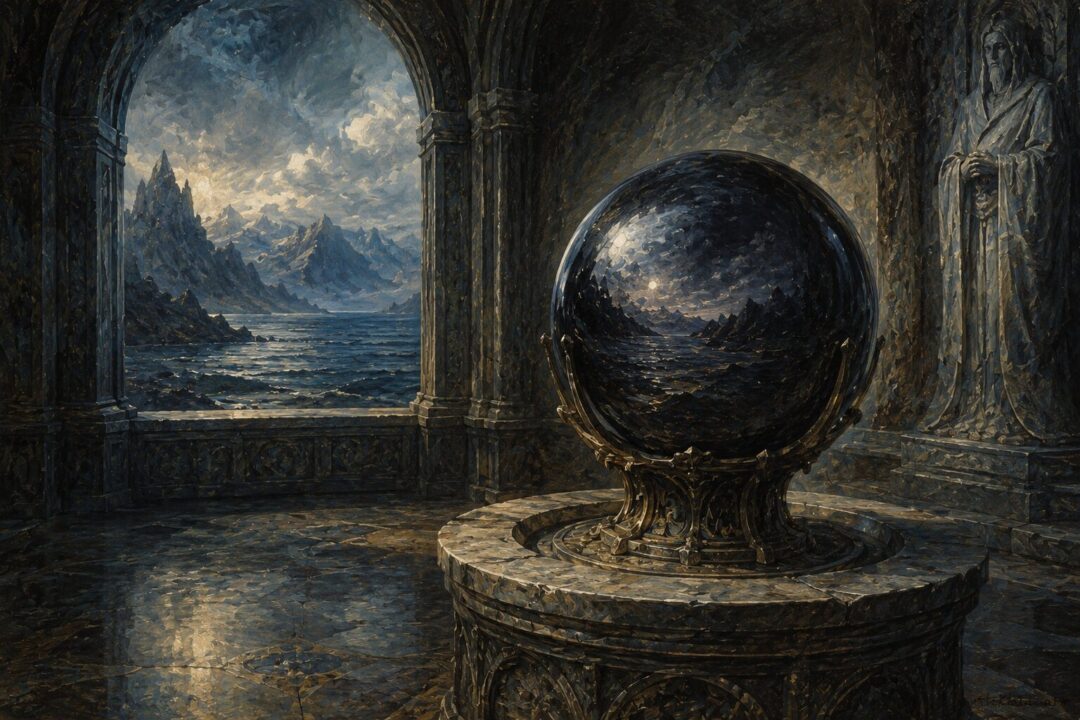
The palantíri were not creations of Sauron. They were ancient Númenórean treasures, traditionally associated with the craftsmanship of Fëanor in the Elder Days, and were brought to Middle-earth by Elendil and his heirs. Their original purpose was communication and observation across vast distances.
The Stones themselves were not inherently corrupt.
A palantír generally showed real things rather than fabrications. The danger lay elsewhere. A viewer might misunderstand what was shown, fail to perceive its full context, or have their attention subtly directed toward particular subjects. The object itself remained truthful, but truth seen incompletely can become deeply misleading.
This distinction matters.
Saruman was not staring into an instrument of lies. He was using an instrument whose value depended upon the wisdom, humility, and strength of the person looking through it.
Saruman Chose to Look
One common misunderstanding is that Saruman simply fell victim to the palantír.
The texts point toward something more complicated.
Saruman had already begun studying the Rings of Power long before openly declaring himself an enemy. He had grown fascinated with Sauron's methods and increasingly believed that knowledge of the Enemy required imitation of the Enemy. Gandalf later reflects that Saruman's mind had turned toward "ring-lore," and his growing pride had become evident well before the climax of the story.
The Orthanc-stone did not create these desires.
Instead, it offered exactly what Saruman already wanted: privileged knowledge, strategic advantage, and the feeling that he alone understood the true shape of events.
That made the Stone uniquely dangerous for him.
The Fatal Difference Between Gandalf and Saruman
Throughout The Lord of the Rings, Gandalf repeatedly accepts limits.
He rarely insists on knowing everything. He trusts others with independent tasks. He allows Aragorn, Frodo, Faramir, Théoden, and many others to exercise judgment without trying to control every decision.
Saruman moves in the opposite direction.
His desire for complete understanding gradually becomes a desire for complete management. Every uncertainty becomes intolerable. Every independent actor becomes either a tool or an obstacle.
The palantír reinforced this mindset.
Rather than broadening Saruman's perspective, it rewarded constant surveillance. It encouraged him to believe that every important event could be observed, predicted, and manipulated if only he looked often enough.
Knowledge slowly became control.
Control slowly became domination.
Sauron's Greatest Advantage Was Psychological
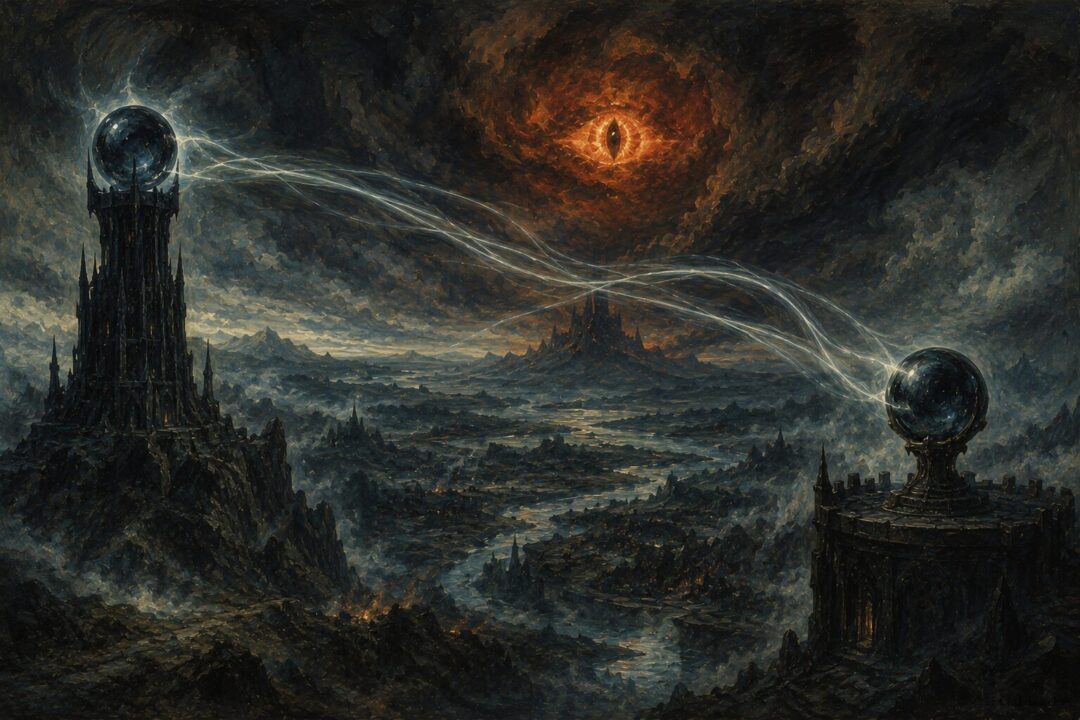
An important detail often overlooked is that Sauron possessed the Ithil-stone from Minas Ithil after its capture.
This gave him enormous influence in any contest of wills conducted through the palantíri.
The Stones did not automatically grant equal authority to every user. Strength of mind mattered greatly.
Sauron was among the mightiest beings remaining in Middle-earth. Saruman, although powerful, was entering repeated encounters with an intelligence vastly older, more experienced, and utterly dedicated to domination.
The result was not mind control in a simplistic sense.
Instead, Sauron appears to have shaped what Saruman saw and emphasized realities that served his own purposes. Because the visions themselves were genuine, Saruman had little reason to doubt them.
He increasingly witnessed Sauron's armies, industrial strength, military preparation, and seemingly overwhelming power.
Those things were all real.
What he failed to perceive were the limits of Sauron's understanding—especially the possibility that someone would willingly seek to destroy the One Ring rather than claim it.
Seeing More While Understanding Less
One of Tolkien's recurring themes is that information alone does not produce wisdom.
Saruman becomes an illustration of this principle.
He likely possessed more military intelligence than almost anyone else in Middle-earth. He knew of troop movements, alliances, fortifications, and political developments. Yet his judgments steadily worsened.
He concluded that resistance was futile.
He believed accommodation with Sauron represented realism.
He assumed every significant figure ultimately desired power.
These conclusions arose not because he lacked facts, but because he interpreted every fact through an increasingly distorted moral framework.
The more he looked into the Stone, the smaller his understanding became.
Why Saruman Could Not Imagine Frodo
The destruction of the Ring depended upon choices that Saruman gradually lost the ability to imagine.
Mercy.
Self-sacrifice.
Pity.
Voluntary renunciation of power.
These virtues repeatedly change history throughout The Lord of the Rings. Bilbo's mercy toward Gollum, Frodo's earlier pity, Sam's compassion, Faramir's refusal to seize the Ring, and Aragorn's willingness to wait rather than grasp power prematurely all shape the outcome.
Saruman increasingly dismisses such qualities as weakness.
His conversations reveal a man who assumes everyone ultimately seeks domination. Even when speaking with Gandalf, he argues that the wise should join Sauron temporarily until the opportunity comes to replace him.
To Saruman, this is simply practical politics.
To Gandalf, it represents complete moral surrender.
The palantír did not teach Saruman this philosophy, but it continually reinforced it by keeping his attention fixed upon contests of power.
Orthanc Became a Prison
There is another quiet irony.
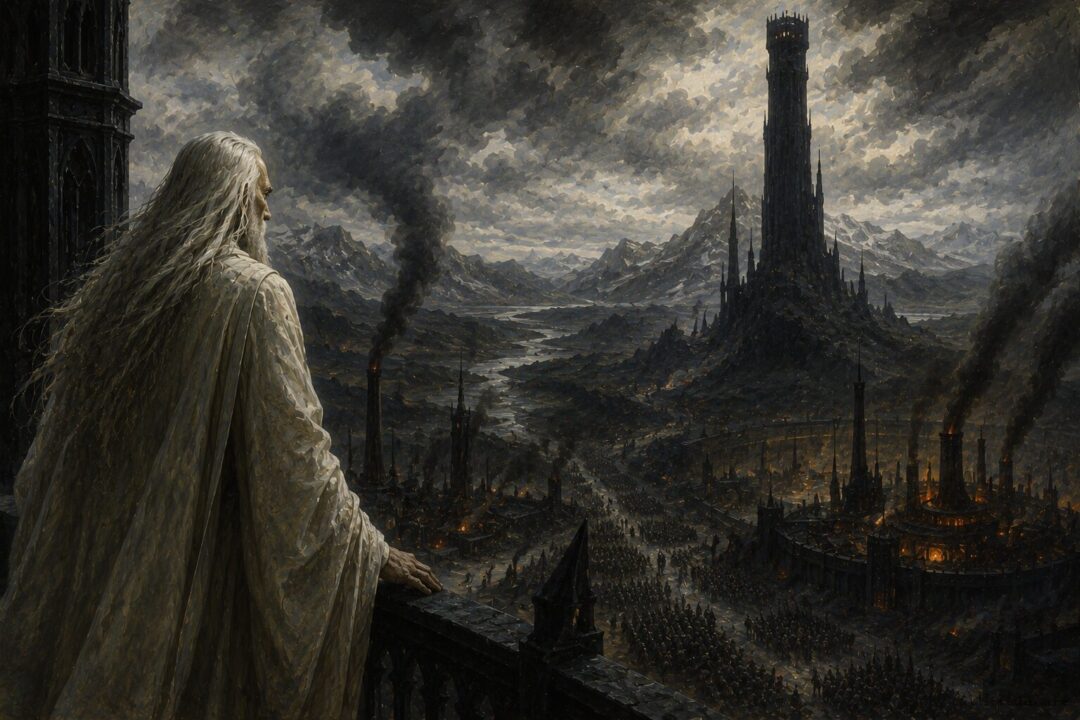
Saruman lived within Orthanc, one of the strongest towers in Middle-earth. Combined with the palantír, it should have made him one of the best-informed leaders alive.
Instead, Orthanc gradually isolated him.
He trusted fewer allies.
He dismissed independent counsel.
He alienated the White Council.
He drove away Gandalf.
He underestimated Rohan.
He failed to anticipate the Ents.
By the end of the story, Saruman possesses extraordinary information yet understands remarkably little about the living world outside his walls.
His physical fortress mirrors his intellectual one.
Both become prisons.
Even the Wise Feared the Stones
The reactions of other characters highlight how dangerous the palantíri could be.
After the fall of Isengard, Gandalf treats the Orthanc-stone with enormous caution.
Later, Aragorn deliberately reveals himself to Sauron through the Stone. Yet this is a calculated risk undertaken by the rightful heir of Elendil at precisely the moment it serves a larger strategy.
Even then, the encounter is dangerous.
Neither Gandalf nor Aragorn treats the palantír as a harmless source of information.
By contrast, Saruman appears to have relied upon it repeatedly over a long period.
The difference lies not merely in courage but in discipline.
The wise use the Stone sparingly.
Saruman comes to depend upon it.
The Illusion of Mastery
Saruman's downfall repeatedly follows the same pattern.
He breeds armies but misunderstands courage.
He builds machines but misunderstands endurance.
He calculates military strength but misunderstands loyalty.
He studies Rings but misunderstands their deepest temptation.
The palantír fits perfectly into this pattern.
It convinces him that greater observation means greater mastery.
Yet Middle-earth continually demonstrates that history cannot be reduced to calculation.
Unexpected mercy changes destinies.
Small people reshape kingdoms.
Providence—never fully explained in the text but repeatedly implied—works through choices that cannot be predicted by simple strategic reasoning.
Saruman gradually loses sight of this entire dimension of reality.
Why the Stone Could Not Save Him
There comes a point when Saruman likely possesses more immediate intelligence than Théoden, Denethor, or even Gandalf about certain military matters.
Yet he makes poorer decisions than all of them.
His greatest defeat does not come because the Stone fails.
It comes because he has become the wrong kind of person to use it.
The palantír amplifies whatever already exists in its user.
A wise mind may use it cautiously.
A proud mind finds its pride continually confirmed.
A fearful mind discovers endless reasons for fear.
Saruman enters the relationship already convinced that exceptional intelligence entitles him to exceptional authority. The Stone rewards this conviction until nearly every event is interpreted through the pursuit of power.

A Different Kind of Greatness
By the end of The Lord of the Rings, the contrast is unmistakable.
Saruman sought to become greater by knowing more.
The truly great figures of the story become greater by accepting limits.
Frodo carries a burden he cannot fully understand.
Sam keeps going without seeing the whole plan.
Aragorn waits for the proper time rather than forcing events.
Gandalf repeatedly trusts others instead of controlling them.
These characters often possess less information than Saruman.
Yet they possess something more important: wisdom about the limits of power.
That is why the palantír ultimately made Saruman smaller instead of greater.
It narrowed his vision until every question became a question of domination. It reduced a being created to guide and encourage the peoples of Middle-earth into someone who believed that victory belonged only to whoever could command the most knowledge and the greatest force.
The tragedy is not that Saruman saw too little.
It is that he looked at more and more of the world while understanding less and less of what truly mattered.
Sources & Notes
- Wikipedia overview of palantíri and their use by Saruman, Denethor, and Sauron — https://en.wikipedia.org/wiki/Palant%C3%ADr
- Wikipedia overview of Saruman and his fall — https://en.wikipedia.org/wiki/Saruman
- Wikipedia overview of Sauron and the strategic pressure behind the seeing-stones — https://en.wikipedia.org/wiki/Sauron
Sources selected for Tolkien-lore context and reader verification.