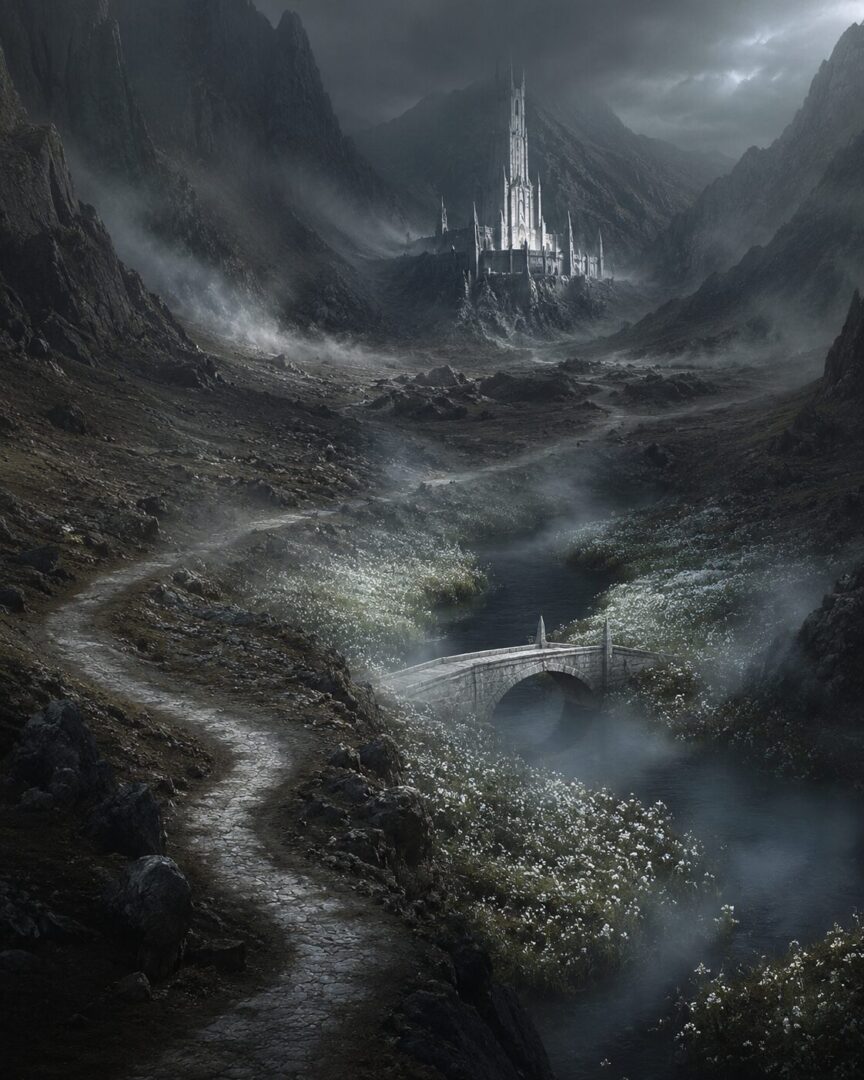
Before Shelob appears, before the tunnel closes around Frodo and Sam, and before the last light of Galadriel’s phial becomes a weapon in the dark, the road itself has already begun to feel wrong. The horror does not begin with the Spider. It begins lower down, in the pale valley beneath Minas Morgul, where flowers shine with an unnatural beauty, the river steams coldly, and even time seems to thicken around the feet of the Ring-bearer.
That is one of the most easily missed details in the journey to Mordor. Shelob is terrifying because she is a living predator, ancient and hungry. But the Morgul Vale is terrifying because it feels like a place that has been sick for centuries. It is not merely dangerous terrain. It is a wounded landscape, a conquered memory, and a spiritual trap.
The texts strongly imply that the vale’s sickness comes from three overlapping causes: the fall of Minas Ithil into Minas Morgul, the long habitation of the Nazgûl, and the particular way evil in Middle-earth can corrupt not only bodies and wills, but places. Shelob waits above the valley, but the valley was already poisoned before the hobbits ever reached her stairs.
Minas Ithil: The Fair Place That Became Its Own Opposite
The tragedy of the Morgul Vale begins with what it used to be. Minas Morgul was not built as a city of horror. It was originally Minas Ithil, the Tower of the Moon, founded by the Dúnedain of Gondor in the mountains west of Mordor. It stood as the sister-city of Minas Anor, later Minas Tirith, and guarded the eastern approaches of Gondor. Its placement was strategic, but also symbolic: a moon-tower watching the shadowed land beyond.
That origin matters because Tolkien’s horror often works through corruption rather than mere ugliness. The worst places in Middle-earth are not always barren from the beginning. They are fair things bent out of shape. The Morgul Vale feels sick because it is not simply dark; it is a desecrated version of something once ordered, proud, and beautiful.
When the Nazgûl took Minas Ithil in the Third Age, the city was renamed Minas Morgul, the Tower of Dark Sorcery. The capture is not presented as a minor military loss. It changes the spiritual geography of the whole region. What had been a watchtower against Mordor becomes one of Mordor’s chief western threats. The guardian becomes the infection.
That reversal explains why the valley’s sickness feels so intimate. It is not the wild terror of Mirkwood’s spiders or the raw desolation of Gorgoroth. It is the horror of a place that still remembers beauty, but can no longer express it except as parody.
The Nazgûl Did Not Merely Occupy the Vale
Faramir’s warning is crucial. He tells Frodo that the valley passed into evil long before Sauron openly returned, and that the Nine filled Minas Ithil and the valley around it with decay. The important point is that the Morgul Vale did not become dreadful only because Sauron sat in Barad-dûr. It was already a menace while the Enemy was still hidden elsewhere. Goodreads
That places responsibility heavily on the Nazgûl. They are not merely military commanders using an abandoned fortress. They are “living ghosts,” men consumed by the Rings given by Sauron, and their presence has a continuing effect. The text does not give a technical rule for how Ringwraiths corrupt stone, water, or air. It does, however, repeatedly associates them with dread, cold, paralysis, and the weakening of will.
So the safest reading is this: the Nazgûl’s long residence made Minas Morgul a center of spiritual pressure. Their evil was not just political control. It was an atmosphere. The vale became a place where fear seemed to live even when no visible enemy appeared.
This is why the city “seemed empty” but was not empty in any meaningful sense. The terror of Minas Morgul is not only that soldiers might be watching. It is that malice itself feels awake there. Faramir calls it a place of sleepless malice and lidless eyes. That language does not require us to invent literal eyes in every stone. It means that the place has become hostile to the mind before it becomes hostile to the body.
The Poisoned Meads: Beauty Turned Rotten
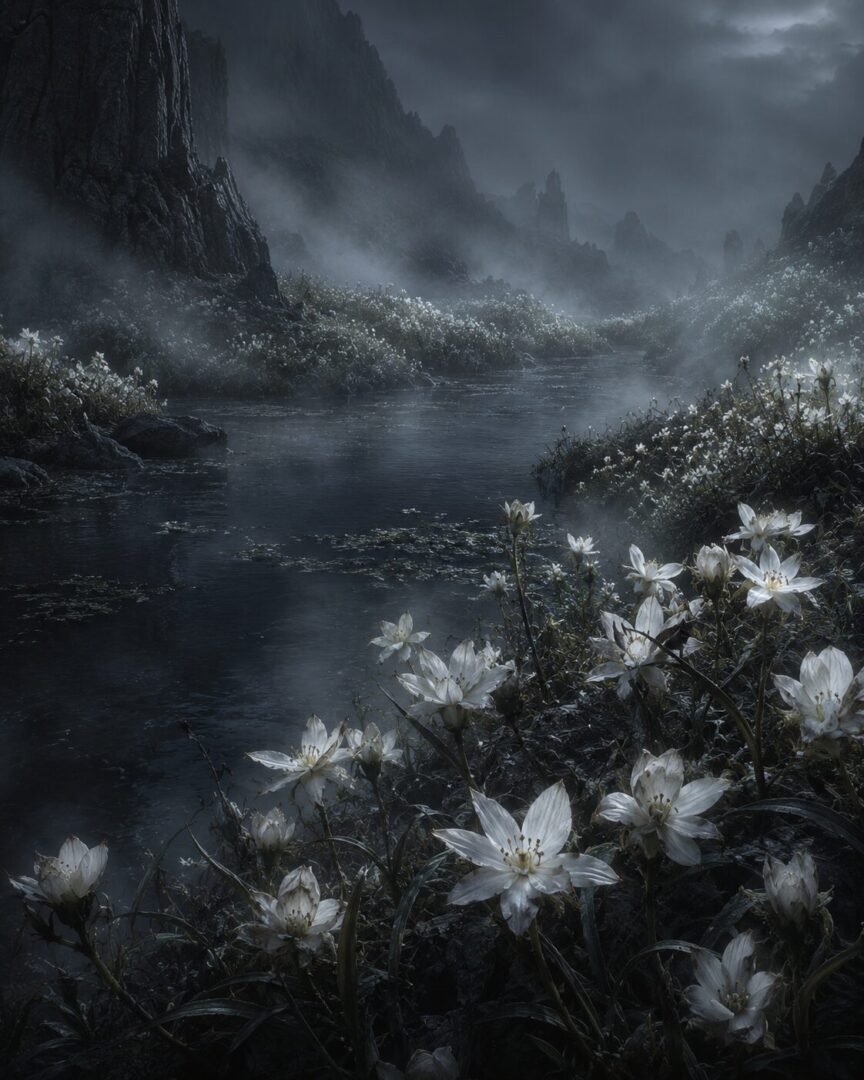
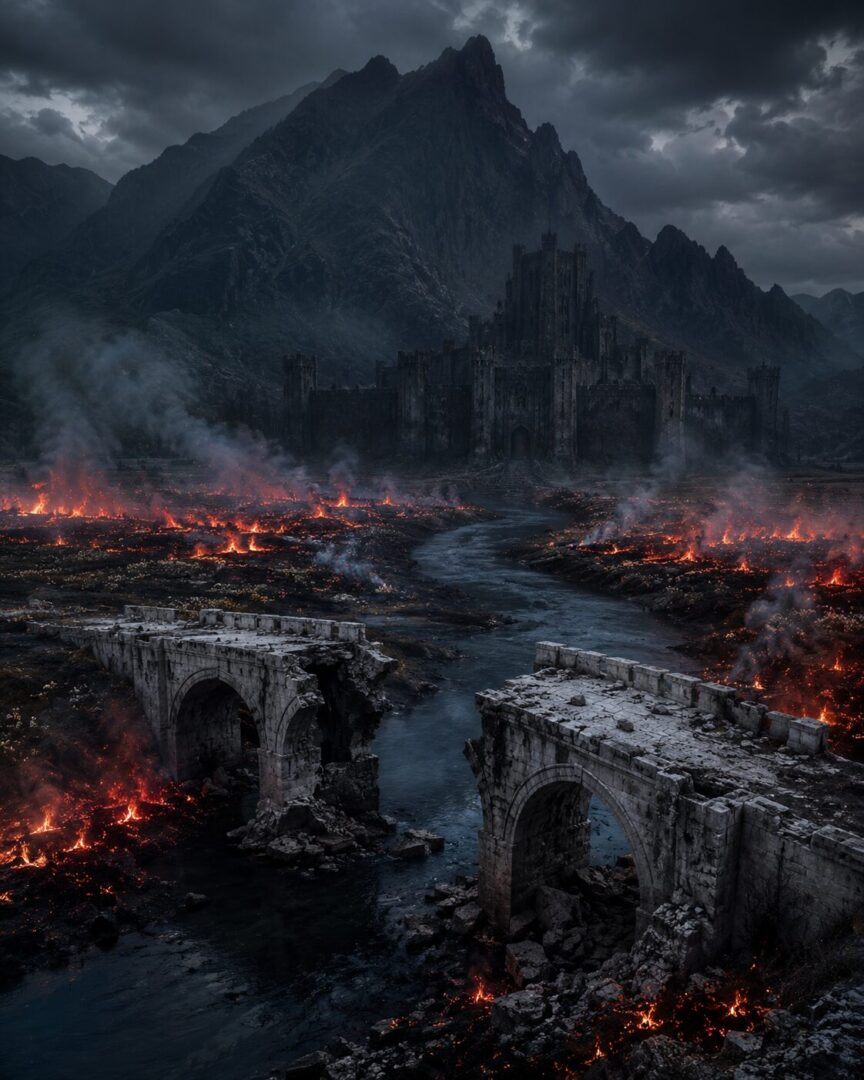
The most unforgettable detail in the Morgul Vale is not a monster, but a meadow. Along the Morgulduin, Frodo, Sam, and Gollum pass flats filled with pale flowers. They are luminous, beautiful, and horrible at once. Their smell is associated with decay, and the air itself feels rotten. The river beneath the bridge is silent, steaming, and unnaturally cold.
This is one of the clearest signs that the sickness of the vale is not only emotional. The land has been physically altered. The flowers are not ordinary flowers growing in a gloomy place. They are a corrupted ecology: life that has not disappeared, but has been made wrong.
That distinction is important. Mordor is often imagined as lifeless, but the Morgul Vale is worse in a subtler way. Things grow there. They glow. They have form, scent, and beauty. But their beauty has become untrustworthy. The valley teaches the same lesson as the Rings on a smaller scale: not all shining things are wholesome.
The phrase “Poisoned Meads” is apt because the meadows are not merely unpleasant. They suggest a landscape where nourishment has turned toxic. Water, flowers, air, and smell all participate in the same corruption. The sickness is not one object in the vale. It is the relationship between everything there.
Why Frodo Is Drawn Toward the Bridge
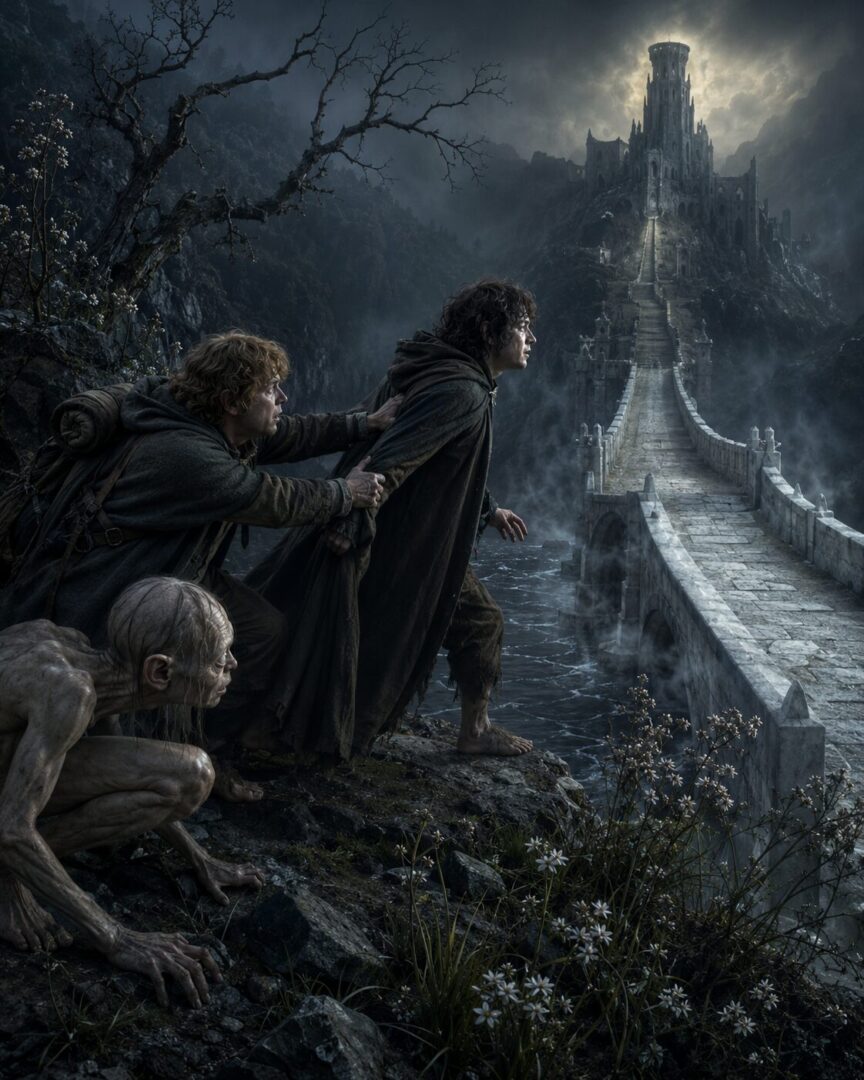
The most frightening moment in the valley may be Frodo’s sudden movement toward the bridge. He does not simply decide badly. His mind darkens, his senses reel, and he begins to move as if some force other than his own will is at work. Sam has to pull him back, and Gollum, for once, is right to panic.
This matters because the Morgul Vale is not just repulsive. It is also attractive in a dreadful way. The danger is not only that Frodo might be seen. It is that he might be drawn toward the very gate that will destroy him.
There are several forces converging on him. He carries the One Ring near one of the chief strongholds of the Ringwraiths. The Witch-king is present in the city. The valley itself has long been steeped in Morgul power. The text does not isolate a single mechanical cause, so it is best not to overstate one. But the implication is clear: Frodo’s burden makes him especially vulnerable to a place shaped by the servants of the Ring’s maker.
The Morgul Vale feels sick because sickness, in this scene, includes the weakening of moral and bodily resistance. Frodo is not attacked by a blade here. He is almost lured into surrender by atmosphere.
Shelob Is Not the Source of the Vale’s Evil
Shelob’s lair lies above the Morgul Vale, near the pass of Cirith Ungol. The route from the valley climbs by the Stairs of Cirith Ungol toward the tunnel where she dwells. She is ancient, independent in appetite, and not simply an obedient servant of Sauron. But the valley below is not sick because Shelob is nearby.
This is easy to confuse because the chapters build dread continuously. The reader moves from Faramir’s warning, to the Morgul-road, to Minas Morgul, to the stairs, to Shelob’s tunnel. The horror feels like one rising movement. But within the lore, the sources of dread differ.
Shelob represents old hunger: a remnant of a darkness connected with Ungoliant, brooding in a tunnel, devouring whatever comes near. Minas Morgul represents organized spiritual domination: the long work of the Nazgûl, the perversion of a Gondorian city, and the shadow of Sauron’s return.
The distinction makes the journey more frightening, not less. Frodo and Sam are not passing through one monster’s territory. They are moving through layered evils. First comes the corrupted city and vale. Then the Ringwraith’s host. Then the stairs. Then Shelob. Mordor is not a single kind of darkness. It is an alliance of different corruptions, some ancient, some political, some bestial, some spiritual.
The Morgul Vale as a Wound in Gondor’s Memory
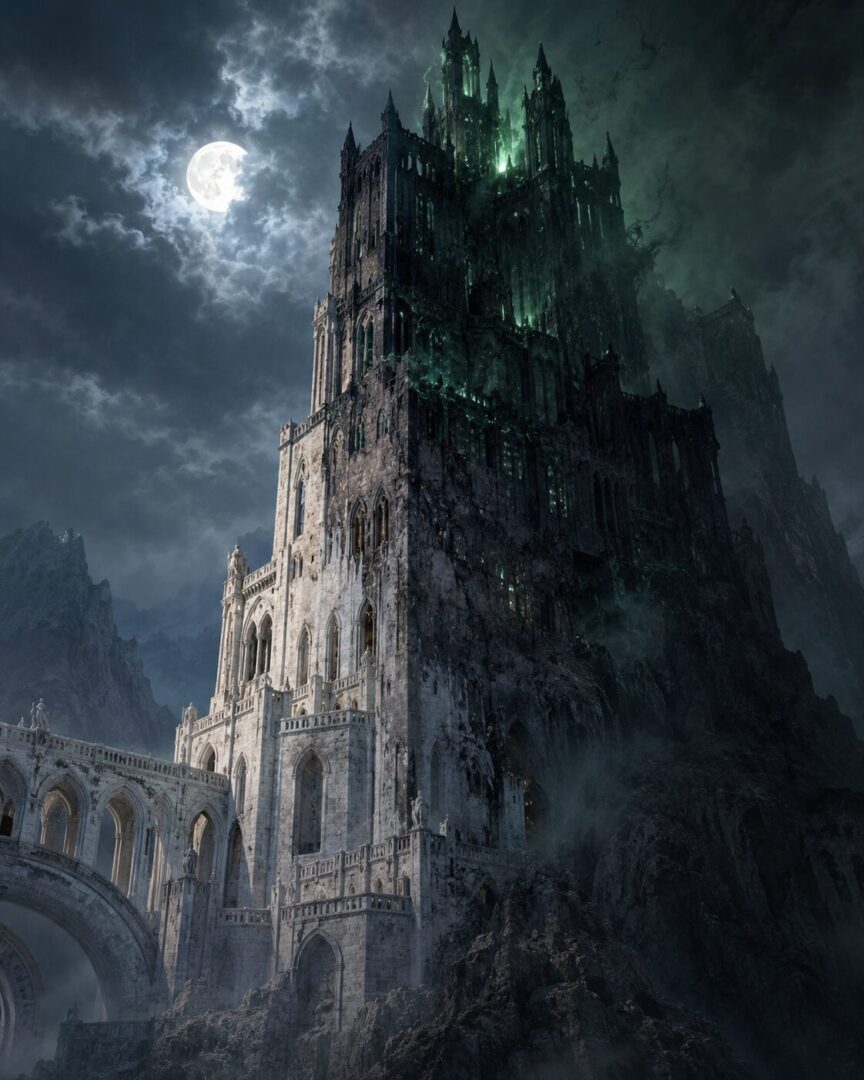
The vale also feels sick because it is a wound in Gondor’s history. Minas Morgul is not far-off evil in an unknown land. It is a stolen Gondorian place. Its existence proves that the Shadow does not only threaten borders; it can take what was made to resist it and turn that very thing into a weapon.
That is why Faramir’s warning carries such weight. He does not speak of Minas Morgul as a traveler repeating frightening rumors. He speaks as a man of Gondor describing an ancestral loss. The valley is part of a long defeat: Ithilien diminished, Minas Ithil taken, Osgiliath ruined, and Minas Tirith left facing its corrupted sister across the lands between.
The sickness of the Morgul Vale is therefore historical as well as supernatural. A place does not need to be conscious to carry memory. In Middle-earth, ruins often mean more than broken stone. They reveal the moral direction of ages. The Dead Marshes remember battle. Weathertop remembers watchfulness and attack. Moria remembers grandeur and delving too deep. Minas Morgul remembers the fall of a moonlit tower into sorcery.
Why the Vale Still Feels Sick After the Army Leaves
A final detail confirms how deep the corruption runs. After the fall of Sauron, Gandalf and Aragorn come to the entrance of the Morgul Vale. The city is dark and lifeless, its forces gone, yet the air remains heavy with fear and enmity. They break the bridge and burn the noisome fields before leaving.
That moment matters because it shows the vale’s evil is not instantly erased when its soldiers depart. The place has been steeped too long. Its sickness has to be answered, cleansed, and perhaps abandoned for a time. This does not mean evil is stronger than good in the end. It means evil leaves residue. It damages what it inhabits.
That is one of the quiet moral truths of the Morgul Vale. Corruption is not only an event. It is a process. The Nazgûl did not merely conquer Minas Ithil; they dwelt there, and over long years the valley became an outward expression of inward ruin.
The Sickness Before the Spider
So why did the Morgul Vale feel sick even before Shelob?
Because Shelob was not the beginning of the horror. She was the next depth of it.
The vale was sick because a fair city had been inverted into a tower of sorcery. It was sick because the Nazgûl had inhabited it long enough for fear to seem rooted in the stones. It was sick because its river, flowers, bridge, and air had become signs of beauty corrupted rather than beauty destroyed. It was sick because Frodo, carrying the Ring, could feel in that place a pressure aimed not merely at his life, but at his will.
Shelob waits in darkness above, but Minas Morgul is already darkness with architecture, history, and memory. The Spider threatens to devour the body. The Morgul Vale threatens something earlier and more subtle: the power to choose the road away from the gate.
That is why the valley feels ill before the tunnel. It is not a prelude to evil. It is evil already settled into the land.
Sources & Notes
- Tolkien Gateway, “Morgul Vale” — outlines the valley’s geography, corruption, and relation to Minas Morgul and Mordor. https://tolkiengateway.net/wiki/Morgul_Vale
- Tolkien Gateway, “Minas Morgul” — explains the city’s fall from Minas Ithil into the Witch-king’s haunted stronghold. https://tolkiengateway.net/wiki/Minas_Morgul
- Tolkien Gateway, “Shelob” — provides context for Shelob’s lair above the vale and her role on the pass into Mordor. https://tolkiengateway.net/wiki/Shelob
Sources added for Morgul Vale, Minas Morgul, and Shelob context.