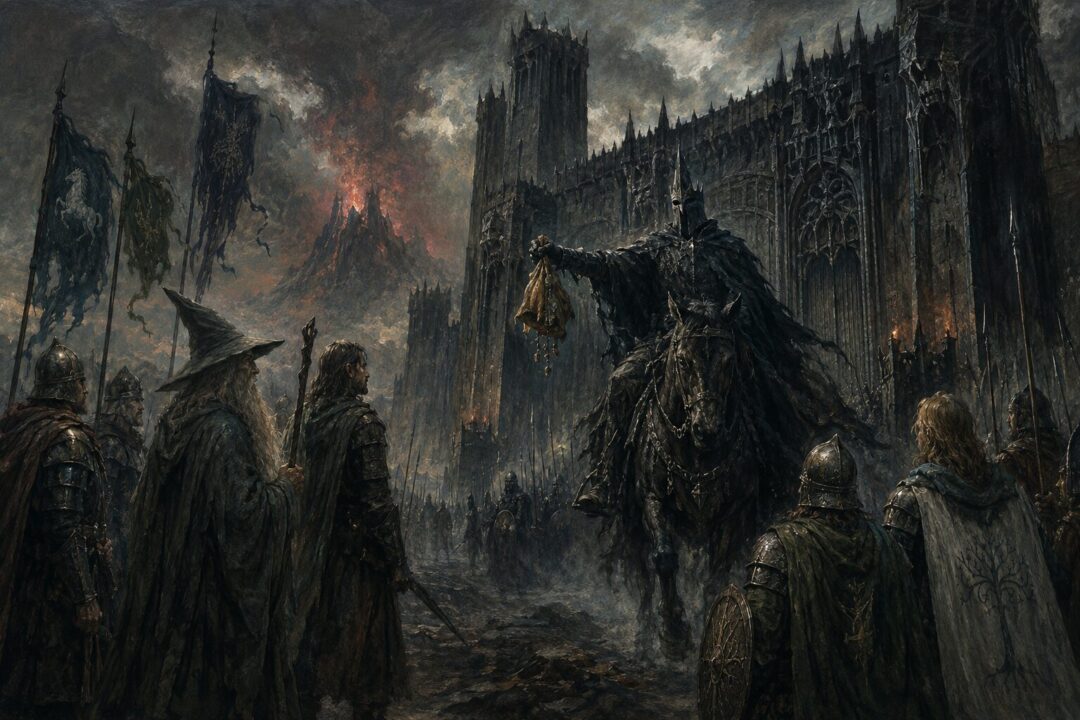
At the Black Gate, Sauron’s messenger does not bring Frodo out in chains.
He does not show a body. He does not produce the Ring. He does not even prove, in any complete way, that the prisoner he describes is still alive. Instead, he unwraps a few terrible tokens before Gandalf, Aragorn, and the Captains of the West: a short sword, a grey cloak with an Elven brooch, and the mithril-coat Frodo had worn beneath his clothes.
It is one of the cruelest moments in The Return of the King because it almost works. Pippin recognizes enough to be horrified. Gandalf is forced to silence the emotional reaction. For a moment, the last desperate hope of the West seems to have been discovered, captured, and broken.
But the detail that makes the scene so frightening is also the detail that reveals its weakness. The Mouth of Sauron has Frodo’s gear. He does not have Frodo. He does not have Sam. And most importantly, he does not have the One Ring.
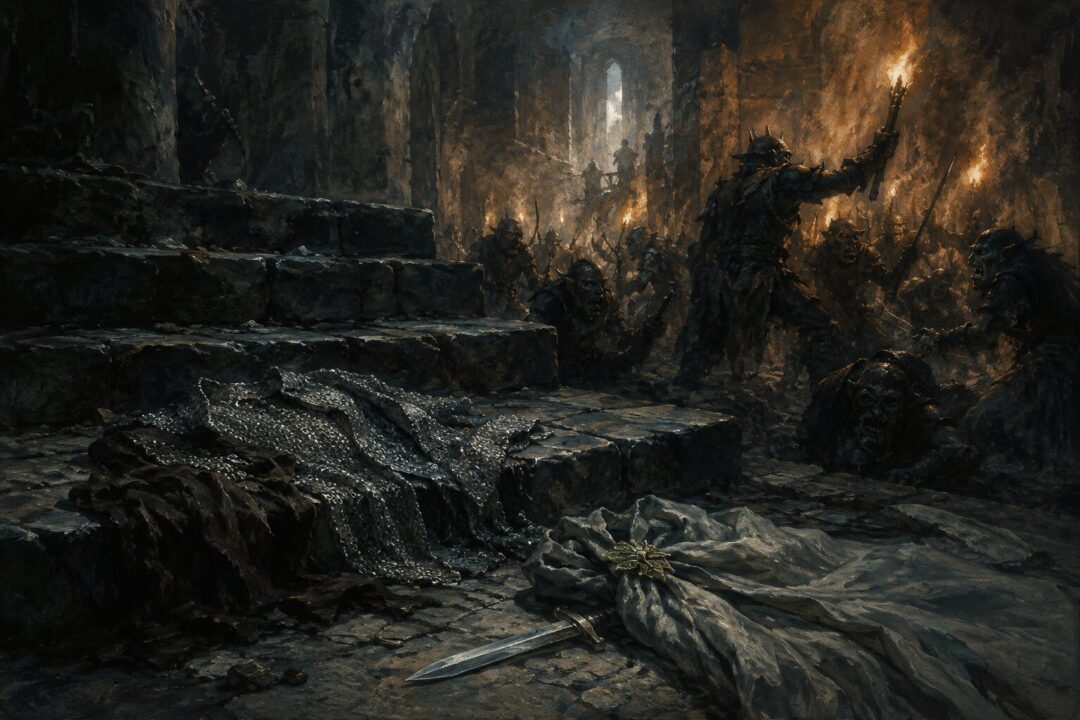
The Tokens Were Real, But The Story Was Incomplete
The objects shown at the Black Gate are not random props. They come from the disaster at Cirith Ungol, after Shelob stung Frodo and Sam believed his master dead. Frodo was taken by Orcs into the Tower, stripped, searched, and left imprisoned. During the chaos that followed, the Orcs quarrelled violently over the spoils, especially the precious mithril-shirt.
That shirt mattered for several reasons. It had come from Bilbo to Frodo. It had saved Frodo in Moria. Gandalf had already said that its value was immense, greater than ordinary treasure. In Mordor, it would not have looked like the possession of a common wanderer. It was exactly the kind of object that would be seized, reported, fought over, and eventually sent upward through Sauron’s chain of command.
The Mouth of Sauron therefore displays genuine evidence. The horror of the scene depends on that. Gandalf and the others are not being shown a cheap forgery. These things really had belonged to the hobbits. Their appearance means that Mordor had touched the hidden mission.
But real evidence is not the same thing as full knowledge.
The Mouth presents the gear as though it proves everything: the “spy” has been captured, his friends should despair, and the West must now bargain for his life. Yet the very form of the evidence is limited. The tokens prove that someone in Mordor found the clothing and equipment of the hobbits. They do not prove that Frodo is still in custody. They do not prove that the Ring has been found. They do not prove that Sauron understands the true purpose of the mission.
That gap is the heart of the scene.
Sauron Thought Like A Conqueror, Not Like A Ring-Bearer
Sauron’s great error throughout the final movement of the story is not simple stupidity. It is a failure of imagination shaped by pride.
He knows the Ring exists. He knows it has been found. He knows a hobbit was connected with it. He knows Aragorn has revealed himself through the palantír and has come openly as Isildur’s heir. From Sauron’s perspective, the most dangerous possibility is not that someone would try to destroy the Ring. The most dangerous possibility is that one of his enemies would try to use it.
That is why the march to the Black Gate works as a diversion. Aragorn’s impossible assault looks, to Sauron, like the move of a rival who has acquired a weapon too powerful to resist using. The army of the West is far too small to conquer Mordor by strength. Its boldness therefore appears to confirm Sauron’s fear: someone must be acting under the confidence of the Ring.
Within that logic, a lone hobbit found near Cirith Ungol is not necessarily the Ring-bearer on a mission to Mount Doom. He can be interpreted as a spy, a scout, a servant of the Captains, or part of some confused western plot. The Mouth’s language at the parley leans into that interpretation. He speaks of espionage and bargaining, not of the Ring.
This matters because it explains why Sauron can possess Frodo’s gear and still fail to understand the truth. The information is real, but it is filtered through the Enemy’s assumptions. Sauron is watching for power. He is not watching for renunciation.
Why Not Show Frodo Himself?
The simplest answer is that Sauron’s servants no longer had Frodo.
Sam rescued Frodo from the Tower of Cirith Ungol before the parley at the Black Gate. By the time the Mouth of Sauron rides out, Frodo and Sam are already moving through Mordor in disguise. Mordor has the tokens because Shagrat escaped with Frodo’s belongings, but the prisoner himself has vanished from the Tower.
That makes the Mouth’s performance partly a bluff.
He speaks as though the prisoner is securely held and subject to torment. But the text gives the reader reason to doubt how much he actually knows. He has objects. He has a narrative built around those objects. What he lacks is the one thing that would make the threat absolute: the captive himself.
This is why the gear is so effective dramatically. If the Mouth had shown Frodo in chains, the quest would be over. If he had shown the Ring, the quest would be over. If he had shown a body, Gandalf would have faced a different kind of horror. But the tokens leave just enough uncertainty for wisdom to survive.
Gandalf’s restraint is crucial. He does not allow Pippin’s reaction to become a confession. He does not collapse into panic. He takes the tokens, but he refuses the terms. He understands that Sauron’s messenger is not offering truth. He is using grief as a weapon.
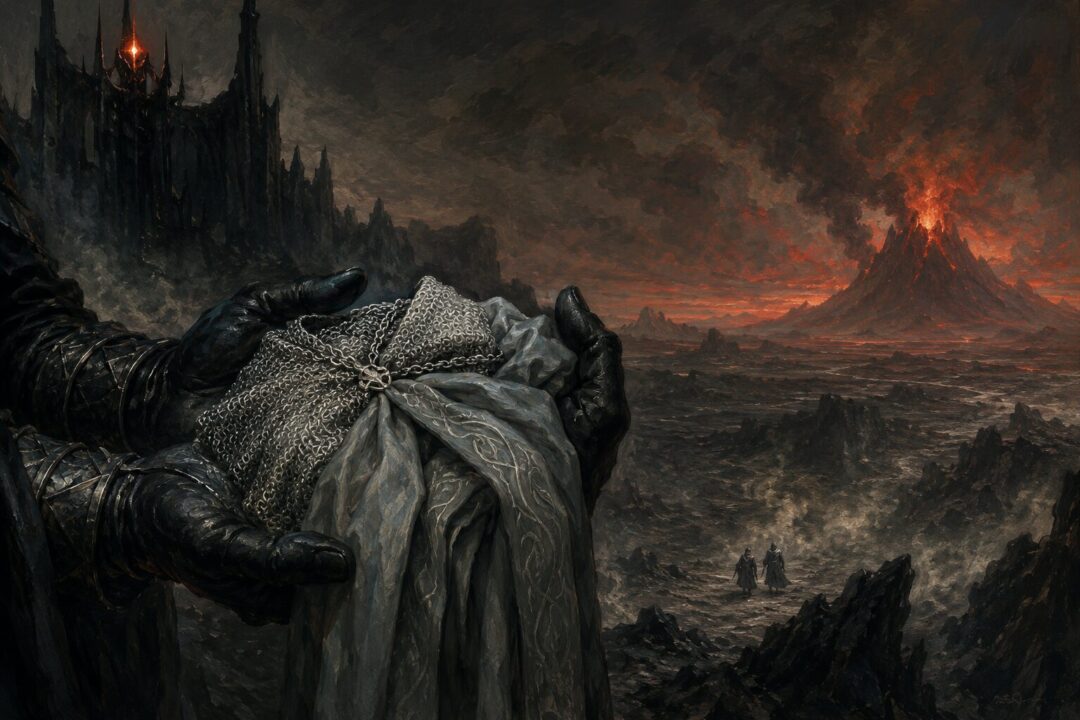
The Gear Was Chosen To Wound The Captains Emotionally
The Mouth of Sauron does not need perfect proof to do damage. He needs recognition.
A mithril-coat, an Elven cloak, and a small sword are enough to stab at the hearts of those who know the hobbits. These are intimate objects, not battlefield trophies. They carry the memory of Rivendell, Lothlórien, the Shire, and the long road south. To Pippin especially, the sight of them is devastating because they belong to someone small, beloved, and seemingly lost inside the darkness.
That is the cruelty of the scene. Sauron’s messenger is not merely reporting a capture. He is trying to make the Captains see Frodo as already defeated. The tokens are arranged as emotional evidence. They are meant to make the West imagine imprisonment, torture, and failure.
The Mouth understands enough about fear to know that a few personal belongings can be more powerful than a corpse. A corpse ends uncertainty. Tokens prolong it. They force the listener to complete the horror in his own mind.
This is very much in keeping with the way Mordor operates. The Enemy rules by domination, terror, and the breaking of hope. At the Black Gate, the Mouth does not need to win an argument. He needs to poison courage before the battle begins.
The Missing Ring Is The Loudest Silence
The most important object absent from the parley is the One Ring.
If Sauron had recovered it, there would be no need for this negotiation. There would be no need to threaten the life of a captured hobbit. The war would already be decided. The fact that the Mouth shows clothing, mail, and a sword, but not the Ring, is the hidden clue beneath the terror.
Of course, the Captains at the Black Gate do not have the reader’s full view of Frodo and Sam’s escape. They cannot know exactly what has happened. But Gandalf can still recognize the shape of the deception. Sauron is demanding surrender from a position that sounds powerful but is not complete. He is trying to turn partial knowledge into total despair.
The Ring’s absence also shows the limits of Sauron’s control. Mordor is vast, brutal, and organized by fear, but it is not all-seeing in the simple way readers sometimes imagine. Messages can be delayed. Orcs can quarrel. Captains can misunderstand. Greed can disrupt orders. The Tower of Cirith Ungol becomes a miniature image of evil turning against itself.
The Enemy’s system gathers Frodo’s possessions, but it fails to keep Frodo. It seizes the signs of the quest, but not the quest itself.
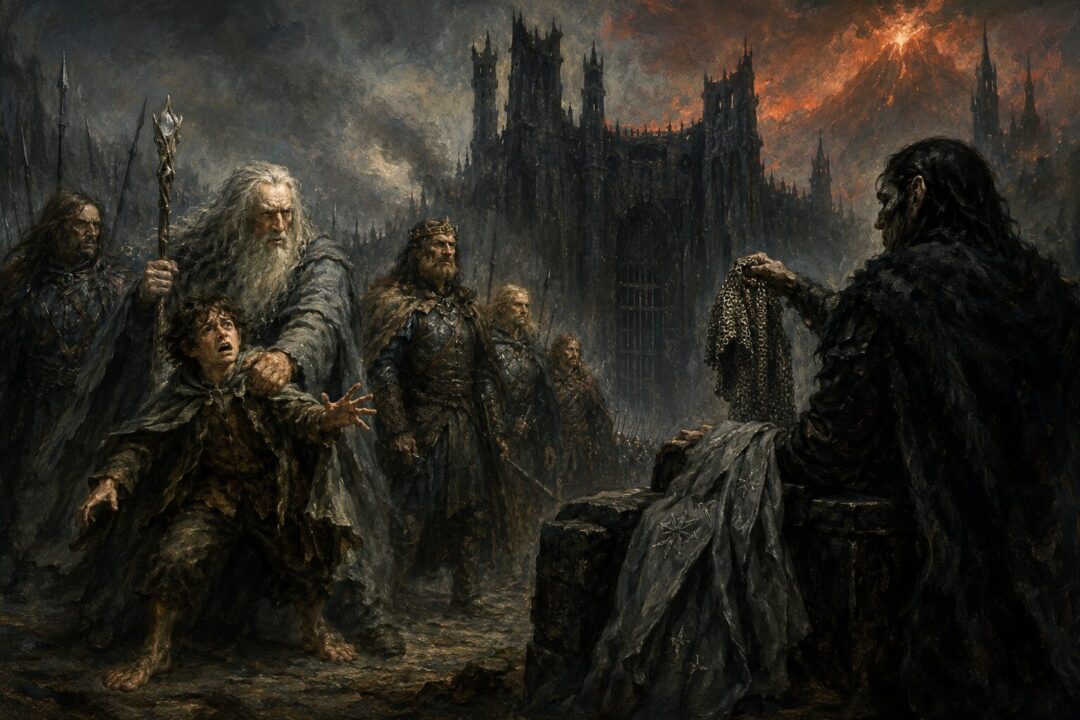
Sam’s Sword Makes The Bluff Even Stranger
One overlooked detail is that the Mouth’s evidence is not perfectly clean. Among the objects is the short sword Sam had carried, while the mithril-coat belonged to Frodo. The bundle is a mixture of belongings from the two hobbits’ ordeal at Cirith Ungol.
This does not mean the Mouth knows there are two hobbits moving through Mordor. In fact, one careful reading is that the mixed evidence may suggest confusion rather than clarity. The Enemy has collected items connected with the captured prisoner and the struggle around him, but the story being told at the Black Gate is simplified into the capture of a single “spy.”
That simplification benefits the bluff. The Mouth does not need to explain every detail. He only needs the Captains to recognize enough to despair.
But for readers, the mixture matters. It reminds us that the truth is messier than the Enemy’s performance. Frodo’s apparent defeat led to Sam’s courage. Sam’s temporary bearing of the Ring preserved the quest. The very objects used to suggest final failure actually belong to a chain of mercy, loyalty, and desperate improvisation that Sauron has not understood.
The Mouth displays the evidence of disaster. He does not understand the hidden grace inside it.
The Terms Reveal The Real Purpose
The Mouth of Sauron’s demands are political and territorial. He seeks surrender, tribute, disarmament, and control. The prisoner is used as leverage to force the Captains of the West to accept domination.
That makes the scene more than a taunt. It is a final attempt to win without needing to explain the truth. Sauron’s messenger wraps terror in diplomacy. He comes as an ambassador, but his offer is enslavement. He pretends there is a bargain to be made, but the bargain is designed to reduce the free peoples to helplessness.
The gear is therefore not proof in a legal sense. It is pressure. It is a negotiation tool. It says: we know enough to hurt you, and we hold enough to make you afraid.
Gandalf’s refusal breaks that spell. He does not deny that the tokens are real. He does not pretend the sight is meaningless. But he rejects the false conclusion Sauron wants him to draw from them. The West cannot buy Frodo’s safety by surrendering the world. And if Frodo is not truly in Sauron’s hands, surrender would only complete the Enemy’s victory.
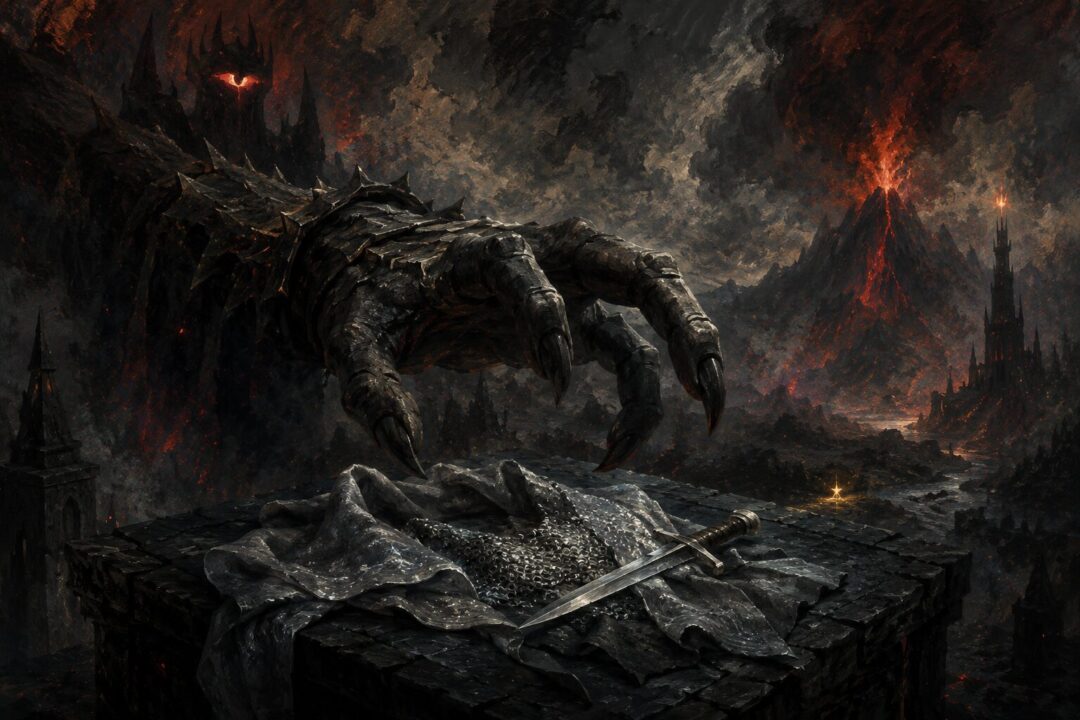
Sauron Almost Wins By Misreading The Truth
The terrible irony is that Sauron is both dangerously close and fatally wrong.
He has evidence from the Ring-bearer’s path. His servants have handled Frodo’s clothing. His fortress has briefly held Frodo himself. His messenger can break the hearts of Frodo’s friends with a few stolen things. Yet Sauron still does not grasp the essential truth: the Ring is not being brought to a new master. It is being carried to destruction.
That is why the Mouth shows gear instead of proof. The gear is all Mordor has. It is enough to frighten, enough to wound, enough to tempt despair. But it is not enough to stop the quest.
The scene at the Black Gate is built on that razor edge. The West stands before overwhelming force. Frodo and Sam are lost somewhere in the ash and shadow. Sauron believes he is tightening his hand around all his enemies at once.
But his hand has closed on the wrong things.
He has the cloak, the sword, and the mithril-shirt. He does not have the hobbits. He does not have the Ring. He does not have the one truth his pride cannot imagine: that the smallest and weakest might come into his land not to claim power, but to give it up.
That is why the Mouth’s display is so memorable. It is a lie made out of real objects. It is terror built on incomplete knowledge. And in the gap between the tokens and the truth, the fate of Middle-earth remains barely, impossibly alive.
Sources & Notes
- J.R.R. Tolkien, The Lord of the Rings, Book V, Chapter 10, “The Black Gate Opens” — the Mouth of Sauron displays the mithril-coat, Elven-cloak, and sword as tokens and uses them to demand surrender.
- J.R.R. Tolkien, The Lord of the Rings, Book VI, Chapter 1, “The Tower of Cirith Ungol” — Frodo is stripped in the Tower; Orcs quarrel over the mithril-shirt; Shagrat escapes with Frodo’s gear while Sam rescues Frodo.
- J.R.R. Tolkien, The Lord of the Rings, Book V, Chapter 9, “The Last Debate” — Gandalf and Aragorn frame the march on Mordor as a deliberate diversion to draw Sauron’s Eye away from Frodo.
- J.R.R. Tolkien, The Lord of the Rings, Book II, Chapter 4, “A Journey in the Dark” — the mithril-coat is revealed as Bilbo’s gift and a treasure of extraordinary value after it saves Frodo in Moria.
- J.R.R. Tolkien, The Letters of J.R.R. Tolkien, Letter 246 — Tolkien explains that Sauron did not imagine his enemies would try to destroy the Ring rather than wield it.