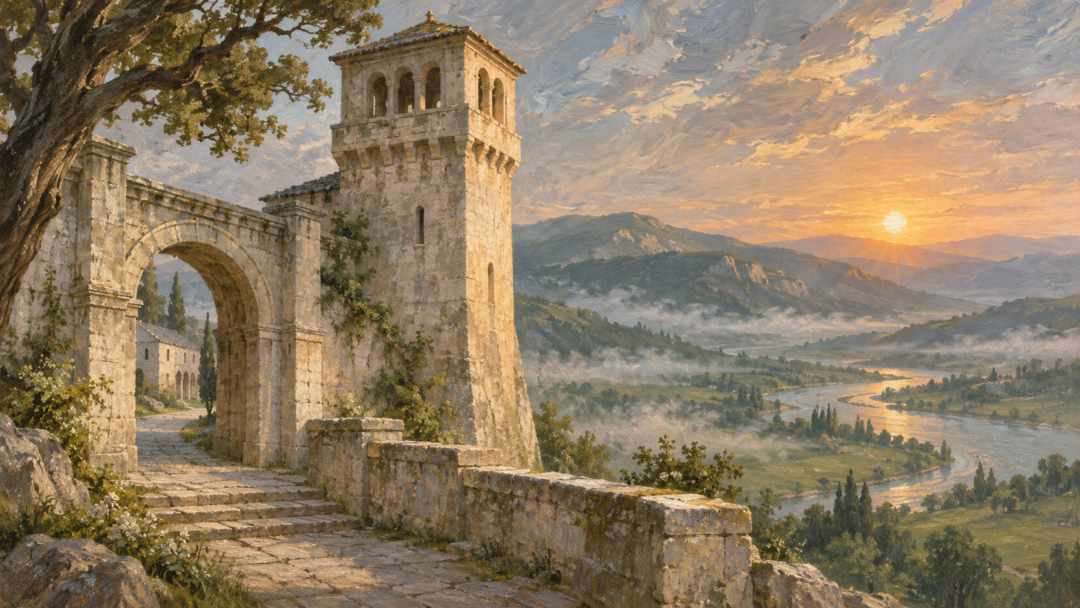
In Gondor’s history, the younger son of Elendil is remembered as Anárion, while the city associated with his house was once called Minas Anor. Put the names side by side and a puzzle appears: why does the Sun seem to be Anor in the city’s name but Anar in the prince’s? Is a vowel changed when another ending is attached? The answer is simpler, and more interesting, than a hidden spelling rule. Anor is Sindarin for the Sun; Anar is the corresponding Quenya word. Anárion is a Quenya name using its own language’s Sun element, not a Sindarin Anor altered by adding -ion. There is a second detail too: the long á in Anárion reflects a question about the form of the Quenya word inside a compound. Language choice and vowel length are separate matters.
A tower and a name do not have to speak the same language
Minas Anor gives us a particularly clear starting point because it is not merely an isolated word in a glossary. It is the earlier name of the city later known as Minas Tirith. Its Sun element is Anor, and the name belongs to the Sindarin landscape of Gondor’s place names. The tower is not evidence that the prince’s personal name must use precisely the same spelling. It is evidence that one form of the Sun word was familiar in that setting.
The neighboring region of Anórien supplies another useful example. Here, too, the Sun-related element has the Sindarin o. Its presence in more than one place name makes Anor look less like an exception and more like what it is: an established form in a particular Elvish language. The acute accent found in the usual spelling Anórien need not be pressed into service as an explanation of Anárion. The relevant comparison here is the o versus the a.
Anárion, by contrast, is a Quenya personal name. Quenya and Sindarin are related Elvish languages, but they are not interchangeable registers of one spelling system. A familiar object can have cognate names in both, just as related real-world languages can preserve a common ancestry while arriving at different everyday sounds. Quenya remained important in Númenórean naming traditions, while Sindarin shaped Gondor’s place names. Neither fact implies a tale of the prince being renamed.
What the names appendix actually establishes
The strongest evidence is unusually direct. In the appendix titled “Elements in Quenya and Sindarin Names” in The Silmarillion, the entry for nár discusses fire-related forms and then identifies the Sun’s name in both languages. It gives Quenya Anar, including its use in Anárion, and Sindarin Anor, illustrated by Minas Anor and Anórien. We do not have to reverse-engineer the correspondence from similar-looking names; the appendix itself supplies it.
That entry begins with a broader word family. Quenya nár means fire, with examples including Narsil and Narya; a related Sindarin form is naur, familiar from Sammath Naur, the Chambers of Fire in Orodruin. The Sun names are traced to the same ancient fire root. This is an etymological relationship, not permission to replace every appearance of “Sun” with “fire” in translation. The appendix distinguishes the fire word from the specific name of the Sun.
The comparison with nár and naur shows another outcome of shared ancestry. Similar roots can yield noticeably different results in Quenya and Sindarin. Anar and Anor are not rival spellings that someone failed to standardize; they are members of an attested family of words.
There is also a limit to what that compact appendix promises. Its introduction explicitly warns that the entries are selective and abbreviated, and can look more final than the evidence warrants. For this question the identification of the two Sun forms is firm. A complete derivation of every vowel and every name ending is another undertaking. The distinction prevents a sound explanation from becoming a supposedly universal grammar that the source never supplied.

Why shared ancestry produces different vowels
Specialist linguistic references such as Eldamo take the comparison a step further. They trace the related Sun words to an older form commonly represented as Anār, connected with the ancient root NAR for fire. That older long ā did not have to remain unchanged in both descendant languages. The development of Sindarin Anor is explained through intervening vowel changes, including a stage with au, rather than by assuming a Quenya a was casually respelled with o.
This historical perspective reverses the tempting question. We should not ask what operation turns the word Anor into Anar each time a character receives a name. Instead we can ask how related languages inherited and developed their own versions of an older word. That distinction matters because an etymology describes a history of sounds; it is not a recipe that characters apply whenever they combine two modern words.
The accent in Anárion is a different question
A careful reader may now spot something left over. If the Quenya word is Anar, without an accent, why is the personal name spelled Anárion? This is not the same o-to-a comparison. The acute accent represents a long vowel: á is not merely an ornamental mark above an ordinary a. Thus the issue is no longer which language supplies the word, but what happens to its vowel length when the word appears within a longer form.
Eldamo’s analysis lists the standalone Quenya noun as Anar and proposes a stem Anár-. In that account, the older long vowel is shortened in the isolated word’s final syllable, while a longer-vowel stem can appear when further material follows. Anárion is an important example supporting that interpretation. The wording matters: the stem analysis is a specialist linguistic explanation, not a sentence from the Silmarillion appendix laying down an all-purpose rule for names.
Think of the difference between a word as it stands alone and the shape of that word within a larger expression. The two need not display every vowel in exactly the same way. Here Anar is the attested independent Sun name; Anár- is the proposed form useful for understanding the compound. It is therefore misleading to write the basic Quenya word as Anár simply because the prince’s name contains an accented vowel.
Just as importantly, attaching -ion is not a switch that automatically changes any preceding vowel. The long á belongs to the analysis of this particular Quenya stem and compound. If we say only that “the suffix changes Anor to Anar,” we have merged two independent questions and invented a procedure that would not explain either one accurately. First identify the language. Only then ask why its own word has a particular form inside the name.
What can we safely say about the ending?
The ending -ion invites another natural question, especially because names often express ancestry or affiliation. Linguistic treatments commonly interpret Anárion as involving the Quenya Sun word and a masculine or son-related ending, yielding the familiar interpretation “Son of the Sun.” That is a reasonable analysis of the full name, but the nár entry’s direct, explicit evidence is narrower: it identifies Anar as the Sun element found in Anárion. It does not provide a complete word-by-word translation there.
Consider what happens when readers spot -ion elsewhere and try to work backward. The matching final letters alone cannot determine whether the preceding material is Quenya or Sindarin, much less tell us what its vowel must have been. It is a clue to investigate, not a master key. A proposed Anorion created by mechanically joining Anor and -ion would not be an attested alternative name for Elendil’s son.

A better way to read an unfamiliar Elvish name
This small puzzle offers a practical method for other names. Start with the complete form as it actually occurs in the narrative or an appendix. Then check which language the source assigns to it. Only after that should you compare the apparent elements with dictionary headwords. If a place name and a personal name have similar meanings but different vowels, they may be using cognate words from different languages rather than displaying an internal spelling change.
Next, notice what kind of claim a reference is making. An appendix can explicitly pair Anar with Anor. A specialist dictionary may go further by reconstructing an older form, suggesting a compound stem, or evaluating a suffix. Those contributions are useful, but they are not identical kinds of evidence. A label such as “probably” or a proposed interpretation should not disappear when someone retells the explanation in simpler language.
Finally, check whether a dictionary entry is discussing the familiar later forms or an early draft of the invented languages. Tolkien revised linguistic ideas over many years, and specialist resources often preserve those stages side by side. A form from an early Gnomish or Noldorin conception may be fascinating, but it cannot simply be inserted into the mature Quenya–Sindarin comparison. In this case the published appendix already gives the answer; the historical scholarship helps illuminate its finer points.
A name can carry a little language history without announcing it. The Sun over Minas Anor and the Sun named in Anárion are the same light, seen through two related tongues. The difference between o and a marks that linguistic divide; the long vowel in Anárion opens a second, subtler question about Quenya itself. The apparent mismatch is not a mistake in the stonework of Middle-earth’s names. It is part of their texture.
Sources & Notes
- Eldamo, Quenya Anar — the Sun word, final-syllable shortening, and proposed Anár- stem in Anárion — https://eldamo.org/content/words/word-2475504767.html
- Eldamo, Sindarin Anor — the related but distinct Sindarin Sun word and its textual history — https://eldamo.org/content/words/word-1930217087.html
- The Encyclopedia of Arda, Anárion — the Quenya personal name and its meaning — https://www.encyclopedia-of-arda.com/a/anarion.php
Reading references: The Silmarillion, Appendix, Elements in Quenya and Sindarin Names, entry nár; The Lord of the Rings, Appendix A. Eldamo distinguishes attested forms from linguistic reconstruction. Anor versus Anar is a language distinction; the Anár- compound stem is a separate analysis.