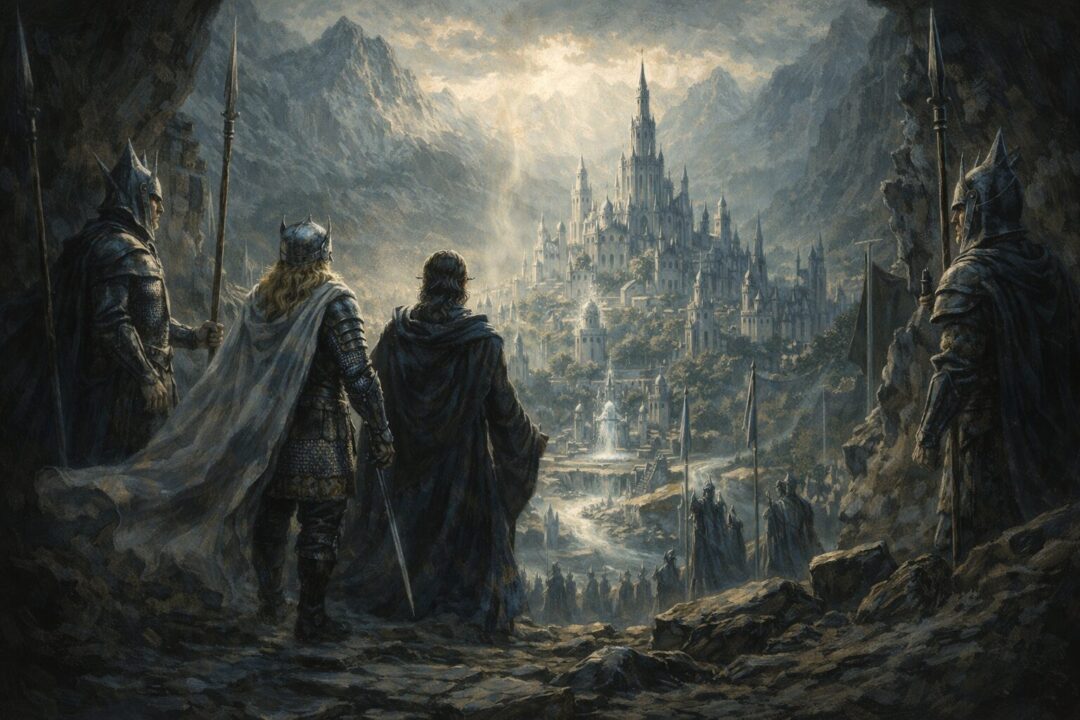
Tuor should feel easier to place than he does.
At first, he seems to belong to one of the clearest patterns in the Elder Days. He is a Man of the House of Hador, born into the ruin that followed the Nirnaeth Arnoediad, fostered by Elves, guided by Ulmo, and sent as a last messenger to Gondolin. Much of his story is direct, traceable, and grounded in named places, named kin, and major events.
And yet Tuor never feels entirely like the other mortal heroes.
Beren dies and returns through an exceptional doom that the narrative treats with solemn clarity. Túrin’s life is marked by catastrophe and ends in terrible finality. Even Eärendil, though extraordinary, becomes fixed in a clear mythic form once his destiny is revealed. Tuor is different.
He feels as if he belongs partly to recorded history and partly to something older and less settled.
That feeling is not accidental. It comes from the way the texts handle him, especially at the end.
Tuor begins as one of the most grounded Men in the legendarium
For most of his life, Tuor is presented in remarkably concrete terms.
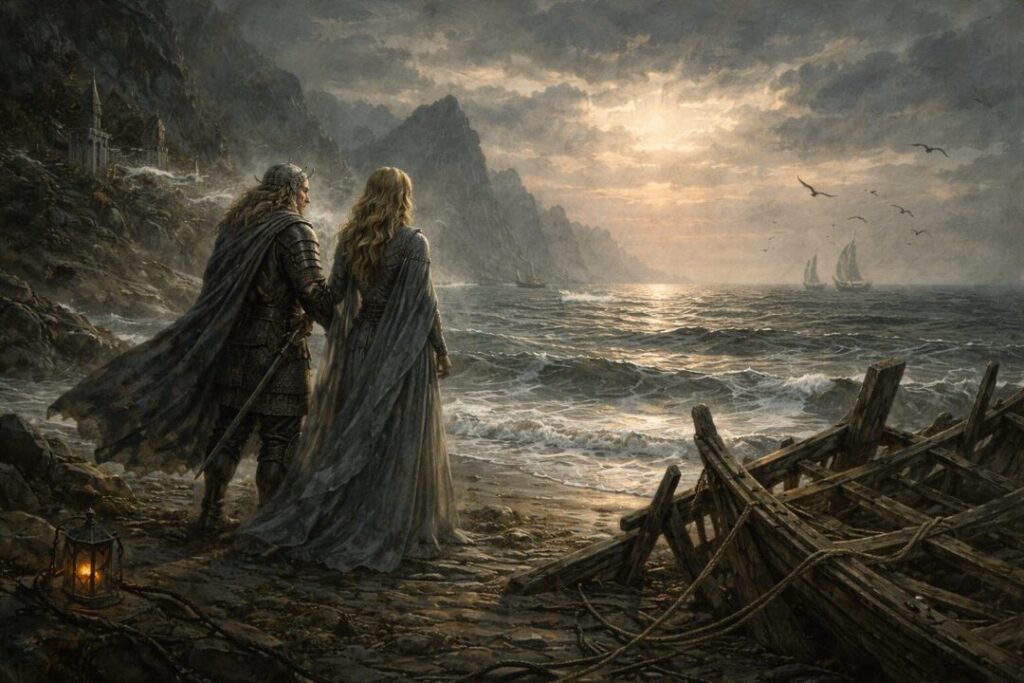
He is the son of Huor and Rían. After the defeat of the Edain in the Nirnaeth Arnoediad, he is fostered by the Sindar of Mithrim. He lives in hardship, escapes bondage, and eventually follows signs westward until he reaches the sea at Nevrast. In Unfinished Tales, this whole movement is told with unusual texture and detail, as if the narrative wants us to feel the weight of roads, weather, exile, and distance.
That matters.
Tuor does not enter the story as a vague legendary hero already wrapped in wonder. He enters as someone almost stubbornly embodied. He walks. He endures. He is guided step by step. Even Ulmo’s intervention does not dissolve that grounded feeling. It sharpens it.
Ulmo chooses Tuor as a messenger to Turgon and sends him toward Gondolin with a warning: the doom of the hidden city is drawing near, and Turgon must not trust its secrecy forever.
So from the start, Tuor stands in an unusual position. He is mortal, but he is drawn directly into the counsels of a Vala and into the fate of one of the greatest hidden realms of the Noldor.
He is already crossing boundaries.
He lives inside Elvish history without ever ceasing to be a Man
When Tuor reaches Gondolin, the strangeness deepens.
He is not merely a visitor. He is received because of Ulmo’s authority, remains in the city, learns much from the Elves, marries Idril Celebrindal, and becomes deeply beloved there. In time he leads the House of the Wing. His son is Eärendil.
This is one reason Tuor feels different from Beren, even though both are Men joined to Elvish destiny.
Beren enters Elvish history through love and quest, but he remains marked by the collision between mortality and immortality. Tuor, by contrast, seems to settle into Elvish life with startling completeness. He does not simply touch that world and depart from it. He dwells in it, serves within it, and becomes part of the living structure of Gondolin itself.
That does not make him an Elf. The texts do not say that during his life in Gondolin he ceased to be a Man. But they do surround him with signs of deep alignment.
He is raised by Elves.
Chosen by Ulmo.
Accepted in Gondolin.
Married to Idril.
Father to the mariner through whom the hope of both Elves and Men will come.
Long before the question of his ultimate fate appears, Tuor already feels like someone whose life is pressing against the normal borders of mortality.
The sea-longing changes the tone of his story
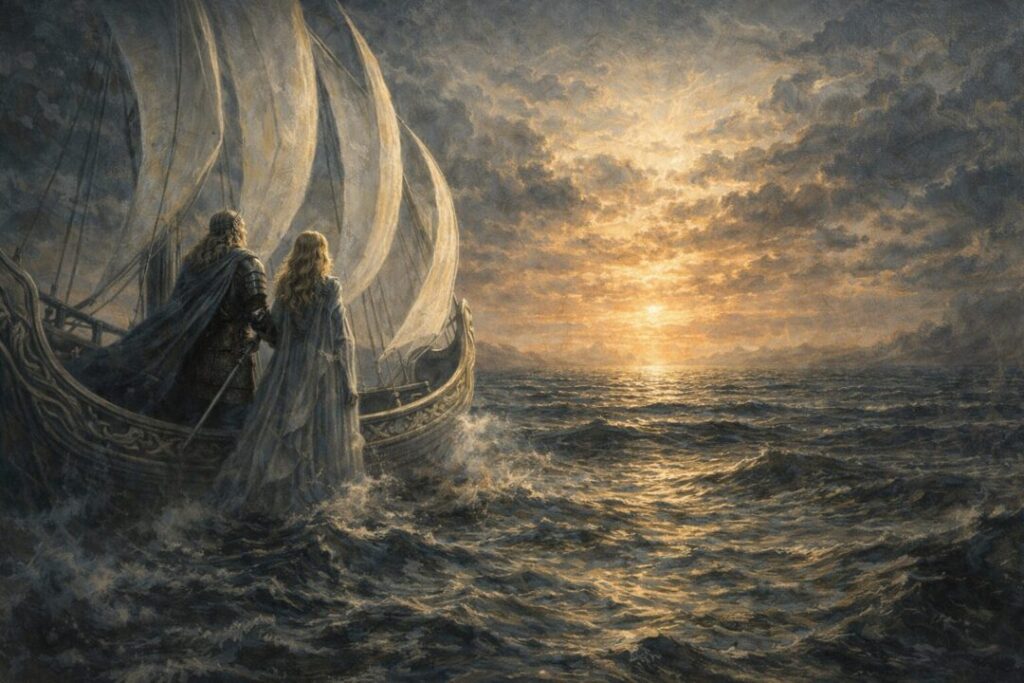
After the fall of Gondolin, Tuor and Idril escape with the survivors and dwell for a time at the Mouths of Sirion. There the narrative remains clear and historical. But eventually another motif, one that often marks transition in these stories, grows stronger in him: sea-longing.
That is the turning point.
The call of the Sea in the legendarium is rarely just travel. It often signals distance from ordinary settled life and a movement toward memory, loss, or the West. For Elves, it can awaken the desire to depart Middle-earth. For Tuor, a Man, it introduces something even stranger.
He builds Eärrámë, sails into the West with Idril, and then the text stops following him in the usual way.
This silence is one of the most important things about Tuor.
Middle-earth often leaves gaps, but Tuor’s gap arrives at the exact point where his destiny would become most astonishing. Instead of narrating what happened in direct terms, the tradition shifts.
And that shift is the key to why he feels half legend and half history.
The most important sentence about Tuor is deliberately distant
The line that defines Tuor’s strangeness is famous because of what it says. But it is just as important because of how it says it.
The text does not simply announce that Tuor was transformed and joined the Eldar as an established historical fact presented in immediate narrative voice. It says that in after days it was sung that Tuor alone of mortal Men was numbered among the Eldar, and that his fate was sundered from the fate of Men.
That phrasing creates distance.
“Was sung” places the claim in memory, tradition, and transmitted belief. It does not necessarily make it false. Quite the opposite: in this world, song often preserves deep truth. But it does make the claim feel elevated out of ordinary chronicle.
Tuor’s end is not given to us like a dated event in a list of kings and battles.
It comes to us like a truth half veiled by reverence.
That is why he feels so unusual. The story gives him the framework of history and the ending of legend.
He is not exactly “Half-elven,” and that distinction matters
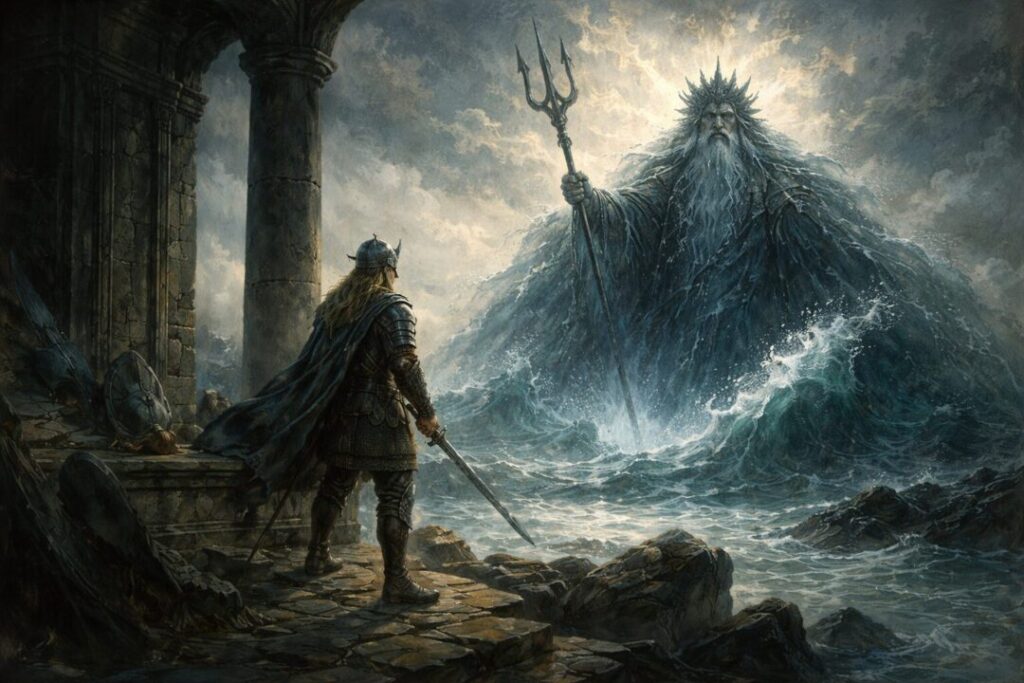
A common mistake is to blur Tuor’s case together with the later choices given to Eärendil, Elwing, Elrond, and Elros.
But Tuor is not presented as “Half-elven” in that later legal and genealogical sense. His son Eärendil is of mixed descent. Tuor himself is a Man. The texts treat his case as exceptional, not as part of the later framework of choice attached to Eärendil’s line.
That makes his fate even stranger.
He is not simply an early example of a rule that would later become clearer. He is an exception standing almost by himself. The tradition says he alone of mortal Men was counted among the Eldar. That language isolates him rather than normalizing him.
So when readers sense that Tuor feels hard to classify, they are noticing something real in the text.
He is not meant to fit neatly.
Why the story leaves him in this unusual position
Tuor’s life stands at the meeting point of several major currents in the Elder Days.
He is tied to Ulmo’s counsel.
He is tied to Gondolin’s rise and fall.
He is tied to Idril.
He is tied to Eärendil.
And through Eärendil, he stands near the turning of the whole age.
Because of that, Tuor almost feels like a bridge-character.
He is mortal, but repeatedly drawn into spaces that belong to the Eldar and to the greater design unfolding around them. He does not wield power in the usual sense. He is not a king, not a sorcerer, not one of the great named Elf-lords. But his path carries him into decisive places again and again.
The texts never fully explain why his final fate should be different. They report the tradition and leave it there. So anything beyond that must be phrased carefully.
The safest reading is not that the story gives us a detailed doctrine of what happened to Tuor. It does not. The safest reading is that the tradition intentionally sets him apart as a mortal whose destiny passed beyond the ordinary fate of Men, and that the narrative preserves this as something received rather than fully disclosed.
That restraint is probably why the effect is so strong.
If the text spelled everything out, Tuor might feel easier to categorize and less haunting.
Tuor’s ending feels legendary because it is meant to remain slightly beyond reach
There are characters in Middle-earth whose mystery comes from lack of information.
That is not quite Tuor’s case.
We know a great deal about him. We know where he came from, who raised him, who chose him, what road he walked, whom he loved, what city he entered, and what son was born to him.
The mystery comes later.
It comes from the decision to let certainty fall away at the very moment when Tuor passes furthest beyond the human horizon. The story does not turn him into a puzzle. It turns him into a remembered exception.
That is why he feels half legend, half history.
His life is narrated like a chronicle.
His ending survives like a song.
And in Middle-earth, that is often how the oldest and deepest truths are allowed to remain.
Why this matters
Tuor’s strange destiny reveals something important about how these stories handle wonder.
Not everything extraordinary is presented with blunt certainty.
Sometimes the most powerful effect comes from restraint.
Sometimes the text tells you enough to know that something immense happened, and then refuses to flatten it into a neat explanation.
Tuor is one of the clearest examples of that method.
He remains one of the most grounded Men in the Elder Days.
He also receives one of the most elevated endings ever attached to a mortal.
And the gap between those two things is exactly what makes him unforgettable.
Sources & Notes
- J.R.R. Tolkien, The Silmarillion, “Of Tuor and the Fall of Gondolin” — gives Tuor’s descent from Huor and Rían, his coming to Gondolin, marriage to Idril, and the famous tradition that he alone of mortal Men was numbered among the Eldar.
- J.R.R. Tolkien, Unfinished Tales, “Of Tuor and His Coming to Gondolin” — supplies the fuller, road-level account of Tuor’s exile, Ulmo’s guidance, the journey through Nevrast, and his commission as messenger to Turgon.
- J.R.R. Tolkien, The Silmarillion, “Of the Fifth Battle: Nirnaeth Arnoediad” — sets the ruin of the House of Hador and Huor’s death, the historical disaster out of which Tuor’s childhood and mission arise.
- J.R.R. Tolkien, The Silmarillion, “Of the Voyage of Eärendil and the War of Wrath” — distinguishes the later Half-elven choice of Eärendil’s line from Tuor’s singular and more mysterious reported fate.