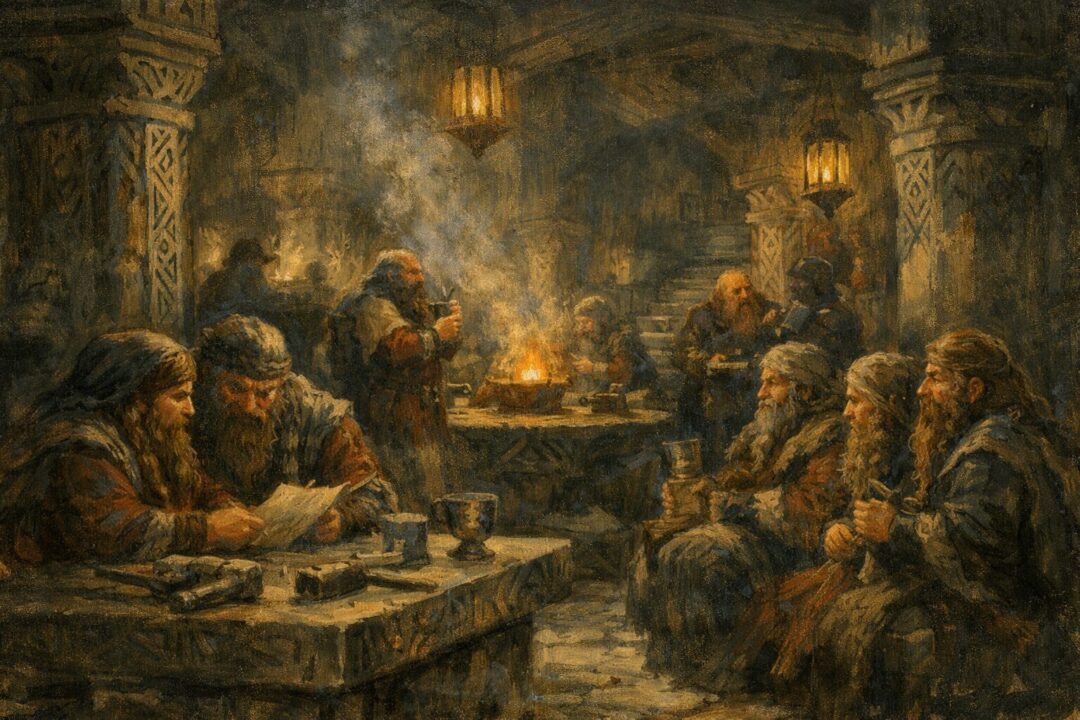
At first glance, the question sounds simple.
Were there female Dwarves in the First Age?
Many readers ask it because the great tales of Beleriand give us so many Dwarven names, halls, quarrels, weapons, and kings, yet almost no women. Belegost and Nogrod stand in the histories. Telchar stands in the histories. Azaghâl stands in the histories. But Dwarf-women seem nearly invisible.
That can create a misleading impression.
It can feel as though the First Age narratives leave open the possibility that female Dwarves were absent, or at least so marginal that they barely mattered.
But that is not what the texts support. The later tradition preserved in Appendix A is explicit that Dwarf-women existed, that they were few, and that they were seldom seen by other peoples. The same body of material explains why outsiders formed false ideas about Dwarven reproduction and why women almost never appear in non-Dwarven records.
So the safest answer is yes.
Female Dwarves were in the First Age.
The real problem is not their existence.
It is visibility.
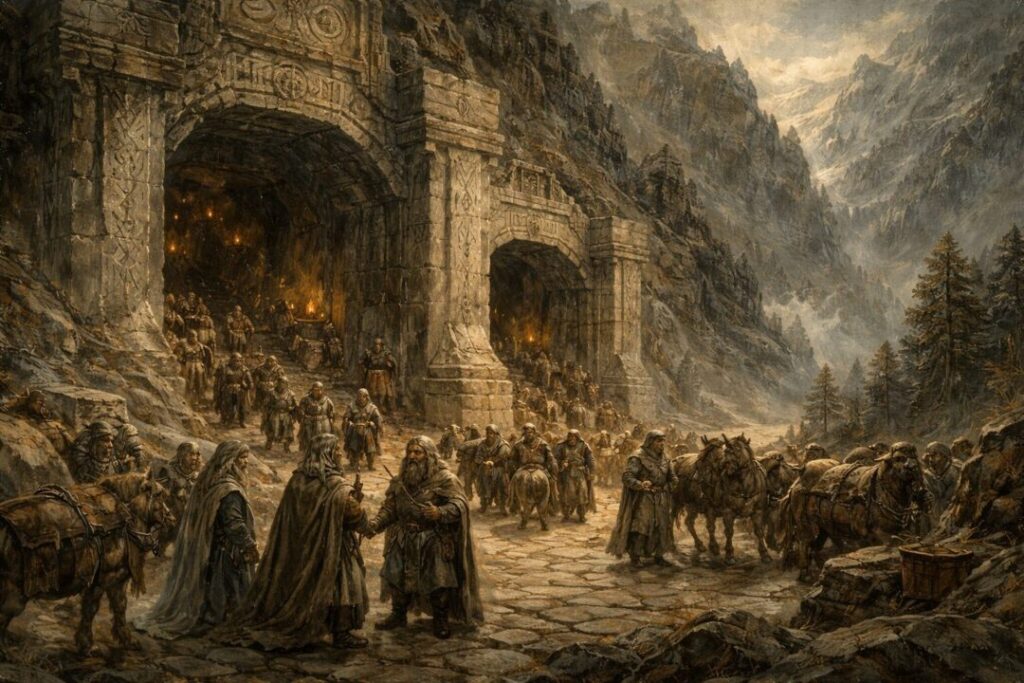
The texts do not deny Dwarf-women. They explain why you do not see them.
The strongest direct statement comes late in the legendarium’s presentation, in The Lord of the Rings Appendix A, in the section on Durin’s Folk. There we are told that there were few Dwarf-women, probably no more than a third of the people, and that they seldom walked abroad except at great need. They were also said to be so alike to Dwarf-men in voice, appearance, and travel-garb that other peoples could not easily tell them apart. That concealment gave rise to the foolish belief among Men that Dwarves “grow out of stone.”
That passage does several things at once.
First, it settles the existence question.
Second, it explains the shortage of references.
Third, it tells us that non-Dwarven observers were in no position to produce detailed, reliable accounts of Dwarf-women in the first place.
That matters because most of the First Age material is not presented as intimate Dwarven history. It is a broad historical tradition shaped heavily by Elvish and Mannish perspectives. The narratives linger on what outsiders saw: smithcraft, trade, military aid, embassies, treasure, and conflict. They do not open the guarded inner chambers of Dwarven domestic life.
Once that is understood, the silence looks less like contradiction and more like perspective.
Why the First Age stories feel as though women are absent
The First Age is full of Dwarves, but only in certain roles.
The Firebeards and Broadbeams of the Blue Mountains enter the histories because they matter to the public life of Beleriand. They trade with the Sindar. They build Menegroth. Their smiths forge famous works. Their warriors fight Morgoth’s forces. Later, the Dwarves of Nogrod are drawn into the catastrophe around Thingol, the Nauglamír, and the Silmaril.
These are all outward-facing events.
They belong to diplomacy, war, labor, artistry, vengeance, and politics between peoples.
That is exactly the zone in which Dwarf-men would be most visible to Elves and Men, and exactly the zone in which Dwarf-women, according to the later tradition, would be least visible. If Dwarf-women seldom walked abroad except in great need, then the public record of Beleriand would naturally preserve almost none of them.
So the apparent absence is largely a consequence of genre and viewpoint.
The surviving tales of the First Age are not family annals of the Naugrim. They are histories of wars, realms, oaths, jewels, slayings, and alliances. A people whose women were hidden, rarely named in outside records, and seldom present in foreign-facing life would almost inevitably seem male-only in such a tradition.
The text does not say that.
But it strongly explains why it would look that way.
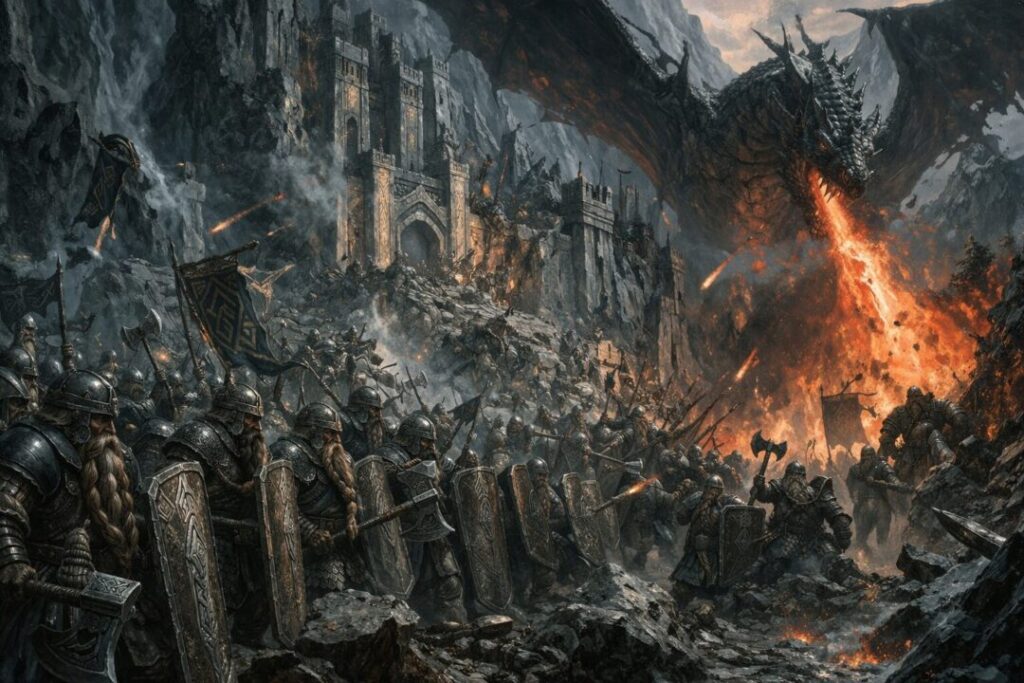
The hiddenness of Dwarf-women is part of a larger Dwarven pattern
This should not be treated as an isolated fact.
Dwarves are secretive almost everywhere the legendarium touches them. Their inner names are concealed. Their language is guarded. Their origins are discussed through tradition rather than open ethnography. Even in genealogies, women are seldom named. Dís is striking precisely because the Appendix tells us she is the only Dwarf-woman named in those histories, and even that notice is tied to the fame and deaths of her sons, Fíli and Kíli.
That pattern is revealing.
The texts do not merely omit Dwarf-women by accident. They present Dwarven society as one that does not willingly expose its private structure to outsiders. In that context, the scarcity of names is not surprising. It is consistent with how the Dwarves handle identity, kinship, and cultural boundaries more generally.
This helps answer the emotional force of the question.
Readers often feel that if women existed, the stories should show them more plainly.
But the legendarium’s answer is effectively that outsiders were not meant to see everything.
And the surviving histories are mostly outsider histories.
Were female Dwarves already present from the beginning?
Here the evidence becomes more layered.
In The Silmarillion, the published account emphasizes the Seven Fathers of the Dwarves. But later materials summarized in The Peoples of Middle-earth indicate that older and alternate conceptions linked the first awakening of most Dwarf-fathers with wives or female companions, while Durin is singled out as the one who “lay alone.” Tolkien Gateway’s summary of those later materials reflects that development and notes that only Durin is explicitly remembered as alone.
That means the textual history is not perfectly simple.
Still, for the user’s question, the practical conclusion is straightforward: female Dwarves are not a late in-world invention. The later explanatory texts treat them as part of Dwarven existence from the earliest periods, not as a new feature of the Third Age.
Even if one prefers very conservative phrasing here, the First Age itself already presupposes reproducing Dwarven peoples with households, lineages, and enduring kindreds in Belegost, Nogrod, and Khazad-dûm. The later explanations fit that reality rather than overturning it.
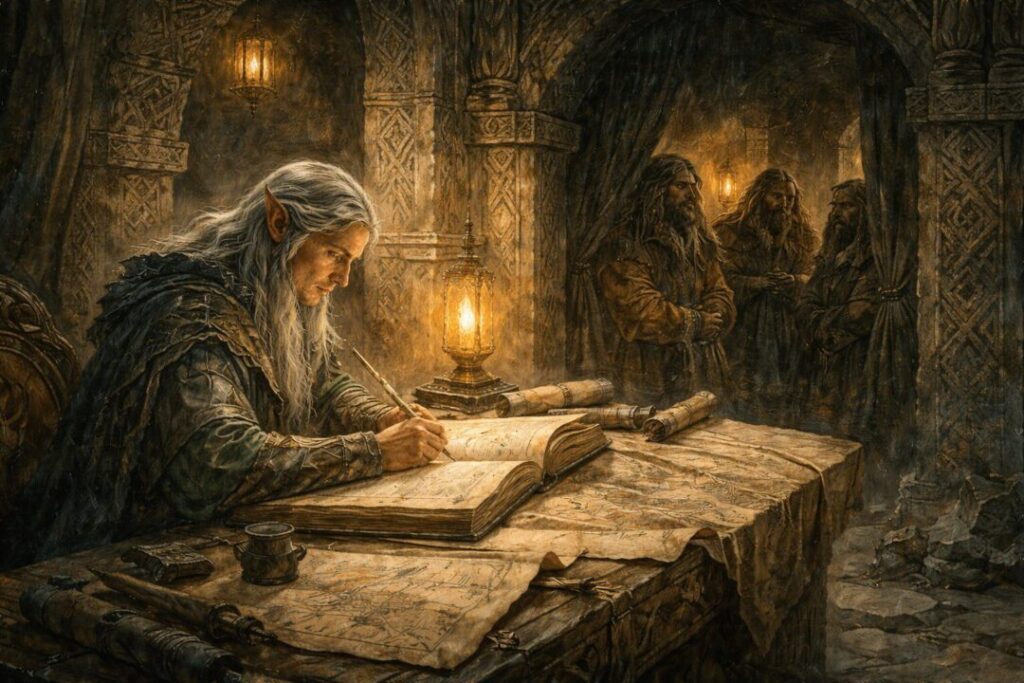
Why are they barely mentioned by name?
Because the texts almost never treat Dwarven domestic life as a subject worth opening fully.
That sounds harsh, but it is the pattern.
The great First Age narratives care about what the Dwarves do in relation to the fate of Beleriand. They care about carvings, halls, helmets, swords, payments, insults, dragon-fire, and vengeance. They do not stop to offer a social history of Dwarven households. The result is that the most hidden part of Dwarven society remains hidden in the record as well.
The genealogical silence reinforces this. Appendix A says women were seldom named in genealogies. That alone explains a great deal. If the official remembered lines presented to outsiders largely follow kings, heirs, and public male figures, then generations of women can be present without entering the textual foreground.
This is one reason the First Age can feel more empty of Dwarf-women than it really is.
The narrative is not counting hidden lives.
It is counting visible deeds.
The beard question, and why it should be handled carefully
A second question often attaches itself to this topic.
Did female Dwarves have beards?
There is a later text in The War of the Jewels that says the Naugrim have beards from the beginning of their lives, “male and female alike.” Tolkien Gateway accurately records that wording in its summary of the passage.
But this is exactly the sort of detail that benefits from careful framing.
It is supported in later material, and it is widely cited for good reason. At the same time, the main published The Lord of the Rings appendix does not make the beard point as directly as that later text does. What Appendix A stresses most clearly is that Dwarf-women were so alike to Dwarf-men that outsiders could not tell them apart.
So the safest way to say it is this:
Later texts support the idea that Dwarf-women had beards, and no canonical text gives us a contrary public description of First Age Dwarf-women. But the stronger point for this article is not the beard itself. It is the deliberate similarity and concealment that made Dwarf-women difficult for outsiders to identify at all.
Why this silence actually fits the deeper logic of Middle-earth
The absence of Dwarf-women from the spotlight is not just about gender.
It is about historical distance.
Middle-earth repeatedly reminds the reader that not every people is equally transparent. Elves preserve memory differently. Men forget. Hobbits record local detail. Dwarves guard what is theirs. So when a text surviving through mixed traditions tells the history of Beleriand, what reaches us is not neutral total knowledge. It is filtered memory.
This is why the question becomes more interesting when turned slightly sideways.
The real puzzle is not “did they exist?”
The real puzzle is “why do the surviving histories not see them clearly?”
And the answer is almost certainly that they were meant not to be seen clearly.
The Dwarves did not advertise their womenfolk.
They did not open their inner life to strangers.
And the stranger’s version of history is the version most readers receive.
That makes the silence feel less like a gap in the world and more like a feature of the world.
So were there female Dwarves in the First Age?
Yes.
That is the most defensible answer.
The texts later state plainly that Dwarf-women existed, that they were few, that they were hidden, and that they were seldom seen by other peoples. Nothing in the First Age material contradicts that. On the contrary, it helps explain why the public-facing narratives of Beleriand scarcely show them at all.
And that is why the topic feels stranger the longer you look at it.
The absence is not really absence.
It is concealment.
The histories of the First Age show us Dwarves in war, craft, pride, trade, and tragedy. But when the story approaches the private life of the Naugrim, it finds a shut door.
That door is not empty on the other side.
It is closed.
And in a legendarium so concerned with memory, inheritance, and the limits of what any chronicle can preserve, that may be exactly the point.
Sources & Notes
- J.R.R. Tolkien, The Lord of the Rings, Appendix A, III, “Durin’s Folk” — Dwarf-women were few, seldom went abroad, and were easily mistaken for Dwarf-men by outsiders.
- J.R.R. Tolkien, The Lord of the Rings, Appendix A, III, “Durin’s Folk” — Dís is noted as the only Dwarf-woman named in these histories, showing how rare such names are in the record.
- J.R.R. Tolkien, The Silmarillion, “Of Aulë and Yavanna” — gives the origin of the Dwarves as a people and frames their guarded, separate place among the Children of Ilúvatar.
- J.R.R. Tolkien, The Silmarillion, “Of the Sindar” — shows the First Age Dwarves of Nogrod and Belegost entering Beleriand’s public history through craft, building, and trade.