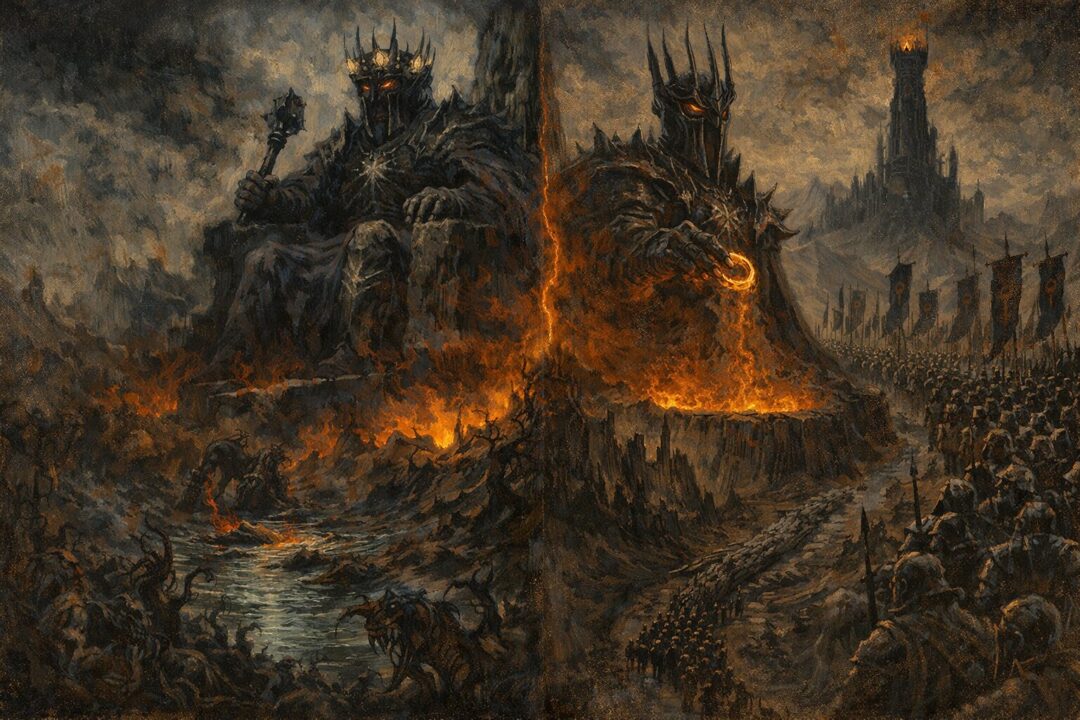
When readers hear the phrase “Dark Lord” in Middle-earth, they usually think of a single type of enemy.
A vast tyrant.
A gathering Shadow.
A will bent on conquest.
That is partly true. But it is also too simple.
Both Morgoth and Sauron bear that title. Morgoth is the first Dark Lord, Sauron the second. Yet the texts do not present them as identical expressions of evil, only as related ones. Sauron follows the path Morgoth opened, but he does not become the same kind of being in motive, scale, or final desire.
That distinction matters.
Because once the two are flattened into one category, some of the most important moral and metaphysical structure of the legendarium disappears with them.
Morgoth is not simply “a stronger Sauron.”
And Sauron is not merely “Morgoth in smaller form.”
The deeper texts suggest something more precise: Sauron is a dark ruler who wants domination, while Morgoth becomes a dark power whose rebellion curdles toward the ruin of the world itself.
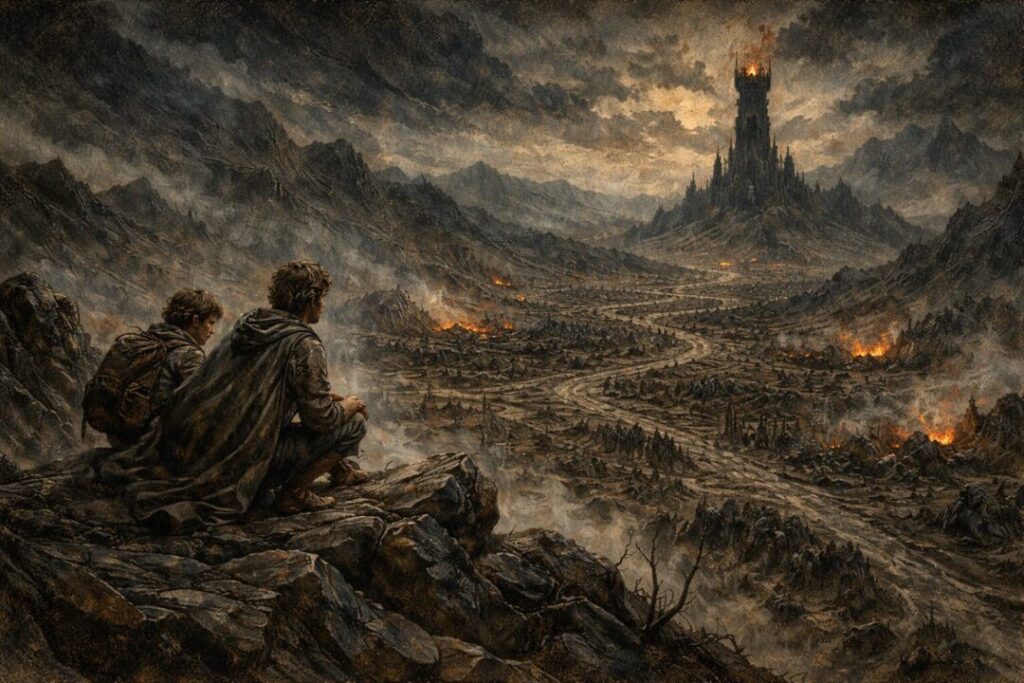
“Dark Lord” Is a Real Title, But Not a Simple One
The title is applied to both figures in the tradition of Middle-earth.
Morgoth is explicitly remembered as the first Dark Lord, the Black Foe of the World, a name given after the destruction in Valinor and the theft of the Silmarils. Sauron, after Morgoth’s overthrow, rises as the next great enemy and is repeatedly treated as the Dark Lord of the later ages.
But those labels do not mean that both occupy the same role in exactly the same way.
The shared title tells us that both are supreme adversaries of the free peoples, both gather power, both seek mastery, and both spread corruption. What it does not tell us, by itself, is whether their evil is identical in character. For that, the deeper explanatory texts matter more than the title alone.
And those texts draw a meaningful line between them.
Morgoth Begins in Greatness and Falls Into Marring
Morgoth begins as Melkor, the greatest of the Ainur in native power. From the earliest stages of the legendarium, his rebellion is not merely political. It is woven into the structure of creation itself, beginning with discord in the Music and continuing into the marring of Arda.
That is the first key difference.
Morgoth is not only a lord who builds a realm of darkness inside the world. He is, in the deepest sense, the source of the world’s marring. Later commentary preserved in Morgoth’s Ring goes so far as to describe him as dispersing his power into the very matter of Arda, in contrast to Sauron concentrating much of his power in the One Ring.
This does not mean that every later evil act is literally Morgoth acting directly.
It means something broader and more disturbing. The world of Middle-earth is not merely attacked from outside by him. It is wounded from within. Morgoth’s presence becomes diffused, structural, and lingering. His defeat removes his throne, but not the damage he has already worked into the fabric of the world.
That already makes him more than a tyrant.
A tyrant rules over a land.
Morgoth helps mar the conditions of the land itself.
Morgoth’s End State Is Worse Than Mere Rule
The clearest explanation of Morgoth’s later character appears in the late notes on motives in the legendarium.
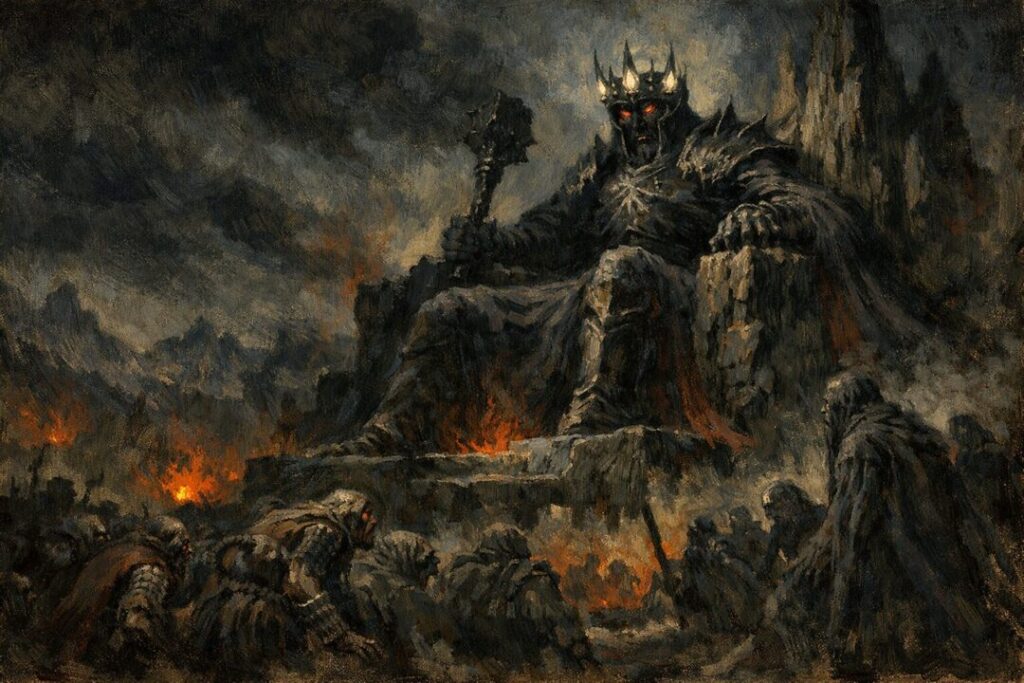
There, the distinction is stark. Morgoth is described as becoming enraged by the existence of other wills and intelligences in Arda. His “sole ultimate object” is described as their destruction. He seeks first to break wills and subordinate them, but the final movement of his evil tends toward negation. The text even says that, left to ultimate victory, he would have reduced the world toward formless chaos.
That is a very different condition from simple world-rule.
Morgoth does dominate. He does inspire fear. He does build armies, fortresses, and systems of servitude. But the later explanatory texts imply that these are not his final end in the way they are for Sauron. They are instruments in a more radical hatred. The existence of a world not wholly of his own making becomes intolerable to him.
This is why readers sometimes feel that Morgoth is harder to grasp than Sauron.
Sauron still resembles a ruler, however monstrous.
Morgoth begins to resemble a principle of total corruption and ruin lodged inside creation.
That is still personality, still will, still pride. But it is pride moving toward nihilism.
Sauron Is Darker in Method, Narrower in Aim
Sauron is terrifying for a different reason.
He is not less evil in the moral sense that would make him somehow moderate. The late texts say plainly that in all Morgoth’s deeds Sauron had a part and was only less evil because he served another for long, not because he was more innocent. But those same materials also distinguish the shape of his evil from Morgoth’s.
Sauron does not want nonexistence.
He wants control.
The explanatory notes say that Sauron desired to dominate the creatures of earth in their minds and wills. They also say that he had not reached Morgoth’s “nihilistic madness,” because he did not object to the existence of the world so long as he could do what he liked with it. He retained, in corrupted form, a drive toward order, coordination, and efficient arrangement.
This fits the Sauron readers actually see across the Second and Third Ages.
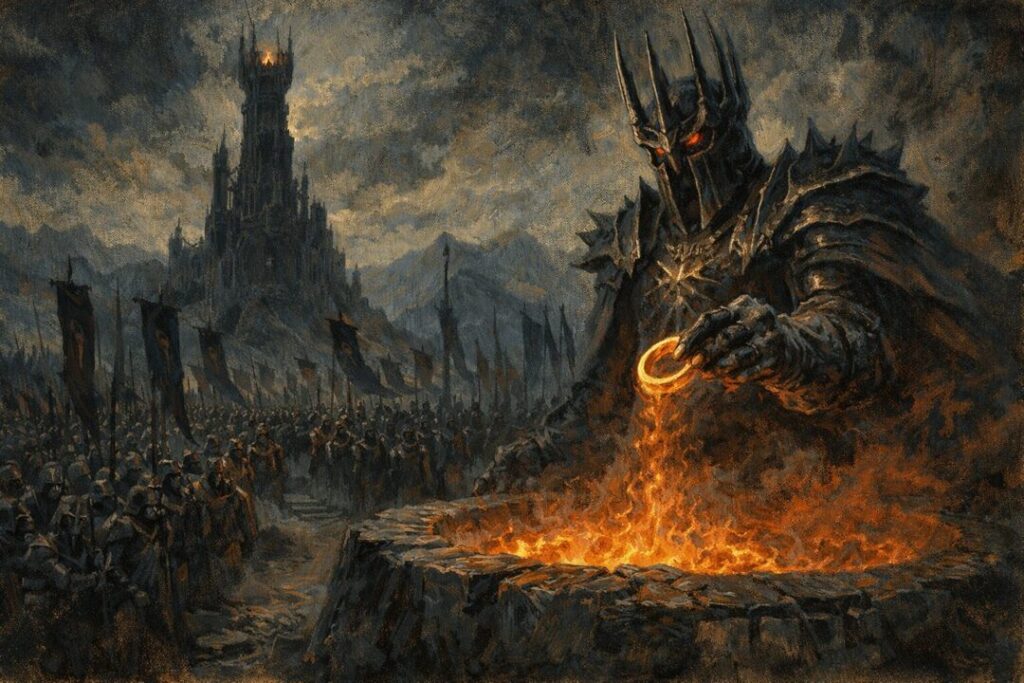
He deceives the Elves not simply to destroy them, but to bring them under a system of control through the Rings. He turns to empire in the East and South. He builds not only terror, but administration, structure, hierarchy, and surveillance. Even his greatest symbol, the One Ring, is not a weapon of random devastation. It is an instrument of domination.
That does not make him lesser in danger to those who oppose him.
In some ages, especially for the peoples actually living under his threat, Sauron can feel more immediate, more organized, and more inescapable than Morgoth. But the difference is still there: Sauron wants the world enslaved; Morgoth, in his final state, cannot rest even in that.
Why Sauron Can Inherit the Title Without Matching the Original
One of the most revealing lines about Sauron says that he rose “like a shadow of Morgoth and a ghost of his malice.” That is a striking description because it establishes continuity and difference at the same time.
A shadow is not the thing itself.
Sauron inherits Morgoth’s corruption, methods of domination, hatred of the free peoples, and long habit of tyranny. The later notes even say that he inherited the corruption of Arda already worked by Morgoth. In that sense, he rules in a world already bent by an older disaster.
But he is still not Morgoth returned.
He is smaller in original stature.
Narrower in metaphysical reach.
More concentrated in his purpose.
Morgoth disperses himself into Arda and diminishes his native being while gaining a terrible grip on the material world. Sauron, by contrast, concentrates much of his power in the Ring. Even structurally, the two dark powers operate differently. Morgoth diffuses corruption across the world; Sauron centralizes domination through a master instrument.
That is why the destruction of the Ring can end Sauron as an effective ruling power, while the overthrow of Morgoth never simply erases the marring he leaves behind.
Morgoth Is the Enemy of Arda; Sauron Is the Enemy in Arda
This is a useful way to frame the distinction, though it needs careful wording.
Morgoth is not outside creation in any absolute sense; he acts within Arda and is bound by its reality. But the texts portray him as hostile not only to peoples and kingdoms within the world, but increasingly to the world as a shared created order that is not exclusively his. His rebellion becomes cosmic in ambition and corrosive in effect.
Sauron, by contrast, is the great tyrant within the marred world.
He takes what Morgoth has damaged and tries to master it.
He does not seek to unmake reality.
He seeks to own it politically, mentally, spiritually, and materially.
That is why Sauron often feels more legible to modern readers.
He resembles the logic of empire, machinery, coercive order, and ideological control.
Morgoth is older and darker than that.
He is closer to the rebellion that cannot bear any good it did not author.
Why This Difference Changes the Reading of Middle-earth
Once this distinction is clear, many patterns in the legendarium sharpen.
It explains why Sauron’s evil so often appears through rings, oaths, subordination, systems, servants, and carefully built power. His darkness is managerial as well as violent. He is the mind that wants every will under one design.
It also explains why Morgoth’s legacy is larger than his throne.
Even after he is thrust out, the world remains marred. Sauron emerges not in a clean world, but in one already scarred by the first Dark Lord. In that sense, Sauron is both independent tyrant and secondary inheritor. He is his own evil, but he also grows in ground that Morgoth poisoned first.
And it helps explain why later evil in Middle-earth so often looks like imitation, reduction, or echo.
Sauron is not the source of all darkness.
He is its greatest later organizer.
That makes him more focused.
Not more ultimate.
So What Makes a “Dark Lord”?
In Tolkien’s terms, a Dark Lord is not merely a strong villain, nor simply a ruler who happens to be cruel.
The title belongs to beings who gather power toward domination, corrupt other wills, set themselves against the rightful order of the world, and become central organizing powers of darkness for an age.
But Morgoth and Sauron show that even within that category there are degrees and kinds.
Morgoth is the first and deepest Dark Lord because his rebellion reaches into the marring of Arda itself and, in its final movement, tends toward ruin and negation. Sauron is the second because he inherits that darkness in a more concentrated form: not the urge to level all things into chaos, but the urge to bring all things beneath one ruling will.
So the title is shared.
The darkness is not.
Morgoth is what happens when pride becomes hatred of being itself.
Sauron is what happens when pride becomes perfected domination.
That is why both are Dark Lords.
And why they should never be read as the same one twice.
Sources & Notes
- J.R.R. Tolkien, The Silmarillion, “Ainulindalë” and “Valaquenta” — Melkor’s first discord and fall establish him as the prime rebel among the Ainur.
- J.R.R. Tolkien, The Silmarillion, “Quenta Silmarillion,” Chapter 9, “Of the Flight of the Noldor” — Fëanor names Melkor “Morgoth,” the Black Foe of the World.
- J.R.R. Tolkien, Morgoth’s Ring, “Myths Transformed,” texts VI–VII — Morgoth’s power is dispersed into Arda, contrasting with Sauron’s later concentration of power in the Ring.
- J.R.R. Tolkien, Morgoth’s Ring, “Notes on Motives in the Silmarillion” — distinguishes Morgoth’s destructive nihilism from Sauron’s desire to dominate minds and wills.
- J.R.R. Tolkien, The Silmarillion, “Of the Rings of Power and the Third Age” — Sauron rises after Morgoth “like a shadow of Morgoth and a ghost of his malice.”
- J.R.R. Tolkien, The Letters of J.R.R. Tolkien, Letter 131 — frames Sauron’s evil as order, coordination, and domination through the Rings rather than simple destruction.