At first glance, the answer seems easy.
Gollum had the Ring because he would never let it go.
That is true as far as it goes. By the time Bilbo meets him under the Misty Mountains, Gollum is completely bound to it. He calls it his birthday present, his precious, the center of his inner life. Losing it is not like losing a tool or even a treasure. It is like being torn open.
But that answer is still too shallow.
Because the One Ring is not passive.
Again and again, the story shows that it does not merely get carried. It works on its bearer. It preserves, distorts, narrows, and betrays. Gandalf is explicit that the Ring abandoned Gollum just as it had once abandoned Isildur. That means the real question is not only why Gollum clung to the Ring.
It is why the Ring clung to Gollum for so long.

Gollum Was Not Just a Keeper of the Ring
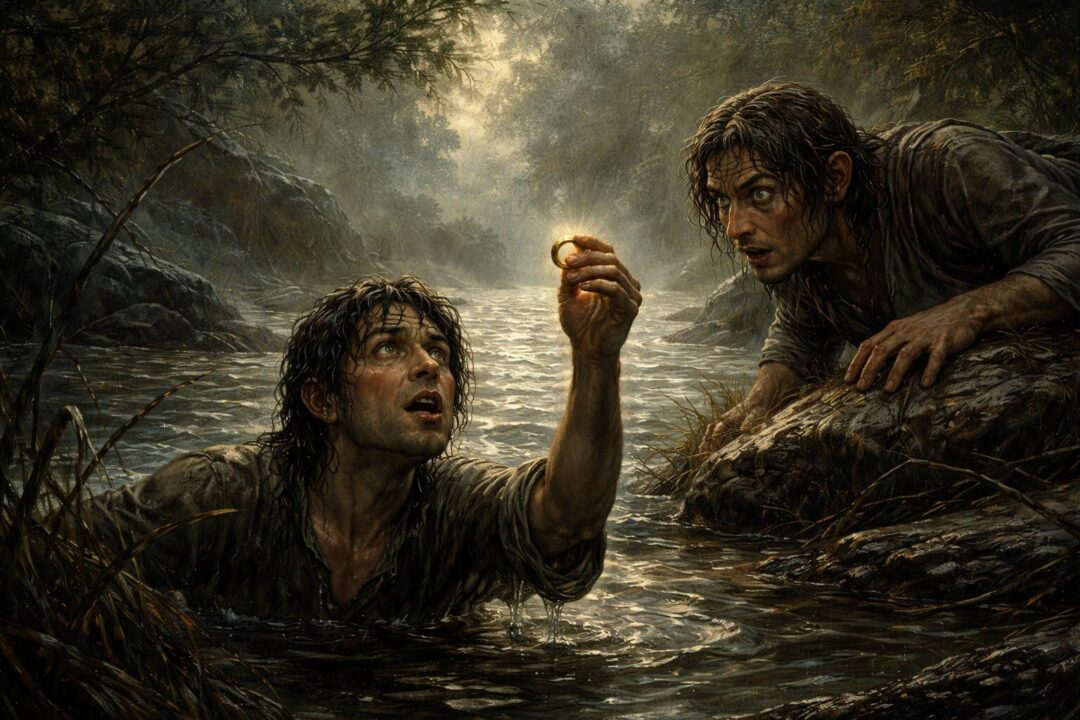
Sméagol does not come by the Ring innocently.
He sees it in Déagol’s hand, desires it at once, and murders for it on the same day. That matters because the moral corruption is immediate. The Ring does not need centuries to begin its work. It finds something in Sméagol that it can use at once: possessiveness, selfishness, secrecy, and appetite.
Yet even here the change is not simple.
Sméagol does not become mighty. He does not rise in the world. He does not gather servants or build a realm. Instead, he is driven downward. He uses the Ring for petty malice, spying, and theft, and he is cast out by his own people. Eventually he disappears beneath the Misty Mountains and remains there for generations.
That detail is easy to miss, but it is central.
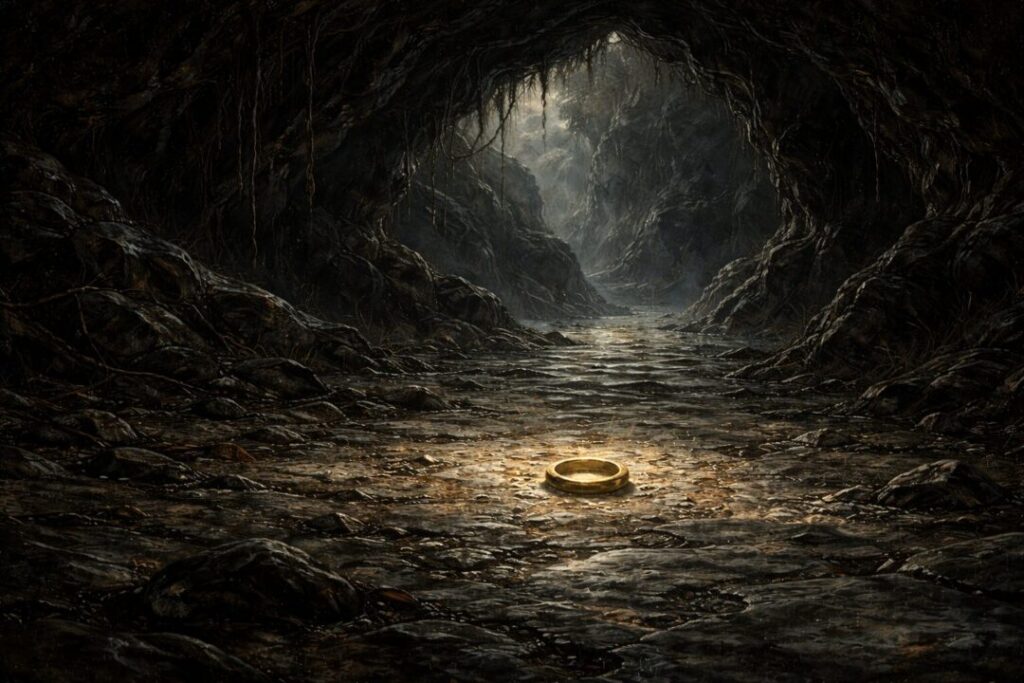
The Ring had fallen from Sauron’s hand at the end of the Second Age. It had lain lost in the Anduin for a vast stretch of time. When it was found again, it did not immediately return to open history. It vanished into darkness with a creature too small, too broken, and too hidden to do much with it.
So why stay?
The Ring Preserved Gollum, But Did Not Advance Through Him
“The Council of Elrond” makes one point unmistakable: Gollum kept the Ring for far longer than the natural life of his people. Gandalf treats that as proof of the Ring’s nature. Only a Great Ring could do such a thing.
So the Ring did something essential for Gollum.
It prolonged him.
But prolonging life in Middle-earth is not the same as healing it. Extended life under the power of a Great Ring becomes thin, stretched, and unnatural. Gollum is not restored by longevity. He is withered by it. He survives, but survival itself becomes part of the torment.
That is one reason the Ring could remain with him. Gollum was not overcoming it. He was being sustained in a ruined form by it.
And yet the Ring also seems not to have gained very much through him for a long time.
Gollum lived in the dark.
He used invisibility mostly to hunt, sneak, and avoid danger.
He was not a king, captain, or sorcerer.
He was not in contact with Sauron.
He was not moving through the great centers of power in Middle-earth.
In other words, Gollum was useful as a vessel, but not yet as a path.
The Ring could keep him.
It could deform him.
It could make him incapable of surrendering it.
But under the mountains, it was trapped almost as much as he was.
Gollum Became a Dead End
This is where the matter grows more interesting.
The Ring does not seem to leave every bearer at once. It remains where it can continue its work, and it does not need to hurry unless there is advantage in moving. With Gollum, it had a bearer who was utterly enslaved to it yet hidden from the wider world.
That made him, in one sense, ideal.
He would not throw it away.
He could not freely part with it.
He kept it near, guarded, and adored.
But it also made him a dead end.
The Ring was made for domination. Its deepest logic is mastery. In Gollum’s hands, that logic had almost nowhere to go. His desires had become cramped and animal. Fish, goblins, darkness, concealment, and the repeated pleasure of possession were enough to hold him. He did not become harmless, but he did become narrow.
That narrowness helps explain why the Ring stayed with him so long.
It had not found a good road back to power.
A hidden cave-dweller beneath the Misty Mountains was not a fitting instrument for the Ring’s larger purpose. But until something better appeared, Gollum could preserve it. He was a locked box with a heartbeat.
The Ring Did Not Leave Gollum Randomly
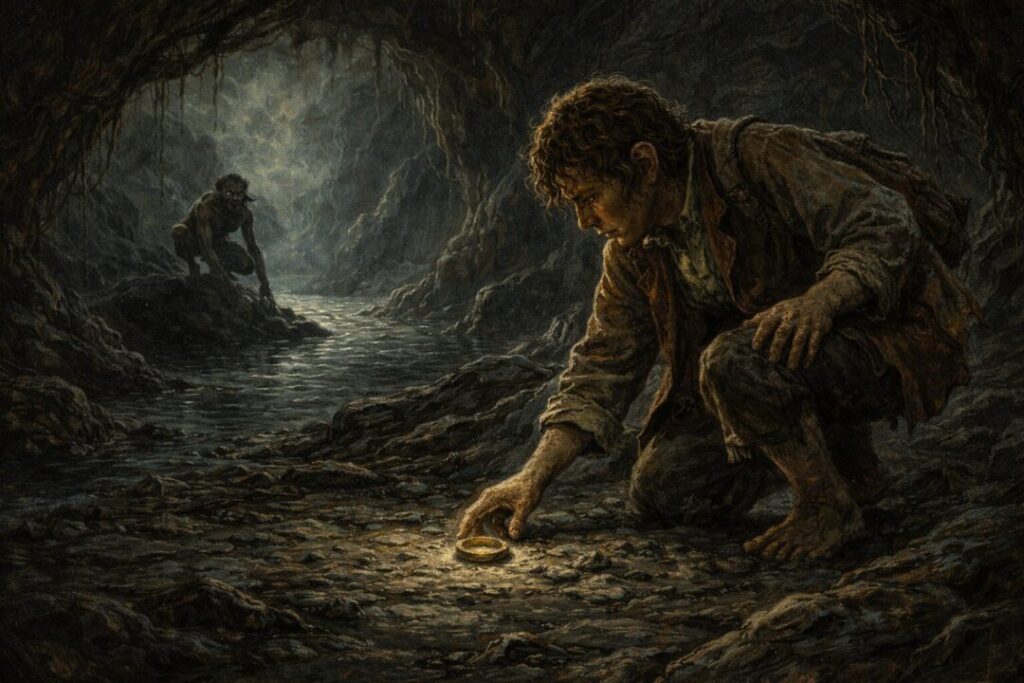
The decisive point comes when Bilbo enters the tunnels.
The text does not treat Bilbo’s finding of the Ring as a simple accident in the ordinary sense. The language around the event is more suggestive than that. Gandalf speaks of the Ring leaving Gollum. Elsewhere in the story, chance repeatedly stands close to providence without being reduced to mere luck.
That does not mean the Ring planned every detail with full intelligence. The texts do not require that. But they do strongly imply a kind of will or direction in it. A Ring of Power “looks after itself.” It can betray. It can slip away. It can pass from a bearer at the crucial moment.
And Bilbo is exactly the kind of new bearer Gollum was not.
He is mobile.
He is still part of the open world.
He can carry the Ring out of darkness and back into history.
He is attached to a journey already moving toward larger events.
So the Ring’s long stay with Gollum ends not when Gollum weakens, but when an opportunity appears.
That is the important shift.
The Ring did not remain with Gollum because he was the perfect master for it.
It remained because he was a workable prison until someone more useful came within reach.
Why Gollum Could Not Simply Let It Go
There is another layer to the question.
Even if the Ring had ceased to be useful to Gollum in any positive sense, why did he not cast it away in misery?
Gandalf’s answer to Frodo is one of the bleakest in the book: the keeper does not abandon a Ring of Power. At most, early on, one may imagine handing it on. But once its grip has deepened, the bearer no longer has real freedom in the matter.
That describes Gollum exactly.
He hates the Ring and loves it.
He is tormented by it and sustained by it.
His identity has wrapped itself around possession.
This is why the long years matter so much. Time did not loosen the bond. Time tightened it. Gollum’s whole existence was reduced until the Ring stood at the center and everything else fell away.
So when readers ask why the Ring stayed with Gollum, part of the answer is painfully simple:
because by then Gollum had become the kind of creature who could no longer choose against it.
Not because he was strong, but because he had been hollowed out.
The Ring’s Long Patience Makes Gollum More Tragic
Gollum is often remembered as the most visibly corrupted bearer of the Ring.
That is true, but it can obscure something worse.
He is also the clearest example of what happens when the Ring has time.
Isildur had it only briefly.
Bilbo had it for decades, but in a relatively gentle life and without full knowledge of what it was.
Frodo bore it under terrible pressure, but not for centuries.
Gollum endured its possession for almost five hundred years.
That does not make him powerful. It makes him wasted.
He becomes a prolonged ruin: alive beyond nature, morally bent, physically diminished, cut off from sun, kinship, and ordinary speech. The Ring does not need to turn him into a conquering tyrant for its evil to be complete in him. It can produce something smaller and still devastating: a life consumed by possession.
That may be the darkest answer of all.
The Ring stayed with Gollum so long because it could.
It could keep him alive.
It could feed on his attachment.
It could leave him buried in darkness until the right chance arrived.
And in the meantime, Gollum paid the cost.
Why This Changes the Way We Read His Story
Once that becomes clear, Gollum’s role in the legendarium looks different.
He is not just a grotesque obstacle left over from Bilbo’s adventure.
He is not merely a warning about greed in the abstract.
He is the record of the Ring’s long work on a small creature with nowhere to go and no strength left to resist.
For centuries, the Ring did not return to Sauron.
It did not march openly through kingdoms.
It did not reveal itself in war.
It waited.
And Gollum was the form that waiting took.
That is why his story matters so much. He shows that the Ring’s evil is not only spectacular when it appears in lords, armies, or visions of power. It is also intimate. It can shrink a person before it destroys him. It can make possession itself into a prison. It can turn long life into long diminishment.
So why did the Ring stay with Gollum so long?
Not because Gollum mastered it.
Not because he was worthy of it.
Not even because he was unusually useful in any grand sense.
It stayed because he was hidden, enslaved, and available.
A bearer too small to fulfill its purpose, but too bound to lose it.
Until the day another hand reached down in the dark.
Sources & Notes
- J.R.R. Tolkien, The Lord of the Rings, Book I, Chapter 2, “The Shadow of the Past” — Gandalf recounts Sméagol’s murder of Déagol, Gollum’s centuries-long possession, and the Ring’s treacherous habit of slipping away.
- J.R.R. Tolkien, The Hobbit, Chapter 5, “Riddles in the Dark” — Bilbo finds the Ring in Gollum’s tunnels, while Gollum’s “precious” language and panic show how completely possession has shaped him.
- J.R.R. Tolkien, The Lord of the Rings, Book II, Chapter 2, “The Council of Elrond” — sets Gollum’s loss of the Ring within the larger history of Isildur’s fall, the Ring’s disappearance, and its return to open events.
- J.R.R. Tolkien, The Letters of J.R.R. Tolkien, Letter 131 — describes the One Ring as bound to Sauron’s power and desire for domination, supporting the article’s reading of the Ring as purposeful rather than merely inert.