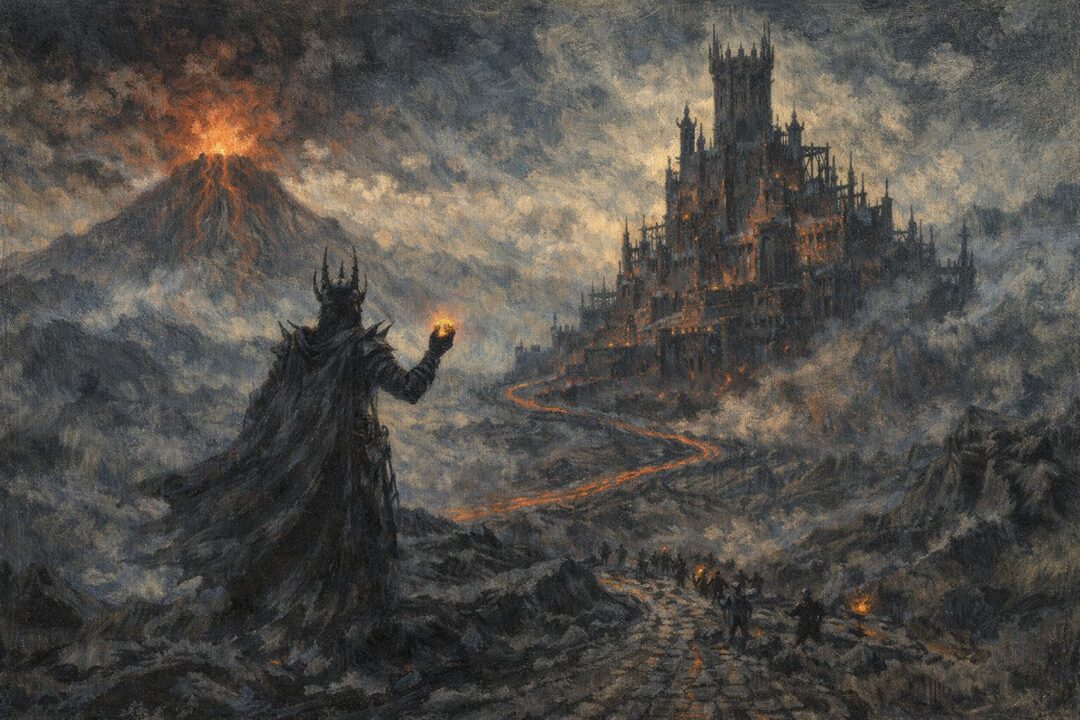
Barad-dûr often feels less like a building and more like a dark fact of the world.
By the end of the Third Age, it stands over Mordor with such weight and menace that it seems almost beyond history. It does not feel constructed. It feels inevitable.
That is precisely what makes the timeline so striking.
Because Barad-dûr was not raised in a moment of sudden sorcery. It was not a fortress thrown up in a few years of war. The chronology preserved in the texts places its beginning around the year 1000 of the Second Age, and its completion only around 1600. In other words, the first building of Barad-dûr took roughly six hundred years.
That immediately raises two questions.
How did Sauron build something on that scale at all?
And why did it take so long?
The Canon Gives Us Dates, Not a Construction Manual
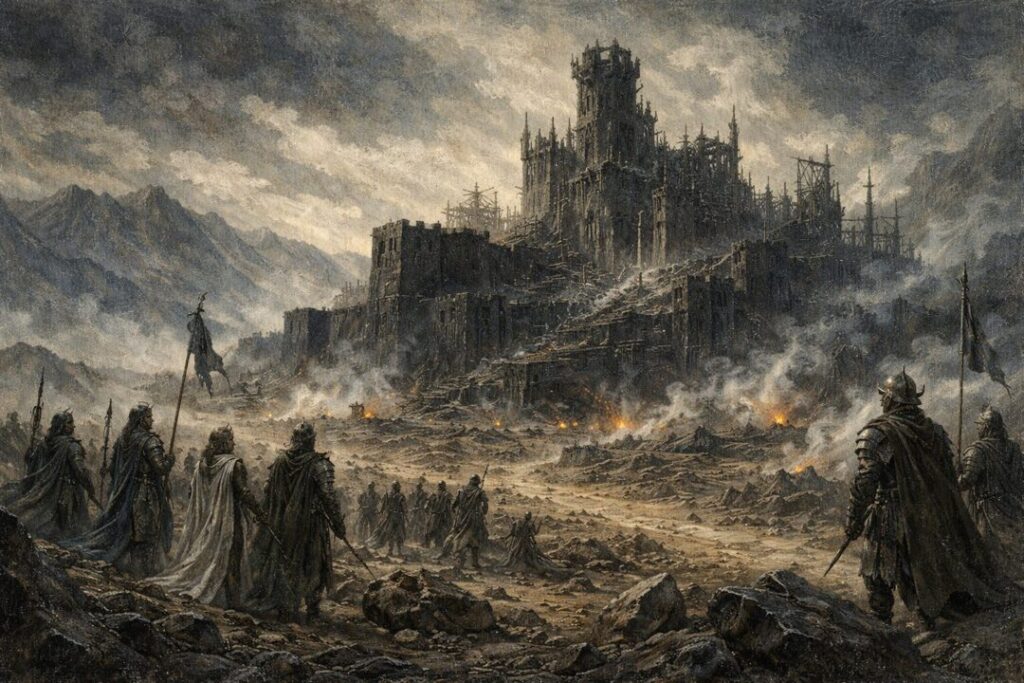
The first thing to say clearly is that the texts do not describe the physical process in detail.
There is no passage that walks us through architects, foundations, quarries, or work gangs in the modern sense. Anyone claiming the canon gives a precise engineering account is overstating the evidence.
What the canon does give is a sequence.
Around the year 1000 of the Second Age, Sauron—“alarmed by the growing power of the Númenóreans,” as the chronology is commonly summarized—chooses Mordor as a stronghold and begins the building of Barad-dûr. Around 1600, he forges the One Ring in Orodruin and completes the Dark Tower. Later, after his defeat by the Last Alliance, the tower is broken, but its foundations remain because they were made with the power of the Ring.
That means the safe, text-based answer is not that we know exactly how Barad-dûr was built.
It is that we know when the project begins, when it reaches completion, and that the Ring becomes bound up with its deepest structure.
Why Mordor Was the Right Place
The choice of Mordor matters as much as the tower itself.
Mordor is not simply Sauron’s later war-base. It is selected early, when he is consolidating power in the Second Age. Its geography makes it ideal for a dark realm: mountain walls, a defensible northern entry, proximity to Orodruin, and a central plain from which power can be organized outward. Barad-dûr itself stands in the northern part of Gorgoroth, linked by road to the Black Gate and to Mount Doom.
That matters because the Dark Tower was never just a residence.
It was the heart of a system.
Sauron did not merely need a high seat. He needed a fortress, an armoury, a prison, a command center, and a symbol that could anchor his rule in Middle-earth. The descriptions we get of Barad-dûr emphasize not elegance but scale and dread: walls upon walls, battlements upon battlements, steel gates, dungeons, windowless prisons, and a topmost tower looming over the land.
So from the beginning, Barad-dûr should be understood less as an isolated tower and more as the core of a militarized dominion.
What the Texts Allow Us to Say About the Actual Building
This is where careful phrasing matters most.
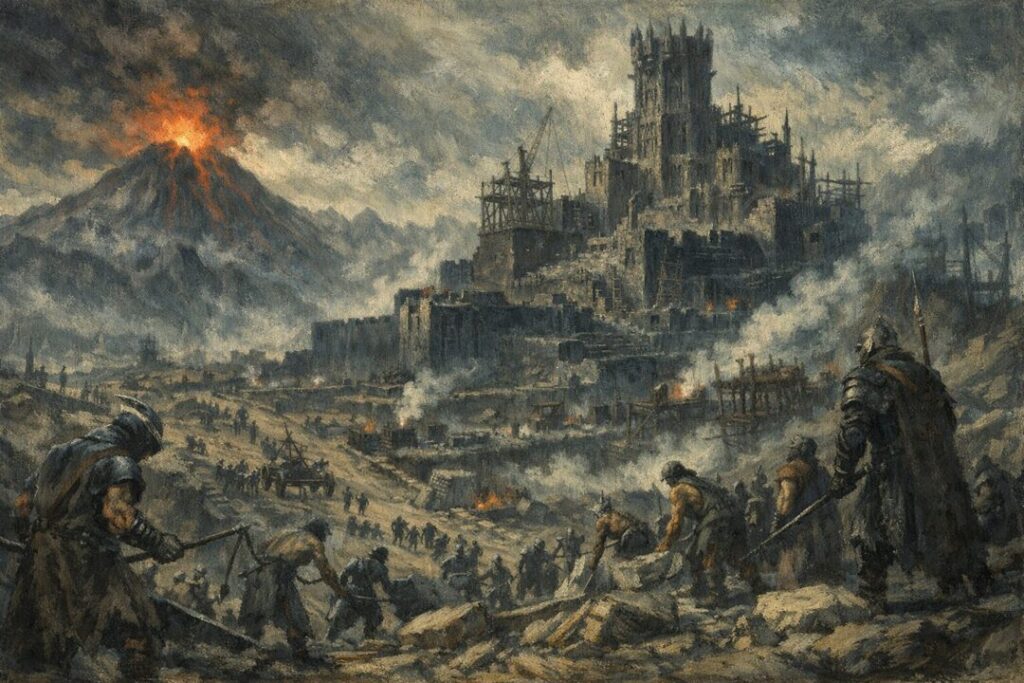
The texts do not explicitly say, “Orcs built Barad-dûr,” in one neat line. But they do show Sauron, during his rise, commanding immense forces of Orcs, Trolls, and Men, building other strongholds, fortifying Mordor, and arming those under his domination with iron. They also show that he had the capacity to build the Black Gate and many fortified places under his rule.
So the conservative conclusion is this:
Barad-dûr was almost certainly raised through the organized labor and resources of Sauron’s realm, under his direct power and will.
That is stronger than mere guesswork, but weaker than a fully described scene. The canon supports the existence of the labor pool, the military infrastructure, the fortified building program, and the long period of domination. It does not give us a page showing exactly who laid which stones.
There is also another layer to the question.
Sauron is not an ordinary ruler. He is a Maia, a being whose power can shape the world in ways far beyond ordinary craft. The canon never says he simply “cast a spell and the tower rose,” but it does tell us something close to equally important: the foundations of Barad-dûr were made with the power of the Ring and endured while that Ring endured.
So whatever physical labor was involved, Barad-dûr was not only a work of stone and metal.
It was also a work of invested power.
Why the Six-Hundred-Year Timescale Matters
Six hundred years is the detail that changes everything.
If Barad-dûr had been built in a decade, it would read like wartime construction: urgent, practical, immediate.
But six centuries suggests something else.
It suggests that Barad-dûr is part of Sauron’s long strategy for dominion in the Second Age. He is not merely preparing for one campaign. He is establishing a permanent seat of power from which he can dominate peoples, direct war, and challenge the western realms over generations.
This also helps explain why the tower is so bound up with the One Ring.
The Ring is forged only near the end of that long process, around 1600. The chronology places the completion of Barad-dûr in the same period. That has led many readers to notice an apparent tension: how can foundations be made with the power of the Ring if construction began centuries earlier? The texts do not explain the mechanics. So here we have to stop short of certainty.
The safest reading is that the tower was built over centuries, and that when the Ring was forged, Sauron completed and bound the deepest strength of Barad-dûr to that power.
That is not a fan-fiction solution. It is a cautious inference from the dates and from Elrond’s statement about the foundations enduring with the Ring. What we cannot honestly say is exactly how that binding worked in material terms. The text never explains it.
Barad-dûr Was More Than Architecture
This is the heart of the matter.
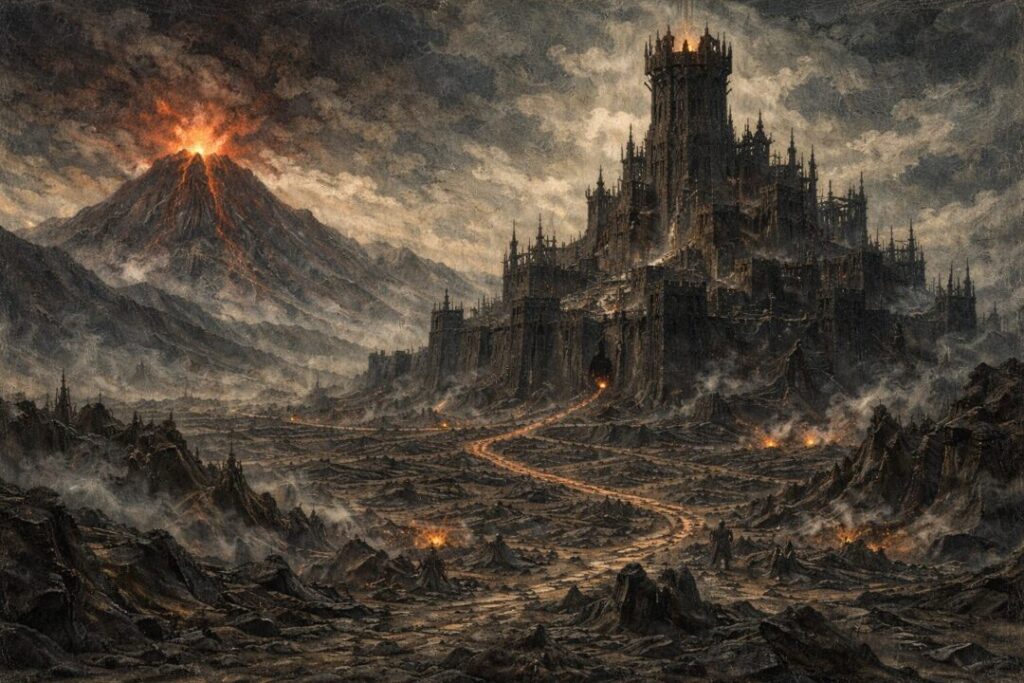
Barad-dûr was not impressive only because it was vast. It was terrible because it embodied Sauron’s method.
He does not merely conquer lands. He orders them.
He does not merely gather armies. He organizes a world around domination.
He does not merely build a fortress. He creates a center from which fear, surveillance, imprisonment, war-making, and command can radiate outward.
That is why the tower matters so much symbolically.
Its sheer duration tells us that Sauron’s evil is patient. Barad-dûr is not a burst of rage. It is the visible form of a plan sustained for centuries.
And the text repeatedly nudges us toward that idea. Mordor is fortified. Roads are laid. strongholds are raised. The Dark Tower becomes the focal point of a realm that has been deliberately shaped for control.
The Last Alliance Did Not Truly End It
Another crucial clue comes from Barad-dûr’s first fall.
After the siege of the Last Alliance, the Dark Tower is broken. But it is not annihilated at the deepest level. Its foundations remain because the Ring remains. That means Sauron’s defeat at the end of the Second Age is real, but incomplete. The tower’s endurance reflects the same truth as Sauron’s own survival: so long as the Ring exists, the deepest root of his power has not been wholly torn out.
This is why the later rebuilding matters so much.
When Sauron returns openly to Mordor in the late Third Age, he does not need to create Barad-dûr from nothing. He begins rebuilding it in 2951, and because the old foundations still endure, the second rise of the Dark Tower is much faster than the first.
The texts do not tell us how long it took before the rebuilt fortress was fully operational. But the outer limit is clear: from 2951 to the destruction of the Ring in 3019 is less than seventy years. Compared with the first six-hundred-year construction, that is astonishingly fast. The surviving foundations are the obvious reason the second building could proceed on a very different timescale. That last point is an inference, but it is a strongly grounded one.
So How Did Sauron Construct It?
The most accurate answer is also the least sensational.
He appears to have built Barad-dûr the same way he built his broader dominion: through long preparation, organized labor, vast resources, military rule, iron industry, and the personal power he poured into his works. The canon supports the timescale, the political context, the fortified world around him, and the Ring-bound endurance of the tower’s foundations. It does not support a cinematic image of Barad-dûr simply erupting whole from the ground in a single act of magic.
And that is, in some ways, more disturbing.
Because Barad-dûr was not a miracle.
It was a project.
A dark tower raised over centuries by a power patient enough to shape an entire land around it, and cunning enough to bind its deepest strength to the one thing that could not safely be left in the world.
That is why the timescale matters.
It reveals that Barad-dûr was never just Sauron’s home.
It was the material form of his long war against Middle-earth.
Sources & Notes
- J.R.R. Tolkien, The Lord of the Rings, Appendix B, “The Tale of Years” — Sauron chooses Mordor about S.A. 1000; the One Ring is forged and Barad-dûr completed about S.A. 1600; Sauron returns to Mordor and rebuilds Barad-dûr in T.A. 2951.
- J.R.R. Tolkien, The Lord of the Rings, Book II, Chapter 2, “The Council of Elrond” — Elrond says Barad-dûr was broken after the Last Alliance, but its foundations remained because they were made with the power of the Ring.
- J.R.R. Tolkien, The Lord of the Rings, Book VI, Chapter 3, “Mount Doom” — the fall of the Ring brings down Barad-dûr’s towers, battlements, dungeons, and great court.
- J.R.R. Tolkien, The Lord of the Rings, Book VI, Chapter 2, “The Land of Shadow” — shows Mordor’s inner roads, Gorgoroth, Orodruin, and the landscape around Sauron’s stronghold.
- J.R.R. Tolkien, The Silmarillion, “Of the Rings of Power and the Third Age” — summarizes Sauron’s settlement in Mordor, the making of the Ring, Barad-dûr, and the Last Alliance’s victory.
- J.R.R. Tolkien, The Letters of J.R.R. Tolkien, Letter 131 — Tolkien frames Sauron’s evil as the will to order and dominate, useful context for reading Barad-dûr as more than architecture.